Book Review: “The Blood Miracles” by Lisa McInerney

I LOVED The Glorious Heresies; we read it in my book club last year after it won the Baileys Women’s Prize for Fiction and all of us thought it was fantastic. A well-deserved winner. So, we had no problem picking the follow-up to read as one of our summer three and I had very high expectations.

The Blood Miracles imgThe novel begins more or less where The Glorious Heresies left off with the central character, Ryan Cusack, embroiled ever more deeply in the Cork city underworld of drugs, money laundering and violence. McInerney has managed to keep Ryan’s character consistent – he has evolved in an entirely credible way – although, unlike in the first novel, there now seems almost no hope of the more refined, gentler side of his personality prevailing to choose a different lifestyle. He is more embedded in the criminal fraternity than ever but remains an engaging and attractive central character. If anything, his charisma grows as he matures; true, he does some pretty unpleasant things, and not always at the behest of his criminal masters, but you can see that McInerney, if this turns out to be part of a series of novels, is building him up to be the tormented gangster.

Other characters remain consistent too. There is Karine, Ryan’s long-suffering girlfriend; their teenage romance was a beautiful precious thing in the first novel, amidst the degradation of events. Their relationship continues in The Blood Miracles but with new twists and turns as they grow up and innocence is left well and truly behind them. The addition of another potential love interest, in the form accountancy student Natalie, brings some further complications to Ryan’s messy personal life. There is also Ryan’s father Tony, the broken man, an alcoholic who was widowed young with five children to bring up. Portrayed as pathetic and useless in the first novel, he plays a lesser part here, but in some ways his strengths and his importance to Ryan become more apparent. I was puzzled by the title of the novel until almost near the end when an exchange between father and son on Ryan’s birthday makes it clear – blood, family, can drive the greatest and most profound acts in all of us.

The remaining characters include the two senior gangsters – Dan Kane, for whom Ryan works as a dealer, and Jimmy Phelan, who was so prominent in The Glorious Heresies – and their various acolytes, including Maureen Phelan (Jimmy’s mother) who once again plays a pivotal role. The city of Cork also looms large in the novel, as does Ryan’s love-hate relationship with it:

“This city, like all cities, hates its natives. It would rather be in a constant state of replenishment than own up to what it has warped.”

The basic plot is a drug deal, a major shipment of MDMA from Italy to Ireland. Ryan’s mother was Italian and he speaks the language. This has made him an instrumental part of the deal with the Camorra in Naples. The drugs go astray in what appears to be a theft from Dan Kane’s girlfriend after she’d picked up the shipment and was moving it to a safe house. The rest of the book is about solving the mystery of the missing merchandise and the accusations and counter-accusations.

I found the novel a bit slow to start and I was worried that it wasn’t going to live up to the promise of The Glorious Heresies, but about a quarter of the way through the pace changes quite significantly. So, if you’re struggling initially, persevere at least to page 100! You realise that in the first part of the book there is a lot of scene-setting going on and the author is working hard to recreate the settings, themes and characters from her earlier book. If you hadn’t read The Glorious Heresies this would help set the context for you, but you will enjoy this book more if you’ve read the first. As the plot around the missing drugs thickens, it becomes completely compelling and the denouement is utterly brilliant – I could actually feel my heart beating faster!

Can’t tell you more without giving too much away, I’m afraid. Suffice to say it is a page-turner. It’s earthy and visceral with plenty of sex, drugs, booze and swearing! The writing is incredible, particularly the dialogue. It is narrated almost like one of those old-fashioned 1950s gangster movies, with smoke-filled rooms, seductive women and a lilting sax in the background! Like the title of the first Ryan Cusack novel it’s also glorious!

Highly recommended.

Have you read this book? How do you think it compares to The Glorious Heresies and do you think you can read this without reading the first?

If you have enjoyed this post, I would love for you to follow my blog. You can do so by clicking on the Follow button. Thanks.

Book review: “The Power” by Naomi Alderman

So earlier in the week, I posted about the Man Booker 2017 shortlist and today I want to tell you about a prize winner, The Power by Naomi Alderman which won the Bailey’s Women’s Prize for Fiction in June. This year’s shortlist was a strong one, so it did well to come out on top. I’d also read Do Not Say We Have Nothing and Stay With Me from the shortlist; this latter book is wonderful and so I was expecting great things from The Power. I took it on holiday with me and read it in just a handful of sessions (my favourite way to read) and I’m afraid to say I was a little disappointed. For me, it was not better than Stay With Me.

Naomi Alderman

I’m not a huge fan of science fiction; my last foray into this genre was Station Eleven by Emily St John Mandel, which I think I probably enjoyed more than The Power if I’m honest. Because I’m not a big reader of this genre I find it quite difficult to review. I’m not sure what the norms and expectations are, so the things I might criticise or dislike are perhaps standard constructions in science fiction. For example, when reviewing a historical novel, we expect accuracy, realism, research. When reviewing a novel set in our own time we expect realism in the sense of standards that we recognise as possible. With science fiction, however, it irritates me that all normal conventions are suspended. Perhaps that why SF writers write in this genre, because they are free of those constraints, but to me it seems a bit lazy. I’ll give you an example: I enjoyed Station Eleven but I couldn’t get this nagging thought out of my brain that we were dealing with one small part of the United States, and I just couldn’t quite believe that the rest of the world had been similarly afflicted and could not make contact – pre-electricity societies managed to get around the globe fairly successfully!

img_3831However, The Power is a prize-winner and seems to have been universally lauded, most notably by Margaret Atwood (Alderman’s literary mentor) whose ground-breaking novel The Handmaid’s Tale has just enjoyed a very successful television adaptation. The premise of The Power is a subversion of current social norms where men dominate, to one where women discover that they have a physical superiority, an ability to electrocute and disable, even kill, men. The novel begins (presumably in the current time) when women begin to discover they have this power and start to use it in ways that enable them to dominate. The story is told through the experiences of a number of women and a male. First there is Roxy, the young daughter of a London gangster who, once she discovers her power, undertakes a purge of all her male foes, her father’s enemies, and her half-brothers who threaten her, to become the top gangster in her field. Then there is Margot a small-time US politician who discovers she has the power and uses it, over a period of years to eliminate her political enemies and rise to great things. Initially, Margot has to hide her power; society is initially hostile to it, and therefore those who have it, seeing at as a threat which could upset order and stability (yes, much of the novel has to be read as a deep irony). Margot, as a politician is also connected with a number of corporations who would no longer support her if they knew she was a carrier of the power. Third, there is Allie, a teenager adopted into a right-wing southern American Christian family (more irony). She is abused by her adoptive father and in one of his assaults she electrocutes and kills him. She then escapes to a convent from where she morphs into Mother Eve, the head of the cult which spreads the power worldwide. One of the followers of the cult is Tatiana Moskolev, the estranged wife of the President of Moldova, who sets up her own republic in the north of the country and establishes a brutal regime where men are mere playthings, sexually abused and murdered at will. Finally, there is Tunde, a young Nigerian, who when we first meet him is trying to seduce a young woman, unsuccessfully as it turns out, because she gives him a small but still very humiliating electric shock when he makes his move on her. It is clear the power dynamic has shifted! Tunde senses that change is about to come to the world and so he sets about travelling the globe, posting his obervations on the internet and thereby becomes an international journalistic sensation.
The story has a complicated structure, which at times I found difficult to follow. It is very much a satire, but not in the mode of Paul Beatty’s The Sellout, which won last year’s Man Booker Prize. There are parts of the book which are almost too brutal, too visceral, too emotionally raw for satire (maybe it’s me, maybe it’s the age we live in?). At 42 the author is not much younger than me, so I can’t say it’s a generational thing, although I note that among the many other strings to her bow she is a computer game designer. I wonder whether the kind of violence common in that medium means the author has a different perspective (taste?) for use of violence and physicality in art.

It’s a clever book, the idea is fantastically original, subversive (women dominating men!) and mischievous. Alderman is also a very able writer, and it’s an impressive read. I did find the book a page-turner, but it fell off towards the end for me. It just got a bit…silly! But then I also accept that maybe it wasn’t supposed to be credible, and that is indeed the powerful central irony. It’s a good read, but I still preferred Stay With Me for the Bailey’s Prize!

What did you think of The Power? I’d be interested in your perspective if you’re a regular reader of science fiction.

If you have enjoyed this blog, I would love for you to like or follow me, and for us to connect on social media. 

Book review: “On Chesil Beach” by Ian McEwan

I read this for my August reading challenge, which was to choose a book, the title or cover of which was reminiscent of summer. I chose On Chesil Beach because I love Dorset, possibly my favourite county in England, and I love Chesil Beach, which we visited on a family holiday about three years ago. Chesil Beach is one of those fascinating geographical features, dating back to Jurassic times, which reminds you that human habitation on earth is a mere blip in time. It’s an 18-mile stretch of shingle beach, separated from the mainland by a saline lake called the Fleet Lagoon, and formed thousands of years ago as deposits of sediment were plopped near to the coastline, but not on the beach, so creating a ‘barrier beach’ separated from the actual coastline. It’s a haven for wildlife as well as being one of those mysterious oddities that Wessex (yes, I’m a huge fan of Thomas Hardy!) does so well.

2017-08-05 07.34.39

The front cover of On Chesil Beach shows a picture of a woman in a white dress walking along the beach at what appears to be either dawn or dusk. She is walking away from us, into a vague distance. The sky is grey-blue, twilit, with a slash of brightness from the emerging or receding sun. In the far distance are cliffs and the sea on either side of the beach is grey, somewhat forbidding. The skirt of the woman’s dress, and her hair, are blowing in towards the land; there is clearly a strong breeze coming in from the sea. This image is everything I love about the English coast. It reminds me that nature is in charge here, that the earth will prevail. This area is part of Dorset’s Jurassic coast where fossils are easily found and where there is much evidence of the prehistoric past. It is a humbling place to be.

Chesil Beach is the setting of McEwan’s moving, domestic tragedy. Set in the summer of 1962 it begins in a hotel where Edward and Florence are having dinner in their suite on their wedding night. The awkwardness, the tension and the weight of expectation are apparent from the outset, and the detail with which McEwan describes every aspect of the scene made me feel like I was living every excruciating moment of the evening in real time. It is clear very quickly that this is a book about sex. It’s 1962 so the couple have not yet experienced the benefits of the sexual liberation of the 1960s and are still victims of the much more staid post-war attitudes of the 1950s. Despite being newlyweds, and therefore supposed to be a happy young couple, it is clear very early on that each is in a very different place; it is apparent that they have had little intimacy, sexual or otherwise, prior to their wedding. Edward has been ‘patient’ assuming that all will be well once they are married, while Florence has been hoping simply for strength, that she will be able to endure what she thinks will an unpleasant duty once within the confines of marriage.

“They separately worried about the moment, some time soon after dinner, when their new maturity would be tested, when they would lie down together on the four-poster bed and reveal themselves fully to one another. For over a year, Edward had been mesmerised by the prospect that on the evening of a given date in July the most sensitive portion of himself would reside, however briefly, within a naturally formed cavity inside this cheerful, pretty, formidably intelligent woman. How this was to be achieved without absurdity, or disappointment, troubled him…..But what troubled her was unutterable, and she could barely frame it for herself. Where he merely suffered conventional first-night nerves, she experienced a visceral dread, a helpless disgust as palpable as seasickness.”

And therein lies the nub of the whole book really, how these inner truths reveal themselves, how the pleasant mask of their love begins to crumble and how the relationship is affected under the pressure of these problems.

The book is structured in five parts: the first part is the awful wedding night, subsequent parts provide the back story to Edward and Florence’s relationship, their early lives and their very different backgrounds – class difference plays a big part in the novel too and whilst this is not named as an explicit barrier between them, you get the sense as a reader of her as more refined, affluent, uptight, middle-class, while he is seen as ultimately more vulgar, preoccupied by earthier matters and that this is somehow a consequence of his socially humble background.

I don’t wish to spoil the ending for you if you haven’t read the book, but the final part, the denouement, takes place on Chesil Beach itself, as the two individuals encounter one another at the climax of their so far bitter wedding night experience. It is like a classical scene, like a game of chess as the two manoeuvre around their respective problems. It is a very fine, forensic study of a 1960s relationship that could barely be called a relationship.

A stunning read, which I didn’t expect to be so good. Highly recommended.

(Apologies for any typos I haven’t spotted – my daughter’s hamster gave me a nasty bite on the middle finger of my right hand it has badly affected my typing!)

If you have read this book, what did you think?

If you like what you read here, please follow my blog. I would love also for us to connect on social media.

Book review: “The Lady and the Unicorn” by Tracy Chevalier

Tracy Chevalier’s second novel Girl with a Pearl Earring was published in 1999 (really, it was that long ago!) and was a sensation. I remember reading it at the time and was bowled over. It was made into a film starring Scarlett Johansson and Colin Firth in 2004. I’m afraid to say that I have not read any of Tracy’s subsequent work and until now would not have been able to name any of her nine other books (although I love the look of New Boy, published this summer, and recommended it just a few weeks ago).

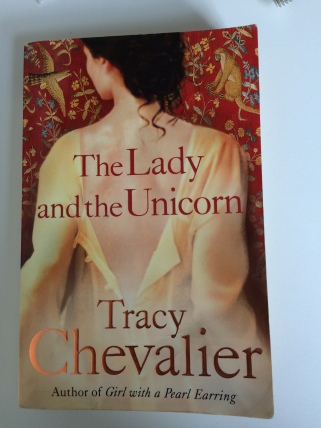
The Lady & the Unicorn imgI picked up The Lady and the Unicorn at the secondhand book stall at my youngest daughter’s school summer fair and read a large chunk of it whilst there. It would not normally have caught my eye on a bookshelf as the cover is more suggestive of a cheap sexy romance (nothing wrong with that if that’s your thing!), but I was very quickly drawn into the world that Chevalier evokes, as she also did so brilliantly in Girl with a Pearl Earring.

The novel is set in Paris and Brussels in 1490-92. Parisian nobleman Jean Le Viste wants an impressive tapestry in his home, a way of showing off his wealth, status and fine taste. He commissions local artist Nicolas De Innocents to paint a design which will then be turned into a tapestry by specialist weavers in Brussels. The subsequent story is about Nicolas’s travels between the two cities, the time he spends in Brussels with the family of weavers and the effect the work has on all their lives.

It’s a very simple premise and you would be forgiven for wondering how a full-length novel could be strung-out from this. Like Girl with a Pearl Earring, it’s the characters, their motivations, their internal lives and the relationships between them that drive the narrative. Here, Nicolas des Innocents is the central figure. He is young, virile, charismatic and mischievous. In Paris, he threatens to destabilise the Le Viste family when the youngest daughter Claude falls for his charms (he has already seduced the maid!), but socially, he is an outsider, a class well below his employer, and thus it is important he is kept at arm’s length. In Brussels, he penetrates the family more deeply as he needs to work alongside the weavers to design the various features of the tapestry and to help realise these in the final product. Nicolas the charmer develops a close bond with the weaver’s blind daughter. I’ll leave it at that – no spoilers here!

The book is written from several perspectives, with each chapter narrated by different characters. This allows us as readers to observe the events of the story from a number of viewpoints. It’s a sexy novel, there are simmering passions throughout (to that extent the suggestive cover on my copy is not far wrong!). It provides an insight to the issues of the period – honour, social status, the role and standing of women, as well as the process of creating a tapestry and the meaning behind all the imagery – and Chevalier has a brilliant talent for bridging the past and the present and showing us that in many ways day to day concerns remain the same throughout the ages. I particularly like how the author marries her skills for story creating into some bare facts about a real tapestry (it does exist) and real people. This is what she did in Girl with a Pearl Earring too, of course.

Whilst this novel clearly did not make the same splash as Chevalier’s more famous earlier book, it’s a good read and I would recommend it. Glad I found it on that book stall!

Have you read any of Tracy Chevalier’s books?

If you have enjoyed this post, I’d love for you to follow my blog. Let’s also hook up on social media. 

Book review: “Jo Cox: More in Common” by Brendan Cox

No-one could forget the terrible events of June 16th 2016, the week before the UK referendum on exiting the EU, when Jo Cox, the British MP for Batley and Spen in West Yorkshire, was brutally murdered whilst in her constituency. It was shocking on so many levels. Firstly, that, in the midst of a profound expression of our democracy (which I believe we should never take for granted), campaigning during a referendum, one of our most conscientious and hard-working elected members should be killed for doing her job and what she believed in. Secondly, and most upsetting to me and, I’m sure, to many others, that a mother of two young children, a wife, a sister, a daughter, should lose her life and all those close to her should lose the most important person in theirs. It was truly awful.

more-in-common-img.jpg

In the days that followed, campaigning in the referendum was suspended as the news reverberated around the world. Support was shown and condolences sent by dozens of world leaders, not least President Obama. Jo’s death had a huge impact. So many had felt the insult to our democracy. In those subsequent days and weeks, we also learned much about this young woman and her life, and the loss felt even greater.

Jo’s husband, Brendan, became famous overnight, a role he would never have wanted. The grieving widower, the father of two shocked and grieving young children (then aged just five and three), the spokesperson for his late wife and all the good and powerful things she stood for. He was frequently on our television screens, looking dazed and gaunt, in Parliament, just days after Jo’s death, hearing MPs’ tributes, at a memorial event in Trafalgar, attended by thousands. It is a wonder how he got through those days.

It is thirteen months since Jo’s death and Brendan has been busy. He has set up the Jo Cox Foundation which seeks to promote fairness and tolerance in the world through practical actions. He has also published this book, which is part biography of Jo, partly an account of loss and, I suspect, part catharsis. It is rare that I have sat down and read a book in a couple of sittings over a weekend, but this book lends itself to that kind of immersion.

First and foremost the book, for me, provides an intimate glimpse into the architecture of grief. We will all experience grief in our lives, but most of us will never have to lose someone in the circumstances that Brendan lost Jo, that their children lost their mother. The pain is profound. We see Brendan go through all the stages we are familiar with – shock, denial, etc, though he clearly fights very hard against anger, and seems to have won. He describes in detail the unique way that nature enables children to process it. In the midst of his own grief Brendan’s primary concern was to support his children through their even greater loss to ensure that it was handled in the best possible way. Brendan talks about taking advice from experts in child psychology on how he should talk to them about their mother. The overwhelming consensus is that children should be allowed the space to grieve as they need, in their own unique way, and that it is important that we do not impose adult preconceptions and expectations about their level of sadness. For a young child, losing a mother is a profound and life-changing event that will affect the rest of their lives and it is so important to handle it right.

The sadness in this book is at times unbearable, but Brendan also writes with joy too. He provides an account of Jo’s life, her humble family background and childhood, her life as a student at Cambridge and her early achievements in a career that was destined to be stellar. Brendan, in providing this account, is honouring his late wife and the enormous achievements she made in her short life. There is a definite sense that the best was yet to come.

We are far more united and have far more in common with each other than things that divide us.” Jo Cox, maiden speech to Parliament, 2015 


Finally, the book is a love letter, a tribute from a bereaved husband to the woman he clearly loved so deeply. His love drips from every page. Some of the detail he gives is surprisingly intimate almost too much for me as a reader. The kind of small details of a relationship that couples normally only share with one another. But then you remember that Brendan no longer can, and his sharing with us feels all the more poignant.

The book is structured so that parallels are drawn between events in the months following Jo’s death and important stages in Jo’s life. For example, the account of Jo and Brendan’s time working in America and joining the Obama presidential campaign is given alongside an account of Brendan’s visit to the White House with his children, at the invitation of President Obama.

It is an incredible book and all proceeds from sales will go to the Jo Cox Foundation. It is hard to say I ‘enjoyed’ it but it felt like a very important read. It has certainly caused me to reflect, and the lesson that comes from it, for me, is along the lines of that old truism (with apologies for misquoting) that it’s not the years in your life that really count, but the life in your years. And Jo certainly packed a lifetime’s worth in her 42 years.

An emotional read, but highly recommended.

If you have read this book, I’d love to know how it affected you.

If you have enjoyed reading this post, I would love for you to subscribe to the blog and for us to connect n social media.

Book review: “WE: A Manifesto for Women Everywhere” by Gillian Anderson and Jennifer Nadel

I plan my reading a good few weeks in advance, partly because planning is what conscientious bloggers are supposed to do (so I’m told!), but also because I always have such a substantial TBR (to be read) pile, that the only way I can excuse my excessive book-buying is to write down my intention to read them all! It seems that for the next few weeks I am planning to read a number of what might be described as feminist books, starting with the one I have just completed and which I’m reviewing here today.

WE: A Manifesto for Women Everywhere demonstrates its feminist credentials by encouraging a “sisterhood” in which women support and encourage one another. That is quite an ambition, given that we live in a society which often seeks, or so it seems to me, to set women against and in competition with one another. Anderson and Nadel deplore the scandal of inequality in our society which they seek to counter by encouraging us all to strive for a fairer and more just world for ourselves and for others.

2017-07-26 20.42.01 I am an admirer of Gillian Anderson, not since her X-Files days, but since watching The Fall, the hugely popular television drama about a misogynistic and brutal serial killer in Northern Ireland, in which Anderson played the beautiful, enigmatic, but also rather damaged DSI Stella Gibson. The drama ran for three series between 2013-2016 and I was hooked. (It also starred Jamie Dornan, which helped). Jennifer Nadel, Anderson’s co-author, is a former journalist, writer and activist. Both women are open about their experiences of depression and poor self-esteem, despite their hugely successful careers and enviable lifestyles, and this book is their account of recovery and a ‘guidebook’ for other women who may be suffering from mental health issues.
To that extent the book is very much a self-help guide, but it is also provides a roadmap for women to avoid depression, suffering and, in their words, live “a more meaningful life” by offering nine principles for living.  Before discussing the nine principles, the authors set out four essential daily practices which, they say, we should all be incorporating into our lives in order to achieve greater peace. These are: showing gratitude, being gentle with ourselves and others, taking responsibility for self-care, and meditation.

“Taking care of yourself emotionally, physically and spiritually is a profoundly political act”

The nine principles are: honesty, acceptance, courage, trust, humility, peace, love, joy and kindness. Each of the principles is discussed in a separate chapter and there are exercises and instructions readers are invited to undertake to get the most out of the book. There are also individual paragraphs from each of the authors scattered throughout where they reflect on their own experiences. They rail against fear as a barrier to woman achieving happiness and their potential and they discuss at length what they call the “Toxic Cs”, the five bad habits of the ego – Comparing, Criticising, Complaining, Controlling and Competing. They offer instead Compassion, Cooperation and Connection.

There is a great deal in this book which makes sense. It is well-written, well set-out, the motivational quotes are well-chosen and I found many of the exercises useful. I liked its gentle approach; some self-help books can come across as self-righteous and are self-congratulatory exercises by an author wanting to tell us how well they have done. This is not like that. I have already given this book as a gift to a dear friend who I thought could benefit from reading it. I think its audience could be clearer: it talks about “addiction” as one of the ways women can sabotage themselves. For most women who read this, that is not going to mean drug or alcohol addiction, I imagine, but it could apply to weight problems or other subtler ways that we become reliant on repetitive behaviours as a coping strategy. Some women who may benefit from the book may therefore not see it as for them.

I enjoyed reading this. I borrowed it from the library but think I will buy a copy as I could see myself dipping into it quite regularly. Recommended.

Do you find self-help books useful?

If you have enjoyed reading this post, please subscribe to the blog and get future posts straight to your Inbox. I would love if we could also connect on social media.

Book review: “Post-truth: Why we have reached peak bullshit and what we can do about it” by Evan Davis

I love Evan Davis; I think he is probably the cleverest journalist on telly at the moment. I marvel at his ability to cut to the core of an issue and his mastery of material across a broad range of topics. His analytical ability, tenacity and eloquence made Newsnight unmissable during the UK election campaign earlier this year. I actually felt a bit sorry for some of the second and third-rate politicians he had to interview at times because he was clearly so much cleverer and in command of the brief than they were! He never goes for the jugular though, as Paxman used to, it’s just more like watching a grown-up talking to a child.

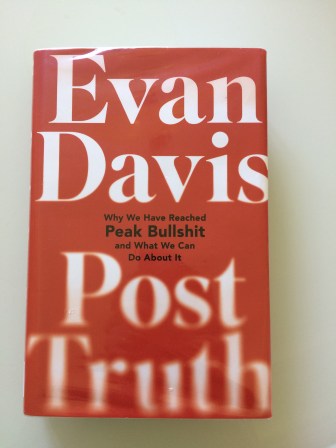
Post truthThis is actually my July reading challenge book, which was to borrow something from the library. I read it in virtually one sitting on a train journey to London. For a weighty non-fiction book it’s very readable and the writing is resonant of Evan’s relaxed and articulate presenting style. There were parts where I could almost hear him reading it out. There are many references to the help and support he has had in the acknowledgements, so I’m sure he had plenty of research assistance (how could he not – with Newsnight, The Bottom Line and Dragon’s Den he is a very busy fellow!), but the authorial voice is definitely authentic, and I would bet it isn’t ghost-written, which just makes me love him all the more!
The central premise of the book, and indeed which lends him his title, is the concept of “post-truth”, which was the Oxford Dictionaries word of the year in 2016 and is defined as:

Relating to or denoting circumstances in which objective facts are less influential in shaping public opinion than appeals to emotion and personal belief.”

For Westerners, key events which have lent prominence to this concept are, of course, the UK referendum on membership of the EU and the election of Donald Trump to the US presidency. More latterly, for those of us in the UK, the British election campaign is pertinent to the discussion, though the book was written before it was announced.

The book is divided into three sections: What, Why and How. In the first part “What” Evan (is it okay to call him that? I spend most weekday evenings with him, after all!) deconstructs his subject, looking at the various forms BS takes in our society today. His starting point is the professionalization of the information industry and the increasing desire to ‘sell’ rather than ‘tell’ in order to further a cause. In spite of (or perhaps because of) the unprecedented amount of information that we as citizens and consumers have access to, our weak ability to navigate it makes us vulnerable to those who would convince us that their particular interpretation of the facts is the one and only truth.

If you were unhappy with the UK European referendum campaign (regardless of which side you were on) or opposed the election of Donald Trump, there are times in the first section where you will be screaming “Yes, yes, yes”, but the second part is more sobering as it looks at the social forces that have enabled BS to become the new norm. Basically, we are all at least a little bit guilty. Haven’t we all, at some point, slightly misrepresented ourselves, or exaggerated our strengths in order to achieve something? Have you ever overstated an achievement on a CV, pushed up a price estimate of a job, in the knowledge you’ll be negotiated down by a percentage, been a willing accomplice in overpaying for desirable commercial goods (mobile phone, car, clothing, etc) simply to get a bit of the status that rubs off from owning it? We’re all at it. And as for those of us (irony alert) who might look down on the poor unfortunates misled into voting for the ‘wrong side’ Evan simply says the

“Disposition to accept bullshit probably derives from a sense of tribalism fuelled by feelings of grievance. The bullshit becomes more than just a signal of tribal allegiance; it becomes a way of strengthening a sense of membership of the tribe.”

In the final section of the book, Evan flags up a number of ways that we can all halt the rise of the post-truth tendency. He acknowledges that, basically, we get the BS we deserve, so the power lies with us to change it. Firstly, he says

“Where you have a craving for something to be true, apply a double dose of scepticism to anybody telling you that it is?”

We all have to do more research to ensure we are given the full facts and hold professional communicators to account rather than be complicit in the deception, what he refers to as “information hygiene”. (Using product X will prevent condition Y – show me the evidence?)

This book is quite an accomplishment which made me think very hard about the world we live in and what I am teaching my children. Undoubtedly, we all need to improve our skills when it comes to challenging what we are being told. A fascinating and engaging read on a very current issue.

Book review: The Essex Serpent by Sarah Perry

This book was everywhere when it first came out last year, surprising since it was written by a little known author and published by a relatively small independent publisher. It became a bestseller, was shortlisted for the 2016 Costa Novel Award and was the Waterstones Book of the Year. I was very keen to read it but it seemed to take a long time to be issued in paperback, so I’ve been hanging on for a while.

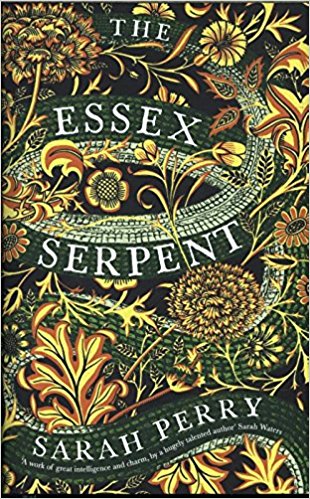
The Essex Serpent imgThe book is set mostly in the fictional Essex village of Aldwinter in the 1890s and the action takes place over the course of a year. The central dynamic of the plot is the relationship between Cora Seaborne, a woman approximately in her late 30s, who at the start of the novel is newly widowed, and William (Will) Ransome, the local minister. Will is happily married to Stella and they have three children, while Cora is happily widowed! It seems hers was a fairly loveless marriage in which she felt constrained and imprisoned and her husband appears to have been somewhat older than her. The lack of intimacy in the marriage is indicated by the fact they had only one child, Francis, and that he is an unusual boy (for Cora “nothing shamed her as much as her son”), who is almost certainly autistic.

Once she becomes widowed, Cora is able to follow her passion for natural science, and she moves out of London to Essex. There she becomes captivated by a local myth, a mysterious serpent that villagers feel is responsible for unnatural happenings, including unexplained deaths, crop failures, madness and distressed livestock. Cora first encounters Will on one of her forest walks, when the two rescue a sheep from a bog. They later meet socially and thereafter strike up an increasingly intimate friendship. The book becomes about the development of their relationship against a backdrop of events connected with the serpent, with the illness of Will’s wife, and Cora’s relationships with other friends, including that of Luke Garrett, a brilliant surgeon who is clearly in love with her.

Whilst the book is essentially about relationships and the nature of love (it is explored in many forms) it is also about a clash of worlds. Firstly, the old versus the modern – it is no coincidence the book is set on the eve of the 20th century – and science versus religion, where Cora and Will have some of their most passionate debates. There is also reason versus superstition; the villagers fear the Essex Serpent, whereas Will finds his parishioners’ fears almost pagan in tone, and Cora wants to prove the existence of the serpent, as some sort of lost creature.

Perry also explores the position of women, from Cora, the scientist, for whom marriage had “so degraded her expectations of happiness” and for whom widowhood and thus the single life had “freed her from the obligation to be beautiful”, to Stella the model dutiful Victorian wife and mother, afflicted by a quintessentially 19th century illness. There is also Martha, Cora’s maid (although her exact position in the household slightly defies definition!), also a political activist who utilises the connections she has made through Cora to further her Marxist leanings. In many ways the themes of the novel are very modern indeed – Martha’s campaigning for suitable social housing for the poor of London is resonant of a very 21st century problem. It’s also a very erotic novel, in the Gothic sense, without being explicit; there are many tensions below the surface and some of these do not get fully resolved, which is actually quite true to life when you think about it.

I thoroughly enjoyed this book and would recommend it highly. It gripped me to the end. It’s a novel rich in themes, rich in its descriptive power and rich in its evocation of time and place.

If you have read this much talked-about book, I’d love to know what you thought of it.

If you have enjoyed this post please follow the blog, and let’s connect on social media.

Book review: “On a Shoestring to Coorg” by Dervla Murphy

I selected this book for my June reading challenge. June was a slow month for reading for me – half term, plus running my son to and from school for exams ate into my time. So, it took me a while to get through this book. That said, I think it’s genuinely a slow book to read, rather like the unhurried travelling that takes place within the pages. I was very specific in my challenge for the month, which was to read a literary travel book, not a guidebook. I am somewhat perturbed by the preponderance of ‘pack as much into as little as possible’-type travel guides that I see all over the bookshops: the 48 Hours in… series is popular, but the New York Times now has a range of 36 hours in… various European capitals! I’ve spent longer than that in the railway stations and airports of various European cities on my travels in the past! Art imitates life, it is true, and that is the nature of life these days. I feel sure this will be to our detriment, ultimately, but perhaps the pendulum will swing the other way at some point.

On a Shoestring to Coorg imgIf, like me, you find yourself a little nostalgic for an era when travel meant slowing down, getting to know a place and its people  (rather than just taking a selfie with a local and posting to Instagram), and immersing yourself in the new environment, then Dervla Murphy could be the travel writer for you. In On a Shoestring to Coorg, Murphy travels for the first time with her five-year old daughter, Rachel. They travel scarily light (I would take more stuff on a day out when my kids were younger!) with very little money and are dependent on the kindness and hospitality of people they meet, including a number of British ex-pats, who have made India their home in the post-colonial era.

Murphy confesses at the outset to being not especially enamoured of India generally, and openly expresses what she sees as the hypocrisy implicit in Hinduism and the caste system which she feels keeps so many in poverty and destitution. (You have to remember this was written in 1976). However, she and Rachel fall in love with the tiny region of Coorg (in southern India), with its continued observance of many traditions (which she sees as an indicator of the society’s wellbeing), the warmth of its people and the beauty of the landscape.

“Seldom in the 1970s is folk-dancing performed for fun – not self-consciously, to preserve customs, or cunningly, to please tourists. But my pleasure can never be unalloyed when I chance upon such fragile and doomed links with the past. One knows that before Rachel is grown even Coorg will have opted for that pseudo-culture which ‘kills time’ (grimly significant phrase) but leaves the sprit starving.”

They travel further south to Kerala, which Murphy also loves. As the book progresses you get the sense of Murphy settling into the journey more, as she adapts to travelling with her young companion where, previously, this very unusual and idiosyncratic traveller was accustomed to being alone and not having anyone depend upon her. She writes more and more of the landscape:

“Beyond the palmy islands across the bay the sun was sinking in a red-gold sky and when it had gone – so swiftly – a strange amber sheen lay on the water and I felt very aware of the drama of day and night: something that passes us by in the twilit north.”

On a Shoestring to Coorg img 2

It is a meandering but engaging read, where you very much travel with the author and her daughter and feel the pace of their journey. This is a way of travelling that most of us no longer do. It feels very much like a bygone era and yet is only 40 years ago. The pace of change in all our lives all across the globe has altered so dramatically in that relatively short time. It felt good to slow right down with this book. If you fantasise about long slow travelling (with or without your children) you will find this an interesting read and after reading it you will definitely want to go to Coorg!

Do you have any travel writers to recommend? Are there any young contemporary travel  writers you enjoy who take the ‘slow’ approach?

If you have enjoyed this post, please subscribe to my blog by clicking on the button below or to the right (depending on your device).

“Everything Everything” by Nicola Yoon

Everything Everything, first published in 2015 to great acclaim, was reissued in 2017, after the novel was made into a film, and my edition shows a still from the movie with our two main protagonists, Maddy and Olly, gorgeously pictured on the front cover. It’s a YA novel which I selected for my May reading challenge, having bought it for my teenage daughter a few weeks ago (she hasn’t read it yet!), and I absolutely loved it. I didn’t expect to enjoy it as much as I did, especially when, leafing through, the chapters looked a bit short and I saw that there were several pages with line-drawn illustrations of, for example, diary entries, notes from an exercise book, emails, set out as if they were on a screen, text conversations, etc. Hmm, I thought, all designed to sustain the digital native’s interest! Well, as is so often the case when I stray off my well-beaten literary track, I was truly humbled.

2017-06-21 11.08.32The novel opens with our central character Maddy’s eighteenth birthday. She celebrates this with her mother and her nurse, Carla; Maddy suffers from severe allergies and lives an isolated existence in her hermetically sealed home, which she has not left for many years, so these two women provide the only relationships she really has. Maddy is home schooled, receiving almost all her tuition over Skype from various tutors. Occasionally, they are allowed to tutor her in person, but only after they spend a period of time in a decontamination unit in the house, to ensure Maddy does not come into contact with any pathogens or foreign particles which might harm her. Maddy’s father and older brother were killed in an accident when Maddy was a baby and she and her mother are therefore incredibly close.

Maddy is a voracious reader and in the absence of a lived experience of the world she has framed all her perception of life outside the bubble of her home, and her tiny circle of human contact, from the books she has read. Whilst she is initially reasonably content with her life, accepting its limitations and appreciating the love of her mother and Carla, her love of books is an early hint of her desire to embrace the world. Early on, we learn that she has taught herself not to want things she cannot have:

“Wanting just leads to more wanting. There’s no end to desire.”

But then she meets Olly, when he moves into the house next door with his parents and sister, and everything (everything) changes:

“Maddy knows that this pale half-life is not really living.”

Olly has his own troubles: his father is a violent alcoholic who terrorises the rest of the family. Olly and Maddy begin to communicate by text and email, and it is clear that not only are they deeply attracted but that each fulfils an unmet need in the other. A cascade of events follows which will expose the inexorable pull of the world to the young and vulnerable Maddy, and the pointlessness of an anxious parent’s attempts to protect her child from all risk.

It is a coming-of-age novel, in that we see a young woman separating from her mother, but it is also a great novel for a parent coming to terms with the coming of age of their kids! To that extent, it is an instructive read for parties on both sides of the debate: the older generation can see how important it is for our youngsters to live, love and to learn for themselves, but the young can also see the parent’s perspective, Maddy’s mother’s fear of losing something (everything) so precious to her when she has already experienced so much loss in her life (her husband and son).

It’s a cracking story, with some clever plotting, and great themes which are beautifully handled for a younger readership. It’s well-written and well-crafted and the line drawings do add to the experience! There’s a little bit of sex, but it’s very subtly and sensitively done. Recommended for parents and teenagers alike.

If you have read this book or watched the movie, would you recommend it for teenagers? Could boys and girls alike enjoy it?

If you have enjoyed reading this post, it would be great if you could ‘like’ by clicking below, or follow my blog by hitting ‘Subscribe’. Let’s connect on social media too!