June reading challenge – a literary travel book

2017-06-14 12.50.24

We have just booked our family summer holiday and so I’m delighted that June’s reading challenge is to read a travel book, not a guidebook, but a literary travel book. I’m certain there will be plenty of titles to choose from in your local charity bookshop, if you’d care to join me.

2017-06-14-13-19-11.jpgI’ve decided to pick a long-neglected title from my well-populated ‘not yet read’ bookcase – On A Shoestring To Coorg: an experience of Southern India by Dervla Murphy. I bought it as part of a set of three some years ago, and of the trio I only read Full Tilt: Dunkirk to Delhi by bicycle. I loved that book: Murphy cycled across Europe to India, through countries like Afghanistan and Iran, before they were devastated by conflict. Sadly, these wonderful and fascinating places will probably not now be visited by travellers for many years so this book provides a vicarious experience that most of us will never be able to have.

Last summer, I watched a wonderful documentary about Murphy on a long-haul flight to New York, where we spent our holiday last year, and I was fascinated once again. Murphy is a complete one-off, somewhat eccentric, perhaps, but undoubtedly fearless and someone who has always pushed the boundaries. She is now 85 and still lives in Co. Waterford in Ireland. On her last trip in 2011 she visited the Gaza Strip.

Murphy has one daughter and On A Shoestring is about a trip she took with her then 5 year-old child. This would no doubt have been been considered a very reckless act in 1973! I wonder if she did it during term-time…?

Everything Everything imgMay’s reading challenge was fairly straightforward, to read a YA novel, and I expected to zip through Everything Everything by Nicola Yoon. Alas, half term and ferrying my eldest to and from GCSE exams has rather cut into my reading time this last few weeks, so I was still reading it a few days into June. However, I have now completed it and will post my review here next week. I thorougly enjoyed it and recommend it highly for YAs and OAs (older adults?!) alike. Look out for my review and let me know your thoughts if you or any teenagers you know have read it.


I would love for you to join me in my reading challenge this month. What literary travel books do you fancy reading?

If you have enjoyed this post, it would be great if you could subscribe to the blog by clicking the button below or to the right, depending on your device.
2017 reading challenge

2017-05-05-13-37-01.jpg

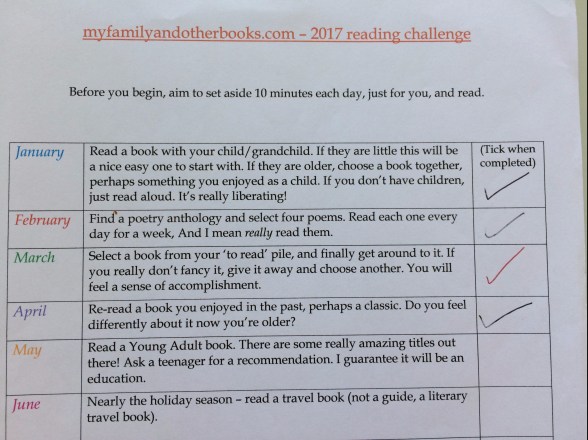
April’s task (to revisit a classic) really was a challenge; I chose Elizabeth Gaskell’s North and South, which has been an absolute joy, but  IT’S LONG! With school holidays and the break in my routine reading it has tipped over into May, but I’ll post my review here in the next week or two.

The challenge for May is to read a YA (Young Adult) novel. I’m looking forward to this; I read Emily Barr’s first YA novel The One Memory of Flora Banks, my first foray into this genre for some time, and thoroughly enjoyed it. You can read my thoughts here.

Everything Everything imgI picked up a book for my teenage daughter the other day, Everything Everything by Nicola Yoon, which was published in 2015, but has also been turned into a movie, released later this month. It’s the story of a young woman (18 year old Maddy) who suffers from an illness which means she must live in a sterile environment. She develops a friendship with the boy next door, Olly, communicating only through windows and via text. The blurb says that they develop a deep bond and risk “everything” to be together. I’m expecting young first love and possibly a few tears, along the lines of John Green’s The Fault in our Stars.


It will be nice to read it alongside my daughter and to share our opinions. That’s as good a reason as any to cross genres from time to time.

Easter holiday reading suggestions

2017-03-30-11-55-53.jpgI’m off on a short holiday to the Netherlands so I’m planning to take some reading with me, of course, and have decided on another book from my ‘to read’ pile (I’m in the groove now!) called In the Dutch Mountains by Cees Nooteboom. It looks delightfully weird and I love the Dutch so am very excited to be reading it at last. I’m also taking Roxane Gray’s Difficult Women, a collection of short stories which was a gift from a friend. Looking forward to that and hoping I can get some tips for my own short story writing. I’ll also take North and South which I’m re-reading this month as part of my 2017 reading challenge.
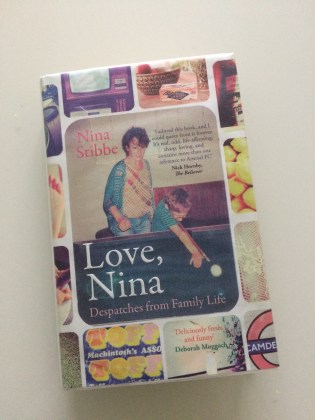
If you’re looking for ideas yourself and would like something light and amusing which you can dip in and out of, you could try Love, Nina: Despatches from Family Life by Nina Stibbe. I mentioned this book in a blog a few weeks ago; I read it whilst on a ‘break’ from a book I was finding quite heavygoing (Do Not Say We Have Nothing). It was the perfect antidote: a straightforward jolly read. It’s a series of letters from Nina, to her sister Victoria in Leicestershire and therefore readable in bitesize chunks.

Love Nina imgNina is twenty when we meet her in the early 1980s. She lives with Mary-Kay Wilmers, editor of the London Review of Books, and her two young sons, Sam and Will, to whom she is a nanny. They live at 55 Gloucester Crescent NW1, an area that was also home to other literary types, among them Alan Bennett and Claire Tomalin, who also make appearances in the book, particularly ‘AB’ who is a great friend of ‘MK’.

Nina’s letters home detail the events of daily life in the household, and are brought alive by her pithy observations on the quirkiness of her employer and the neighbours. It was particularly nice to read this after watching Alan Bennett’s The Lady in the Van over Christmas, which was also set in Gloucester Crescent and features many of the same people. Nina’s affection for the family shines through and she writes with great fondness of Sam and Will, her young charges. MK is idiosyncratic, but charming, and Alan Bennett leaps off the page. The personalities of the individuals come across strongly; Nina clearly has a talent for this since much of what we learn about them is through the conversations she reproduces in the letters as extracts of dialogue. She manages to pick out the little details or the nuances and word choices that reveal so much.

The letters cover a couple of years, and at the end of the book Nina is part way through her degree in English literature at Thames Polytechnic. By this stage you can see she herself is becoming a more accomplished chronicler, although the later letters, many of which are about her university friends, I found less endearing than the earlier ones.

Nina, now in her 50s, eventually became a writer, and had two children with Nunney, one of the other inhabitants of Gloucester Crescent (though they got together much later), and has subsequently published two novels in addition to this memoir: Man at the Helm and Paradise Lodge, which I’d be interested in reading. Love, Nina was also adapted for television by Nick Hornby, and starred Helena Bonham Carter. I think that could be fun to watch.

So, a good little read, perfect if you’re going away this Easter holiday.

What are you reading this Spring?

If you have enjoyed this post I would love for you to subscribe to my blog by clicking on the follow button below or to the right, depending on your device.

My ‘to read’ pile is shrinking!

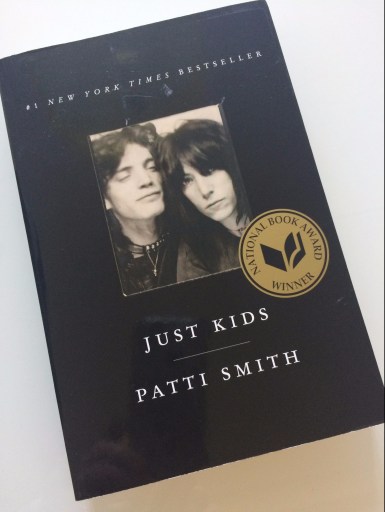
Last week I posted a review on this blog of Patti Smith’s Just Kids, which I’d read as part of my 2017 reading challenge. The challenge for March was to select something from my ever-growing ‘to-read’ pile. I know you have one too! It felt very satisfying to finally get around to something that I’ve been wanting to read for some time but which never seemed to rise to the top of the pile. My ‘to read’ pile bothers me a lot, so much so that I have many “‘to read” piles’ around the house. I’m a compulsive book-buyer so I feel guilty about the money I spend (although it has to be said a great many of the books I buy on impulse are from charity shops or waiting rooms) and about the space taken up, especially since I read Marie Kondo’s The Life-Changing Magic of Tidying! Clutter, to me, feels like a powerful signal of under-achievement. I bet my tidy, high-achieving friends don’t have large ‘to read’ piles! The psychology of the ‘to read’ pile is clearly very deep.

2017-03-30-12-10-56.jpgSo, it gives me great pleasure to announce that I completed the March challenge and the pile is one volume smaller. I really enjoyed Just Kids and I’m pleased I finally got around to it. I’ve also given up book-buying for Lent so hopefully I will be better able to resist temptation in the future and tackle the unread books before buying new ones. Sometimes.
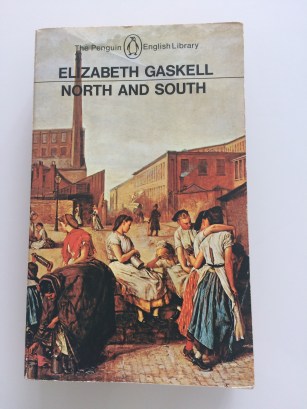
April’s challenge is to re-read a book I have enjoyed in the past. I’m not a big re-reader and yet I know this can be hugely rewarding, especially if you’re in a quiz or something and the name of the central character from that really famous book you read years ago is on the tip of your tongue! My husband is a good re-reader and he finds that he is able to get something new out of a book each time he goes back to it. I’ve decided to re-read Elizabeth Gaskell’s North and South. I read this many years ago, whilst studying English Literature at university and I’m afraid I remember very little about it, but I do know that I enjoyed it.

2017-03-30 11.25.47I am fortunate to live in Manchester, northern England, the setting of this book. It’s also where Gaskell spent much of her early life. You can visit Gaskell’s house in Plymouth Grove, Ardwick (and then stroll over to the Pankhurst Centre nestled in amongst the buildings of the Manchester Royal Infirmary) which I did last year. It’s still a work in progress, so well worth supporting, but has a fascinating collection of her possessions and is set out as it would have been when she and her family lived there. I moved to Manchester relatively recently and have become fascinated by the city’s history and culture. It will be interesting to read the book now, with that new knowledge and awareness.

My copy of North and South is a slim little thing, perfectly innocuous-looking, but the text is tiny and it has over 500 pages! I’m looking forward to immersing myself in 19th century northern industrial poverty. I also note that the Introduction to my edition is written by one of my former Professors, so it will be a trip down Memory Lane altogether.

Did you start a reading challenge this year? If so, how are you getting on?

If you have enjoyed this post, I would be delighted if you would follow my blog by clicking on the subscribe button, below or to the right, depending on your device.

Books for Spring

What do you think of when you think of Spring? I think of birth, renewal, reinvigoration, green shoots, hope, beginnings, fresh air, clean, the colour yellow, eggs, baby animals and life. There is a little more light each day, and it’s getting ever so slightly warmer. I want to be outdoors and I want to let the outside in by throwing open the windows. It’s also a time when people start to think about putting into effect changes they’d like in their lives, whether that be losing weight, decluttering or pursuing a new venture, because it’s easier to motivate yourself when the sun is shining and you have more energy.

With all those things in mind, I have come up with a list of books for Spring, a mix of fiction and non-fiction, hopefully covering a broad range of topics and interests.+

This slideshow requires JavaScript.

  1. The Life Changing Magic of Tidying by Marie Kondo – for those of you determined to do some spring decluttering. I read it last year and you can read my review here. It is a great talking point even if you don’t follow the Kon-Mari method for clearing your home and unblocking your life to the letter.
  2. My Mother My Self by Nancy Friday – 26th March is Mothering Sunday in the UK and I think this book is essential reading for all women. I learned so much about myself when I first read this some years ago, reflected a great deal on my mother and my relationship with her, and thought about the kind of mother I wish to be to my daughters.It covers all sorts of issues from how we talk about our bodies, sex,
  3. We: A Manifesto for Women Everywhere by Gillian Anderson and Jennifer Nadel – I am a huge fan of Gillian Anderson and I am dying to read this book. She is a very interesting and uncompromising woman who is open about her lifelong struggles with mental health. Jennifer Nadel is apparently a writer friend of hers.
  4. Gut: the inside story of our body’s most under-rated organ by Giulia Enders – the microbiome is getting a lot of publicity at the moment as we realise how little we have still to learn about the body and the influences on our health prognosis. This is a fascinating book, not just a handbook on how you can improve your overall health through what you eat, but, for those of us who like our advice to come backed up by a little more evidence, has plenty of science in it too.
  5. Exit West by Mohsin Hamid – published just last week, I’m very keen to read this. Globalisation and migration will be the defining issues of our time, I suspect, and this book is a novel about two young lovers who leave their home in the ‘east’, as civil war is about to break out, and plan their escape to an idealised ‘west’. The seemingly impossible clash between the desire of those who want a better life and those who are anxious about the pace of change is explored.
  6. Stay With Me by Ayobami Adebayo – Chimamanda Nogozi Adiche, possibly one of Nigeria’s finest literary figures, has been in the news a lot recently, as her views and publications on feminism have been getting some profile. Her work has certainly roused my interest in African women writers (I’ll be writing more about this in a future blog) and this novel by Adebayo stood out for me when the longlist for the Baileys Women’s Prize for Fiction was announced last week. It is the story of a young woman whose husband and family are desperate for her to have a child, yet she seems unable to conceive. It is set in 1980s Nigeria and explores the social and cultural pressures faced by Yejide, the main character.
  7. Tweet of the Day: a year of Britain’s birds by Brett Westwood and Stephen Moss – I have a bit of a phobia about birds, but I love them and am fascinated by them at the same time. This is a really gorgeous book that I want to look at when I see all the young birds landing on my neighbour’s bird feeder (we have a cat, so a bird feeder is not an option for us!)
  8. A Year in the Life of the Yorkshire Shepherdess by Amanda Owen – the story of a farmer in a remote Yorkshire location. She has eight children, so plenty of birth and renewal here. Also, the very outdoor nature of her and her family’s life may inspire you if you want to get your family off the sofa.
  9. The Detox Kitchen Bible by Lily Simpson and Rob Hobson – Spring is a good time for a health detox, I find. I have my own little detox method, which I’ve used for years, but if you’re looking for one for yourself this book, published at the end of 2016, has had some excellent reviews.
  10. Jane Eyre by Charlotte Bronte – you don’t need an excuse to revisit this classic, but if you want one, Charlotte was born in the Spring (21st April 1816) and she died in the Spring (31st March 1855).


What are your recommendations for Spring reading?

If you have enjoyed reading this post, please take a moment to follow my blog by clicking on the subscribe button below or to the right (depending on your device). Thank you!

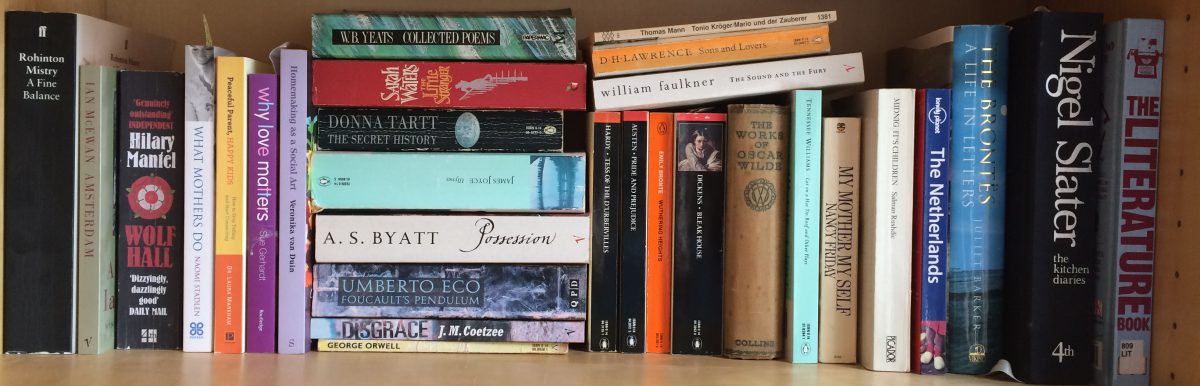
I have 14 books on my ‘to read’ pile – oops!

2017-03-01-11-38-09

And that’s just the living room pile! I have a few more beside my bed, and, ahem, a shelf or two full in bookcases here and there. If I sat down and worked out how long it would take me to get through them all I’d probably find I don’t need to buy another book for…some time! It’s a fairly harmless vice, compared to some, but I can’t help thinking that there’s something wrong with me – am I an eternal optimist (thinking I CAN read all these books) or do I have my head stuck in the sand (believing I WILL read all these books)? Is it wasteful? Of money and the earth’s resources? Or am I right to reward the many hard-working writers who have put so much time and effort into their books, by purchasing copies, even if I might never read them?

Who knows, but the piles do rather haunt me and get bigger in my mind, in true Dorian Gray fashion.

2017-03-01-13-21-23-hdrSo, the task for March on my 2017 reading challenge is to grip up this issue and tackle one of the books on my ‘to read’ pile that has been sitting there the longest. It’s Just Kids by Patti Smith. I came to Patti relatively late in life; I was a bit young to be into her in the ’70s when she was prominent. I’m not a big music fan and am relatively ignorant but I picked up her career-defining album Horses in one of those ‘2 for a tenner’ type sales in HMV, or somewhere similar, a few years ago, and it quickly became one of the soundtracks of my 30s, and my children loved it too! We all loved ‘Gloria’ particularly and that song would definitely be one of my Desert Island Discs, both because I love the power and energy of the song and because it brings back happy memories of us all singing in the car – “Gloria, G-L-O-R-I-A, Gloria!”

2017-03-01-11-40-14Patti Smith is a fascinating woman who has led a fascinating life. I have been meaning to read this book for years (it was published in 2010), so when I came across it in the Strand Bookshop whilst on my trip to, where else, New York last summer, it had to be bought! (It’s a very New York book.)
I’m looking forward to starting it, especially as I have now at long last finished Do Not Say We Have Nothing, with which I rather struggled, as I wrote about here a couple of weeks ago (I’ll post my review of that book soon). Reading Just Kids will I hope transport me back to last summer as I await the proper arrival of spring; I see a few snowdrops sprouting in my garden, but I also saw snow yesterday so we’re not there yet.

So, if you fancy joining me on the challenge this month, and picking a book from your ‘to read’ pile, do let me know what you’ll be tackling and why. (I think I’ll also give up book-buying for Lent!)

If you’ve enjoyed reading this post, I’d love you to subscribe to the blog, which you can do by clicking the link below or to the right, depending on your device.

A month of poetry

How often do you read a poem? The answer for me is rarely these days. It’s one of the reasons I wanted to include some poetry in my reading challenge for the year, to make myself sit down and do it. Why February? Well, firstly, it was Valentine’s Day last week, a time when one is more inclined, perhaps, to encounter a verse or two (or maybe even write one!) Secondly, and much more prosaically, it was half term, so I knew I wouldn’t get as much reading done as usual.

Well, I didn’t write my husband any poems (he was away, for goodness’ sake!), but I did read a few. The challenge was to choose a poem for each week and to read it every day for that week. In other words, four poems. The first one I chose was The Wild Swans at Coole by WB Yeats, a favourite of mine, having first got to know his work when studying for my English degree. It’s also a short poem, so an easy way into the challenge. First published a century ago (pure coincidence that I chose it), a year after the Easter Rising in Dublin, which affected Yeats deeply, the First World War was still going strong, and it was the year that he first married (at the age of 51), never having persuaded the real love of his life, Maud Gonne, to accept him.

“Their hearts have not grown old;

Passion or conquest, wander where they will,

Attend upon them still.”

It is a poem about ageing, about loss and grief and about the passage of time and Yeats’ search for true lasting beauty in a world where all about him was deteriorating and decaying. I had a different response to the poem, reading it now, aged forty-something, than I did in my early twenties, for obvious reasons.

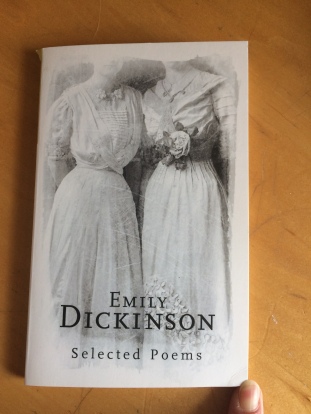
I’ve always wanted to get to know Emily Dickinson (1830-86) better; she is a celebrated American poet, who lived as a virtual recluse in Massachusetts. She remains something of an enigma, not least because of the deep passions expressed in her poetry, so at odds with what is known about her life. A book was published in 2015 by Nuala O’Connor called Miss Emily, written from the point of view of an Irish maid who was taken on by the Dickinson household. I am keen to read this now, having dipped into the poetry.

dickinson-img

I picked up this lovely little volume in my local Oxfam bookshop (what wonderful work this charity does, not only in its programmes abroad, but in providing many towns with such a fantastic literary resource). From it I chose poem no. 249 (Dickinson did not give titles to her poems so they are known by numbers or first lines) “Wild Nights – Wild Nights!” Very appropriate for the week in which Valentine’s Day fell and fascinating when you think of the kind of life she led – a middle class spinster living in 19th century rural America.


“Wild Nights – Wild Nights!

Were I with thee

Wild Nights should be

Our luxury!”

For my final two choices I thought I’d better get a bit  more modern, so I chose Jackie Kay from my other Oxfam purchase The Penguin Book of Poetry and Britain and Ireland since 1945. It’s quite an old anthology, published in 1998, so only one of Jackie’s poems is in there Brendon Gallacher. For my brother Maxie, but what a super poem it is. It’s about the narrator’s imaginary friend, a fantasy of a life much more exciting than her own. I had an imaginary friend as a child (Leda), through whom I had access to a much more colourful world, so can idenitfy with the theme! I also love listening to Jackie Kay, and here is a YouTube video of her reading this poem


The final poem for my challenge, which I shall continue reading next week, is Warming Her Pearls by the current British Poet Laureate Carol Ann Duffy. It is written from the point of view of a lady’s maid, one of whose tasks is to wear her mistress’s pearls before she goes out, in order that they are not cold on her skin. It has obvious themes about class but also has a deep erotic resonance – another one for Valentine’s Day perhaps!

I’ve enjoyed this month’s challenge much more than I expected and I have actually read more poems as a result than the four that I set myself. Poetry really is a pleasure and requires a lot less time commitment than a novel. It’s also incredibly relaxing!  I would urge you to give it a try if it’s not your usual thing.

Do you have a favourite poem or poet?

If you have enjoyed reading this post and would like to received email notifications of future posts, I would love for you to subscribe to my blog. You can do so by clicking on the link below or to the right, depending on your device.

What to do when a book feels like a hard slog?

Last Autumn I set myself a challenge to read the full Man Booker Shortlist 2016 (six books). I didn’t manage all of them before the winner, Paul Beatty’s The Sellout, was announced. I planned to complete and review the final one on my list (Do Not Say We Have Nothing by Madeleine Thien) this week, but I’m afraid I haven’t finished it; it is taking me an inordinate amount of time to get through!

swan-319379_640Now, dear reader, this blog is rather like the proverbial swan – whilst it may look smooth and effortless to you on the surface, the planning (reading, idea generation, social media, writing, etc) that goes on behind the scenes is like a military operation! Well, not exactly, but, you know, I do plan my reading, aim to bring you a book a week and try to blog twice a week. And this book has totally blown my schedule! You know what it’s like when you’ve got a busy day planned either at home or at work…and you hear the words “Mum, I’ve just been sick!” and you know your day is irretrievably banjaxed. Well, that’s how I feel.
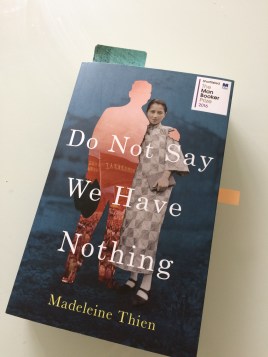
2017-02-08-11-48-44Do Not Say We Have Nothing, broadly speaking, is about China after the revolution, what it was like living under the dictatorship of Mao Tse Tung and about the hardships endured by the population, particularly by artists and intellectuals, in an era when culture was heavily proscribed. I have had a lifelong fascination with China, have read very widely about this enormously diverse and culturally rich nation, so I should be loving it. But I’m not! And I’m barely halfway through! I took a break from it this week and read Love, Nina by Nina Stibbe (which I’ll be reviewing soon), and that book is at the very opposite end of the literary spectrum – light, fun, quick to read. Many people probably would have given up by now. After all, a book, particularly a long one, is a huge investment is it not? I rarely give up on a book – I gave up on White Teeth by Zadie Smith a few years ago after a couple of false starts, but I have always planned to go back to it. My rationale for continuing with Do Not Say We Have Nothing is as follows:

  1. I’ve already sunk several hours into it
  2. I keep thinking that it’ll get more enjoyable
  3. It seems a worthy book, so I feel I ought to finish it
  4. I set myself the challenge to complete the shortlist and I can’t let one book make me fail.

Reasons 2 and 4 are the most compelling. So, I will carry on to the bitter end and hope that a turn of the plot will make it all worthwhile. I’ll keep you posted!

Do you give up on a book if you’re not enjoying it?

If you’ve already read this book, I’d love to hear your thoughts on whether you think it’ll be worth it in the end. Is it just me?

February’s reading challenge – four poems

The aim of my 2017 reading challenge was not to binge on books or to find quirky ways of seeking out different kinds of books, it was very much about challenging reading habits and embracing reading for the sake of it. Finding more joy in reading, not just lengthening the list of books read. Naturally, I had myself in mind! Books have been at the centre of my life for as long as I can remember, but I am not a big poetry reader. So, February’s challenge (to select four poems and read each one every day for a week) has required a good deal of thought for me. I did a degree in English Literature and so, book hoarder that I am, I have a few poetry anthologies lying around. WB Yeats is my favourite poet, but I am ashamed to say that my poetry knowledge is not that wide.

It requires a different set of reading skills for sure! Firstly, I’m quite a quick reader, and evidence shows that most of us can quite easily comprehend a piece of text without reading every word or even every letter of the words we do read (it’s how proofreaders make a living!). I’m sure you’ve seen or done one of those Facebook tests which tells you you’re super-intelligent if you can understand a quoted piece of jumbled and misspelled text? Secondly, like mindfulness colouring, or yoga, it forces you to slow right down. Poems have special unique rhythms and they can’t be speed read. Well, they can, but it misses the point.

If you know your Beowulf or your Chaucer, even your Shakespeare, you’ll know that prose fiction is a fairly recent phenomenon; poetry was by far the more popular form until around the late 18th/early 19th century. Furthermore, when ‘story-telling’ was a verbal or performance art form, and passed on by the telling, not by print, it was much more poetic in terms of the language used and the sound and rhythm of the sentences. And aren’t many of the first books we read our children, rhyming ones? Poetry undoubtedly taps into something very human and very instinctual. When you think about all of that, it’s extraordinary that most adults rarely indulge in poetry (perhaps pop music has replaced it?) So, for February, poetry it is!

For this first week, I’ve selected a Yeats poem to ease myself back into a poetry reading habit. Something familiar, which will also transport me back to my youth and dusty lecture halls! I’ve chosen a short poem, ‘The Wild Swans at Coole’ I’m reading this every day for the next week, so I’ll let you know how I get on. Perhaps you’d like to join me?

I’m off to the library tomorrow to do a bit more research and decide on poem number two!

Do you have any poetry recommendations? I’m particularly interested in something contemporary.

If you have enjoyed this blog, then I’d be delighted if you could follow me on social media or, better still, subscribe to the blog and get email notifications each time I publish a new post. You can do so by clicking on the link below or to the right, depending on your device.


How are you getting on with your reading challenge?

2017-01-25-13-03-10

I know many people are following reading challenges at the moment – it’s becoming very popular. Not to be left out, I set my own at the beginning of the month, which you can find here  if you’d like to join me. I know, however, that many busy book-loving parents don’t get as much time to read as they would like, so my challenge was about reading deeper – enjoying, embracing, rekindling the reading passion – rather than reading more.

January’s challenge was to read a book with a child (or simply to read out loud if you don’t have a child to hand). This month I have been reading two books with my youngest daughter, who is now 10. First of all we read Time Travelling with a Hamster by Ross Welford, which I reviewed here last week. We have also been reading Black Beauty by Anna Sewell.

My daughter is still young enough that reading together is something we do regularly, although we are not in the habit of doing it as much as we ought to for the purposes of school (oops!). Partly because, well, the usual, life is just full, but also because now that she is in Year 6 and a pretty good reader, we just don’t need to as much, so it’s slipped off our agenda somewhat. It just happens, doesn’t it? One minute you’re reading ‘Spot’ every bedtime, the next you realise your kids have hardly looked at a non-textbook for months.

Doing it regularly this month, however, has been a joy. For both of us. It was so lovely when we were reading a particularly dramatic section in Time Travelling with a Hamster where it was so tense she begged that we keep reading because she didn’t think she’d be able to sleep without knowing what happened next! Needless to say, I gave in, even though we’d gone way beyond official bedtime as I was pretty keen to find out if they escaped too!

Time Travelling with a Hamster, is a brilliant book, so if you haven’t got hold of it for your 9-12 year olds yet, you must. It was the first book in my daughter’s primary school book club, which I run, so I felt I was cheating slightly, putting it down for my January challenge. So, we’ve also been reading Black Beauty. I remember reading this when I was my daughter’s age and it’s been wonderful coming back to it as an adult. It has brought back so many happy memories from my childhood, not just from reading the book, but that wonderful television series. Do you remember the music? If you click here it will take you to a youtube clip of the opening and closing credits – watching it made me cry, it’s such a lovely piece of music, particularly the end theme with the choir. And that beautiful horse! It’s from 1972 so the TV show must have prompted me to read the book, as I would have been only 4 at the time. So, TV can be a good thing sometimes!

I hope you are enjoying reading with your child this month. I’d love to hear about it.

If you haven’t started yet, it’s not too late – maybe choose something together this weekend? You don’t have to finish by the end of January; we’re pretty relaxed about that sort of thing here at myfamilyandotherbooks.com!