
As I write this, it looks very much as if Greater Manchester, where I live, will be placed in the highest, Tier 3, level of restrictions in the coming days. There’s a lot of politics about, but let me tell you there is also a lot of frustration and anger about too. There is also a lot of division, differing perspectives, conflicting interpretations of data and statistics. But around me the human cost is evident – businesses are closing, I know people who have lost work, people under strain from not seeing their loved ones, and others paralysed by fear of the virus. One person’s asymptomatic response is another’s death sentence. We find ourselves at a difficult moment and we all have to find our way through this conundrum as best we can.
In the midst of all this confusion and anxiety, I took myself back in time last week to one of my favourite places in Manchester, but one which I have not visited for some time – the former home of Elizabeth Gaskell in Plymouth Grove, Rusholme, Manchester. It is close to the Manchester Royal Infirmary, The University of Manchester, and the Pankhurst Centre, a little house, in the middle of the hospital campus, that was the birthplace of the Suffragette movement (also now a museum).

Elizabeth Gaskell’s house is a fairly modest property that has had a chequered history. Elizabeth’s unmarried daughters Meta and Julia lived there until they died, and after Meta’s death in 1913, an attempt to preserve it as a memorial to the author was unsuccessful and it was sold and its contents dispersed. It continued to be occupied as a family home until it was bought by Manchester University in 1968 who used it as accommodation for overseas students. It fell into some disrepair (though thankfully not too much irreversible ‘renovation’ was done) but was finally purchased by the Manchester Historic Buildings Trust in 2004 and a project was set up to restore it as a museum to Elizabeth Gaskell.
It is still a work in progress and it is really only the ground floor rooms that have been set up as they would have been in Gaskell’s time. While I was there, I was shown work underway to restore what is believed to have been Elizabeth’s bedroom, but other rooms have been given over to research, educational spaces and meeting rooms. There is currently a very interesting exhibition about John Ruskin on display until the end of the year. The rooms have been painstakingly restored and furniture and artefacts either belonged to the family or are the Trusts’s best guess at what they would have had around them.
I was looking for some peace, tranquility and inspiration there and I found it. I was the only visitor that afternoon, and whilst it saddens me that so few people are going out to see the many interesting and beautiful places that remain open to visitors and safe, I had to admit that having the place to myself felt like a treat. Numbers are controlled and all the volunteer guides are well protected with PPE. You have to book your slot online and the £5.50 admission price gives you access for a full year. There is a tea room and a huge selection of secondhand books for sale.
Most of all there is a sense of dedication, to the memory of the author and her remarkable achievements (she died suddenly at the age of 55).
I recommend a visit to this wonderful house. The arts and culture are suffering terribly at this difficult time with opening restrictions, the cost of being Covid-safe, and reduced (or in many cases zero) numbers. Book a visit, you won’t regret it.
 A Long Petal of the Sea is Isabel Allende’s twentieth novel and, as with many of her works, is based on the true story of a close friend of hers. It concerns refugees from the Spanish Civil War who escape the fascist regime in September 1939 and flee to Chile via France on a ship called the Winnipeg, in an operation organised by the legendary Chilean poet Pablo Neruda, who felt his nation had a duty to support those fleeing the terror in Spain.
 Fleabag: The Scriptures by Phoebe Waller-Bridge £20.00
 Who Am I Again? by Lenny Henry £20.00
 Wilding by Isabella Tree £9.99
 Ness by Robert Macfarlane and Stanley Donwood £14.99
 Twas the Nightshift before Christmas by Adam Kay £9.99
 The Jewish Cookbook by Leah Koenig £35.00
 Mother: A Human Love Story by Matt Hopwood £9.99
 Poems to Fix a F**ked Up World by Various £9.99
 Fucking Good Manners by Simon Griffin £9.99
 I have chosen a book which caught my eye a couple of months ago – The Lido by Libby Page. It concerns a friendship between two women, 86 year-old widow Rosemary and 26 year-old Kate, who strike up a bond when their local outdoor swimming pool in Brixton, south London, is threatened with closure. The two women have different reasons for wanting to campaign to keep the lido open, but they are brought together in a common cause.
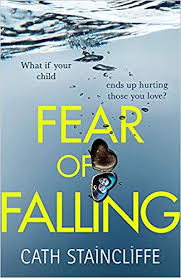 However, the full diary will be emptying out a little as this month progresses, so I’m hopeful I’ll be able to restore my daily reading hour. My selection for the Facebook Reading Challenge this month will also help. The theme is contemporary crime fiction and I’ve chosen the latest book by north-west (England) crime writer Cath Staincliffe, Fear of Fallling, which was published last year. I met Cath at a writer’s conference a couple of years ago and she was such a lovely, warm, down to earth person that she really inspired me to think that I too might be able to pursue a writing life. Crime is not usually my genre of choice, but I read a couple of her books, including
  The book is about a young newly-married couple, Celestial and Roy, and is set in the American Deep South. Their lives appear full of potential until Roy is accused of a crime he did not commit. He is convicted and sentenced to twelve years in prison. The book concerns the effect of the separation on their marriage, how Celestial copes alone and what this means for their shared dreams.
 Julia's books