
My children and I are privileged. On every level. There is no doubt about it. Because we have a roof over our heads that we can afford to pay for, because we know where not just the next meal, but the one after that and the one after that are coming from, and because we can turn the heating up when there’s an unexpected cold snap, we are more privileged than many. And I don’t just mean those children fleeing war or who have lost their families, but many in our country, our city, or our town. And yet. And yet.
I read somewhere once that you are only as happy as your unhappiest child. And just now I have an unhappy child. A child who feels that nothing is going right for them, who feels there is pressure, who struggles sometimes in their social network. A child. One who is too young for this. A child who says that sometimes life is so hard they wish they could just hide away from it all. So no matter how good my life, no matter how well my other children are or are doing, I too am unhappy. I’d go through the pain of childbirth every day to take that pain away.
I was lucky to be a relatively successful child. I sailed through most things. I was disliked by some of the nastier kids in the neighbourhood, but I managed to avoid them, mostly. I thank my lucky stars I wasn’t bullied because I was a prime target for it (nice, timid, studious, spectacle-wearing), but I came through school largely unscathed. It was in young adulthood that the realities of the world hit me. When I realised that, hmm, life was tough. That it wasn’t all going to be plain sailing. That life wasn’t fair. And I was powerless to do anything about much of life’s injustice. It was only later I learned all I could do about it was just to be the best that I could be.
Mental nd emotional wellbeing have been a lifelong challenge for me, as for many people I know (most?). I admire and am fascinated by people who have a natural positive outlook, that sunny disposition, and I wish I knew how to get it. No. I wish I knew how to get it for my child. My question is, is it better for children to learn when they’re young that life is not fair and you just have to make the best of it? Does disappointment and heartache when you’re young help to build resilience when you’re older? I sometimes wonder whether a bit of disappointment, a reality check, when I was a kid, might have helped me cope better with it in adulthood. But maybe not.
More recently, I’ve learned how focusing on gratitude can help to build resilience and a positive mindset, so I practice this every day. And I know I have so much to be grateful for. Just recently I heard a single mother on the radio talking about the pain of having to put her severely disabled 12-year old into care because she could no longer cope. And, again, I thank my lucky stars, my guardian angels, or whatever force in the world is out there looking after me and mine, that I have a healthy, stable family. That said, the least empathic thing you can say to someone who is feeling low is to invite them to think of all the people who are worse off than they are.
I also read somewhere once that you get the children you need; maybe that divine force out there has gifted my children to me because I have within me the love to support and care for them, when unhappiness strikes. But today I feel ill-equipped and today I feel as unhappy as my unhappiest child.
“Happiness, not in another place but this place, not for another hour but this hour”
As ever, I look to my books for help. The above quote from Walt Whitman is a call to embrace joy in the here and now, and is one of the techniques for being happy listed in a little volume I picked up in a bargain bookshop a while ago. A little book I keep to hand for times like this – How to be Happy by Anna Barnes.


I don’t think Whitman will mean much to my child at this point, but perhaps my job as a parent is to try and pass on some of my own hard-earned resilience to my child, who is still maturing, still growing, still learning.

 So, the task for March on my
 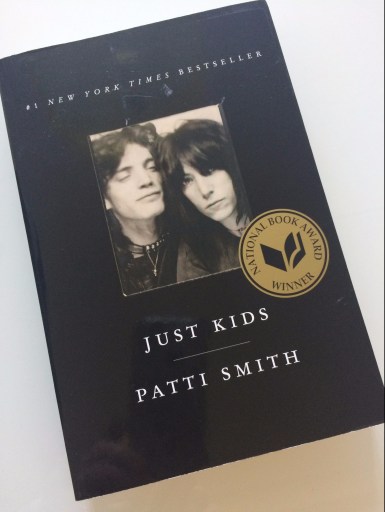 Patti Smith is a fascinating woman who has led a fascinating life. I have been meaning to read this book for years (it was published in 2010), so when I came across it in the Strand Bookshop whilst on my trip to, where else, New York last summer, it had to be bought! (It’s a very New York book.)
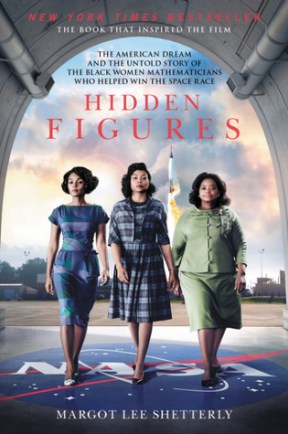 This year, literary references are a little thinner on the ground, but I want to tell you about a couple that have caught my eye. My children were on their half term holiday last week and I took my youngest daughter (aged 10) to see Hidden Figures. It is based on a true story, but the film was inspired by a book of the same name by Margot Lee Shetterly. You will no doubt have seen the trailers, but, to summarise, it tells the story of three exceptionally talented mathematical minds whose contribution to the US space programme in the 1960s went largely unacknowledged…because they were African-American women working at a time when racial segregation was still in place. It is a remarkable story, very moving and very well told.

 Now, dear reader, this blog is rather like the proverbial swan – whilst it may look smooth and effortless to you on the surface, the planning (reading, idea generation, social media, writing, etc) that goes on behind the scenes is like a military operation! Well, not exactly, but, you know, I do plan my reading, aim to bring you a book a week and try to blog twice a week. And this book has totally blown my schedule! You know what it’s like when you’ve got a busy day planned either at home or at work…and you hear the words “Mum, I’ve just been sick!” and you know your day is irretrievably banjaxed. Well, that’s how I feel.
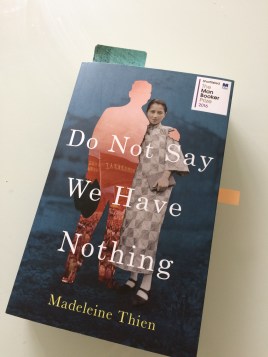 Do Not Say We Have Nothing, broadly speaking, is about China after the revolution, what it was like living under the dictatorship of Mao Tse Tung and about the hardships endured by the population, particularly by artists and intellectuals, in an era when culture was heavily proscribed. I have had a lifelong fascination with China, have read very widely about this enormously diverse and culturally rich nation, so I should be loving it. But I’m not! And I’m barely halfway through! I took a break from it this week and read Love, Nina by Nina Stibbe (which I’ll be reviewing soon), and that book is at the very opposite end of the literary spectrum – light, fun, quick to read. Many people probably would have given up by now. After all, a book, particularly a long one, is a huge investment is it not? I rarely give up on a book – I gave up on White Teeth by Zadie Smith a few years ago after a couple of false starts, but I have always planned to go back to it. My rationale for continuing with Do Not Say We Have Nothing is as follows:


 I’m not knocking either of these genres, I’m simply saying that literary non-fiction is a very tough genre to sell in. I read recently that the average non-fiction title in the US sells 250 copies a year (one for roughly every million people), or 2,000 copies over its lifetime. It makes you wonder why on earth you would write one! Many seem to be written by academics, journalists or people who have already established themselves in a chosen field and know they are writing for a particular niche. One striking thing about the genre, though, is that authors have a real passion for the topic, and the authenticity of the work is palpable.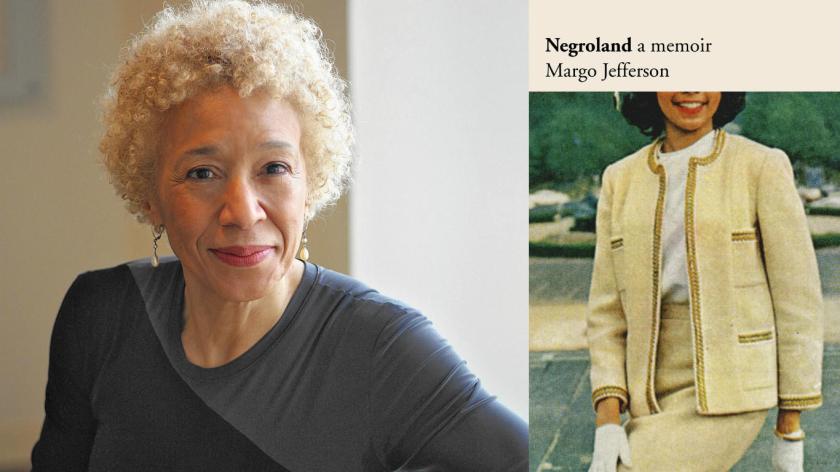



 Julia's books