Kids books for Christmas – non-fiction

As promised, the first of three blogs this week on book recommendations. Even though my children are now teenagers, they still get a book or two in their stocking – I live in hope! In my experience younger kids are easy – you can just buy them a story or picture in some subject they’re vaguely interested in and they will love it. Older children are not so easy, especially if you don’t know them that well. Having said that, I don’t always get it right for the kids that live with me either! Oh well, it’s ALWAYS worth giving a book, in my view, and you never know, you might even spark a new interest – kids are notorious for sticking with what they know.

So, if you are looking for some ideas for the young people in your life, here are some fab non-fiction titles that I have spotted.

Primary School
xmas 18 1


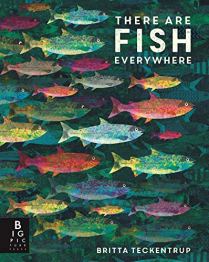
There Are Fish Everywhere – Britte Teckentrup and Katie Haworth

Stunning illustrations, informative, weird and wonderful facts about sea creatures. Beautiful.


xmas 18 2


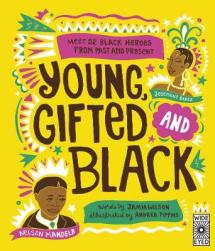
Young, Gifted and Black: Meet 52 Black Heroes from Past and Present  – Jamia Wilson and Andrea Pippins

Short biographies of towering figures in Black history, some you will have heard of and some less well-known, but equally important. Boldly illustrated.


xmas 18 3


The Human Body: A Pop up guide to anatomy – Richard Walker and Rachel Caldwell

Anatomical books make very popular gifts and the pop-ups in this one are wonderful. Has the added twist of presenting it from the perspective of a 19th century medical student, so something for those with an interest in history too.


Late primary/early secondary

xmas 18 4


Code Like a Girl: Rad Tech Projects and Practical Tips  – Miriam Peskowitz

I’m all for a book that busts a gender stereotype – boys can like fashion, girls can like coding.


xmas 18 6


Unlock Your Imagination: 250 boredom busters – published by Dorling Kindersley

When you try to peel your children off their devices, how often do you hear them cry “But, I’m bored!”? There is an argument that our kids should be more bored, as this can stimulate creativity. This book may help and many of the activities are short and straightforward, so could be done whilst travelling. Suitable for younger kids too, so good if you have children of different ages to please.

xmas 18 5


An Anthology of Intriguing Animals – Ben Hoare

This is a beautiful book, taking a close-up look at 100 animals and their special talents and characteristics. Lovely short chapters with some off the wall facts, and a mix of stunning photographs and illustrations.


Teens

Many teenagers are happy with adult books, but we all know that they can also have some very unique and specific needs and interests. Thankfully, the book market in recent years has evolved to cater to this very special group, when interest in books can really fall off a cliff.

xmas 18 7


Zen Teen: 40 ways to stay calm when life gets stressful – Tanya Carroll Richardson

This book will be published on 6 December and I’ve already got one on pre-order! Many teens are interested in mindfulness now as a way of managing the pressures in their life, and this can only be a good thing. This title looks as if it will be a worth addition to any teenager’s library.
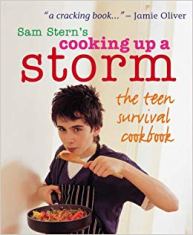
 

xmas 18 8Cooking Up a Storm: The teen survival cookbook – Sam Stern & Susan Stern

Teenagers love independence and at some point that is going to mean cooking for themselves, so you may as well get them started sooner rather than later. This book dates back to 2014, but is a good one, with real food, and not just the sugary bakes that are often marketed at this age group, and particularly females. Boys need to know how to cook too!

xmas 18 9


Would You Rather Randoms: A collection of hilarious hypothetical questions – Clint Hammerstrike

My kids’ favourite dinner table conversation seems to revolve around such questions as would you rather eat the same thing for the rest of your life or never eat the same thing twice???? Hmm. They love it though. This little book could spark some similarly edifying conversation in your household.


I hope there is something here that is useful to you. I’d love to hear your suggestions too.

Look out for my fiction recommendations later in the week.

If you have enjoyed this post, I would love for you to follow my blog. Let’s also connect on social media.

It’s that time of the year again!

cinnamon-stars-2991174_1920As I have been told many times by some of the people in my household, today is the official start of Christmas as it is the first Sunday of Advent (sounds like a bit of an excuse to me since we are not a religious family). Not quite feeling it myself yet, but then I tend to prefer to hold off for another week or two so as not to feel too exhausted by it all when the big day finally arrives. There is no doubt though, when you have children, or just a larger extended family with some children in it, you kind of have to get a little organised otherwise things can get a bit stressful.

So, as days 1 and 2 on the Advent calendars lie open, your thoughts might be turning to what gifts to give your loved ones this Christmas. Like an increasing number of people, I do worry about excess consumerism, about ‘stuff’, and about the environmental impact of both. Many people I know are trying hard to reduce the amount of single-use plastic and non-recyclable materials they consume. Books, of course, are mostly recyclable, certainly re-giftable, have little and usually no non-recyclable components, no batteries and use very little gift wrap. They make the perfect gift and are an antidote to the pace the season often takes on as well as the blue-screen glare!

I’ve been doing plenty of research these last few weeks, building up a list of recommendations for books you might like to give, and I’ll be sharing it all with you next week. So look out for blogs on Monday, Wednesday and Saturday, starting with children’s non-fiction.

In the meantime, enjoy the rest of this first weekend of Advent. I will be watching my daughter perform in a Christmas musical concert later today and will no doubt have a mince pie, so perhaps the festive spirit might grip me later on!

star-17075_1920


YA book review – “The Hurting” by Lucy van Smit

Regular readers of this blog will know that I am a huge fan of literature for children and young people and that I review such books on here from time to time, not just because I think it’s good for ‘grown-ups’ to delve into these genres (you’re missing out if you don’t), but also because I know many of you often want recommendations for the youngsters you live with.

I picked up The Hurting from my local library recently (most now have online catalogues with a ‘What’s New’ section so you can browse new titles) and libraries are great for young readers because, unlike me, they often make a quick decision about whether they like something or not and if a book is worth their time, so it can be frustrating when they toss something aside after half an hour that you’ve paid £6 plus for!

Lucy van Smit is a first-time author and the publisher, Chicken House Books, has a good reputation for quality fiction for young people. It’s a YA book, for 15+ I’d say, as there are sexual references, some swearing, quite a bit of peril, and some challenging themes – cancer, alcoholism, death of a parent – all high-grade emotional stuff that teens seem to love! For me, it’s not the best YA book I’ve read this year, but then I’m judging it against The Disappearances, which I think is a phenomenal book, and Just Fly Away, which had a more concise and coherent plot and was for me more enjoyable. There is a lot going on in this book, perhaps too much.

The Hurting imgNell is in her late teens and lives with her father, a very religious alcoholic, and her sister, Harper, who has cancer. They are from Manchester but moved to Norway, ostensibly for Harper’s medical treatment. The girls’ mother, we learn, left when they were young and they have had no contact since. Nell is a confused young woman; she is the primary carer for her sister, their father either working or incapable most of the time, and she wants to be a singer-songwriter back in Britain, but finds herself cut off from any possibility of making a career in that field. She attends a local school where she experiences bullying and isolation. She decides to go back to the UK, without her family’s knowledge, for an audition, but gets into a spot of bother en route and meets Lukas, a handsome but mysterious boy. At first it appears he rescues her but we learn later that he in fact engineered the whole episode in order to entrap her.
There is an instant attraction between Nell and Lukas and Nell quickly falls in love with him. Lukas pursues Nell (and yes, that is the right word), and she is drawn into what can only be described as an edgy relationship with him. It turns out that Lukas is the son of the late Harry Svad, a Norwegian minerals entrepreneur (and Nell’s father’s employer who, mysteriously, her Dad seems to hate). Svad, along with his wife Rosa, has recently been killed in a helicopter crash. Lukas was not his biological son, however; he was discovered as a very young child living in a wolf pack in an area of forest Svad wanted to mine. Svad ‘rescued’ and adopted him, but Lukas cannot forgive him for killing the wolves he loved, and says he was also treated cruelly. This draws Nell further into a web of sympathy. Lukas has a baby brother, Pup, who, now an orphan, is in the care of social services. Lukas wants to adopt him when he turns 18 (very soon) but feels he needs to get Pup back now before events spiral out of control, and he says that by the time they catch up with him, he’ll be 18 so he’ll be able to adopt without a problem. By this stage he is well able to coerce Nell into kidnapping Pup from the foster carer.

Still with me? Yes, I struggled to suspend my disbelief too, but I suspect some young people would not! Nell goes along with Lukas’s plan, they kidnap the baby and then run away, back to the grand, extraordinary but isolated Svad home, via stolen car and light aircraft. They are pursued of course, though Lukas is careful to shield Nell from too much contact with the outside world where CCTV images of her are being splashed across news screens.

Spoiler alert: once at the Svad home, Nell begins to realise that Lukas has tricked her, that he actually wants to kill Pup, and frame her, and yet she cannot reconcile these facts with her intense passion for Lukas, the only person who appears to have shown her any love. His behaviour frightens her sufficiently, however, that she decides to escape with Pup (who it turns out is her half-brother, his dead mother, Rosa Svad, having also been Nell’s estranged Mum) but this involves a perilous trek through dangerous wolf-inhabited forest. With a baby.

Yes, there is a lot going on here; rather too many events, strands and themes for my liking, and I felt a bit overwhelmed. It rather lost me in the last third of the book, I’m afraid. However, for teens who need a lot of stimulation to keep their interest, this may suit. As I said, I found it hard to believe in the events, but, again, teens who like a touch of fantasy may be able to lose themselves in it and be more forgiving about the lapses in credibility. There were, in my view, some editorial oversights which annoyed me (including a frustrating number of typographical errors, grrr!), but most teens will overlook these. I loved the evocation of place – Norway provides a great setting for the book – and the author does well to convey the sense of threat as well as beauty in the natural world. Nell is a great character and her vulnerability and confusion, her difficult life, and her thwarted dreams may have a resonance for young people. Also, her journey, her survival against the odds and her ability ultimately to overcome her fears, some seemingly insurmountable obstacles and the effects of her first-love blindness, make her a positive role-model.

Recommended for the young people in your life, even if it wasn’t quite for me.

Have you read any good YA titles recently?

If you have enjoyed this post, I would love for you to follow my blog. Let’s also connect on social media.

Listening versus reading

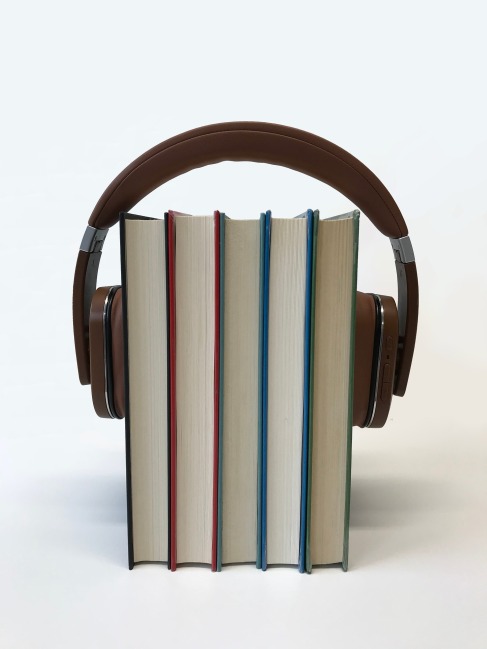
headphones-3658441_1920

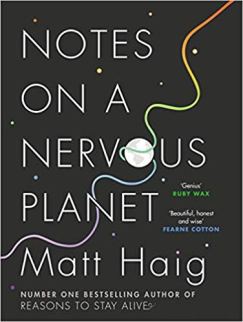
I loved listening to Matt Haig read his wonderful book Notes on a Nervous Planet. I downloaded the audiobook in the Summer and blogged about it here in October. I decided that it was definitely a book I wanted to have on my bookshelves, to dip into occasionally, to read certain chapters at specific times, and to be able to jot notes down. I also decided that it would make a great gift for a few people I know.

I set it as the November book for my Facebook Reading Challenge and so far the feedback seems to be positive. Apart from a handful of my very favourite books (eg Wuthering Heights) I seldom re-read books. I always feel I should; my husband is a great re-reader and says he gets different things out of a book each time he returns to it, and he is right of course. For me, though, there seem to be just too many books to read first time around!

Notes on a Nervous Planet imgI have made an exception and decided to read Notes on a Nervous Planet again. I’m surprised at how different the reading experience is versus listening. Firstly, the author has a wonderful reading voice and I suppose because it is non-fiction and is very much about his experiences of anxiety and depression, you can sense that it comes straight from the heart. I really think that the narrator of an audiobook plays such an important role in the experience. For example, I loved Hilary Huber’s narration of Elena Ferrante’s Neapolitan Novels, but I struggled with the reading of 1984 by Andrew Wincott…who is Adam in The Archers. I just couldn’t get Adam out of my head!
The second interesting difference is the speed. I read quite fast, and I am aware that this means I don’t always take in every detail. With listening, however, I listen at the natural pace (I dislike the 1.25 and 1.5 speeds). It does mean that you absorb a lot more of the text. I was surprised reading Notes on a Nervous Planet how many passages I remembered virtually word for word.

The third difference for me may be a very subjective one, but it’s about the way the content of the book organises itself in my head. Here, my preference is for the tangible book. Listening to this book I found it more of a continuous narrative, but reading it is more useful to me in terms of taking forward some of the ‘recommended’ actions – I use the term loosely as it’s not a smug, instructional just do as I say and your life will be perfect, sort of book! For others who are more aurally oriented the experience may be different.

Audiobooks are great, especially for long car journeys (if you have the appropriate technology), or, my particular preference, walks into town. I have found with this book, though, that reading again has brought me some extra insight, and that can’t be bad.

Are you a fan of audiobooks? Have you ever both read and listened to a particular title?

If you have this post, I would love for you to follow my blog. Let’s also connect on social media.

Book Review – “The Music Shop” by Rachel Joyce

I posted on here last week about my brain needing to have a little break from the Man Booker shortlist (especially as I have not found all the books particularly engaging so far). It is a rather bleak shortlist. I have also been unwell for a couple of weeks with sinus problems, and none of these books are exactly a ‘pick me up’! So, on a day when I was feeling particularly sorry for myself I lay down on the sofa with The Music Shop, my book club’s reading choice for November, and read the whole thing in one sitting. I loved it!

This book caught my eye last year, so it has been on my mental TBR list for some time. In September I attended a one-day conference run by the group that publishes the Writers’ and Artists’ Yearbook on how to get your book published (almost finished my novel), at which Rachel Joyce was a speaker. Rachel came to novel-writing relatively late in life, coming to prominence only in her late 40s (encouraging!) when her first novel, The Unlikely Pilgrimage of Harold Fry (2012) was widely acclaimed, and in fact found its way onto the Man Booker Longlist. Rachel came across as a lovely, down to earth human being, but with her own fascinating story to tell, and a warm and inspiring approach to all the novice writers in the room. I bought The Music Shop at that event.

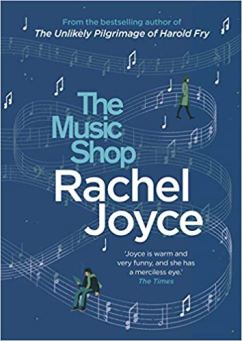
The Music Shop imgThe books open in 1988 when the central character Frank opens a music shop in a rundown area (Unity Street) of an unnamed city. Frank is passionate about music, something that was instilled in him by his late mother, the eccentric Peg. It is probably the only the good thing that Frank got from her, and as the book goes on, we learn much about the lack of love and security in his childhood. This is important as it helps us to understand Frank’s actions later on. The other thing that Frank is passionate about is vinyl; he refuses to sell either cassette tapes or the new-fangled CDs in his shop, much to the chagrin of the salesmen who tell him he is a dinosaur and will have to change with the times. They gradually abandon him.
Unity Street is run-down and regularly vandalised. There are only a handful of businesses, all of them marginal and barely surviving, such as the small shop selling religious souvenirs, run by a former priest, the tattoo parlour run by the indomitable punky Maud, and the two brothers running the funeral parlour. It is a street of misfits and Frank, with his assistant Kit – clumsy, loveable, naïve – slots right in. It is the ‘80s, however, and Britain is changing. Property developers are anxious to get into Unity Street, for the residents in their run-down houses and the shop-owners barely making ends meet to leave and to bulldoze the whole area to make way for shiny new apartments.

One day, Frank meets Ilse Brauchmann. First, she faints outside his shop. The traders all rally round to help her. Frank is immediately attracted to her, which throws him into a tailspin as this is something he has never felt before. Frank has no self-esteem and does not believe she could possibly feel the same way about him. Ilse, however, leaves her handbag behind in the shop. Kit and the others make great efforts to track Ilse down, fascinated by her mysterious presence, though Frank is nonchalant. They find Ilse and draw her into their community.

Eventually, after some false starts, Ilse, on hearing how Frank has changed the lives of so many of his customers by bringing music to them, asks him to teach her about music. They begin to meet weekly in a café where Frank’s confidence gradually builds as he talks about the one subject he knows, that he feels confident about and which enables him to be his true self.

Their burgeoning relationship is destined to fail, however, as they stumble from one misunderstanding to another, because of Frank’s fear, but also because there seems to be something about Ilse that she is not revealing.

This book is a love story, but it is a roller-coaster of one, that will take you on twists and turns you cannot anticipate. It kept me absolutely gripped – I was at times so frustrated with both of them, but also deeply moved by their respective stories and the things I as the reader knew were getting in the way. The ending is not what I was expecting at all.

It is also a story about something softer and gentler which we lost when certain powerful commercial forces came and took over our towns. To that extent this book is much more than a love story, it succeeds on so many other levels too. The Unity Street traders are all lonely people who have had their troubles in life. They are all ‘the left-behind’ but they have each other and they are rich, nuanced, powerful characters in their own right and mostly have the last laugh.

I recommend this book highly. A great story which is truly uplifting. It will make you laugh at times and it may also make you cry.

Have you read The Music Shop? If so, what did you think?

If you have enjoyed this post, I would love for you to follow my blog and to connect with me on social media.

Time for a little light reading

Regular followers of this blog will know that I have recently been reviewing each of the Man Booker shortlisted books. It’s a month since the winner, Anna Burns’s Milkman, was announced, and I still haven’t finished all six books – I don’t know how on earth I thought I’d get them all read before the gala dinner! I’ve found them all pretty heavy going, to be honest, which is perhaps why it has taken me so long. And, I have to say, it’s been a bit bleak too!

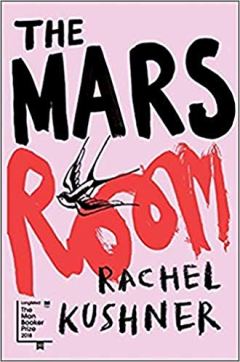
The Mars Room imgSo much so that I had to have a break from all the heaviness to read something a little more uplifting and which didn’t tax my brain quite so much. I wasn’t very well last week and simply couldn’t face into The Mars Room (next on my Man Booker list) – if you have heard it is bleak, well it is! So far (not quite finished it yet). So, with my blanket, hot water bottle and cups of tea to hand I settled onto the sofa and read Rachel Joyce’s The Music Shop cover to cover in one day. I simply could not put it down.


The Music Shop imgThis book came to my attention last year. I really liked the sound of it and recommended it in one of my ‘what to look our for this season’ blogs, so it was on my TBR list. Then I saw Rachel speak at a Writers & Artists Conference I was at in September. She was such a wonderful speaker, really warm, authentic and engaging, that I had to get a copy of this book and have been eager to start it. It was a joy and just what I needed, when I was feeling unwell and when my brain was starting to hurt from the Man Booker. Look out for my review of The Music Shop next week.
 

The Mars Room is quite good, but, for me, just unremittingly bleak. Yes, good fiction should challenge us, but sometimes you just need something that makes you feel up rather than down. I’ve found it quite a dark shortlist this year and I haven’t even started The Overstory yet which, since it is meant to be about climate change, I am fully expecting to be a sobering if not depressing read. Maybe that reflects the times we find ourselves in. It’s not just the subject matter though; some of the books, though I have admired them, have, at times, felt like wading through treacle. I felt like that about Everything Under, and I’m rather getting that feeling about The Mars Room. It is only the colourful prose style, with its American prison vernacular, that is keeping my attention at the moment, because it has little story to speak of, it seems to me.

The Music Shop on the other hand, was all story, all character, all cliffhanger, all page-turner. This high-brow literature, which, don’t get me wrong, I dearly love and support, is all very well, but sometimes you just need a jolly good read. Especially when your sinuses are blocked and your head hurts!

So it’s more Rachel Joyce on the TBR list for me, and a second wind to finish The Mars Room and complete that shortlist.

Happy reading everyone!

Are you drawn to literature that is dark or do you feel reading should always be about pleasure?

If you have enjoyed this post, I would love for you to follow my blog. Let’s also connect on social media.

Theatre Review: “Hamilton”, London

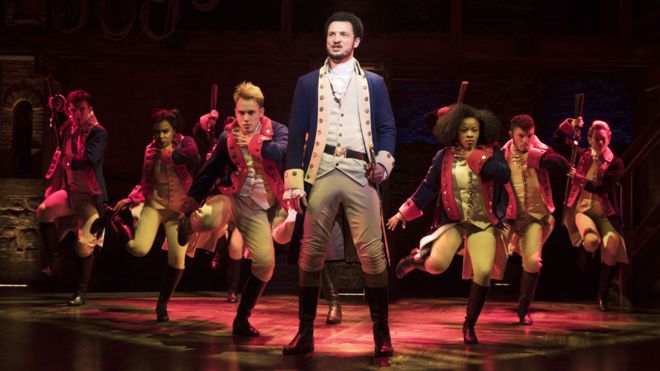
I first became aware of the Broadway show Hamilton when we visited family in the US in 2016. I was told that if (when!) this came to London I should beg, steal or borrow tickets because it was sensational. Yes, I said, politely, thinking that a show about the Founding Fathers of America probably would not do as well in the UK. It has. And it is. Sensational.

Hamilton 1My youngest daughter, a keen singer, started getting into the show a year or so ago. She has been listening to and singing along to the soundtrack almost continuously ever since. When it was her birthday earlier this year I decided to get her tickets. I was astonished to discover how difficult these were to obtain (and how expensive!), so she has been waiting patiently for almost six months to enjoy her birthday gift. Last week, during half term, we travelled to London to see the show. It was worth the wait and she promptly declared that it was the best experience of her life. For me, seeing her enjoying something so much and how she has engaged so wholeheartedly with the story, the music and the ethos of the production, has the been the greatest pleasure.

I’ve seen a few musicals over the years, and many of the biggest ones, but they would not normally be my first choice for theatre. I prefer drama. Also, I find that some of these productions, when they have had very long runs, can become tired. Hamilton has been at the Victoria Palace for over a year now and it certainly has not run out of steam. The show was a tour de force from the opening bars to the final curtain. I must also say that, knowing the songs as well as I do (they’ve been in my background for months!) added to my enjoyment.

I knew next to nothing about Alexander Hamilton the man. He was the brains behind the United States financial system, the first Treasury Secretary, influential in George Washington’s presidency and founder of the national bank. As an orphan who climbed his way to the top of politics, he embodies the American dream of self-made success. He was killed in a duel by his long-time rival Aaron Burr in his late forties. Quite a life.

As you may know, Hamilton has won many awards, including the Pulitzer Prize for Drama, mostly for its originality. The music of the show incorporates rap, hip-hop, R&B and soul, unusual for this type of production, and it is both refreshing and memorable. It is also well-known for its colour-conscious casting of non-white actors. Whilst none of the main protagonists in the story were actually people of colour, the aim was to draw attention to how black and non-white history is so often under-acknowledged and under-discussed. It seemed appropriate that we went to see the show during black history month which aims to redress that balance.

So, a stunning show that I enjoyed much more than I expected to. I now consider myself a fan and would definitely see it again. The energy of the show left both my daughter and I on a real high.

Have you seen Hamilton? If so, what did you think?

If you have enjoyed this post, I would love for you to follow my blog. Let’s also connect on social media. 

Seven stories to spook you this Hallowe’en!

halloween-2870607_1280
I just adore this picture!

The clocks have gone back, the nights are drawing in so it must be time to curl up with a book! It’s Hallowe’en (sorry, I’m a pedant when it comes to this particular apostrophe) this Wednesday. 1st November is All Saints Day, the day we remember the dead. The night before was traditionally All Hallows’ Even, which has got shortened over the years. My attachment to the apostrophe spelling stems from a preference for the original festival rather than the saccharin, plasticised, commercialised, trick-or-treat dominated version that has taken over. I say this as a mother of three teenagers who went along with it all for many years, so no criticism at all intended (though I’m afraid I could NEVER bring myself to accept murdered schoolgirl costumes which still appal me).

However, not to be a party pooper, I thought you might you might like some Hallowe’en reading suggestions. Ghosty, spooky, scary books. Here are a few that I thought of:

  1. The Little Stranger by Sarah Waters – a poltergeist in an old manor house terrorises the inhabitants!
  2. The Woman in White by Wilkie Collins – dramatised brilliantly for television earlier this year, a legal drama but with the spectral presence of Anne Catherick.
  3. Frankenstein by Mary Shelley – there will be a few of these knocking on my door next week no doubt. A brilliant, gory, scary book.
  4. The Shining by Stephen King – or anything by Stephen King really! Great movie too.
  5. The Secret History by Donna Tartt – still one of my favourite novels ever. Less about ghosts and ghouls, more about death, rituals and a dysfunctional coterie held together by a shared dark secret. If you liked The Blair Witch Project you’ll love this.
  6. Dracula by Bram Stoker – well, obviously!
  7. The Turn of the Screw by Henry James – this Edwardian novella ticks all the boxes – ghosts, orphans, wicked uncles, country houses – and is the perfect length for the time-pressed who want a scare!

I hope you like these suggestions. I’d love to hear yours. I can’t bring myself to say ‘Happy Hallowe’en’ (really?) but I’ll enjoy the cold, the dark, the treats, the pumpkins, the candles and the small skeletons knocking on the door.

If you have enjoyed this post, I’d love for you to follow my blog and for us to connect on social media.

Man Booker shortlist review #3 – “Everything Under” by Daisy Johnson

This was my third book from this year’s Man Booker shortlist and the one I have enjoyed the least so far. At just 277 pages it’s the shortest novel on the shortlist, but, I’m afraid to say, for me, the end could not come soon enough. At just 28, Daisy Johnson is apparently the youngest author ever to grace the shortlist, and her achievement is remarkable considering this is her debut novel (she has had a short story collection published previously). There is no doubting her talent: the concept of the book is ingenious (a modern re-telling of the Oedipus myth) and her prose is as fluid and alive as the river that dominates the book. However, for me, there was something in the execution that was missing.

Everything Under imgGretel is a 32 year old woman living alone in Oxford. She works as a lexicographer, a natural career for her as her life has been dominated by words – their invention, their use, and, perhaps also, their lack. She had an unconventional upbringing with an eccentric mother on a canal boat. In her early years, Gretel and her mother developed their own language, a succession of private words for things for which a single expressive term did not exist, for example “sheesh time” refers to a desire to spend time alone, and “Bonak” will come to mean something to be afraid of, something threatening.

Gretel has been estranged from her mother since she was 16 years old. It is remarkable that this young woman has managed to make any sort of life for herself at all, given the background which we come to learn about. But Gretel has always known that she would be reunited with her mother, either dead or alive. For years she has occasionally contacted morgues and hospitals to ask if any unclaimed, unidentified older women have been admitted. One day, a morgue assistant says that, in fact, yes, a middle-aged woman fitting Gretel’s description had been admitted. Gretel believes this is it, and she goes off fully expecting to find the body of her mother. She is disappointed to find that it is not, but it sets her off on a quest in search of her mother.

This is where it gets confusing, because each of the eight chapters is divided into sections headed “The Cottage”, “The Hunt” and “The River”. The novel jumps back and forth between different times – the ‘cottage’ sub-chapters refer to Gretel caring for her mother at her home (she found her). Sarah, the mother, either has dementia or a serious mental illness so the circumstances are challenging to say the least. The ‘hunt’ sections refer to Gretel’s search for her mother, and the ‘river’ sections look back on the past, to Gretel’s past, her childhood, and Sarah’s life before Gretel was born.

None of it proceeds in a linear fashion, which is fine, and normal for modern novels, but within the sub-stories (ie, cottage, river and hunt) there is jumping back and forth in time, so you need to be on your toes…which I was not, so I found it difficult to follow. Threaded through the ‘hunt’ and ‘river’ stories is the story of Margot/Marcus, a transgender child/adolescent who was the child of Roger and Laura, a couple Gretel meets in her search for her mother. Marcus was born Margot, and grew up as part of Roger and Laura’s family until one day he/she disappeared without explanation or further trace, a fact the couple have never come to terms with. There is a connection with Sarah that only becomes apparent much later.

I knew before I read the book that this novel is a re-telling of the Oedipus myth – in Greek mythology, Oedipus, you may know, inadvertently killed his own father and married his birth-mother, Jocasta, who then hanged herself when she discovered the truth. Even when you know the ending to the Oedipus story, it is difficult to see how Everything Under is going to end. It wasn’t until about three-quarters of the way through that I had the a-ha moment. In that sense it’s an extremely clever novel, brilliantly conceived, and I felt that perhaps I wasn’t paying enough attention, but, in a way, that’s the point: I wasn’t paying enough attention because the book rather lost me as a reader. I found the narrative voice confused and confusing, the handling of past and present was not done as well as it might have been, in my view, and this was frustrating. There have been some comments from the Man Booker judges this year about editing, and how some of the books on the longlist could have been much the better for being shorter. This is clearly not the case with a shortish novel like this one, but I did feel that it needed a jolly good edit, a reordering, and I’m afraid I did think there was quite a bit of chaff (I still don’t understand the significance of the dog that Gretel finds!)

If you are interested in the Man Booker and in literature generally, I think this is an interesting read, to see how the modern novel is evolving, and to see how an ancient story might be handled in a modern setting. (I think a lot of popular soaps handle some of the same themes pretty successfully!) I found this novel somewhat laboured in its adherence to the myth and it sometimes got itself in knots. For me.

What has been your favourite/least favourite of the books shortlisted for the Man Booker?

If you have enjoyed this post, I wouold love for you to follow my blog. Let’s also connect on social media.

Man Booker Review #2 – “The Long Take” by Robin Robertson

Time for my second Man Booker shortlist review and of the three I have read so far, my favourite. I wasn’t expecting to enjoy it as much as I did; the subject matter – a D-Day veteran suffering from PTSD – did not appeal particularly and when I saw the format – extended verse – I found my heart sinking slightly. That’s totally unfair, and I can in no way begin to justify that reaction other than to say I just love a good solid novel! I am delighted to say I was completely wrong, and I think it’s great when our prejudices and preferences are tested and we are pleasantly surprised.

The Long Take imgThe central character is Walker, a man from rural Nova Scotia, who fought with the Allied forces in the D-Day landings. He has seen and experienced terrible events, death and injury that most of us can barely even imagine, and he survived. After the end of the war, he goes back to the United States and finds himself living among the homeless in New York City. The book is divided into four sections: 1946, 1948, 1951 and 1953 each set in a different US city (though Los Angeles is the setting for both 1948 and 1953). As he reflects on his experiences, it becomes clear that it was impossible for him to return home to Canada. He reminisces about the quiet, gentle life he led there, where the rhythms of the seasons, the dependence on the harvests of the seas, and community events (such as village hall dances) dominate everyone’s existence. It’s as if the contrast between that life and the brutality he witnessed in the war means he fears contaminating the innocence of those he has left behind. He can never go back, never unsee what he has seen, and those he once loved will never be able to understand how he has been changed.

In New York City, Walker lives among the vulnerable and the dispossessed. He is already suffering the effects of his PTSD:

A dropped crate or a child’s shout, or car

                Backfiring, and he’s in France again’

                That taste in his mouth. Coins. Cordite. Blood.”

In 1948 Walker moves to Los Angeles and begins working on a city newspaper, initially writing film reviews, but then, as his profile grows and he earns respect among fellow journalists for his writing, he is given weightier projects. He persuades his Editor to let him do an extended investigation into homelessness. This takes him to San Francisco in 1951, and then back to LA in 1953. Walker is an observer, he seems to move on the periphery. He earns the trust of the cast of characters he befriends on the streets and his own personal trauma enables him to empathise with them:

                “People; just like him.

                Having given up the country for the city,

                Boredom for fear, the faces

                Gather here in these streets

                Like spectators in a dream.

                They wanted to be anonymous

                Not swallowed whole, not to disappear.”

The final part of the book is the most intensely drawn. Walker recalls the devastation of older parts of the city, the traditional buildings, to make way for modern concrete highways and car parks, fuelled by corruption in the city authorities and mafia money. In the process many of the itinerant population were made homeless from whatever meagre shelter they had created for themselves and effectively thrown onto the scrap heap. The account of the destruction of the soul of the city is juxtaposed with vivid and detailed descriptions of the war:

                “The side of a building fell like a tree.

                Then the rest of it just collapsed

                In on itself, immediately lost

                In a dense cloud of brick dust;

                The delay of the noise and shock waves.

                There was an army there, pulling down everything north of 1st.

                …

The sound of mortars like gravel on a metal slide; a running tear. Right next to me, young Benjamin took some shrapnel in the throat: his windpipe torn open, so he’s gargling blood and staring at me, fumbling at his neck like he feels his napkin is slipping.”

What is fascinating and moving about the work is how Walker’s wartime experiences have made him more human, more empathic, whereas those who live oblivious are consumed by inhumanity, lack of feeling for others and, in the case of the authorities, cruelty. America is failing those in need in the pursuit of economic growth, greed and modernism.

I thought I would find the verse structure annoying, but it is beautiful, as is the economy of Robertson’s language. It perfectly suits the slightly ethereal, enigmatic central character and his own relatively silent presence in the communities in which he moves and verse provides a way of creating the vivid imagery of his wartime recollections.

I recommend this book highly. Don’t be put off if you are not used to reading verse, you will get used to it quickly. An amazing piece of work.

What is your favourite book on the Man Booker 2018 shortlist so far?

If you have enjoyed this post, I would love for you to follow my blog. Let’s also connect on social media.