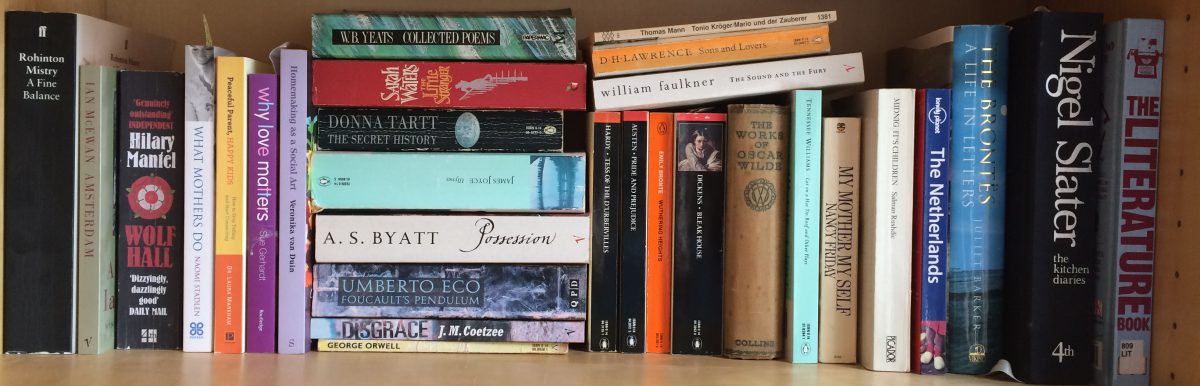
I posted last week with some suggestions for non-fiction books for children for Christmas. Today, I’ve got some fiction ideas for you. Here is my round-up of some of the best books around at the moment, which I recommend for children. I’ve given you an idea of the age range too. As a rule of thumb, the central character in a book is generally a year or two older than the age of the children the book is aimed at. Kids like reading about people who are slightly older than them.
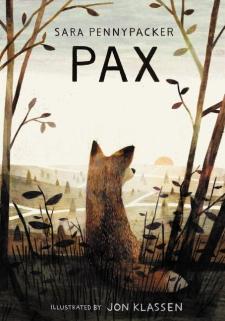
Pax by Sara Pennypacker – suitable for 10-11 year olds
I reviewed this book here a few weeks ago. I loved it. Set in America, it concerns 12 year old Peter and a ‘pet’ fox he has raised from a cub. Peter is forced to release Pax into the wild when his father is called up to serve in the army. Peter’s mother is dead and he is sent to live with his grandfather. He runs away to search for Pax after realising what a terrible mistake he has made, and meets Vola, who lives on an isolated farm. Vola nurses Peter after he breaks his ankle and the two form an unlikely friendship which sets them both on a journey of self-discovery. Some challenging themes, but ultimately a heart-warming tale, with some lovely illustrations.
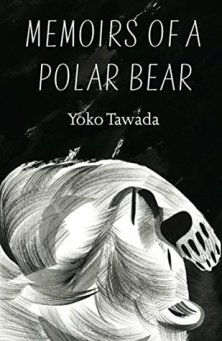
Memoirs of a Polar Bear by Yoko Tawada – suitable for 11-13 year olds
Perfect for pre-teens whose reading tastes and skills are maturing but who still love their animals. Narrated in three parts by three generations of a polar bear family who find themselves in different parts of the world: beginning with the matriarch in the Soviet Union, her daughter Tosca in East Germany, and her grandson, Knut, raised in Leipzig zoo. Very quirky and gently political. It is translated from the original Japanese so will also give children a taste of a quite different style of writing.

Lucky Button by Michael Morpurgo – suitable for 9-12 year olds
I love a book with illustrations and I love Michael Morpurgo. This entry-level Morpurgo is a perfect Christmas offering. It concerns Jonah Trelawney who is the victim of school bullies and a carer for his mother. an accidental encounter gives him a life-changing insight to life in a Foundling Hospital in the 18th century (the original Foundling Museum was the inspiration for the story). Lovers of Jacqueline Wilson’s Hetty Feather will enjoy this.


The Adventures of John Blake: Mystery of the Ghost Ship by Philip Pullman – suitable for 10-13 year olds
Pullman’s The Book of Dust, part of the Lyra trilogy, is possibly the biggest children’s literature event of the year. Fans will already have bought it, so I’m not going to mention it here. Instead, I draw your attention to this graphic novel by the same author, which may encourage more reluctant readers, particularly boys. Just because it has pictures, does not mean it is for younger ones, who may find the storyline complex and the themes quite dark. John Blake is a seafaring time traveller. He rescues a young girl from a shipwreck, but his efforts to return her to her own time place them both in grave danger.
 The Disappearances by Emily Bain Murphy – suitable for 12-14 year olds
This debut has been very well-reviewed. It concerns Aila and her younger brother Miles who are sent to live in the rural town of Sterling, after their enigmatic mother, Juliet dies. The town carries a mysterious affliction: every seven years certain memories, experiences that people share in common, vanish. The locals believe that Aila’s dead mother, is somehow responsible and Aila must bear the brunt of their prejudice and hostility. A long book with some challenging themes which will suit keen readers who like a bit of depth.
 Do You Speak Chocolate? by Cas Lester – suitable for 10-12 year olds
Friendship between girls is explored in this novel, which has been compared to Jacqueline Wilson. It is also a story about how friendship can transcend the bounds of language. Nadima is a new girl at school, recently arrived from Syria, and speaks no English. Jaz is a strong personality, and becomes friends with Nadima after the two share some confectionery. Their relationship does not always go smoothly and this book explores the ups and downs via themes of integration, community, and the things that bring us together.
Do you have any recommendations for children’s fiction this Christmas? I’d love to hear your suggestions.
If you have enjoyed this post, I would love for you to follow my blog and for us to connect on social media. You can do this by clicking on the various buttons on this page.
 The Bastard of Istanbul is a curious book, which my fellow book club members found disappointing. At the heart of the novel is the Kazanci family, living in Istanbul. The household is exclusively female and comprises Asya, (the eponymous ‘Bastard’) her three aunts and her mother (whom she also calls ‘Auntie’), her grandmother and ‘Petite-Ma’ who I think is her great-grandmother (more of that later, it’s part of the problem with the book). There is an uncle, who moved to America as a young man and has never returned. All the men in the family are afflicted by early death. Mustafa, the prodigal son, is in his 30s.
 I was really torn between Claire Tomalin, Anjelica Huston and Alan Cumming. I left it in the hands of the local library and it was Alan Cumming that became available first! I’m still waiting for Claire Tomalin, and that is probably the one I was keenest to read. I was attracted to Alan Cumming’s book, however, because its premise is not dissimilar to the book I am writing, namely family research and the uncovering of a long-held secret. There the similarity ends, however, as Alan’s book is much more about his relationship with his father.
 For November, the challenge is to read a book set in or by a writer from the southern hemisphere – which is, broadly, South America, southern Africa and Australasia. As the nights draw in and it gets increasingly wintry I wanted to be reminded that in other parts of the world it is Summer! So, my choice this month is Isabel Allende’s Portrait in Sepia, a book I picked up in my local Oxfam bookshop and which has been sitting on my ‘to read’ pile for far too long. Allende is such a fine writer and I’ve read a number of her books over the years. It’s great to have an excuse to dive into this one and experience the sensuousness of her writing and the world she evokes, as the last leaves fall from the trees here and nature seems to go into hibernation.
 I read A Clockwork Orange on my husband’s recommendation, straight after he’d completed it – it’s one of his favourite films, which we have watched many times, but neither of us had read the book. It’s quite short, but also quite hard-going as it is narrated by the central character, Alex, who speaks in ‘nadsat’ a kind of teenage vocabulary of the future, based loosely on Slav languages. I read it with a glossary (though Burgess intended that it should not be), but after while I found I did not consult it, and it flowed better just to read it and understand the sense, if not every word.
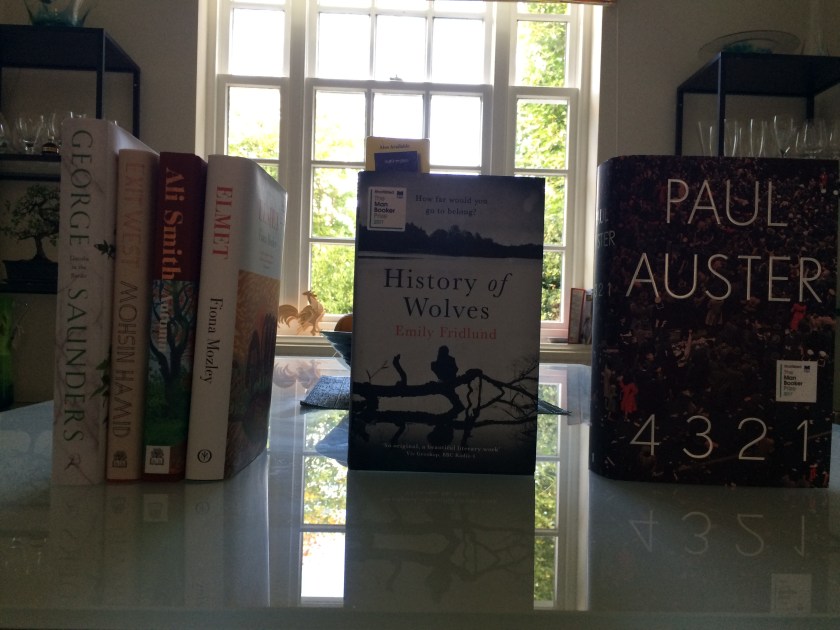
 The narrator and central character is Daniel, who lives with his father (always “Daddy”) and his sister Cathy (a nod to Wuthering Heights, I wonder?) somewhat on the margins of society. Initially, they live with Granny Morley somewhere in the north east, and seem to attend school regularry, though not particularly successfully; it is clear they are ‘different’ and considered outsiders, rather akin to travellers. Cathy and Daniel’s mother has been mostly absent, seemingly a troubled soul with mental health problems and probably addiction, but who then disappears completely, assumed dead. Daddy is a more reliable carer, though he too is frequently absent as he tours the country competing in illegal boxing bouts. He is at the top of his game, however, unvanquished wherever he goes, and seems to make enough of a living from this activity, as well as making plenty of money for those with sufficient funds to gamble heavily on his success.
 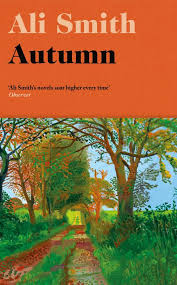 Ali Smith has said that she wrote this book very quickly in the aftermath of the EU referendum in the UK last year. As UK citizens will all understand by now, as we continue to reflect upon/reel over the events of Summer 2016, the outcome of that vote was about so much more than should Britain remain in or leave the European Union. That our social, cultural and political path in this country could be determined by a simple yes or no answer to that question now looks absurd. The election of Donald Trump to the US Presidency in November last year was another cataclysmic event, which provides the context to this novel. Ali Smith has, I believe, outside this book, nailed her political colours fairly firmly to the mast. (I’m not going to do that.) But what we are seeing now, I believe, is the response of artists and writers to the shock of last year’s events, and Autumn is for me, my first foray into a literary reflection.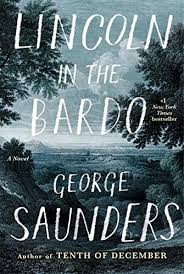
 Eleanor communicates poorly with others, being rather too literal and pedantic for most people to tolerate and is therefore unable to form effective relationships. At first, she is not an easy character to love, except that we as readers know a couple of things about her that her workmates do not, and which make us more sympathetic to her. Firstly, we know she drinks herself into oblivion at the weekends: as a reader we are bound to ask what she is trying to escape from. Second, there is Eleanor’s mother, with whom she speaks every Wednesday evening; “Mummy” is controlling, manipulative, cruel, nasty. Eleanor is an adult and yet there is something disturbing about the way she always refers to her parent as a child would (never ‘Mum’ or ‘my mother’). The fact that Eleanor also receives regular monitoring visits from social workers tells us that there is something dark in Eleanor’s past that has contributed to her present quirkiness, but we are not told what.
 This is Gail Honeyman’s first novel and it is a stunning achievement. A thoroughly enjoyable read. In an era where poor mental health, social isolation and dysfunctional relationships seem to have reached epidemic proportions, this novel is both an examination of one person’s particular circumstances and an antidote. Highly recommended.
 The novel begins more or less where The Glorious Heresies left off with the central character, Ryan Cusack, embroiled ever more deeply in the Cork city underworld of drugs, money laundering and violence. McInerney has managed to keep Ryan’s character consistent – he has evolved in an entirely credible way – although, unlike in the first novel, there now seems almost no hope of the more refined, gentler side of his personality prevailing to choose a different lifestyle. He is more embedded in the criminal fraternity than ever but remains an engaging and attractive central character. If anything, his charisma grows as he matures; true, he does some pretty unpleasant things, and not always at the behest of his criminal masters, but you can see that McInerney, if this turns out to be part of a series of novels, is building him up to be the tormented gangster.
 Julia's books