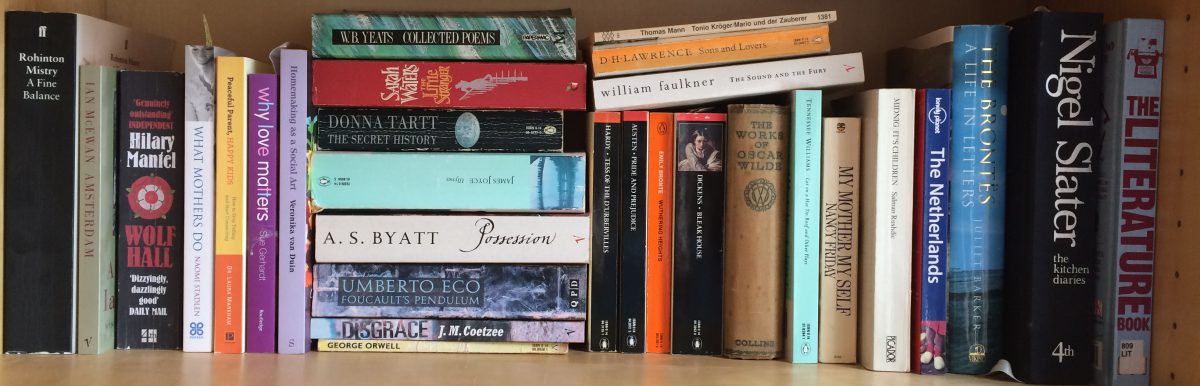
This has been on my TBR list for years – it was a sensation when it was first published in 2001, went on to win the Man Booker Prize in 2002 and was adapted for film in 2012, winning four Academy Awards, including Best Director for Ang Lee (though critical reception of the film was mixed). However, my life at that time was rather dominated by small children – these were what I call my ‘lean years’ of reading, of adult books anyway! I determined to read Life of Pi this summer because my elder daughter thought it was brilliant and has been harassing me to read it for months. I will put my cards on the table straight away – I thought it was extraordinary. The best thing I have read since The Overstory by Richard Powers, which I finished in January.
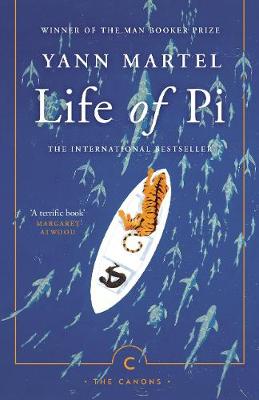 The story is well-known: a young Indian boy, Piscine “Pi” Patel (a name he adopts to get back at the school bullies who taunt him with the nickname ‘Pissing’) grows up in the territory of Pondicherry where his parents own a zoo. The first part of the story gives us a detailed account of the family’s life there, including enormous detail about life for the animals in a zoo setting (I was fascinated by this and it changed my perspective on zoos). We learn in particular about the fierce Bengal tiger, Richard Parker, who is the zoo’s prized possession. I love the use of ‘naming’ in this book – the story of how Richard Parker came to be given this name is brilliant and a sign of the author’s ingenuity and creativity. The other important feature of this part of the novel is that we learn of Pi’s deeply philosophical nature, his decision to adopt three religions (Hinduism, in which he has been brought up, Islam and Christianity), much to his family’s dismay, because he can see benefits in all of them.
Difficult political events in India lead his parents to make a decision to move to Canada, taking their most precious animals with them, in order that they can start a new zoo. Shortly after leaving port, however, the Japanese freighter in which the family is travelling sinks. All souls are lost, except Pi, who escapes in a lifeboat, with, as he will soon discover, four animals – a hyena, a zebra, an orangutan, and Richard Parker, the Bengal tiger. The first part of the journey is gruesome and terrible; the zebra has broken its leg in the fall and is soon brutally and graphically finished off by the ravenous hyena. The hyena then attacks, kills and eats the orangutan. This is not for the squeamish! Pi believes he is going to be next on the hyena’s list until he discovers they are sharing the lifeboat with the tiger, who has been hiding under a tarpaulin for days, suffering with severe seasickness! When he does emerge, the hyena is no match for Richard Parker, who summarily kills him. This undoubtedly saves Pi’s life but it is out of the frying pan and into the fire as he wonders if he will be Richard Parker’s next meal.
What we are treated to next is many months of a precarious symbiotic existence on the lifeboat – boy and tiger trying to survive. It is a quite extraordinary feat that the author can make 227 days on a lifeboat in the middle of the ocean such edge of the seat reading. First we have Pi’s incredible ingenuity, the powerful survival instinct which enables him to stretch the meagre rations in the lifeboat’s emergency pack, and utilise all the supplies available. Second, there is the way he manages Richard Parker to ensure that he, Pi, becomes the alpha animal – he uses all his zoo knowledge, plus his exceptional courage, to teach the tiger submissiveness and this enables them both to survive. Third, there is the incredible storytelling, the highs and lows of shipwreck (at one point they land on a lush island, only to discover that it is dominated by deadly carnivorous plants) plus Pi’s account of his own mental health.
We know that Pi will survive – the novel begins with the author meeting the older Pi in Canada, and Pi promising to tell him his story – but this makes the account no less tense, so close to peril do the pair exist. There is a brilliant twist at the end, which I will not disclose, but it kind of leaves you breathless. Untethered!
I found this a profoundly fascinating book that you can read on so many levels. It is a philosophical tract about the nature of the divine. It is a book about the triumph of the human spirit when faced with adversity. It is a book about the relationship between man and beast. It is also, quite simply, a brilliant yarn about that most traditional of stories, the shipwreck and the survivor.
Absolutely brilliant, loved every second of it, highly recommend it, can’t believe it took me so long to get around to it!
I’d love to hear about a book on your TBR list that you loved once you finally got around to reading it.
If you have enjoyed this post, I would love for you to follow my blog. Let’s also connect on social media.
 The story concerns Romy Hall, a young woman whom we first meet in a prison van en route to Stanville Women’s Correctional Facility, somewhere in California. Romy was convicted of a brutal murder and has been given two life sentences plus six years. Romy worked as a lap dancer at The Mars Room nightclub in San Francisco and it was a former customer at the nightclub that she killed. Romy is at once similar but different to her fellow convicts. For one thing she has a seven year old child, Jackson, whose welfare she becomes increasingly concerned about during her incarceration, and she also completed high school, so she is considerably more educated than many of those around her.
 So much so that I had to have a break from all the heaviness to read something a little more uplifting and which didn’t tax my brain quite so much. I wasn’t very well last week and simply couldn’t face into The Mars Room (next on my Man Booker list) – if you have heard it is bleak, well it is! So far (not quite finished it yet). So, with my blanket, hot water bottle and cups of tea to hand I settled onto the sofa and read Rachel Joyce’s The Music Shop cover to cover in one day. I simply could not put it down.
 This book came to my attention last year. I really liked the sound of it and recommended it in one of my ‘what to look our for this season’ blogs, so it was on my TBR list. Then I saw Rachel speak at a Writers & Artists Conference I was at in September. She was such a wonderful speaker, really warm, authentic and engaging, that I had to get a copy of this book and have been eager to start it. It was a joy and just what I needed, when I was feeling unwell and when my brain was starting to hurt from the Man Booker. Look out for my review of The Music Shop next week.
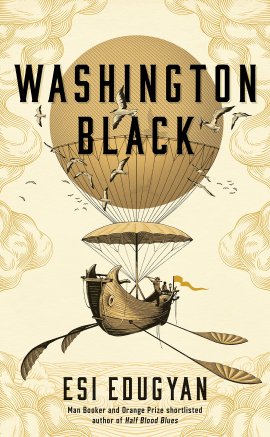 Washington Black’s life is turned around, however, when Erasmus’s younger brother, Christopher, or ‘Titch’, arrives at the plantation. He is an inventor, a man of science like his father, who does not share his brother’s views on slavery. Titch has come to Barbados in order to work on a flying machine he has designed and asks his brother for a helper. Erasmus loans him Washington Black and the boy goes to live in Titch’s quarters, helping him with drawings and experiments as well as practical household tasks. Titch discovers that Washington has considerable artistic talent as well as abilities which will be useful in his science projects and he teaches him to read. This change in Wash’s circumstances means he can probably never go back to being with the other slaves and the question is posed whether Titch has served his protégé well.
 Gretel is a 32 year old woman living alone in Oxford. She works as a lexicographer, a natural career for her as her life has been dominated by words – their invention, their use, and, perhaps also, their lack. She had an unconventional upbringing with an eccentric mother on a canal boat. In her early years, Gretel and her mother developed their own language, a succession of private words for things for which a single expressive term did not exist, for example “sheesh time” refers to a desire to spend time alone, and “Bonak” will come to mean something to be afraid of, something threatening.
 The central character is Walker, a man from rural Nova Scotia, who fought with the Allied forces in the D-Day landings. He has seen and experienced terrible events, death and injury that most of us can barely even imagine, and he survived. After the end of the war, he goes back to the United States and finds himself living among the homeless in New York City. The book is divided into four sections: 1946, 1948, 1951 and 1953 each set in a different US city (though Los Angeles is the setting for both 1948 and 1953). As he reflects on his experiences, it becomes clear that it was impossible for him to return home to Canada. He reminisces about the quiet, gentle life he led there, where the rhythms of the seasons, the dependence on the harvests of the seas, and community events (such as village hall dances) dominate everyone’s existence. It’s as if the contrast between that life and the brutality he witnessed in the war means he fears contaminating the innocence of those he has left behind. He can never go back, never unsee what he has seen, and those he once loved will never be able to understand how he has been changed.
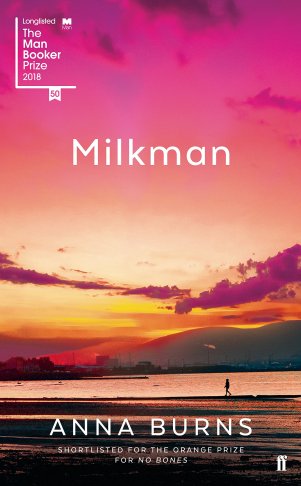 Milkman is set in Belfast during the Troubles in Northern Ireland and the central character and narrator is a young Catholic woman who finds herself drawn unwillingly into a relationship with a local paramilitary leader. It is not clear when the book is set, but I am guessing around the late 1970s, early ‘80s. Northern Ireland is known to be socially conservative, but the general sense of the place of women in society suggests to me that it dates back quite some time. Our central character (not named, I’ll come onto this) is from a large family. Her father is dead and she has several siblings, both older and younger. She is in a “maybe-relationship” with a local young man, who she has been seeing for about a year, though they have not made a commitment to one another. She is keen on running as a hobby and shares this with “third brother-in-law”. Whilst out running one day in a local park she finds that she is observed by a man in a white van. Over subsequent weeks he infiltrates her life by stealth, indicating that he expects her to have a relationship with him. He is known only as “Milkman”. It becomes clear to her that he is quite a powerful local figure in the paramilitary world, so not only does she have little choice about whether to become involved with him or not, it is made quite clear to her that as long as she goes along with him no harm will come to her “Maybe-boyfriend”.
 This shortlist was announced in May and the list was then put up for a public vote. My personal favourite of these was Wolf Hall. In 1983, the celebrate the 25th anniversary of the prize a “Booker of Bookers” contest was set up and three judges chose Salman Rushdie’s Midnight’s Children, which I probably agree with. It was good to see the vote open to the public this time rather than a small group of the literati, and the winner was
  Julia's books