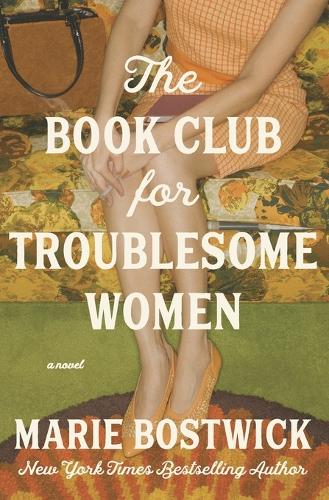
This was a book club pick a couple of months ago and I listened to it on audio whilst doing a lot of travelling back in May. It was a very good accompaniment to rolling scenery from the window of a train and a bus, when my eyes needed a rest and I did not want to think too hard! The author describes it as ‘historical fiction’, and it is, although the 1960s don’t seem that long ago to some of us! Set up in a suburban town close to Washington DC in the United States it tells the story of four women who call themselves ‘the Bettys’, after setting up a book club with the inaugural title being the, at the time, controversial book The Feminine Mystique by Betty Friedan. Funnily enough, my husband was reading The Feminine Mystique at the same time I was listening to this novel. It was highly contentious when it was first published in 1963 and is credited with having triggered second-wave feminism, based on some research Friedan, an academic, had done which found that the majority of American women were dissatisfied with their roles as housewives and mothers, and those who had received a college education felt their talents and knowledge were wasted.
The founder of the book club is Margaret Ryan, a happily married mother of three, who comes up with the idea as a way of bringing new neighbours together. She invites her good friend Viv, a happily married mother of six, and Bitsy, a very young woman married to a vet who is much older than her. Bitsy has no children but the need to become pregnant and her husband’s impatience preoccupy her constantly. The fourth member is the newest neighbour Charlotte, an outgoing, haughty artist, who makes it plain that she is a fish out of water on the neat housing estate and that it was not her idea to move there. Charlotte has two teenaged children and a largely absent husband.
Over time, the reading of The Feminine Mystique, forces the women to ask themselves whether they are happy and fulfilled, an uncomfortable question for some of them. They explore employment opportunities (which they find are limited) and find that their husbands are not all entirely supportive of the changes the women are seeking. Some of the men are clearly threatened by the change to the status quo.
The women meet regularly and begin to form close bonds, despite the obvious differences between them. As each one encounters personal challenges, such as Margaret’s struggles to find a publisher for her writing, Charlotte’s marital difficulties, Viv’s unplanned pregnancy (she was unable to get a prescription for contraceptives without her husband being present) and Bitsy’s failure to fall pregnant at all, they find their little club grows into something much more meaningful and supportive.
The women are on a journey, as are their partners, trying to break through the barriers that the prevailing social norms have placed in the way of their often very modest ambitions, and as they grow in self-confidence, thanks to the support of the group, they find themselves fighting to bring down those barriers, with varying consequences and degrees of success.
It is hard to credit that some of the barriers facing women outlined in this novel were in place only a couple of generations ago. It is also a reminder that in some parts of the world, freedoms and equality are still denied to many women, either by law or by culture. The job is not yet complete and this book is a powerful reminder.
Very enjoyable and recommended reading. I listened to it on audio and found the reader Lisa Flanagan to be very good.

