Three days after Hallowe’en and I still haven’t quite finished last month’s book!
The beginning of each new month seems to come around ever more quickly, and I can’t believe that I’m on the second last book of this year’s reading challenge. I’ve been reading my way through the Booker Prize shortlist these last few weeks so I am still not quite finished with October’s book, Michelle Paver’s Dark Matter. It’s a quick read so I am looking forward to its conclusion in the coming days. Look out for my review next week.
This month’s theme is going to be interesting – classic erotic fiction! There are some great titles to choose from, much of it a century or two old, surprisingly enough. There are some French options, of course, but the book I have chosen is Erica Jong’s Fear of Flying. Its central character and narrator is poet Isadora Wing who accompanies her academic husband on a trip to Europe where she decides to act out her sexual fantasies in encounters with other men.
Published in 1973, the novel was highly controversial and caused a storm. It is also credited with setting off the second wave of feminism. The book has sold over 20 million copies worldwide and I believe we have a copy in the house on a shelf somewhere. I did not buy it so I think it must have been my husband’s – that should provide for some interesting conversations!
Fear of Flying was Erica Jong’s first novel, published when she was 29 years old
At the time I wrote Fear of Flying there was not a book that said women are romantic, women are sexual, women are intellectual and that brought all those parts together.
Erica Jong, 2011
So, I am hoping this one will be a page-turner after all the highbrow Booker shortlist reading. I’ll let you know in about four weeks time!
My final review from this year’s Booker shortlist, and just getting in under the wire, since the winner is to be announced at 7.15 this evening in a live broadcast from the BBC Radio Theatre. You can listen on Radio 4’s Front Row programme, This is the first time, in the four or five years that I have been setting myself this challenge, that I have managed to read all six books in the six or so weeks between the publication of the shortlist and the announcement of the winner. I have really only managed it by being able to listen to some of the books (four of them) on audio while I was out walking or running and, in recent days, while cooking, shopping or drying my hair!
I hope that my appreciation of the last couple of books I read has not been compromised by my having read them quickly. I particularly regret this in relation to this last book that I tackled A Passage North by Anuk Arudpragasam. It is by far the most meandering, langorous and philosophical of the six books and I would rather have read it at just such a pace than at speed. The author is a young Sri Lankan Tamil who recently completed his PhD in philosophy at Columbia University in the US. This is his second novel. His first, The Story of a Brief Marriage, was published in 2016 and widely acclaimed. Both novels draw heavily on Arudpragasam’s background and his home country’s troubles during and after its three decades-long civil war.
Sri Lankan Tamil author Anuk Ardpragasam’s has a philosophy PhD and A Passage North is his second novel
A Passage North takes place some time after the end of the civil war, which concluded in 2009 when government forces finally defeated the insurgents (known as the ‘Tamil Tigers’) who had fought to establish an independent Tamil state in the north of the country. The UN estimated that as many as 100,000 deaths may be attributable to the war, including about 40,000 civilians, and the Sri Lankan Government has often been accused of war crimes. The civil war pervades every aspect of this novel.
The central character of the novel is Krishan, a young man who works for a non-governmental organisation in Colombo, the nation’s capital. He lives with his mother and grandmother, both of whom are widowed. His father was killed in an explosion during the war. The novel opens with the death of Rani, his grandmother Appamma’s private carer. She was engaged by the family when Appamma’s health deteriorated, and Krishan and his mother needed help with caring duties due to their work commitments. It is Rani’s daughter who comes to the house to inform them of Rani’s death; she had been discovered in a well, her neck broken, and it is assumed that a tragic accident has occurred and that she fell in. We soon learn, however, that Rani a refugee from the north, had lost both her sons in the war and suffers from depression and anxiety.
This is a novel about relationships conducted in the context of the aftermath of a civil war. Krishan has known nothing but war in his life and yet, as a resident of Colombo, he has not been as directly affected as others. Life, its meaning, the impact on society and on individual citizens of protracted conflict and wartime atrocities are explored by young Krishan. He is on various journeys in this novel, whether it is an evening walk through the city or a train journey to the north to attend Rani’s cremation and during these travels he contemplates his relationships. All are considered in the context of whether the person is more or less affected by the war. For example, he considers at length, his relationship with his girlfriend Anjum, a young Indian woman who works as a political activist. But her distance from the Sri Lankan civil war makes him feel distant from her. When he considers what Rani has gone through, he seems to feel that he can never fully connect with Anjum because they lack an essential experience in common. There is so much suffering, whether it is Rani’s or his grandmother’s whose health is declining rapidly, that he cannot take seriously what he sees as Anjum’s more trivial preoccupations.
This is a powerful novel that deserves a slower and more considered reading than I have given it. It has been described as ‘Proustian’, with its long meandering passages. It is beautifully written and the audiobook was wonderfully read by Neil Shah.
So, who is going to win the Booker?
Who will win in 2021?
Last year, I read four of the six novels on the shortlist before the winner was announced. Of those, the standout book for me was Shuggie Bain by Douglas Stuart, so I was delighted when it won. Having read all six books on the shortlist this year, the one that I have most enjoyed has been Great Circle by Maggie Shipstead and I also think this is the standout work. Its scale, its scope, its concept, characters and the quality of the writing are superb. It simply has everything you want from a book, including a cracking story. This was also the case with Shuggie Bain, which is why I wonder whether the Booker judges will, for the second year running, award the prize to such a novel. A case could be made for all the nominees actually, but I will stick my neck out and say that if it’s not Great Circle I think it will be The Promise. Like A Passage North it explores the impact of national trauma through the lens of individual crises. I loved all the books this year, any one of them would be a worthy winner.
This is my penultimate review of this year’s Booker Prize shortlist, just one more to go before the winner is announced tomorrow night. Nadifa Mohamed is a Somali-British novelist and The Fortune Men is her third novel. She lectures in creative writing at Royal Holloway College, University of London (my very own alma mater!) and attended the University of Oxford. She was born in Hargeisa in what was then Somaliland, but moved to the UK with her parents when she was a child. She is the only British author on the shortlist.
The rest of this review contains spoilers.
The Fortune Men is a fictionalised account of a true story about the last man to be hanged in Cardiff in 1952. Mahmood Mattan was a Somali merchant seaman who came to Britain to escape poverty in his homeland and settled in Tiger Bay, Cardiff. There was already a significant immigrant population in the area, including other Somalis, but they still faced discrimination and racial abuse. For Mattan this was made worse by the fact that he married a local woman, Laura Williams, and they had three sons.
Lily Volpert was a middle-aged shopkeeper in the town. She and her sister were themselves immigrants, Jews who escaped the growing Nazi threat in mainland Europe, and they too experienced discrimination and abuse. The picture painted in this book is of a town divided, disparate communities existing alongside one another, but with violence and antipathy always beneath the surface, and often above it.
When Lily is murdered one March evening in her shop, her throat brutally slashed while her sister and niece prepared dinner in the adjoining apartment, the police immediately start looking for a black man; Lily’s young niece reported seeing a dark man in the shop doorway around the same time. The evidence upon which Mahmood is arrested and charged is flimsy and entirely circumstantial, so much so that he assumes it will be only a matter of time before he is released. To him, the arrest seems ridiculous and he is both affronted and angry. Mahmood’s pride does not help him; it seems only to further raise the heckles of the local detectives whose only interest is in securing a speedy conviction.
We learn a lot about Mahmood’s background in Somaliland, his family, his faith and his upbringing. We also learn a lot about Lily, the murder victim, and her family. Both are victims of a racist society and a corrupted justice system. The novel makes it clear that neither the victim, the accused or the community are served by the police or the courts in this case. The chapter covering the trial is interesting. It is written as if from court records and the plain reported proceedings expose the sham nature of trial. These scenes are heartbreaking and made me feel ashamed.
A newspaper cutting from the time of the events of the novel
Mahmood and Laura were living apart at the time of the events in the novel; Mahmood lived a shady life as a gambler and petty thief and there were clearly tensions in their relationship. But the love between them and for their children comes across clearly, particularly when Mahmood is being held in prison. Ultimately, Mahmood’s defence could have been strengthened by an alibi had he not chosen to protect Laura from an uncomfortable truth. In real life, Laura fought for decades to clear her husband’s name and his conviction was finally quashed by the Court of Appeal in 1998 in the first case to be referred to it by the newly-formed Criminal Review Cases Commission.
This is a story that needed to be told, and Nadifa Mohamed has done the job powerfully and sensitively in The Fortune Men. I listened to this one on audio and it was beautifully read by Hugh Quarshie.
This is my third Booker review of this year. The winner will be announced this coming Wednesday. At this point I have completed four novels, almost finished the fifth and have yet to start my final one, although, at this point, I am pretty hopeful that I will succeed in my goal of completing and reviewing all six before the winner is announced. That will be a first and I am particularly pleased with that since my house in in chaos, due to a long-awaited kitchen refurbishment, my day job has been super-busy and there has been a lot of family stuff going on these last few weeks.
I was really looking forward to reading Bewilderment; Powers’s 2018 novel The Overstory, which was also shortlisted for the Booker that year, remains one of the most powerful books I have ever read and is particularly apt for our times as the Cop26 negotiations get underway in Glasgow today. The Overstory did not win in 2018, Anna Burns’s Milkman did. That was also a brilliant book, although for me Powers had the slight edge. I don’t envy the Booker judges!
The stunning cover of Bewilderment
The reviews of Bewilderment have not been quite as strong. It is indeed a very different book, but it bears the author’s characteristic attention to detail, and a quite breathtaking amount of research.
Theo Byrne is an astro-physicist whose life’s work is to try and uncover the secrets of the universe. His research has furthered knowledge on the stars and planets with whom we share this universe and he is pursuing the biggest question of all – is there other life out there? And yet, he struggles to understand his nine year-old son Robin. Theo’s partner Alyssa, Robin’s mother and an activist advocating for the rights of animals, is killed in a car accident and their lives are thrown into turmoil. Robin, neuro-divergent, it is intimated, struggles at school, both with the constraints of the routine and getting on with other kids. After he fractures another child’s nose when the boy repeats a disparaging remark about his dead mother, Robin is threatened with exclusion from school. Theo comes under significant pressure to medicate his son, which he refuses to do. Instead he takes the decision to home-school him, but this presents numerous other challenges, not least with managing his own work.
Before they had Robin, Theo and Alyssa were involved in some highly experimental research by an esteemed neuro-scientist and former lover of Alyssa’s, Marty Currier. He is trying to map the brain patterns associated with certain emotional responses in the hope that in the future, others might be able to learn to manage their behaviour through a treatment which would involve their brain ‘learning’ from the better response patterns of others. Theo and Alyssa agree to be early guinea pigs. When Theo approaches Marty for help with his son, Marty suggests putting Robin through the treatment where his brain will learn how to mimic his mother’s responses to events. Although she is dead, Alyssa is a powerful presence throughout the book. Theo places her on a pedestal and is constantly reaching for her as he grapples with what to do about Robin, believing she was the only one who could truly understand him and was therefore able to support him.
They share a lot, astronomy and childhood. Both are voyages across huge distances. Both search for facts beyond their grasp. Both theorize wildly and let possibilities multiply without limits. Both are humbled every few weeks. Both operate out of ignorance. Both are mystified by time. Both are forever starting out.
“Bewilderment”, by Richard Powers
Theo finds his own ways of parenting his son and the relationship the two of them develop in the absence of Alyssa, the new way of being that they must find for themselves, is delicately and beautifully handled by Powers. Theo is able to share his fascination with the universe with his son, but also learns from his attention to detail, his fascination with the minutiae of nature, that Robin has inherited from his mother. The degree of knowledge and understanding of these disciplines (astrophysics and natural history) that Powers brings to the story is astonishing, as it was in The Overstory.
Powers won the Pulitzer Prize for The Overstory. Can Bewilderment bag him the Booker?
This is a powerful story with two highly contrasting themes – the devastating human impact on the natural world, and the struggle to parent in the face of tragedy and adversity, especially in a world that seems so hostile to anything outside the norm. It has a huge canvas (the universe), but also intimate detail (a father-son relationship).
I did not find the book as gripping The Overstory, but frankly, it would be unjust to compare anything to that book, in my view. Some parts of it I struggled with, the long passages on the universe, for example, I found the least engaging. But the characters are well-drawn and I felt close to both Theo and Robin, pulled into their small world.
Highly recommended, but a tough read at times.
The river of forms is long. And among the billions of solutions it has so far unfolded, humans and cows are close cousins. It wasn’t surprising that something on the fringe of life – a strand of RNA that codes for only twelve proteins – was happy, after one small tweak, to give another host a try.
A devastating disease amongst livestock threatens to jump the species barrier in “Bewilderment”.
This was the September choice for my Facebook Reading Challenge, the theme of which was a YA novel. I had not heard of either the author or the book despite the fact it has become an international best-seller since its publication in 2012. It’s always nice to discover an author for the first time and I am certainly glad I read this. It is a heartwarming story and covers some very interesting topics.
THIS REVIEW CONTAINS SPOILERS
I don’t usually have spoilers in my reviews, but when I review children’s or YA books, I do include them as I am assuming that any adult readers of this blog who might want to get hold of the book for a child they know, will also want to know what’s in it. So, you are hereby warned – there be spoilers!
Dante Quintana and Aristotle (Ari) Mendoza are two Mexican-American teenage boys who meet at a swimming pool where they live in El Paso, Texas. Ari cannot swim so Dante offers to teach him. The two are very different characters: Dante is the only child of academic parents. He is bright, quirky, bookish and artistic. Ari is the fourth and youngest child of somewhat more troubled parents. Ari has an older brother whom he has not seen since he was four years old because he is in prison, for reasons he does not know and which his family never discusses. Also, Ari’s father is a Vietnam veteran, a closed man, unable to talk about his war experiences. The novel is set in the 1980s.
And thus begins my annual attempt to read my way through the Booker Prize shortlist before the winner is announced. Customarily, the shortlist is announced in mid-September and the winner announced at the beginning of November, giving about six weeks to read six novels. I have never yet managed all six. I think the closest I have come is about four. I am optimistic this year as I have a strategy – a mixture of audiobook, e-reader and actual book – and a plan. So far I have completed one (the shortest), am part-way through another (the longest) and I am the proud owner of a signed copy of a third. With just over four weeks to go I am, if not optimistic, then at least hopeful. I expect kitchen renovations at the end of the month to disrupt all my plans!
The first book I am ticking off the list is Patricia Lockwood’s No One Is Talking About This, which has become one of the most talked about books of the year since it was first published in February. This is Lockwood’s first novel; she is better known as a poet and published a memoir in 2017 entitled Priestdaddy which was highly acclaimed. No One Is Talking About This has been compared variously to William Faulkner’s The Sound and the Fury, Virginia Woolf’s To The Lighthouse, and James Joyce’s Ulysses. I count all three of those among my all-time favourite reads so I should have loved this book.
It is a really difficult book to describe (for me, that’s where the comparison with Ulysses ends). I should also add, by way of a caveat, that I listened to this on audio and may well have been affected by the slightly manic reading of it. It is narrated in the first person by an unnamed character who has an unnamed family but who lives, we can assume, in New York City. The first half of the book is pure stream of consciousness, a portrayal of the wildness of modern life, particularly those parts conducted through ‘the portal’, which is pretty much everything. We see the ridiculousness of life lived out online, where only appearances matter, where substance and empathy and humanity appear to have vanished. Where photographing and documenting your food is more important than eating it. Where how your relationships look is more important than the relationships themselves. I think most of us can recognise this as the way we might all actually be heading if we are not careful. If indeed, we are not already there.
The second half of the book, described by the author herself as ‘autofictional’ centres around a devastating family event. The narrator’s sister becomes pregnant and the journey is duly recorded on the portal, until a scan reveals an irregularity in the baby’s head measurement. The pregnancy and the baby are no longer as photogenic or fit for the portal, but the event will have a seismic impact on the family and on our narrator in particular. She is completely unprepared for the immense love she feels for the severely disabled baby girl her sister delivers, a child whose life expectancy is limited and whose quality of life would usually be described as poor. And yet, the baby, with her rudimentary abilities, her dependency on her loved ones and her complete helplessness, draws out the humanity in those around her, that, because of the evils of the portal, they had forgotten they had.
This second half of the book is based on an event in Lockwood’s own family – her sister gave birth to a child with Proteus syndrome – and knowing there is truth in it, makes it a powerful read indeed. For me, it is not Ulysses, and Lockwood is not yet Woolf or Faulkner. I wasn’t awed or stunned by the book, but it is innovative. Her instincts as a poet serve her well. It reminded me a little of the 2018-shortlisted book Ducks, Newburyport by Lucy Ellman, which I have recently finished. I have to say I found that book better, but Lockwood has a good chance of winning with this novel.
So, recommended. I’m looking forward to what the rest of the shortlist has to offer.
It’s that time of the month again (where exactly did September go?) when I choose a new book for my reading challenge. Last month the theme was a YA novel and the title I selected was a challenge in itself just to say! Aristotle and Dante Discover the Secrets of the Universe by Benjamin Alire Saenz has become an international best-seller and won multiple awards since its publication in 2013. A follow-up – Aristotle and Dante Dive into the Waters of the World – is due for publication later this month. Look out for my review next week.
For this month, the theme is a ghost story. This is a genre I have eschewed over the years, although two such novels I have loved have included The Little Stranger by Sarah Waters and Beloved by Toni Morrison. There are many, what you might call, psychological ghost stories I could have chosen, such as The Shining by Stephen King, which I was tempted by since I have never got around to reading anything by this author. It would also give me a reason to watch the film again which I saw many years ago when I first met my husband as it’s one of his favourites. I was also tempted by Susan Hill’s The Woman in Black a classic English ghost story if ever there was one, and its adaptation for stage is the second-longest running (non-musical) theatre show in London’s West End (after The Mousetrap). Incredibly, it has been in production since 1989.
In the end, however, I have gone for Dark Matter: A Ghost Story by Michelle Paver, an author I know almost nothing about, but whose name seems to keep cropping up in my world. It must be a sign! This novel was published in 2010 and its setting is an Arctic expedition.
Autumn seems like a good month to curl up with this particular type of book as the nights begin noticeably to draw in and there are mists in the mornings. October is also the month of All Hallows Eve, of course, which in many cultures is a time for remembering the dead. I always disliked this particular festival when my children were young because of the preponderance of things I hated – plastic, synthetics and sweets! – which inevitably are designed to attract children. The supermarkets are beginning to fill with garish costumes and even more garish food products, but perhaps reading this book will give me a different appreciation of this ancient festival.
Image by Pexels from Pixabay
I would love for you to join me in the reading challenge this month.
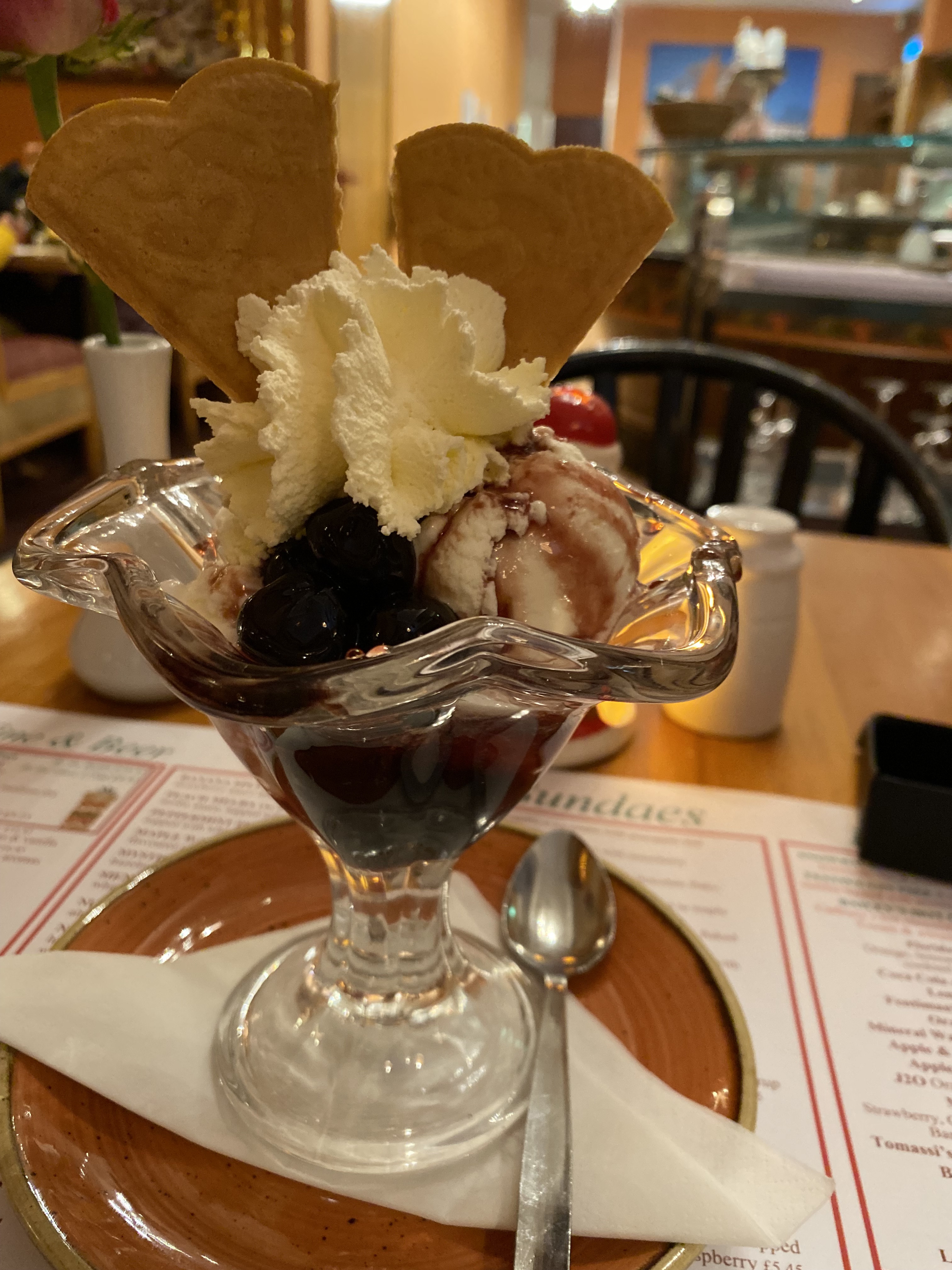
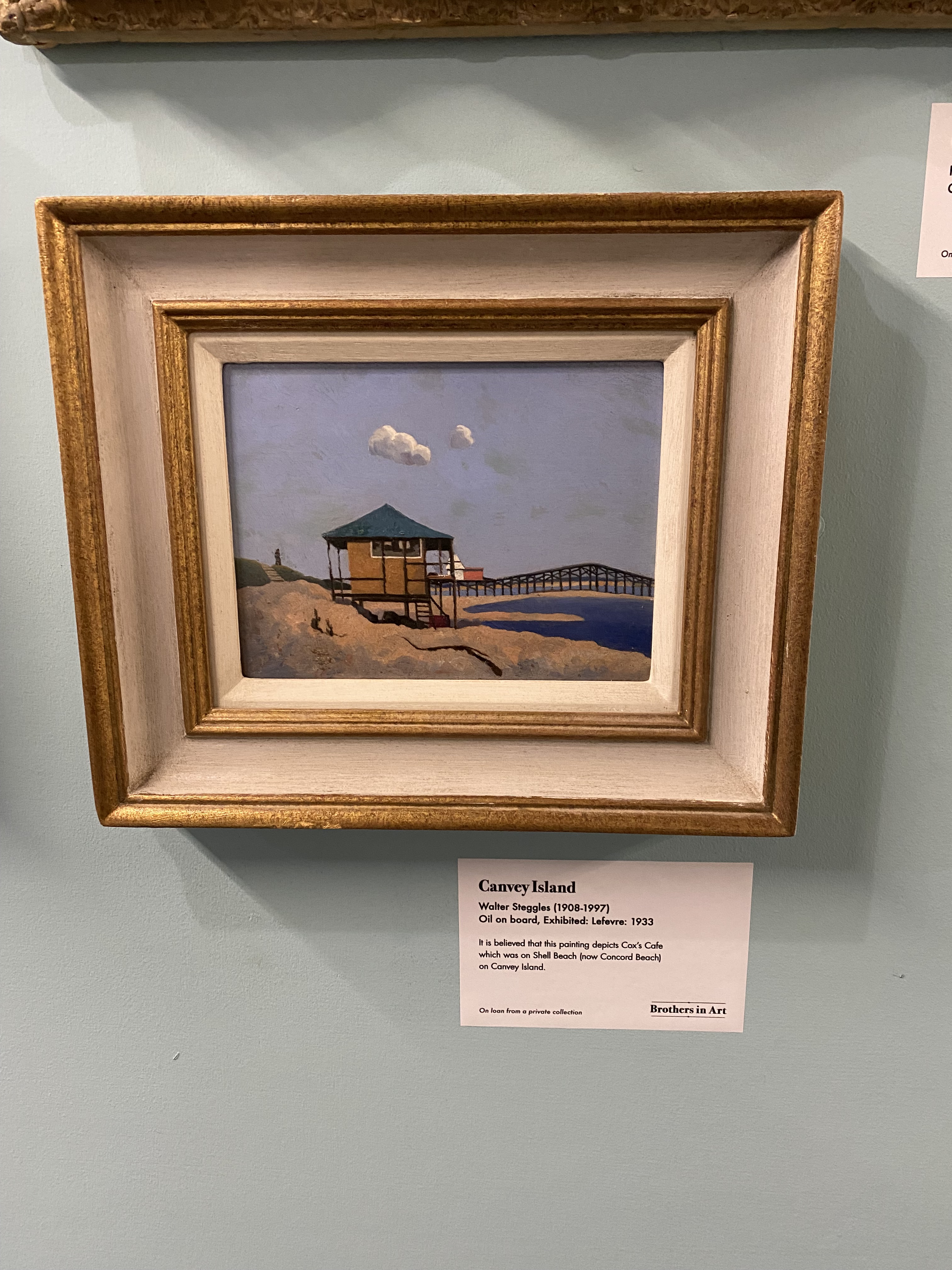
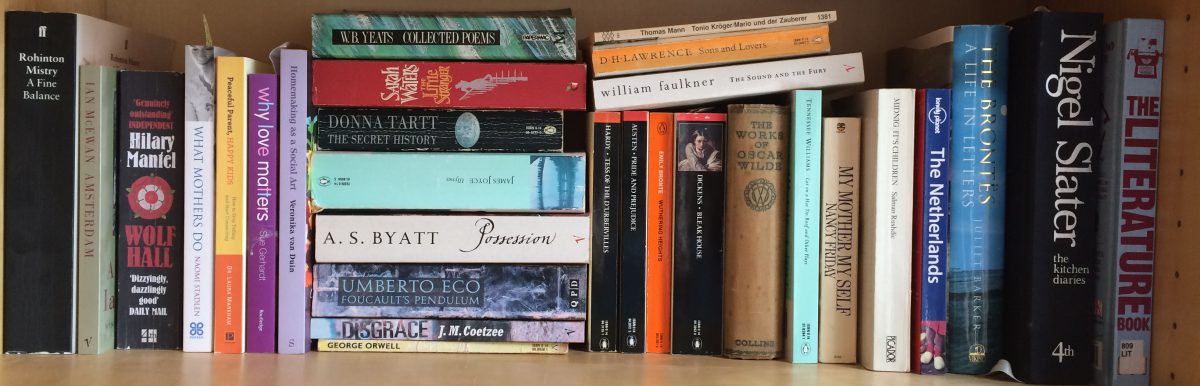
This is a new monthly post where I aim to do very little writing (!!!) and tap into some visual creativity (which I always feel I don’t really have). So, this was September for me, in a few pictures and very few words.
Books I read (and may still be reading)
Found a very beautiful world at the Museum of the Home in Shoreditch
One of my favourite places in Manchester – the WhitworthSheltering under a tree during a sudden shower, while the sun still shone
A couple of weeks ago I posted about a work trip to London. I’d bought a copy of the very newly minted Sally Rooney novel Beautiful World, Where Are You which had been published earlier that week amid great excitement (there were queues and bookshops were opened at midnight to enable the keenest readers to get their hands on a copy). Whilst in London I also happened to stumble on a ‘pop-up’ in Shoreditch selling not only the novel, but other books to which there are references in the novel, and some merchandise echoing the design of the book’s cover. This book has surely been the most anticipated of the year, and who can blame the publishers, but it has definitely become a ‘product’. As has the author I suspect. I hope she is okay.
I sort of hoped I might devour the novel on the return train trip to London, but I didn’t and in fact it took me a further week or so to finish it. Rooney’s previous novel, Normal People, was a sensation, not least because of the success of the television series, one suspects, which was brilliantly put together with brilliant performances from the two wonderful new young Irish actors playing the lead parts. It was all a moment of pure serendipity and it was a joy that something so good got the attention it deserved.
Rooney’s follow-up novel therefore was always going to be a challenge and I admire her for just getting the thing out under what must have been intense pressure. It is unmistakeably Rooney – the beautiful prose, the masterful dialogue, the introspective characters, Dublin, the palpable tensions between the characters and the things unsaid. There are four characters: Alice, a successful, famous and thus fairly wealthy author (hmm) who has recently had a nervous breakdown and whom we meet when she is renting a seaside house in the country. Felix, her lover, whom she meets on Tinder, a warehouse worker and cash-strapped under-achiever. Eileen, who lives in Dublin and is Alice’s best friend from childhood. Eileen works for a publishing company in a junior role which pays poorly. She is intellectually and emotionally unfulfilled, and bitter at the hand life has dealt her. Simon is Alice and Eileen’s friend, also from their youth, but a little older, a political researcher he lives in Dublin too. He is single, but seems to have a series of much younger girlfriends, handsome, gentle and compassionate, with a strong Catholic faith.
Much of the novel is an exchange of long and detailed communications between Alice and Eileen. They are more like letters, the kind that middle class people of previous centuries might have exchanged, full of lengthy discourse on the meaning of life, love, sex, career, fame and mental health, cleverly punctuated with much more prosaic gossipy tidbits on their love lives. These of course are emails, though, not letters. In between the letters chapters we follow the various events of the characters’ lives, primarily Eileen’s gradual descent into personal crisis and her relationship with Simon, and Alice’s recovery and unlikely relationship with Felix.
It is some way into the book before the characters collide, when Simon travels with Eileen to visit Alice at her rural retreat. The weekend is a kind of catharsis for them all. Everything must break before it can be reassembled in a meaningful way.
If you are expecting a re-run of Normal People you will get some of the same things – a good deal of sex, middle-class angst and working-class insecurity, and a grown-up exploration of Irish identity in the 21st century. But it is a very different book. There are surely some autobiographical elements. It has a lot less pace and it seems a long time before anything significant happens. This novel is a much slower burn. I liked it but I didn’t love it. I did not care as much about any of the characters as I did about Marianne and Connell. I think it is the book Sally Rooney needed to write though, good enough to follow Normal People but perhaps not quite as good, so that, one hopes, some of the hype around her dissipates and she can get on with being a brilliant author and not have to worry about being a celebrity.
I think it will always be worth reading what Sally Rooney writes, so I have no hesitation in recommending this book.
As I write this, the sun is setting for the day and the moon (a waning one now, since it was also a full one just two days ago) will soon be visible. We are at the precise mid-point between the summer and winter solstices when the sun is positioned directly above the equator, giving equal time to darkness and light. In the northern hemisphere, our nights will now start to grow longer, while in the southern hemisphere it is the day that is lengthening as the spring turns into summer.
Not the view from my window! Rather, beautiful photography from Ingo Jakubke on Pixabay
It is an important time of the year in the literary world too; as we begin to spend more time on home-based pursuits we inevitably read more. The shortlist for the Booker Prize was announced last week and a number of literary festivals traditionally take place in the autumn – I am looking forward to the Manchester Literary Festival in October. And like it or not, some of us will be starting to think about Christmas shopping and publishers are competing to attract our attention in the hope that one of their new releases will make it into your shopping basket as the perfect gift. So, it’s a bumper time of year for new books to be published. I posted on here last week about the furore surrounding the publication of Sally Rooney’s Beautiful World Where Are You? It is surely one of the most hotly anticipated books of the year.
But the noise surrounding that book has obscured somewhat the many other big publications of the season. Here are some of those that have caught my eye and which I very much hope to add to my TBR list over the coming weeks.
Bewilderment by Richard Powers
Powers maintains his Booker-nominated streak with his new novel. The Overstory was shortlisted in 2018 and remains one of the best books I have read in recent years. Bewilderment is a good deal shorter but continues with similar themes of the environmental damage wrought by humanity. The main characters are a widowed father and his troubled 9 year-old son seeking connection in the face of global, national and personal tragedy. I can’t wait to read this.
Cloud Cuckoo Land by Anthony Doerr
Another author whose last work was one of my absolute favourites of recent years (All the Light We Cannot See, 2015). Doerr’s latest novel is a complex interweaving of five characters and three parallel storylines set in the past (the 15th century siege of Constantinople), the present (during an attack on a public library in Idaho) and the future (a community under threat). They might all be separated by centuries, but the author explores the things that connect them.
The Inseparables by Simone de Beauvoir
Lost for 75 years, this novel was not published in de Beauvoir’s lifetime as its themes were not considered appropriate. It concerns the friendship between two young girls and how it unravels as they grow up. It is based on a friendship de Beauvoir herself had. The novel’s discovery has caused a frenzy and you can read an extract from The Guardianhere.
The Magician by Colm Toibin
I am always wishing I’d read more Toibin, but I never seem to manage it and have only read Brooklyn (after I’d seen the film!). So, I’m determined to read this one as its subject is the great German author Thomas Mann, a favourite from my German A level days.
Four Thousand Weeks by Oliver Burkeman
I watched a discussion between Burkeman and Guardian journalist Zoe Williams a couple of weeks ago about this book. I have enjoyed Burkeman’s columns in The Guardian’s Weekend magazine for some years and like his take on life. This is not a traditional book about producitivity, apparently, despite what the title might suggest, it sounds more like an ‘anti-producitivity’ book, encouraging the reader to focus on what is really meaningful in life.
Pax, Journey Home by Sara Pennypacker
I make it my business to read plenty of children’s literature. It helps me reconnect with the sheer joy of reading that I felt as a child. I loved Pax, Pennypacker’s first novel, and this is a follow-up. I am keen to find out what happened to the young fox and his human companion Peter.
And yet more…
There are a number of other books out which readers might like to note: The Man Who Died Twice by Richard Osman is the second in his Thursday Murder Club series, and looks to be an equally big success. Apples Never Fall by Liane Moriarty is out – will it continue her run of best sellers, following Big Little Lies and Nine Perfect Strangers? I expect so! And in a similar vein, Paula Hawkins’s A Slow Fire Burning looks set to bring the author more success. I probably would not pick up this kind of novel, but I loved The Girl on the Train so I might give it a go. Michaela Coel is everywhere at the moment, deservedly so after the phenomenal success of her television series I May Destroy You. She is an incredible role model and continues to campaign on the issues the series raised. She has now written Misfits: A pesonal manifesto which promises to be a powerful read. Finally, Pat Barker’s The Women of Troy, the follow-up to her 2019 success The Silence of the Girls. I found that book difficult to get into, but it was critically acclaimed and shortlisted for The Women’s Prize.
So, plenty to get my teeth into there. Not sure how many of these I’ll actually manage, given that my present TBR pile is toppling, but I am ever the optimist!
What are you reading this autumn? Do enjoy this beautiful time of the year, before the winter kicks in.