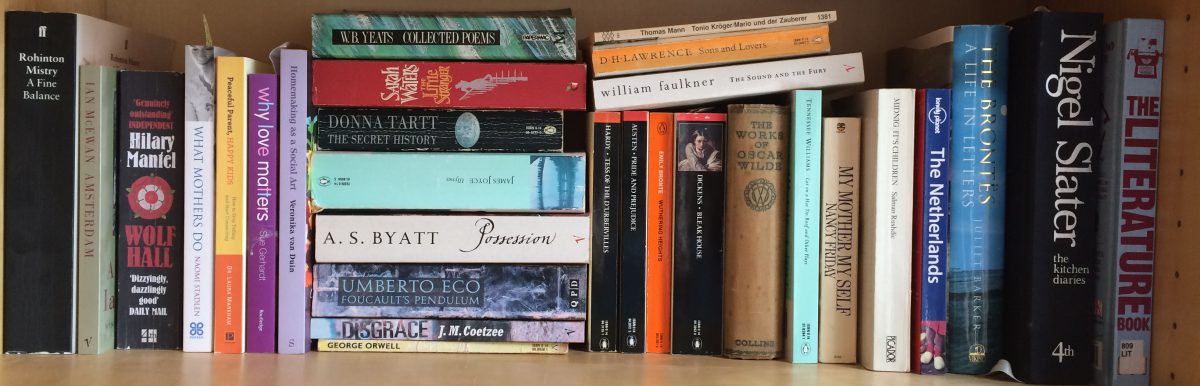

A book is a great gift to give at Christmas – long-lasting, can be personalised, relatively inexpensive, easy to wrap, and wil always look as if you’ve thought hard about it, even when you haven’t! And if the worst comes to the worst it’s recyclable and re-giftable! I’ve posted recently about books for children, both fiction and non-fiction, but what about the grown-ups? Below, I’ve listed my stand-out reads of the year, any one of which would make a fantastic gift. Click on the title of each book to see my longer reviews.
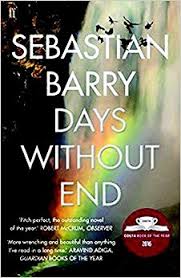 Days Without End by Sebastian Barry
Would suit men or women of any age who just love a great story, brilliantly told. It’s about two young men, mercenaries in the American Civil War, one of whom is an Irish immigrant, who find love amidst the horror, carnage, poverty and degradation. It’s graphic and hard-hitting but also tender and moving. Shouldda won the Man Booker IMHO.
 Elmet by Fiona Mozley
For lovers of Yorkshire who like their fiction a bit dark. Shortlisted for the Man Booker but sadly did not win. Daniel lives with his father, a bare-knuckle fighter, and his sister Cathy in an isolated rural home they built themselves, life takes a very dramatic turn when they are threatened by the local landowner who bears a grudge against the family.
 Eleanor Oliphant is Completely Fine by Gail Honeyman
For anyone interested in mental health issues. A fine first novel, which has rightly won many plaudits. Eleanor is our narrator, an unusual and vulnerable young woman who struggles to find her place in the world and conform to social norms. At times funny, at others heart-breaking, it’s a cracking read.
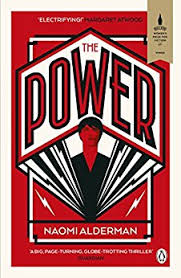 The Power by Naomi Alderman
A great book for strong women who would like to turn the gender tables! Winner of this years Bailey’s Women’s Prize for Fiction, it’s a brilliant satire on what it might be like if women ran the world. In this powerful commentary on gender politics, the world’s women find they have a physical ability to injure, kill and therefore control men with an electrical charge. Imaginative and original.
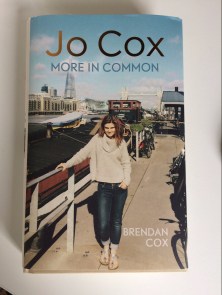 Jo Cox: More in Common by Brendan Cox
For campaigners and humanitarians. Written by the widower of the late Jo Cox MP, brutally murdered in her Yorkshire constituency by a Far Right Extremist, this account of the woman and her values, not only gives an insight into the life of this extraordinary politician, but is also a reminder of what it is to be human.
 Stay With Me by Ayobami Adebayo
For anyone fascinated by the tussle between modernity and tradition or for lovers of Africa. Set in Nigeria in the 1980s, this novel is a story about Yejide and Akin, an infertile couple and the pressures that places on their relationship. Moving and brilliantly plotted.
 The Essex Serpent by Sarah Perry
For natives of Essex or London or those who like a grown-up mystery story. Newly-widowed Cora Seaborne moves to a small Essex village with her autistic son, and strikes up a deep friendship with the local vicar, Will Ransome, over a mutual fascination with archaeology and in particular a local legend about a serpent who blights the lives of the inhabitants. It explores the conflict between science and religion, reason and superstition at the end of the 19th century, and the nature of love in all its forms.
I’ve just realised that all of these books explore the many types of love. Perfect for this season!
If you have enjoyed this post, please subscribe to my blog by clicking on the ‘Follow’ button and follow me on social media.


 The Disappearances by Emily Bain Murphy – suitable for 12-14 year olds
 Do You Speak Chocolate? by Cas Lester – suitable for 10-12 year olds
 Barefoot Books World Atlas by Nick Crane & David Dean (£9.99). I love the values and ethos behind Barefoot Books. Multi-cultural and humanitarian themes are present in everything they publish and their books can be valuable tools in combatting exclusion in our world and teaching children about kindness. This world atlas focuses on the interaction between environment and the communities and cultures of the world.
 Illumanatomy by Kate Davies and Carnovsky (£15.00). A superb large format book about the human body that goes into real detail. The illustrations are outstanding; when viewed with the special lenses provided you can see different parts of the body (skeleton, muscles, organs) and how they interact. Perfect for budding biologists!
 EtchArt: Hidden Forest by AJ Wood, Mike Jolley & Dinara Mirtalipova (£9.99). This is rather like those books in the colouring trend except the images you create are shiny and sparkly. The child uses the etching tool provided to produce glorious forest-themed pictures (there is also a sea-themed one available). Lovely, and nice and solid.
 Wreck this Journal by Keri Smith (£12.99). Yes, I know it’s not exactly a reading book (though there are plenty of words) there are writing and drawing opportunities. I actually love this series as I think they tap into teenagers’ anarchic tendencies, whilst also encouraging a degree of creativity. Here’s the 2017 offering and the cover is much nicer than previous editions. Good fun.
 The Bastard of Istanbul is a curious book, which my fellow book club members found disappointing. At the heart of the novel is the Kazanci family, living in Istanbul. The household is exclusively female and comprises Asya, (the eponymous ‘Bastard’) her three aunts and her mother (whom she also calls ‘Auntie’), her grandmother and ‘Petite-Ma’ who I think is her great-grandmother (more of that later, it’s part of the problem with the book). There is an uncle, who moved to America as a young man and has never returned. All the men in the family are afflicted by early death. Mustafa, the prodigal son, is in his 30s.
 I love Christmas, especially since having children, but now my kids are a little older (11, 13, 16) I find that I enjoy it more and more as we tend to ‘hunker down’ as a family. We do visits to and from our extended families before and after the 25th of December, but Christmas itself is spent rather quietly together, just the five of us. We have a great time hanging out together (the kids all make a real effort to get along!), watching films, playing games (poker was our favourite last year!), cooking and eating. As the children have got older, the gift-giving (or more accurately, the gift-receiving!) has become less important.

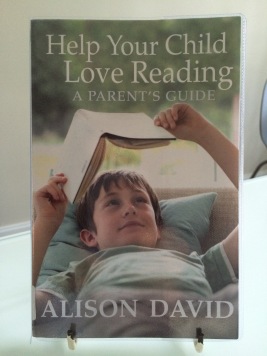 A book I am particularly fond of is Alison David’s
 I was really torn between Claire Tomalin, Anjelica Huston and Alan Cumming. I left it in the hands of the local library and it was Alan Cumming that became available first! I’m still waiting for Claire Tomalin, and that is probably the one I was keenest to read. I was attracted to Alan Cumming’s book, however, because its premise is not dissimilar to the book I am writing, namely family research and the uncovering of a long-held secret. There the similarity ends, however, as Alan’s book is much more about his relationship with his father.
 For November, the challenge is to read a book set in or by a writer from the southern hemisphere – which is, broadly, South America, southern Africa and Australasia. As the nights draw in and it gets increasingly wintry I wanted to be reminded that in other parts of the world it is Summer! So, my choice this month is Isabel Allende’s Portrait in Sepia, a book I picked up in my local Oxfam bookshop and which has been sitting on my ‘to read’ pile for far too long. Allende is such a fine writer and I’ve read a number of her books over the years. It’s great to have an excuse to dive into this one and experience the sensuousness of her writing and the world she evokes, as the last leaves fall from the trees here and nature seems to go into hibernation.
 I read A Clockwork Orange on my husband’s recommendation, straight after he’d completed it – it’s one of his favourite films, which we have watched many times, but neither of us had read the book. It’s quite short, but also quite hard-going as it is narrated by the central character, Alex, who speaks in ‘nadsat’ a kind of teenage vocabulary of the future, based loosely on Slav languages. I read it with a glossary (though Burgess intended that it should not be), but after while I found I did not consult it, and it flowed better just to read it and understand the sense, if not every word.
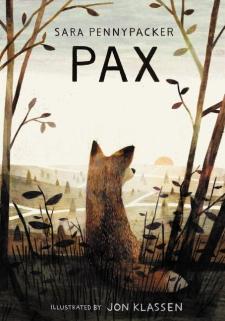
 The cover is lovely and there are a handful of illustrations in the book which are truly beautiful and very evocative. The apparent subject matter (animals) and the fact that it has some illustrations might put off some of the target readership (10-11 year olds, I would say), particularly the more advanced readers among them, who might think it is better suited to younger ones. The themes, however, are much more mature than you might think and may in fact be upsetting to more sensitive 9-10 year olds, say. It is perfect, therefore, for older primary school kids who are perhaps more reluctant readers who may find some of those thick volumes a bit daunting. At 276 pages, with a few pictures and nicely spaced typeface, this is a book where pages will be turned quite quickly; in my experience, this is a surprisingly important factor in many children’s enjoyment of a book!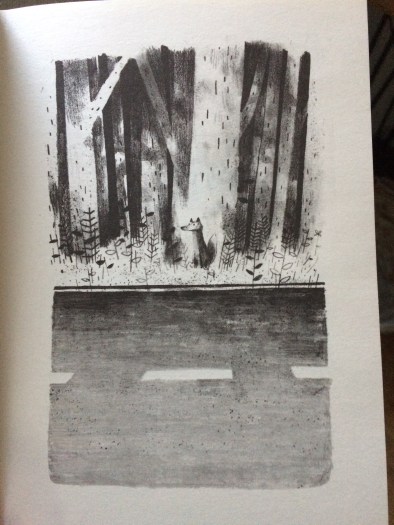

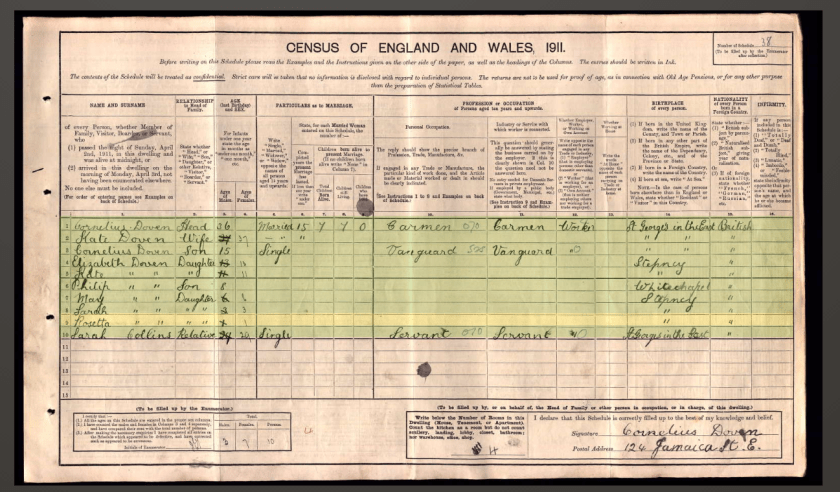
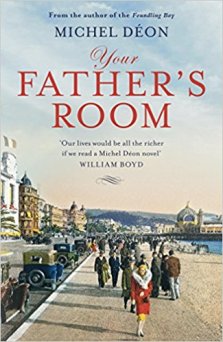 I have been reading a lot of fictionalised biography to help me and one book I read recently I found profoundly moving. Your Father’s Room by French writer Michel Deon is part fiction, part memoir, and looks back to 1920s Paris and Monte Carlo. Edouard, or Teddy, is the only child of a civil servant and his socialite wife. The family moves to Monte Carlo with the father’s job and there is a fascinating insight to life in the south of France at that time, the characters connected to the family and the nature of the relationship between Teddy’s parents. If this is an account in part of the author’s childhood then much of Teddy’s observations will have been imagined by Deon. Perhaps like me he is taking fragments of memory, partial facts and knitting them together to tell a story. It is very engaging even though it is not clear what is truth and what is fiction. How much of any of our family history is a story anyway, ‘facts’ that have been embellished (or concealed) over the years?
 Julia's books