3 non-fiction book reviews

A couple of weeks ago I posted about some of the books I had been reading during my unintended blogging sabbatical, three fiction titles I had enjoyed. I’ve also been reading quite a bit of non-fiction and here are three I’d like to share with you.

When the Dust Settles by Lucy Easthope

This was one of my book club reads. Published in 2022 it is a memoir from one of the country’s foremost disaster experts. This was a profession that I confess I had never really thought about or even knew existed, although after reading this book, that feels like a stupid thing to say. Easthope and her colleagues manage the clear-up after natural and man-made catastrophe, their primary focus being the retrieval, preservation, cataloguing and retention of human remains, from tiny fragments, such as pieces of bone where DNA testing can help to establish identity and ownership, to items of clothing or belongings. Easthope cares passionately about her work and empathises deeply with the loved ones of victims, for whom she sees her role as being part of the grieving process. Easthope writes candidly (and at times this can be challenging) about her role in many significant disasters such as 9/11 in New York city in 2001, to the Lac-Megantic rail disaster in Canada in 2013. She also has much to say about disaster planning in the UK, drawing from her experiences of working with flood victims in Yorkshire and the Covid-19 pandemic. It is fascinating reading. Easthope is a talented writer and also weaves in her personal story, the smaller tragedies in her own life, such as her husband’s near-death and her recurrent miscarriages. This is both a highly personal memoir but also a reflective piece of work about the lessons she has learned (and the many lessons governments fail to learn) about handling disaster. Whilst this is not a book for the faint-hearted, it is a highly-engaging and important read.

How They Broke Britain by James O’Brien
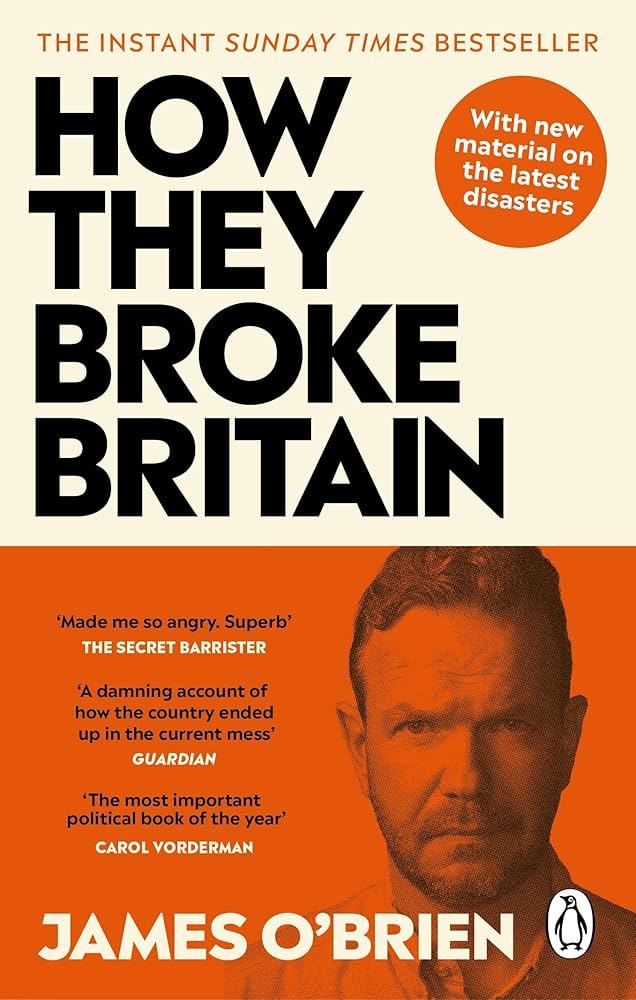
To say I enjoyed this book immensely is probably to come out about my political leanings (for which I make no apology, by the way, but not something I make a big deal about on this blog). I saw James O’Brien give a talk at this year’s Hay Festival (alongside the Financial Times journalist Peter Foster, who was also promoting his own book What Went Wrong with Brexit and What We Can Do About It) and bought both books. It is written in O’Brien’s trademark discursive style and each of the culprits in the tragi-comedy gets a chapter of their own. There are all the faces you would expect to see – Boris Johnson, Dominic Cummings, Nigel Farage and Liz Truss – plus a few you might not, and may not even have heard of such as Paul Dacre, Matthew Elliott (who?) and Jeremy Corbyn. O’Brien is excoriating about the role of each of his culprits in the dumbing-down of public discourse, on the commercialisation of thought, and how each has in their own unique way (sometimes wittingly, sometimes not) corrupted public life. His central thesis is “Shame on you!” which regardless of your politics, is hard to disagree with. I found one or two of his points stretched credulity for me, but only a little. When you see it all written down, page after page of it, it is deeply troubling and it is clear that a lot of painstaking cleaning-up work needs to be done (Lucy Easthope?)

Strong Female Character by Fern Brady

This was another of my book club reads and one that I had mixed feelings about. I should also say that I listened to it on audio, and it was read by the author and this may have affected my view. Fern Brady is a comedian and she is autistic. She did not receive a diagnosis until she was well into adulthood and this memoir is her account of growing up in Scotland with the condition. She writes about her difficult time at various schools, her struggles with her parents (who seem to have found her behaviour difficult to cope with) and the challenges of going to university. It is at times laugh out loud funny and at others deeply upsetting; she has clearly had some rough times. Her accounts of finding herself homeless, experiencing abuse and unable to navigate social relationships well are heartbreaking. This is hard to write but there were also parts where I found my sympathies did not lie with her. For example, her parents come out pretty badly and that felt unfair, especially when I did some research afterwards about her background and upbringing – it does not seem to have been as bleak as it came across to me. Also, the reading was sometimes vulnerable, sometimes bombastic, even boastful. It drew some general conclusions about ‘people with autism’ from the standpoint of her personal experience. From my own experience of the condition I don’t think it was always right.

All three were very good reads that I recommend highly. I’d love to hear what you thought if you have read any of them.

3 fiction book reviews

Having done so little blogging over the last few months I’ve built up quite a backlog of reviews, even though my reading rate has not been that impressive, if I’m honest. I’ve been listening to more audiobooks than I have been reading actual books and I’ve worked through quite a few on my travels and whilst running, so I’d like to tell you about three that I have particularly enjoyed.

The Shadows of London by Andrew Taylor

I love Andrew Taylor’s Marwood and Lovett books and have reviewed them all on here, from the very first Ashes of London to the most recent The Royal Secret. I get very excited each time I see there is a new one out and I listened to this, the sixth instalment, in the spring. For fans of the series, it has all the things you want and love – the courtly intrigue, the meticulous historical research, the same lovable and not so lovable characters, and a thread of continuity that makes you feel you are back with an old friend. This latest novel steps up to deal with sexual exploitation, by cruel and powerful men using powerless women to achieve their ambitions. In an afterword the author writes of how current scandals (referencing Harvey Weinstein, Jeffrey Epstein and others) gave him the inspiration to look back and explore the issue from a historical perspective. It is sobering to realise how little has changed. For fans of this series, the chemistry between the two leading characters is one of the main draws, and in this novel, the author rewards our patience!

Anxious People by Frederik Backman

This was another audiobook I thoroughly enjoyed. It is hard to say too much about it because the joy of it is in the twisty plot, the serial revelations and the about-turns that catch the reader on the hop. This is a book which is not at all what it seems. The novel opens with the police trying to solve a hostage drama. Six strangers who have all come to view an apartment are thrown together when a failed bank robber holds them captive. We first encounter them when the police are interviewing each of them to ascertain the sequence of events that led to the robber evading capture, despite the building being surrounded. Each of the hostages appears unhelpful, irritating and deeply frustrating and I must admit that in the first few chapters I fell into the trap of thinking that the book was going to be long-winded with poorly-drawn characters. Oh how wrong I was! As well as having a fiendishly clever plot the book is a wonderful study of six (plus!) fragile adults, none of whom is quite what they seem. Brilliant! And I will definitely be going back to this author for more.

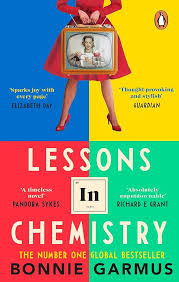
Lessons in Chemistry by Bonnie Garmus

This book was heavily marketed when it was published in 2022 – it had a profile in almost every bookshop I entered and was widely advertised in the print media. Its author also gained a lot of attention for publishing her first novel in middle age. She deserves credit – it’s a good read and has been made into a film starring Brie Larson. Set in the 1960s its central character is Elizabeth Zott, mother to Madeline and presenter of a popular television cookery show, Supper at Six. The show is unusual in that it emphasises the chemistry involved in cooking and the labour and skills required in running a home. This soon gets Elizabeth into trouble, however, as the last thing TV executives want is a show that inspires female viewers to self-actualise! The novel tells us how Elizabeth got to this point. Highly intelligent and driven she was denied the chance to do a PhD, exploited by her male colleagues at the research institute where she worked and sexually assaulted. She falls in love with her colleague Calvin Evans, a brilliant and highly-regarded academic, despite herself and her life looks to be heading in a certain direction. But then events turn her world upside down. This is a great read, sure it’s cliched in parts, but it’s fantastic entertainment and exposes some of the very real hardships talented women faced not so very long ago.

Looking at the above reviews I am struck at how my reading seems to have involved some escapism – perhaps the challenges of my work and domestic life meant that I fell back onto modern popular fiction as a bit of nourishment for the soul! And if that’s not what reading is for, then I don’t know what is.

I’d love to hear if you have read any of the above and if so what you thought of them.

Booker shortlist review #6 – “Prophet Song” by Paul Lynch

January has turned into a bit of a rest and recuperate month for me. As I write, there is exactly one week left of the month and after some pretty wild weather in the UK over the last few days, I can report that the sun is shining in Manchester. I have been in my garden this morning assessing the storm damage and putting the covers back over the furniture after the wind had blown them off, and can report that green shoots are peeking out of the ground. I have an ancient nesting box on a wall that was put there by previous owners of our house and I have noticed from my kitchen window that some blue tits have been busy fluttering around it. The afternoons are definitely getting a bit longer and I do feel a slight sense of spring in the air. It feels like the long dark winter is starting to give way. Hmm, does that mean I have to stop resting and recuperating and start doing?!

For me, this month has also been about catching up. On all the things I did not manage to get done in the hectic weeks leading up to Christmas, and on all the unfinished books that have languished in piles for far too long. Perhaps that’s a sign of spring too, wanting to get rid of the old and usher in the new, draw some lines under what has passed. My most delayed unfinished task, certainly as far as this blog is concerned, is completing reviews of the 2023 Booker shortlisted titles. My final review is of the book that actually won, Prophet Song by Paul Lynch. It was widely welcomed as a good winner and the author has certainly done his time as a hard-working writer, so a good choice from the judges in that respect. It wasn’t my favourite book of the six (The Bee Sting was the outstanding one for me), but it was certainly imaginative, well-crafted and had important things to say. 

Set in Dublin in an apparently near-future, Prophet Song  is a story told from the perspective of Eilish Stack, a scientist and mother of four children, her youngest just a baby. Eilish’s husband Larry is a trade unionist, a senior officer in the Teacher’s Union of Ireland, not exactly a militant group, and when he is arrested on vague charges of seditious behaviour and subversive activity, Eilish’s world begins to fall apart. What also falls apart is the society she has known, normal social order, and most frighteningly, the family’s future suddenly seems very unclear. 

Larry is detained indefinitely and neither Eilish nor a lawyer are able to get access to him or any clarity from the authorities on why he remains in detention and what might happen to him. Eilish has to cope alone as a busy mother of three teenagers and a baby, carer for her elderly father whose dementia is beginning to impact significantly on his ability to live safely alone, and working full-time at the lab, the only breadwinner now. There is the sense of her gradually losing her hold on day to day life as well as the emotional and psychological strain of both personal and social events. 

Civil war effectively breaks out in the country. The government becomes increasingly totalitarian and, as is usually the case when democratic society breaks down in this way, for reasons that are quite baffling, a proportion of the society gets brought along, becomes complicit in the crackdowns and persecution. Eventually, Eilish feels she has no choice but to flee the country, to try and cross the border to the north (Northern Ireland), perhaps even try and get to the British mainland on a boat (anyone spot the irony?). Her sister lives in Canada and wants her and the family, including their father, to go there. Eilish’s father won’t, can’t, leave the country of his birth, and where he wants to die. Eilish has to make some terrible choices. 

I was reading this book at the time when hysteria in Britain about refugees crossing the channel in small boats was reaching boiling point. Nothing there is resolved and we seem unable to have a reasoned debate in this country about immigration or about human rights. In 2024, it is said that a staggering forty per cent of the world’s population live in countries that will hold general elections (how many participate is quite a different question), including in the UK of course. Some of these will take place in countries where it is democratic in name only, Russia for example (hmm, who do we think will win?). In others, like the US, the world is frankly holding its breath. The media in many of these countries cannot be said to be unbiassed, objective, representative or fair, and bad actors are capable of de-stabilising democracy through sophisticated technological tools, social media and deep-fakes. Some governments are also destabilising democracy themselves and implementing laws that favour the outcomes they and their supporters desire. By making Eilish so real, so relatable, her life so like ours, Paul Lynch, shows us how close all of us are to the seemingly unthinkable. It is a wake-up call and we all need to pay attention. 

Highly recommended.

Happy new year and book review – “Yellowface” by RF Kuang

I have been reading and liking a lot of posts from fellow bloggers about their reading year in 2023. I often do such a post myself except that my reading and blogging last year was pretty woeful and I don’t want to depress myself – comparison is never good for self-esteem! Life just got in the way in 2023, but no matter. I’ve also been reading a lot of blogs about, and been receiving a lot of emails from various newsletters and platforms I subscribe to, exhorting me to set my reading goals for the year. I still have a very busy six months ahead of me with education and family commitments so I’m not going to do anything that might make me feel like I’m somehow falling short. Last year, I set myself a challenge to read one long-neglected book from my shelves per month. I was doing pretty well up until the summer…

So, this year, I am going to set myself the same challenge, because I think it’s a good one. Plus my husband has started making noises about thinning out our book collection, not a bad idea in itself, but it does make my blood run a little cold. It is hard to justify buying more books however, when you have very many unread ones lying around. For January, I’m just going to set myself the task of finishing all the books I currently have on the go! If you glance at my Goodreads profile you will note that there are currently SIX(!), and at least three of them have been there for a very long time. So, I am going to try and get these read by the end of the month. A kind of clearing the decks before signs of spring and feelings of fresh starts commence in February. Did you know that in Ireland spring begins officially on the 1st of February? I don’t think it’s any warmer there or anything, but I visited my in-laws in Dublin for new year and I can confirm that daffodils were indeed blooming in their garden! The government has even instituted a new bank holiday in 2023 for St Brigid’s Day, to mark this traditional Gaelic festival welcoming the spring.

So, in the spirit of catching up and clearing out before spring, I want to start my reviewing year with a book that I read some months ago and which I have been meaning to write about ever since, but haven’t quite got around to. Yellowface was one of a few much-hyped novels of last year and I listened to it on audio over the summer. As well as being a great read, it is a complex and brilliantly constructed novel which explores many themes and ideas. 

The central character is June Hayward, a writer who is struggling to make her mark and whose agent and publisher are losing patience with her (lack of) output. June has a friend, Athena Liu, whose fortunes are very much in the ascendant. The two women were at Yale together and in her writing career, Athena has achieved everything that June desires, both commercial success and literary acclaim, making her a wealthy writer, a rare thing. To make matters worse (for June), Athena is beautiful, popular and socially skilled. June and Athena do not have a close relationship, rather they share some mutual friends, but on a night out to celebrate Athena having sold the television rights for her latest book, the two women find themselves drunk at Athena’s luxury New York apartment. On a whim, Athena decides to cook pancakes, but in a freak accident, chokes to death in front of June’s very eyes. In the chaotic aftermath of the incident, June finds herself alone in Athena’s apartment. Looking around her study she comes across the completed first draft of another novel, which Athena has produced in her trademark fashion – on a manual typewriter. Thus, no traceable digital copy. 

The temptation is too much for June and after reading it she decides that fate has decreed that she will be the one to knock it into shape, to turn it into a publishable piece. June works on the draft day and night for several weeks and by the end of the process feels the novel is as much hers as Athena’s. She sends it to her agent and the book is eventually published to great acclaim under the pen-name, Juniper Song, distancing it from June’s previous (mediocre) work, and adding an air of authenticity to the subject-matter – the unsung contribution of Chinese prisoners to the first world war effort in Europe. With her Asian heritage this would have been a natural choice of subject for Athena, but less so for June.

June revels in the success of the book and all appears to be going well until she begins to be trolled on social media by someone masquerading as the ghost of Athena Liu claiming that June stole the work, accusing her of cultural appropriation and even suggesting June may have had a hand in Athena’s death. Events quickly spiral out of control and the rest of the novel proceeds at pace as June tries to uncover who is behind the fake social media account. As doubts about her spread she must face into some very public challenges as well as private demons. At first, the accusations against June about cultural appropriation (the ‘yellowface’ of the title) seem pretty clear-cut, but the author is also unafraid of challenging the publishing industry’s fickleness and the rank hypocrisy that can play out in social media.    

There is only really one way this story can end and yet the author still manages to make it quite shocking and twisty. It is a genuine  page-turner and I was on the edge of my metaphorical seat throughout. Rebecca Kuang is an extraordinary young talent; she left China with her parents when she was just four years old, and the family moved to America. She won a scholarship to Cambridge, did an MSc at Oxford, has a PhD from Yale and had already published four novels before Yellowface. She is only 27. Reading her bio you can sort of empathise with June Hayward!

Highly recommended.

Book review – “Frenchman’s Creek” by Daphne du Maurier

You will recall that I read Daphne du Maurier’s Rebecca a few weeks ago. I devoured it, could hardly put it down, loved the film too. Once I had written my review I went to put the book away and, being  a strictly alphabetical storer of books, discovered I had another du Maurier tucked away on the shelf that I had completely forgotten about. It looks like I bought it in 1989 (I used adhesive book plates in those days) so I was still at university and must have picked it up in a secondhand bookshop. It’s a 1965 Penguin edition, which means it has a very small typeface and is only a little over 230 pages long. I was very excited about this find and could not wait to get stuck in.

My vintage, pre-decimalisation copy!

I assumed that as the book appeared to be so short it would not take me too long to read. It took me the best part of three weeks! I kept falling asleep reading it, which may have been due to the fact that my life has been a bit topsy-turvy this last month or so and I have been tired, or the fact that 1960s typeface is actually impossible to read and a tremendous strain on the eyes. Or perhaps it is just that I was so decidedly underwhelmed. I think that is the kindest thing I can say about it. It was the first novel published after Rebecca, (the latter published in 1938, while Frenchman’s Creek came out in 1941) and yet it reads like it could have been her first, practice or unfinished novel, discovered posthumously. I was so disappointed.

The plot is a simple one – set in Restoration England, wealthy Dona St Columb, bored with the frivolousness of London life (and also bored with her husband), decides to take herself, her two young children and the nanny to the family’s estate in Cornwall, Navron House. The house has been locked up, unoccupied for some time, looked after solely by a single mysterious servant William. There is much gossip around the town in Cornwall about a French pirate, terrorising the locals, and jeopardising the noblemen whose fortunes are made through maritime activity. Dona is intrigued by the stories. At the same time, Dona begins to notice some strange things in her house: a jar of tobacco and a volume of French poetry in her private bedroom, and the feeling that there is more to the servant William than meets the eye.

When Dona confronts William she learns that he is in fact an associate of the infamous Breton pirate of the La Mouette, Jean-Benoit Aubery, who, between raids, lays his ship at anchor in the hidden creek below Navron. Dona is clearly immediately attracted to the idea of the mysterious pirate, and when she does finally meet him, he does not disappoint. They begin a fairly passionate (by the standards of the time!) love affair, and…well, I won’t give you any more spoilers. Suffice it to say, that Dona finds herself torn when her fellow Cornish nobles decide that they want to capture the Frenchman and hang him for his crimes. She will have to use all her feminine wiles to help her lover evade capture. This event is slightly comic (due largely to the ineptitude of most of the men invovled), but the threat grows somewhat darker when Dona’s husband Harry decides he will join her in the country and brings his friend, the rather sinister Lord Rockingham, who is not so gullible as Harry. Not only does he suspect that Dona is hiding something but is clearly intent upon using his suspicion to get what he wants out of her.

I feel like I have just outlined the plot of a Mills & Boon and I’m afraid that’s how I felt reading it. The novel is set in the Restoration era, presumably because that is when pirates were around terrorising coastal communities, but there is very little sense of either time or place in this novel, something that du Maurier does so brilliantly in Rebecca. The love affair between Dona and her pirate is so extremely implausible as is the interaction with the servant William, as are the key events of the novel. None of the characters are fully developed and our Breton pirate (himself a nobleman in his part of the world, but who, like Dona, is a restless soul who likes a bit of high-seas adventure) speaks impeccable English!

I read that du Maurier was often dismissed as a “romantic novelist”, but that she resisted this pigeonhole. Certainly, Rebecca, is so much more than a romance; perhaps not even a romance. But Frenchman’s Creek, in my view, is a poor follow-up to that novel, a throwaway romance that has little of real substance. I’d be interested to know what du Maurier fans think of it and how it is perceived critically. I’m going to try more du Maurier and hope that this novel is an aberration.

Read this book if you love Rebecca and are as intrigued as me by the contrasting quality!

Book review – “Rebecca” by Daphne du Maurier

Last week I posted my review of Tinker Tailor Soldier Spy, the February book in my Facebook Reading Challenge. The theme was something that had been adapted for screen and I had been torn between that book and Rebecca. This was famously adapted by Hitchcock, of course, in 1940 (starring Laurence Olivier and Joan Fontaine) and now there is a new production on Netflix, starring Lily James, Armie Hammer and Kristin Scott Thomas. With Tinker Tailor Soldier Spy I watched the film (the 2011 version, not the television series) first. With Rebecca, however, I did it the other way around and I am so glad to have done so. It is such an extraordinary novel and the impact of the plot and the narrative are thrilling – I would have so missed out on so much if I had known the ending.

Rebecca opens with the well-known words “Last night I dreamt I went to Manderley again.” A short chapter, where our main female protagonist (whom we only ever know as Mrs De Winter) is recounting a dream she had of her first time visiting her husband’s family estate. She recalls, in particular, the long drive through the park, the plants and trees, which seem hostile, almost monstrous, and the setting of the house itself, in an imposing position high above the rocky Cornwall coast. It is described less in terms of realism and more in terms of how it made her feel. But our protagonist’s dream is very much past tense. We know that she is no longer there.

The second chapter goes back a number of years to the Hotel Cote D’Azur in Monte Carlo where Mrs De Winter (at this point a young spinster, though we never know her name, she is without her own identity) is serving as a ‘ladies companion’ to wealthy American Mrs Van Hopper, a vulgar, bully who shows complete contempt for her young employee.

Mrs Van Hopper hears that English aristocrat Maxim De Winter is in residence and is eager to renew her acquaintance with him. De Winter is recently widowed and Mrs Van Hopper explains that he has never got over his wife’s death. Mrs Van Hopper is suddenly taken ill which means that her companion finds herself with some spare time alone. Mr De Winter notices her one day and invites her to lunch. They embark on a whirlwind affair while Mrs Van Hopper convalesces, which ends with Maxim proposing marriage when it appears that his lover will be whisked off to New York with her employer. They marry, quickly and quietly while Mrs Van Hopper is nothing short of appalled at the match and promises her young friend that she will live to regret the decision.

The new Mrs De Winter returns to Cornwall with her husband, to his ancestral home, Manderley.  She is introduced into a household where the influence, of her predecessor, Rebecca, the first Mrs De Winter is everywhere. Her memory is kept alive by the housekeeper, Mrs Danvers, a cool and sinister figure, whom we come to learn was devoted to her mistress, having served her since she was a child. The new Mrs De Winter finds Rebecca’s presence everywhere, from her clothing in the boot room, to her notepaper in the morning room, and the expectations of the staff at Manderley who expect the new Mrs De Winter to simply pick up things as they were left, whether that be menus, social events or flowers in the house.

Although it is painful to her, Mrs De Winter becomes increasingly obsessed with finding out more about Rebecca, whilst also loathing how she continues to dominate the domestic sphere, the society, even her marriage. It is as if she is picking at a scab. We learn that Rebecca, an experienced sailor, drowned in her small boat. Mrs De Winter comes upon Rebecca’s small cottage on the beach, still filled with all her things and her discoveries and questions cause tension in her relationship with her husband. She comes to the conclusion that Maxim is still in love with Rebecca, that Mrs Danvers is scheming somehow to get rid of her and that she can never match her predecessor for beauty, accomplishment, charm or status. The myth of Rebecca takes over her completely.

I cannot say any more without giving away too much. Each new revelation and plot twist in the novel is delivered with jaw-dropping skill. This book had me reading far too much, far too late at night because I couldn’t put it down. It is also an emotional roller-coaster as the reader is forced to confront and re-confront assumptions, prejudices, expectations and moral values. It is a book that will leave you questioning what is right and wrong, who you are rooting for and who is the baddie. It’s an extremely complex and challenging novel that is far more than just its story, but what a story! British author Clare Mackintosh is quoted on the book jacket saying “It’s the book every writer wishes they’d written” and I could not agree more.

Highly recommended. And now for the film!

Book review – “Tinker Tailor Soldier Spy” by John Le Carré

Oh my goodness, Rebecca is taking some very strange and unexpected turns – I wish I could write about them here but that would be unkind to anyone who hasn’t read the book or seen the film. I’m not sure how I feel about the plot twists, at this point, but I’m like a junkie in my reading of it, just dying to get the next ‘fix’! But back to something much more sober – Tinker Tailor Solider Spy, a book that has been described as Le Carré’s “masterpiece”, and which you will recall was my Facebook Reading Challenge choice for February. A Cold War novel for a cold month!

Tinker Tailor Solider Spy is the first in Le Carré’s so-called Karla trilogy in which he pits our hero, retired senior Secret Service operator and later chief, George Smiley, against his Russian opposite number and great nemesis, codenamed Karla. The novel opens at a minor public boys school to which former spy Jim Prideaux has been retired following a botched operation in Czechoslovakia where he was shot, captured and tortured by the Soviets.

The head of the Secret Service in London, known as Control, long suspected there was a mole in the outfit and shared some of his suspicions with Prideaux – the fateful mission to Czechoslovakia was partly intended to try and flush out the mole; Control has whittled down the candidates to a handful of the key operators in the Service whom he names Tinker, Tailor, Soldier and so on.

Control dies of a heart attack, but more senior officials have learned of his suspicions and call in George Smiley from his rather bleak life of retirement to investigate secretly. Smiley has his own troubles; his wife has left him and it turns out she was having an affair with one of Smiley’s former colleagues (the inference is that she was lively and vivacious while George has become plump, tired and dull). Smiley is given support from an insider, a trusted current employee, Peter Guillam, to help him pursue the investigation that Control was never able to finish and they set up an undercover base operating out of a small hotel.

What ensues is a cat and mouse chase where Smiley gradually explores the motives and capacities of each of the suspects – Percy Alleline, Toby Esterhaze, George Haydon and Roy Bland. The investigation has to be conducted covertly to ensure none of the individuals learns of the suspicion surrounding the work of the Service. For Smiley, the investigation involves not only figuring out methods to get the information he needs and to reach the people who may be able to shed light on the murky inner workings of the organisation, but a sometimes painful reliving of past events which have brought him to his present state of lonely and purposeless existence.

The investigation also, of course, has the potential to breathe new life into Smiley and restore him to a position of status and importance. If he succeeds.

The plot of this novel is sometimes complex and difficult to follow – you really have to pay attention! I found it slow to start with, but then I got very sucked in and found it extremely compelling. The theme of last month’s reading challenge was something that has been adapted for screen and I had watched the film before reading the book. This was the wrong way around! As I was reading, the characters in my mind were the actors from the film and when these actors are Toby Jones, Gary Oldman, Colin Firth, Tom Hardy, Benedict Cumberbatch and Kathy Burke, to name but a few, it is hard to forget them. The characters in the film did not quite match up with the way they were portrayed in the book, which was frustrating. Also, some elements of the plot were changed for the film (including the ending, and Benedict Cumberbatch’s sexuality!), presumably to make it a bit easier to squeeze into two hours, so that was confusing for me.

However, all in all, a very good read. In a previous life I worked for the Civil Service in Whitehall (nothing as exciting as diplomacy or intelligence, I’m afraid), and the book caused me to reminisce about those days a little. The atmosphere created in the book was one I recognised even though it was set over twenty years before my time (things don’t change very fast).

Tinker Tailor Soldier Spy is the first in a trilogy, and there are many other Le Carré novels that feature George Smiley and many more screen adaptations to explore. Having previously not felt too interested in Le Carré I have to say that this book has whetted my appetite!

Recommended.

Book review – “The Color Purple” by Alice Walker

I announced my February choice for my Facebook Reading Challenge last week. I also mentioned how much I loved January’s choice, The Color Purple by Alice Walker. The theme was an American classic. I had chosen that theme to celebrate the inauguration (at last!) of President Joe Biden and his Vice-President Kamala Harris. I can tell you I breathed a huge sigh of relief on 20 January! The Color Purple was a particularly fitting choice, given its feminist themes and exploration of racial segregation and discrimination. It was a book I had considered a couple of years ago for a previous reading challenge when the theme was a feminist novel. Back then, I chose Jeanette Winterson’s Oranges Are Not the Only Fruit and I feel quite glad now that I left The Color Purple until 2021.

I feel slightly embarrassed to be calling this post a ‘book review’; embarrassed because it is surely a book that I (everyone!) should have read long before now. How had I not?! You don’t need me to tell you that it’s brilliant – the Pulitzer Prize judges did that back in 1983. The book was made into a film in 1985, directed by Steven Spielberg, and won a clutch of Academy Awards, including Best Actress for Whoopi Goldberg in the lead role of Celie, and Best Supporting Actress awards for both Oprah Winfrey as Sofia and Margaret Avery as Shug.

Because both the novel and the film are so well-known, I believe I actually thought I knew the story and what it was all about, but I am ashamed to say I really did not. Set in Georgia in the early twentieth century (and going up to the early years of the second World War), segregation, racism and black poverty of course provide the backdrop, but the book is so much more than this. Firstly there is the sisterly love between Celie and Nettie, which endures even though they are separated for decades; Celie remains in Georgia, while Nettie goes to Africa as a missionary. The book is brilliantly structured as a series of letters, initially between Celie and her ‘God’, and later between Celie and Nettie, when the two women are separated. I think this is a difficult format to pull off- it may look easy but could become tired or pedestrian in a weaker author’s hands, but Walker pulls it off in masterclass fashion and it gives the book a surprising amount of pace.

The second somewhat surprising theme for me was the resilience of the African-American woman, not just Celie and Nettie, but also Shug Avery (who becomes Celie’s lover, best friend, and is the former lover of Celie’s husband “Mister”), and Sofia, Celie’s step-daughter-in-law. The men in the book are largely feckless, cruel, violent and controlling, but somehow these women rise above them, not only surviving, but thriving.

Thirdly, there is the theme of love; I have already mentioned the intense sisterly love between Celie and Nettie (and the ending will have you weeping), but many other different kinds of love are explored here – the sexual love that Celie enjoys with liberal bohemian Shug, who shows her another way of being a woman in America at that time, and opens up whole new worlds for her. There is also love that is turbulent, between Sofia and Harpo, and love between different age groups, as with Nettie and her husband. It is a tribute to open-mindedness and the joy of love in all its forms.

Finally, there is a difficult theme, which is that of violence, including sexual violence, within the African-American, former slave, community. Celie is basically a victim of child rape, perpetrated by her stepfather, by whom she has two children who are given away to another family. She is married off to a wicked man (“Mister”) who also rapes her, and treats her as his own slave when it is clear he only wanted her to cook and clean for the family that the death of his first wife has left him with. We are left wondering whether the treatment of the black community by their former slave-owner masters has been the cause of this social dysfunction, particularly as it relates to the lowly position that women occupy. Readers are left in further turmoil, however, by the descriptions Nettie provides in her missives from Africa about the tribe amongst whom she lives, where she refers to the widespread practice of ‘cutting girls’ (female gential mutilation). Nettie admires the tribe and learns a great deal from them, but she cannot accept this practice. When the tribe is displaced by white colonial settlers wishing to exploit the natural resources the land offers, Nettie is appalled and foretells the devastating consequences of western industrial expansion on the natural world and the people who have lived in harmony with it for generations. Nettie is further disillusioned when, travelling via Europe (specifically, England) to report back to the authorities of the church to which she and her husband belong, on their work and the horror of the practices they have witnessed by the colonialists, their protests are met with indifference.

It is really extraordinary how the author does so much in a relatively short book and with such a simple format.

So, at last, I can say that I have read this book. If you have not done so, then it really needs to go on your TBR list. And though I will now watch the prize-winning film, I truly doubt whether it can cover everything that the novel encapsulates.

Highly, highly recommended.

Book review – “Hamnet” by Maggie O’Farrell

I could not have been more delighted at the announcement last week that Shuggie Bain, the debut novel by Douglas Stuart (a Scottish fashion designer who now lives in New York city), had won the Booker Prize. I posted last week about how I had enjoyed the book. I did not exactly predict the winner; I’d only read two of the books on the shortlist and the other one I didn’t really like! I felt more a part of the ceremony this year than ever before. It was incorporated into the Radio 4 arts programme Front Row, whereas usually there is a fancy-pants dinner, and Will Gompertz, in his black tie, appears at the end of News at Ten, to tell us, briefly, who has won. The rest of us, the actual real-life readers and book-buyers, are left out of the glittery literati event. Not this time though; sitting at home, like all the nominated authors, I was on tenterhooks too.

It was the same with the Women’s Prize, back in the summer. It was such a treat to attend all the virtual pre-prize interviews, hosted by author Kate Mosse, with the worldwide audience posting their questions and comments on the Zoom rolling chat. We would never have been able to do that before, when such things would all have taken place in London. I hope that is one aspect of life that we keep, going forward. The winner of the Women’s Prize this year was Hamnet by Maggie O’Farrell. I had not read at the time it was awarded the prize, but it was on my TBR list. I have subsequently read it and, if you haven’t already heard, it was a joy to read. It is one of the most profoundly moving books I have read in a very long time; Maggie O’Farrell is an author at the top of her game and she is still only 48.

Hamnet is the story of a marriage and a child. The marriage is that between William Shakespeare (though he is never actually named in the novel) and his wife Agnes (we know her better as Anne Hathaway of course, but her birth name was actually Agnes). The novel does not pursue a linear narrative; it begins with the eleven year old boy Hamnet searching frantically for his twin sister Judith, who is dangerously sick with fever. The house belongs to his grandparents, his father’s parents. His father is away working in London and the family has lived with them since his parents married. The grandfather is a glove-maker and both produces and sells his gloves from the home, where there is a window that faces out on to the Stratford street. The grandfather is a violent bully who believes his playwright son is a hapless good-for-nothing.

Hamnet’s mother is older than his father by some seven or eight years, and they married after a brief and passionate courtship which led to Agnes falling pregnant. This was partly the intention; Agnes, whose mother had died when she was a child, is a wildish creature whom her vulgar stepmother treats with suspicion and contempt. For Agnes, the pregnancy is a wish-fulfilment, and the hasty marriage a way out of her father’s home, which is now dominated by his second wife and a new set of offspring.

Agnes gives birth, as she expects, to a girl, Susannah. Agnes has a deep knowledge of plants and herbs and people come to her for healing. She is also said to have powers of premonition. These qualities are said to be inherited from her mother. When she falls pregnant for a second time Agnes is puzzled and distressed as she feels instinctively that something is wrong or that some ill fate awaits the child, but she cannot pinpoint what it is. Her confusion over whether the baby is a boy or girl troubles her. In the end she gives birth to twins, a girl and a boy, and her husband laughs off her confusion.

While the children are growing, the playwright pursues his career and, encouraged, by Agnes, goes to London, ostensibly to sell his father’s gloves, but actually to explore what opportunities there might be for him there. Dazzled by the theatre and by the thespians he meets, he decides that he should stay in order to make enough money to support his family. He does this with his wife’s blessing although she does not realise, at this stage, how far apart the separation will drive them.

SPOILER ALERT…ish (you have probably already have heard what happens):

Back in Stratford, Judith contracts the plague and becomes dangerously ill. Agnes believes her child will die. There is a shocking turn of events, however, when Judith suddenly recovers, but, exhausted by the sleepless worry and the caring for her daughter, Agnes fails to notice the rapid deterioration in her son Hamnet, who suddenly contracts the disease. It is a brilliant and devastating few pages as we regain Judith and lose Hamnet. O’Farrell has said that she could not write this scene until her own son had passed the age of eleven. It seems it was as profound an experience writing it as it is to read.

Hamnet’s father does not make it back in time for his son’s last breath and this sets the tone of the remainder of the book. Hamnet’s death occurs about halfway through and the rest of the novel explores the grief experienced by husband and wife. Each feels their loss in a different way and their inability to find comfort in each other in such a terrible moment almost breaks them, both as a couple and as separate individuals.

The ending of the book is interesting, I won’t explain how it pans out, except to say that the playwright writes a play called Hamlet in which a young man dies, but, for me, the emotional peak is much earlier on with Hamnet’s death. The rest is a fascinating study of grief but not as intense.

A wonderful book, brilliantly conceived, brilliantly executed. A worthy winner, despite being up against the very brilliant The Mirror and the Light by Hilary Mantel. I think it’s more accessible and a little more human than Mantel’s book, which I also loved, by the way.

Very highly recommended.

Book Review – “The Mirror and the Light” by Hilary Mantel

The big excitement in the literary world recently was, of course, the announcement of this year’s Booker Prize shortlist. In past years I have set myself the task of trying to read the whole shortlist before the award is made, but I have never yet managed it. I think I read five out of the six one year, but last year I think I only managed two or three and abandoned the intention somewhere around Christmas-time. The Booker Prize seems like less of a landmark than it once was, though; one of the criticisms is that it is now dominated by US-published books, since it was opened up to writers in English from outside the Commonwealth in 2014. One of the fears was that it would “homogenise” literary fiction, although it is curious that this year’s prize nominees constitute one of the most diverse I can remember with it having a majority of women and a majority of people of colour. I would like to read all of the novels on this year’s shortlist, they all sound fascinating, but if there is one thing the past twelve months have taught me it is that I should not be too goal-orientated. My world feels like it has been on shifting sands and most of my plans have had to be abandoned, with the consequence that I have often felt like I was failing at every turn. At this point in time I am just trying to be kind to myself, recognise that things change and give myself a pat on the back for things done rather than admonishing myself for things still to do. And keen readers will know that that TBR pile NEVER shrinks!

The brilliant finale to the Wolf Hall trilogy

The big shock of the Booker Prize shortlist was that Hilary Mantel’s The Mirror and the Light, the third and final part of her Wolf Hall trilogy, was not even nominated. This followed hard on the heels of not winning the Women’s Prize a week earlier (that award went to Hamnet by Maggie O’Farrell – my next read!). Hilary Mantel has spoken of these twin ‘failures’ as being something of a relief – there had been so much talk of whether she could ‘do the treble’ (Wolf Hall and Bring Up the Bodies having won in 2009 and 2012, respectively), but remember this is literature not football! I don’t think Hilary will be suffering too much of a crisis of confidence! As an artist, I hope her feeling of achievement is from the work itself. And what a work it is!

Talking of goals, I wrote on here back in March, when we all first went into ‘lockdown’ (I really, really hate that word), that one of the things I was planning to do with all my spare time was to both read The Mirror and the Light and re-read Ulysses (so much endless time), but of course I did not. Both books are enormous. It took a concerted effort during August to finish The Mirror and the Light. One of the reasons it took me so long was because it is so brilliantly written I wanted to savour absolutely every word. Also, with such a huge cast of characters, it was not always easy to follow who was conspiring with whom.

We all know the ending – Cromwell falls out of favour with Henry, following a fairly concerted campaign by his enemies at court, and is eventually executed. Knowing this, rather like re-reading a good book, helps you to track how events are unfolding. This is a really outstanding book, a fine achievement, and one which rewards the hard work, the investment the reader has to put into it. It is much longer than the first two parts of the trilogy, and at times, especially at the beginning, I felt it could have been edited down a bit, but, now I’ve finished it, I’m not so sure. There is no doubt that, as a reader, you get your money’s worth – less than £1 per hour of reading is pretty good value! And the craft, the authorship, the writing skill, and the research, not to mention the years of her life Ms Mantel has put into this book, make it, in my view, a true literary landmark. It seems above prizes.

Hilary Mantel has also given us all a lesson in politics and a lesson in history. It was an interesting time to be reading the book. The name Dominic Cummings (most famous breaker of lockdown rules) will be familiar to most people in the UK. Not just in the UK but in other countries too, there is a culture war going on between an establishment ‘elite’ and ‘upstarts’ perceived not to belong. I do think this is an element in some of the hostility that is expressed towards people perceived to be outsiders. I should add quickly that I do not think this is undeserved (I’m thinking Cummings, but also Trump), but there is undoubtedly self-interest in the hostility coming from some quarters and some people seem to be piggy-backing on legitimate criticisms. Waiting for their moment to strike, perhaps.

Cromwell, as painted by Hans
Holbein the Younger

Thomas Cromwell (according to Mantel) was a schemer, self-interested and a manipulator, but he was also (and I should add that my comparison with the contemporary examples of outsiders mentioned above ends right there!) a brilliant tactician and a man of extraordinary talents with an unmatched intellect. His chief ‘crime’ in the eyes of his enemies at court, though, was being low-born, he son of a blacksmith; he dared to ascend to the very highest roles at court, the chief confidante of the king, but he paid the price, ultimately, for that daring. His enemies eventually succeeding in getting rid of him.

I recommend The Mirror and the Light very very highly.