 Regular visitors to this blog will know that I am passionate about children’s literature. My children are part of the generation that grew up with Harry Potter. JK Rowling is one of my heroes, for a number of reasons, but primarily for all that she has done to get (and keep) children reading, particularly those who might otherwise not have done so. Harry Potter wasn’t the first literary character to bring wizarding and magic into children’s literary lives, however. The Snow Spider was first published 30 years ago and was a multiple award winner. It was originally published as a trilogy, but this anniversary volume has been issued as a stand-alone. I chose it for the book club I run at my daughter’s primary school.
It’s set in Gwynedd, rural Wales, where our central character, nine year-old Gwyn Davies, lives on a farm with his parents. It starts on the morning of Gwyn’s birthday with his grandmother, the eccentric Nain, giving him five gifts: a brooch, a broken wooden horse, a yellow scarf, a piece of seaweed and a tin whistle. It turns out that these rather unusual tokens are in fact a kind of test, designed to determine whether Gwyn has inherited the magical powers that run in the family line but which have now missed several generations.
We learn that Gwyn’s birthday is usually a quiet and fairly sombre affair because it is the anniversary of his elder sister’s disappearance, four years earlier. Bethan went out in search of a pet lamb belonging to her little brother, after he begged her to do so, and never returned. Gwyn’s father blames Gwyn for his beloved daughter’s disappearance and has since become a cold and distant figure in his son’s life.
Gwyn soon finds that he does indeed possess certain magical powers and each of the gifts given to him by Nain has an individual significance, a power he must explore and learn about. The first sign he receives is when the brooch becomes a delicate and beautiful silver spider, Arianwen. The spider becomes his guide and companion throughout the rest of the book and on his journey of self-discovery. The broken horse unleashes some malevolent forces that Gwyn must learn to control – this is a very high-action chapter! The yellow scarf, which had belonged to his sister and was the only sign of her left on the hills after she vanished, attracts Bethan back into the family’s life, but in an abstract way; Eirlys is introduced about halfway through the book when she arrives at Gwyn’s school, apparently an orphan. She lives with a family in the village, but after becoming trapped in a storm finds herself spending some days with Gwyn and his family. Eirlys clearly reminds Gwyn’s father of his missing daughter and her presence brings about a softening in his relationship with his son.
The children in the book club had mixed feelings about The Snow Spider. Some did not like it at all – one even abandoned it! For others I think it was perhaps rather gentler than their usual reading, with not quite enough “action”. Compared to many of the books published today it has a certain innocence that I confess made me rather nostalgic! I loved the sense of place; rural Wales, with all its traditions of myth and magic is beautifully evoked, and the characters are well-drawn and familiar.
The recommended age group for this book is 8-12 years, but I feel it would probably work best for children at the younger end of that spectrum, and it’s a lovely one to read aloud together; some of the keener children in the book club raced through it (it’s quite short) and I think this may have compromised their enjoyment. I think it also helps to have an adult to discuss the book with as it deals with some challenging themes, not least the disappearance of a child. Gwyn’s relationship with his parents, particularly his father, is quite a tricky issue, as is the question of acceptance by peers (once Gwyn’s ‘visions’ become playground gossip, he is teased by some of the other children). Also, Gwyn’s discovery of his magic after his 9th birthday is, I think a metaphor for puberty and adolescence, which may resonate with children approaching double figures.
It is a lovely book that I think quieter, perhaps more thoughtful children will enjoy, or children who like to read with an adult. But it isn’t Harry Potter!


 So, the task for March on my
 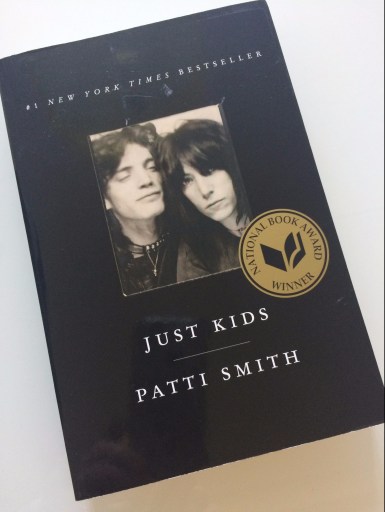 Patti Smith is a fascinating woman who has led a fascinating life. I have been meaning to read this book for years (it was published in 2010), so when I came across it in the Strand Bookshop whilst on my trip to, where else, New York last summer, it had to be bought! (It’s a very New York book.)
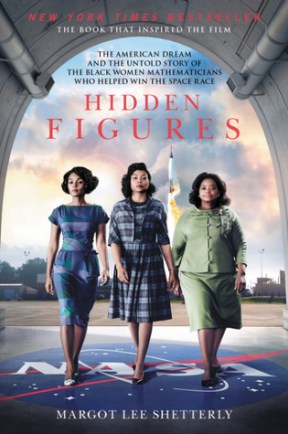 This year, literary references are a little thinner on the ground, but I want to tell you about a couple that have caught my eye. My children were on their half term holiday last week and I took my youngest daughter (aged 10) to see Hidden Figures. It is based on a true story, but the film was inspired by a book of the same name by Margot Lee Shetterly. You will no doubt have seen the trailers, but, to summarise, it tells the story of three exceptionally talented mathematical minds whose contribution to the US space programme in the 1960s went largely unacknowledged…because they were African-American women working at a time when racial segregation was still in place. It is a remarkable story, very moving and very well told.

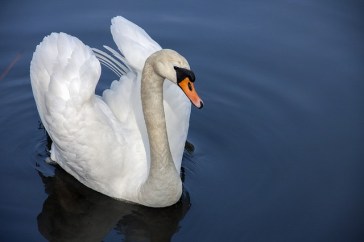 Now, dear reader, this blog is rather like the proverbial swan – whilst it may look smooth and effortless to you on the surface, the planning (reading, idea generation, social media, writing, etc) that goes on behind the scenes is like a military operation! Well, not exactly, but, you know, I do plan my reading, aim to bring you a book a week and try to blog twice a week. And this book has totally blown my schedule! You know what it’s like when you’ve got a busy day planned either at home or at work…and you hear the words “Mum, I’ve just been sick!” and you know your day is irretrievably banjaxed. Well, that’s how I feel.
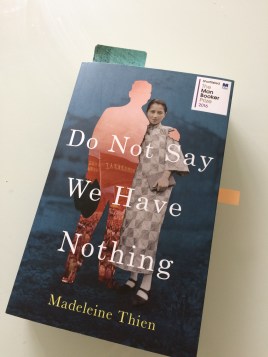 Do Not Say We Have Nothing, broadly speaking, is about China after the revolution, what it was like living under the dictatorship of Mao Tse Tung and about the hardships endured by the population, particularly by artists and intellectuals, in an era when culture was heavily proscribed. I have had a lifelong fascination with China, have read very widely about this enormously diverse and culturally rich nation, so I should be loving it. But I’m not! And I’m barely halfway through! I took a break from it this week and read Love, Nina by Nina Stibbe (which I’ll be reviewing soon), and that book is at the very opposite end of the literary spectrum – light, fun, quick to read. Many people probably would have given up by now. After all, a book, particularly a long one, is a huge investment is it not? I rarely give up on a book – I gave up on White Teeth by Zadie Smith a few years ago after a couple of false starts, but I have always planned to go back to it. My rationale for continuing with Do Not Say We Have Nothing is as follows:


 I’m not knocking either of these genres, I’m simply saying that literary non-fiction is a very tough genre to sell in. I read recently that the average non-fiction title in the US sells 250 copies a year (one for roughly every million people), or 2,000 copies over its lifetime. It makes you wonder why on earth you would write one! Many seem to be written by academics, journalists or people who have already established themselves in a chosen field and know they are writing for a particular niche. One striking thing about the genre, though, is that authors have a real passion for the topic, and the authenticity of the work is palpable.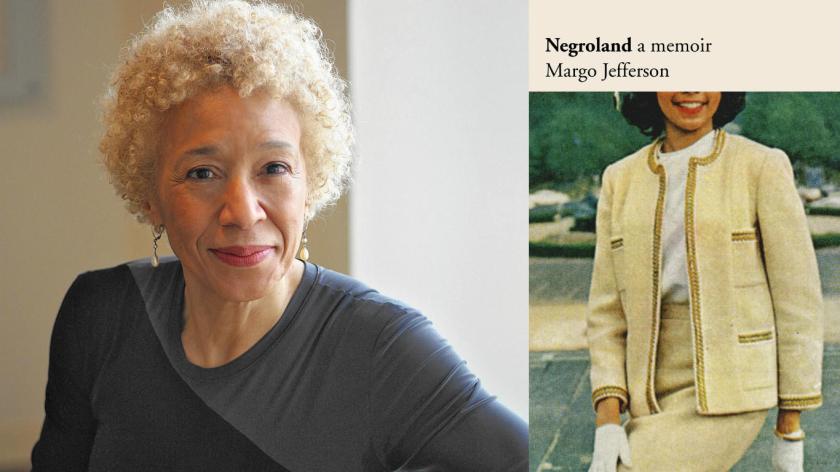
 Julia's books