
Crime fiction is not one of my favoured genres, although whenever I have read any I generally enjoy it. I have really enjoyed dipping into Agatha Christie (I’ve reviewed Murder on the Orient Express, Death on the Nile and The ABC Murders on here and I really enjoyed Betty Boo by Argentinian author Claudia Pineiro, whose work I’d really like to get more into.
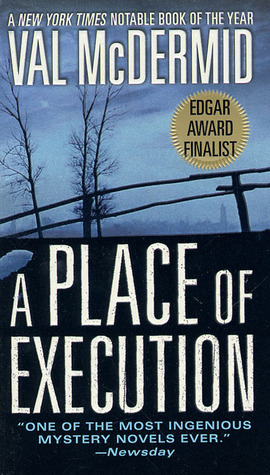
I have a lot of time for Val McDermid; she’s so interesting and entertaining, very funny when she appears on literary panel shows or festival events and just seems like a great ambassador for her profession. I decided over the summer that I really needed to sample some of her writing so I listened to the audiobook of A Place of Execution, one of her earlier works, published in 1999.
Review – A Place of Execution
The central character is George Bennett, an up and coming young detective in the Derbyshire force in the 1960s, somewhat disliked by a few of his colleagues due to his having received a university education, rather than coming up through the ranks. He is put on a very disturbing case involving the disappearance of a young girl, Alison Carter, from the small isolated village of Scardale. Many of the inhabitants of the village are members of the same family and the missing girl is in fact the step-daughter of one of the more well-to-do residents, Philip Hawkin, informally known as ‘the squire’ and very much considered an outsider. Although he has family connections to the village and inherited the manor house he now lives in with Alison’s mother Ruth, he grew up in the south and is not well-liked.
George and his assistant, Tommy Clough, encounter resistance in their investigations and George has a powerful sense of something not being right but he cannot put his finger on why. There is evidence of Alison having been harmed, perhaps sexually assaulted, but even though a thorough search of the vast rural area is conducted, no body is found and the case goes cold. This part of the novel is set in 1963 when the infamous Moors murders took place in Greater Manchester and there are references to the missing children in that case, as the respective forces share information to try and tease out common leads, but none are found.
Years later, journalist Catherine Heathcote, sets out to write a book about the famous unsolved case, and seeks out the now elderly George Bennett. As she digs deeper, however, she uncovers more than she bargained for, and when George suddenly writes to her and says that she must not publish and he can no longer cooperate with her in the work, she is dumbfounded.
I found this a brilliant novel and I was hooked. I could not work out what was going on and then at some point I thought I’d cracked the case, but I hadn’t! the plotting is superb. The characters are also all very authentic and well-drawn. It is no surprise to me that this book won awards and plaudits and was shortlisted for some prestigious prizes.
After reading this book, I encouraged my book club to read a Val McDermid novel. She has written so many so we searched for a ‘Top 10’ online and Past Lying was recommended.
Review – Past Lying

I listened to this novel on audiobook too and I found it to be much less interesting and somewhat more cliched. Published in 2023 and the seventh in McDermid’s Karen Pirie series (the name of the detective) it is set in Edinburgh during the Covid pandemic. Detective Karen Pirie is the head of the Historical Cases Unit at the Leith station, and is supported by two more junior colleagues, one of whom she now finds herself in a ‘bubble’ with in the apartment of Karen’s current boyfriend Hamish, who is spending lockdown in the Highlands making hand sanitiser.
Karen’s assistant Jason is contacted by a librarian at the national library who is in the process of cataloguing the archive of the famous now-dead crime writer Jake Stein, and has found an unpublished manuscript the circumstances of which bear a strong resemblance to an unsolved murder, that of a young student in Edinburgh some years earlier. With nothing better to do in the lockdown, Karen and her colleagues set about following up leads, going in whichever direction their investigative noses take them. They slowly uncover a complex story of literary rivalry and foul play, lust and betrayal. All perfect ingredients for a good crime novel, but for me there was something missing.
There are parallel stories in the novel too, as indeed there are in A Place of Execution, the personal lives of the characters. And Karen’s back story has some drama – her long-term partner was killed a couple of years before (in a previous novel, I believe) and she is still grieving, while working out what Hamish means to her. There is also a refugee story, another theme which appears in an earlier Karen Pirie novel, but the author does not draw out any connections between the case and this side story, which begs the question what then is it for? I wasn’t hooked in the same way as I was with A Place of Execution and when I thought I’d worked out what was going on I was eagerly awaiting a twist, but none came, so the ending of the book just felt anti-climactic.
I have found subsequently that other reviewers have been lukewarm about this book, so I’m puzzled as to why it was recommended as one of McDermid’s top ten; earlier books in the Karen Pirie series seem to have garnered much greater praise, such as A Darker Domain, published in 2009.
So, a mixed experience with Val McDermid. She has many more books in her oeuvre, and legions of her fans can’t be wrong, so I am sure I will trial a few more and hope I find them more satisfying, like A Place of Execution.


 I had been thinking about some of the classic love stories – Jane Eyre, Anna Karenina, Gone with the Wind, The Remains of the Day – but none of these felt much like ‘holiday reading’. But then a bit of online research threw up the perfect suggestion – Call Me By Your Name by Andre Aciman. First published in 2007, this novel was made into a very successful film in 2018 starring Timothee Chalemet and Armie Hammer. It is set in the 1980s on the Italian Riviera (perfect!) and concerns a romance between Italian-American Elio (Chalemet), spending the long hot summer at his parents’ holiday home, and visiting academic Oliver (Hammer). It is apparently quite steamy (perfect!). I have not yet seen the film, so I am delighted to read the book first.
 At the start of this novel Nurit is divorced, ghost-writing money-spinner books for celebrities and somewhat directionless. Her affair with Rinaldi is long over, but he contacts her and asks her to write some columns on Chazarreta’s murder. He arranges for her to stay at the home of his newspaper’s proprietor at La Maravillosa so that she can get close to the scene of the crime and the people who live there. It was Rinaldi who called Nurit ‘Betty Boo’, because of her dark eyes and dark curly hair. As Nurit gradually becomes immersed in the crime, her relationship develops with two other journalists at El Tribuno, which her ex-lover edits: Jaime Brena, the disillusioned middle-aged hack, former crime journalist, now reduced to the lifestyle section of the paper, and ‘Crime Boy’ the young upstart, now the lead crime writer on the paper, who, with his limited experience, turns increasingly to Brena for help on the Chazarreta case.
 In The ABC Murders Poirot is involved in a cat and mouse game with a serial killer, someone who warns in advance where and when he will strike, taunting our Belgian hero; the murderer begins with middle-aged shopkeeper Mrs Alice Ascher in Andover, then flirty young waitress Betty Barnard in Bexhill-on-sea, and so on. In this novel Poirot is past his career peak and his approach is challenged as somewhat old-fashioned in the form of Inspector Crome, an ambitious young detective who prefers more modern methods in his investigation. The murderer, however, pits himself squarely against our ageing Belgian hero; it is, unusually for the Poirot novels (it seems to me), a psychological game between perpetrator and hunter.
 The centre of the story is the relationship between two women, Bel and Lydia, who meet at a New Year’s party in 1985, when they are both sixth-formers although at different schools in Yorkshire. They are very different people – Lydia is reserved, generally quite sensible, and from a secure and ordinary family. Bel is wilder, her family rather more bohemian and she has a difficult relationship with her parents. Bel grew up in France and then London and it is her father’s job that has brought them to northern England, where she is something of an outsider. Bel and Lydia are drawn to one another, despite their very different personalities; for Lydia, Bel represents spontenaiety, excitement, danger even. For Bel, Lydia represents security, a steady point in a turning world.
 The book starts with 18 year-old Allie Kennaway, and her friends heading out for their college prom night. They are at Allie’s home with her father Steve and younger sister Teagan. Steve is a single parent, his wife, the girls’ mother, Sarah, having died a couple of years earlier from cancer. Allie, we learn is a transgender woman, formerly Aled.
 To my shame, I have not read anything by Agatha Christie before, although I have stayed at the Old Swan Hotel in Harrogate, to which Agatha famously disappeared for nearly two weeks in 1926 after a row with her husband! She is quite extraordinary when you look at the stats: said to be the best-selling author of all time, her books have sold around two billion copies (yes two billion!) worldwide, second only to Shakespeare and the Bible. She wrote 72 novels, 14 short story collections, and one play, The Mousetrap, the longest-running in the world. Miss Marple and Hercule Poirot are perhaps two of the best-known literary characters of all time, and her work has been adapted for film and television countless times. She is truly a literary giant.
 Julia's books