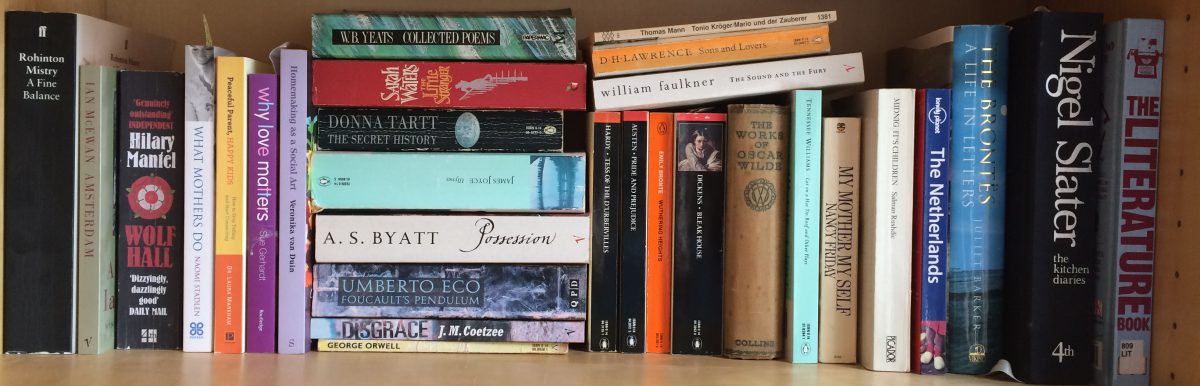
This book was everywhere when it first came out last year, surprising since it was written by a little known author and published by a relatively small independent publisher. It became a bestseller, was shortlisted for the 2016 Costa Novel Award and was the Waterstones Book of the Year. I was very keen to read it but it seemed to take a long time to be issued in paperback, so I’ve been hanging on for a while.
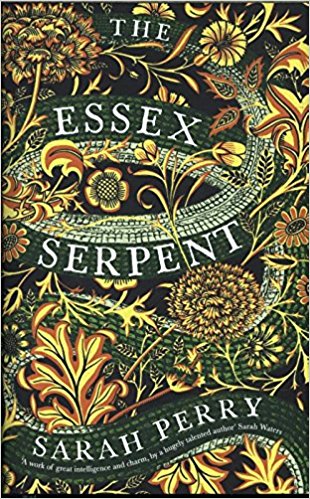 The book is set mostly in the fictional Essex village of Aldwinter in the 1890s and the action takes place over the course of a year. The central dynamic of the plot is the relationship between Cora Seaborne, a woman approximately in her late 30s, who at the start of the novel is newly widowed, and William (Will) Ransome, the local minister. Will is happily married to Stella and they have three children, while Cora is happily widowed! It seems hers was a fairly loveless marriage in which she felt constrained and imprisoned and her husband appears to have been somewhat older than her. The lack of intimacy in the marriage is indicated by the fact they had only one child, Francis, and that he is an unusual boy (for Cora “nothing shamed her as much as her son”), who is almost certainly autistic.
Once she becomes widowed, Cora is able to follow her passion for natural science, and she moves out of London to Essex. There she becomes captivated by a local myth, a mysterious serpent that villagers feel is responsible for unnatural happenings, including unexplained deaths, crop failures, madness and distressed livestock. Cora first encounters Will on one of her forest walks, when the two rescue a sheep from a bog. They later meet socially and thereafter strike up an increasingly intimate friendship. The book becomes about the development of their relationship against a backdrop of events connected with the serpent, with the illness of Will’s wife, and Cora’s relationships with other friends, including that of Luke Garrett, a brilliant surgeon who is clearly in love with her.
Whilst the book is essentially about relationships and the nature of love (it is explored in many forms) it is also about a clash of worlds. Firstly, the old versus the modern – it is no coincidence the book is set on the eve of the 20th century – and science versus religion, where Cora and Will have some of their most passionate debates. There is also reason versus superstition; the villagers fear the Essex Serpent, whereas Will finds his parishioners’ fears almost pagan in tone, and Cora wants to prove the existence of the serpent, as some sort of lost creature.
Perry also explores the position of women, from Cora, the scientist, for whom marriage had “so degraded her expectations of happiness” and for whom widowhood and thus the single life had “freed her from the obligation to be beautiful”, to Stella the model dutiful Victorian wife and mother, afflicted by a quintessentially 19th century illness. There is also Martha, Cora’s maid (although her exact position in the household slightly defies definition!), also a political activist who utilises the connections she has made through Cora to further her Marxist leanings. In many ways the themes of the novel are very modern indeed – Martha’s campaigning for suitable social housing for the poor of London is resonant of a very 21st century problem. It’s also a very erotic novel, in the Gothic sense, without being explicit; there are many tensions below the surface and some of these do not get fully resolved, which is actually quite true to life when you think about it.
I thoroughly enjoyed this book and would recommend it highly. It gripped me to the end. It’s a novel rich in themes, rich in its descriptive power and rich in its evocation of time and place.
If you have read this much talked-about book, I’d love to know what you thought of it.
If you have enjoyed this post please follow the blog, and let’s connect on social media.

 If, like me, you find yourself a little nostalgic for an era when travel meant slowing down, getting to know a place and its people (rather than just taking a selfie with a local and posting to Instagram), and immersing yourself in the new environment, then Dervla Murphy could be the travel writer for you. In On a Shoestring to Coorg, Murphy travels for the first time with her five-year old daughter, Rachel. They travel scarily light (I would take more stuff on a day out when my kids were younger!) with very little money and are dependent on the kindness and hospitality of people they meet, including a number of British ex-pats, who have made India their home in the post-colonial era.
 We’re all on a budget and we’re all busy, so why would you make the effort to go to an independent bookshop when, with a couple of clicks, you can get what you want from the comfort of your armchair and have it delivered, and probably for a discount on the jacket price? Well, as they say, use it or lose it!


 The novel opens with our central character Maddy’s eighteenth birthday. She celebrates this with her mother and her nurse, Carla; Maddy suffers from severe allergies and lives an isolated existence in her hermetically sealed home, which she has not left for many years, so these two women provide the only relationships she really has. Maddy is home schooled, receiving almost all her tuition over Skype from various tutors. Occasionally, they are allowed to tutor her in person, but only after they spend a period of time in a decontamination unit in the house, to ensure Maddy does not come into contact with any pathogens or foreign particles which might harm her. Maddy’s father and older brother were killed in an accident when Maddy was a baby and she and her mother are therefore incredibly close.
 This was April’s choice for my book club and one of the members described it as the best book we have read – she consumed it in virtually one sitting in the middle of the night when she was wide awake with jet lag! A fine endorsement indeed. It really is a marvellous book and, as I so often say on this blog, totally unfair that one so young should exhibit this much talent in a debut novel! It has also been shortlisted for the Baileys Women’s Prize for Fiction this year (winner to be annonced on 7 June), so it’s hot.


 Julia's books