May chronicles

I’ve had another long break from blog posting, but I’m happy to report that I have had a busy month of travelling, some near and some far. It was my middle child’s 21st birthday so we made a short trip to the beautiful city of Cambridge for a family celebration. Hotel accommodation in Cambridge can be pricey and I have found that the cheaper accommodation can be hit and miss and seldom has free parking. So we stayed a little outside town at the wonderful Madingley Hall. It belongs to the University and there seemed to be some conference groups there, although it is a substantial property and was by no means full. It was beautiful, with fabulous grounds and is close to one of the park and ride facilities so I recommend it highly if you are thinking of going there.

Madingley Hall, Cambridge

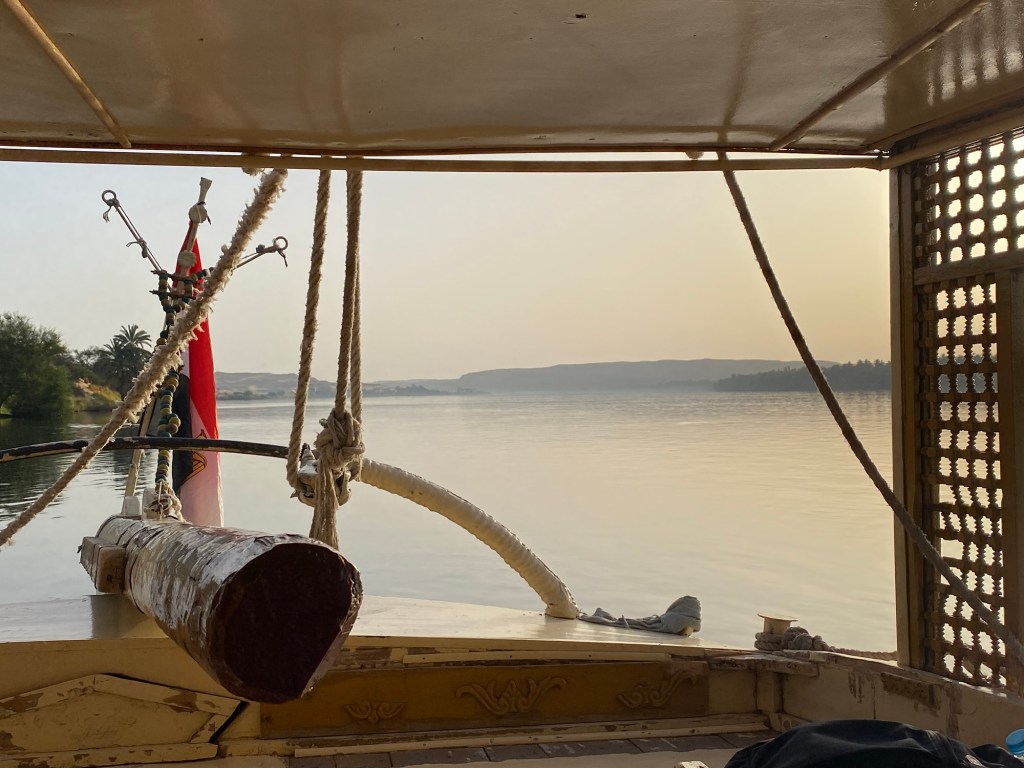
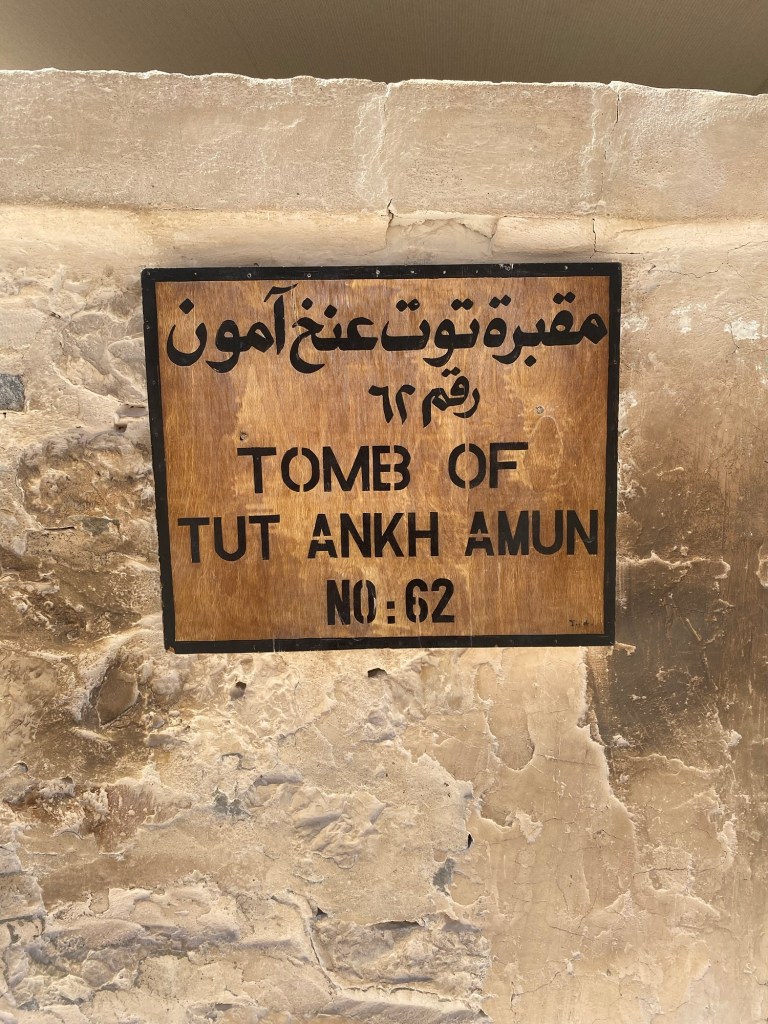
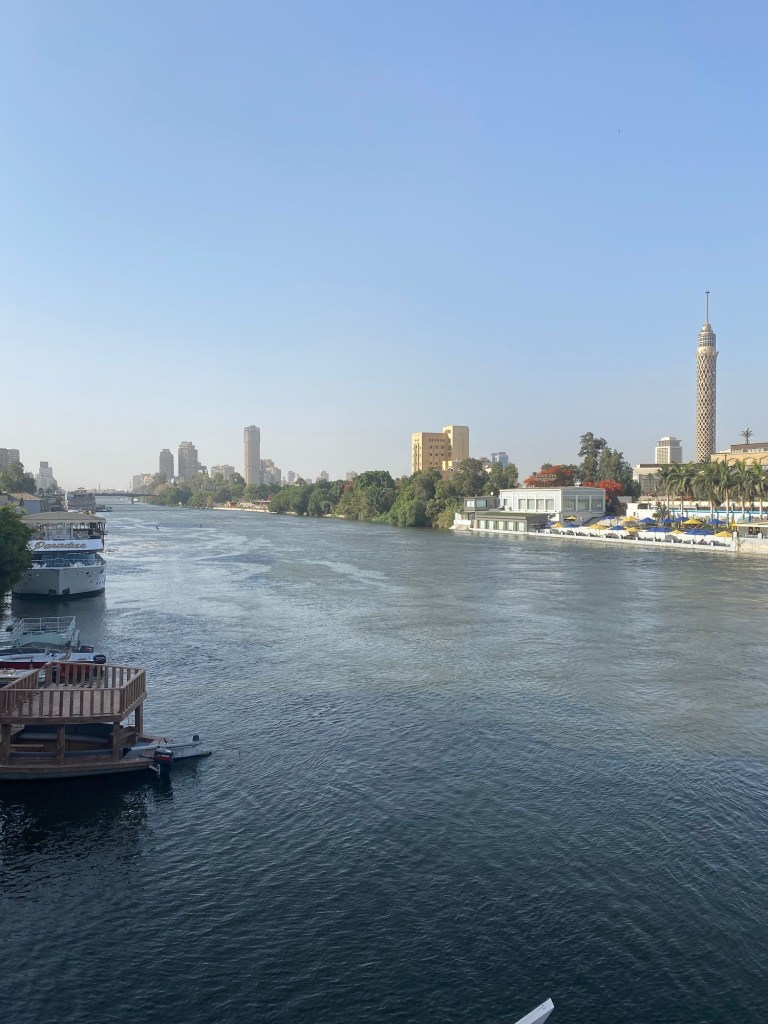
A few days after the birthday I set off for Egypt! I always enjoyed travelling when I was younger, but since having my children this has been on the back burner. Our holidays have been family affairs and we have tended to stick to UK and European destinations with the kids. This has also been the first year in about two decades (!) when I have not been bound by school holidays. My husband has a busy work schedule and is less interested in exotic locations than me so I took myself off alone! Well, not exactly alone…I went on a group tour, feeling that perhaps I needed to build my confidence a bit with solo travel before going it completely alone. I could not have made a better decision! I travelled with a company called Intrepid and the tour was fantastic. It was a very international group- Australians, New Zealanders, US, Canadian and Italian citizens and even a couple of other Brits! Such a wonderful and interesting group of people, we bonded really well and I am missing them all so much. Our tour guide was brilliant, so knowledgeable about ancient Egyptian history and culture.

I had the most marvellous time and as soon as I came back I was on Intrepid’s website thinking about my next trip! Some of my fellow travellers went on to Jordan and looking at their Instagram posts I think that might be next on my list. I’ve posted some photos below. Egypt is an incredible country, with beautiful friendly people and I will definitely go back there.

I had a few days to find my feet again and catch up on laundry before I was off again, this time on what has become an annual visit for me – to the Hay Festival. For the past couple of years I have camped at the Tangerine Fields site just outside Hay on Wye, but I decided I am over camping! I stayed in a B&B in Talgarth, about 10 minutes drive from the Festival site.
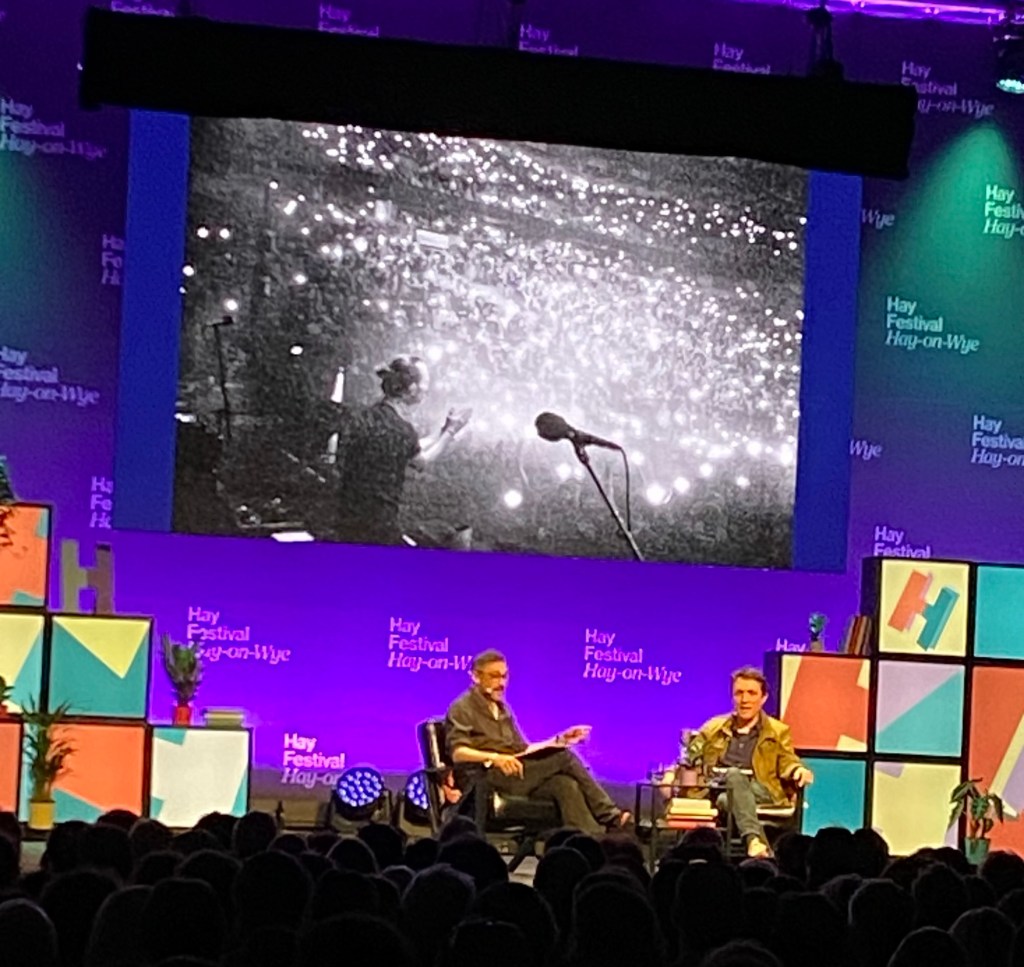
I was there for three days and, as usual, had a fantastic time. There were two particular highlights for me: my final event on Saturday evening was a talk from Radiohead bass player Colin Greenwood, who has recently published a book of photographs he has taken over the years performing and recording with his band. He was very warm and candid and clearly exhausted having just returned from touring the US with Nick Cave and the Bad Seeds. Despite this he spent almost two hours afterwards signing copies of his book How to Disappear, chatting to fans and having selfies with them – such a pro. My other highlight was seeing Kate Mosse and Jacqueline Wilson, two giants of the literary scene. Apparently, between them, they have sold 50 million books worldwide – staggering. The pair are great friends and talked about their writing habits, their current projects and many other topics. They were both so down to earth and modest.

My other events were Jeremy Bowen, BBC International Editor and often to be found reporting from the Middle East or Ukraine – I have seen him at Hay before. Listening to him is sobering indeed. I saw Hallie Rubenhold, author of best-selling non-fiction book The Five about the women victims of Jack the Ripper. she has just published a book about the case of Dr Crippen and his lover, who murdered Crippen’s first wife. She was very interesting. Less interesting was Jeremy Hunt MP. Politicians are usually good value at Hay, but I’m afraid Mt Hunt had disappointingly little gossip! He has just published a book talking about how Britain can be great again, but it struck me as somewhat blinkered about how we became un-great in the first place. His interviewer Robert Peston was a little more entertaining.


A few photos of my Hay Festival experience below.

I am looking forward to a bit of staying put in June! The winner of the Women’s Prize will be announced next week (12th June). I have a couple of reviews to post of books on the shortlist that I have read, so will aim to get those out in the next few days.

Postcard from Venice

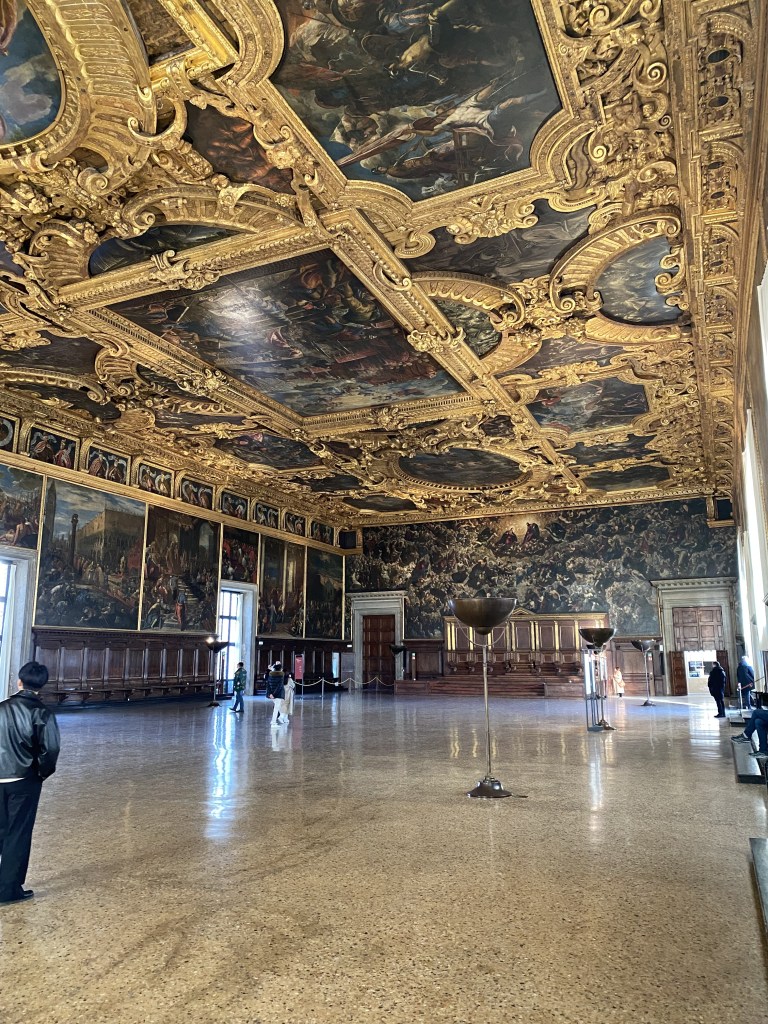
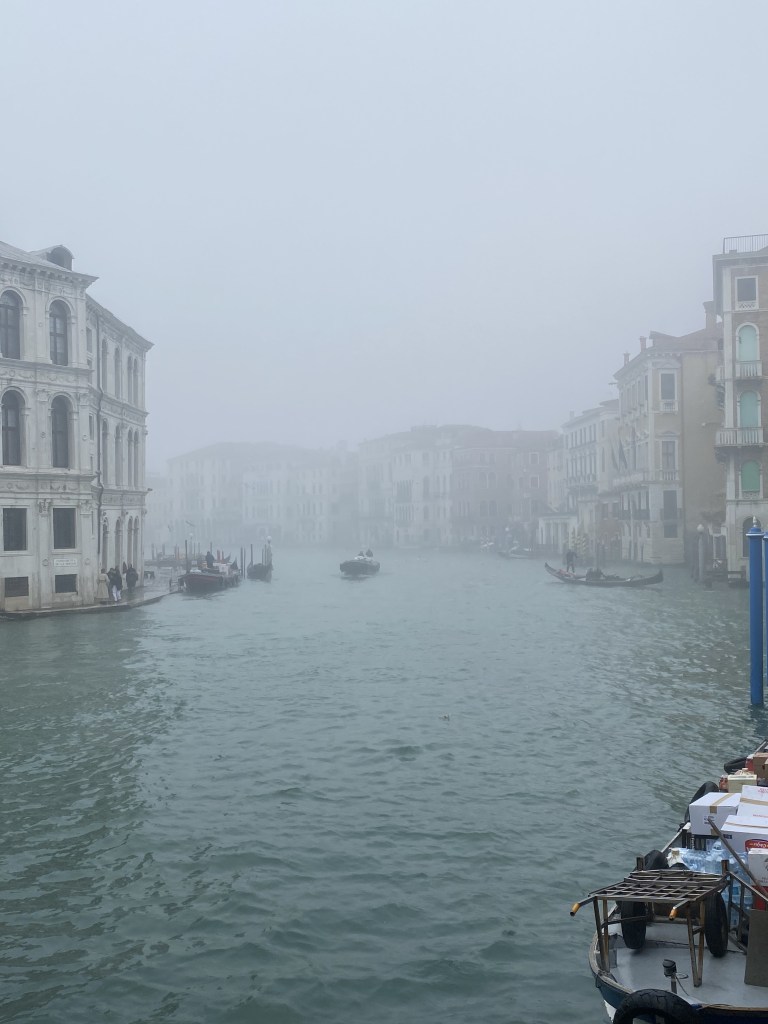
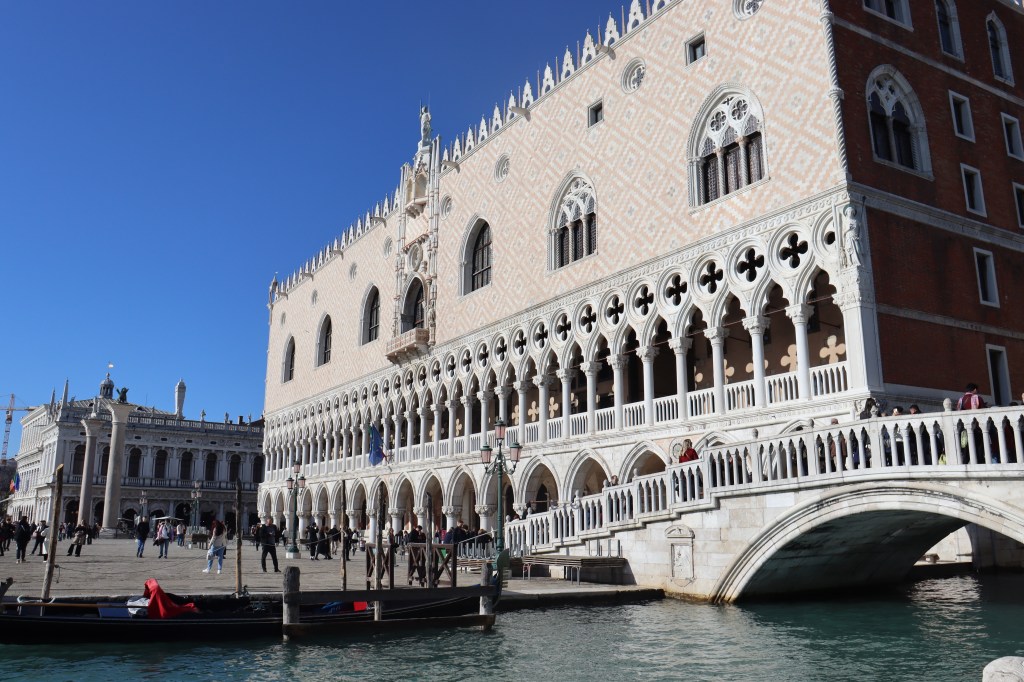
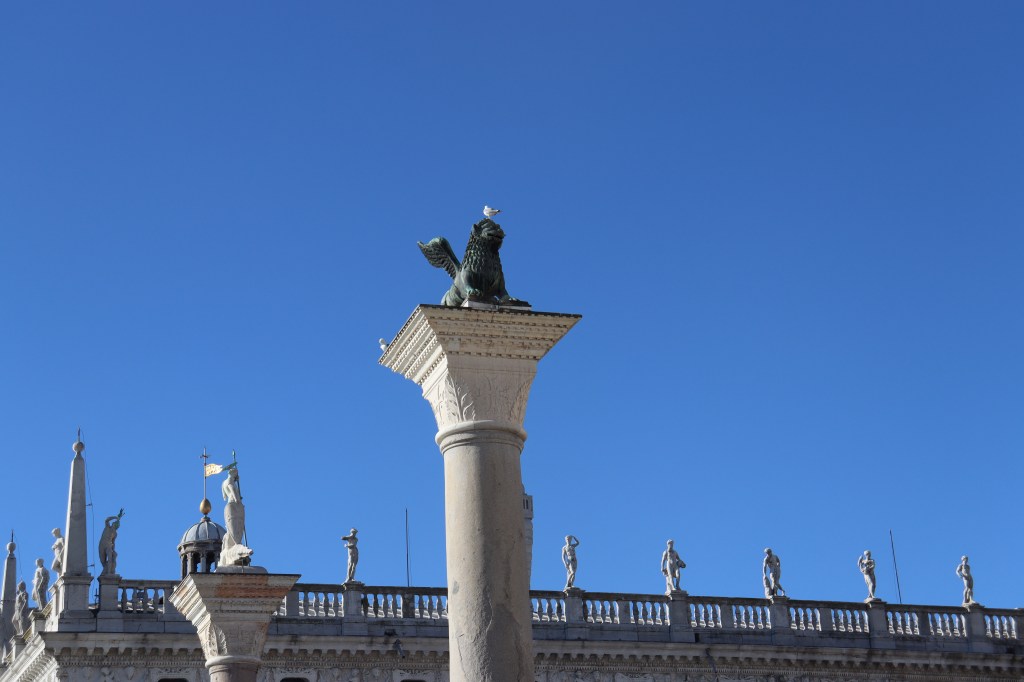
I have started the year as I hope to go on, fulfilling a long-held travel ambition! I have visited Venice a couple of times (once about 12 years ago when my kids were still quite young, and once when I was 18 and went inter-railing in Europe) and on both occasions it was mid-summer, very hot and very, very busy. Ever since, I have wanted to experience Venice in the winter season and last week, with no school term dates holding us back, my husband and I made the trip, spending 6 glorious days in this unique city. One of our favourite films is Nicholas Roeg’s Don’t Look Now (1973), starring Donald Sutherland and Julie Christie. It tells the story of a couple, grieving after the death of their young daughter, in a very grey wintry Venice, where Sutherland’s character is restoring a church. The setting is so atmospheric and ever since seeing it I have fantasised about being Julie Christie wandering along empty the alleyways and bridges over deserted canals!

Needless to say it wasn’t quite like that – it was still quite busy, although not nearly as much as spring through to autumn. But the Venetians were warm and friendly, less harassed perhaps than at other times of the year, there were no queues for the big tourist sights (by closing time at Basilica San Marco we had the place practically to ourselves) and good restaurants had plenty of tables. It was well worth compromising on the weather to get the more authentic experience (it was chilly but we did have some bright sunny days) and although Venice is never ‘cheap’ you can definitely get more hotel for your money out of season. Here are a few of my holiday snaps!

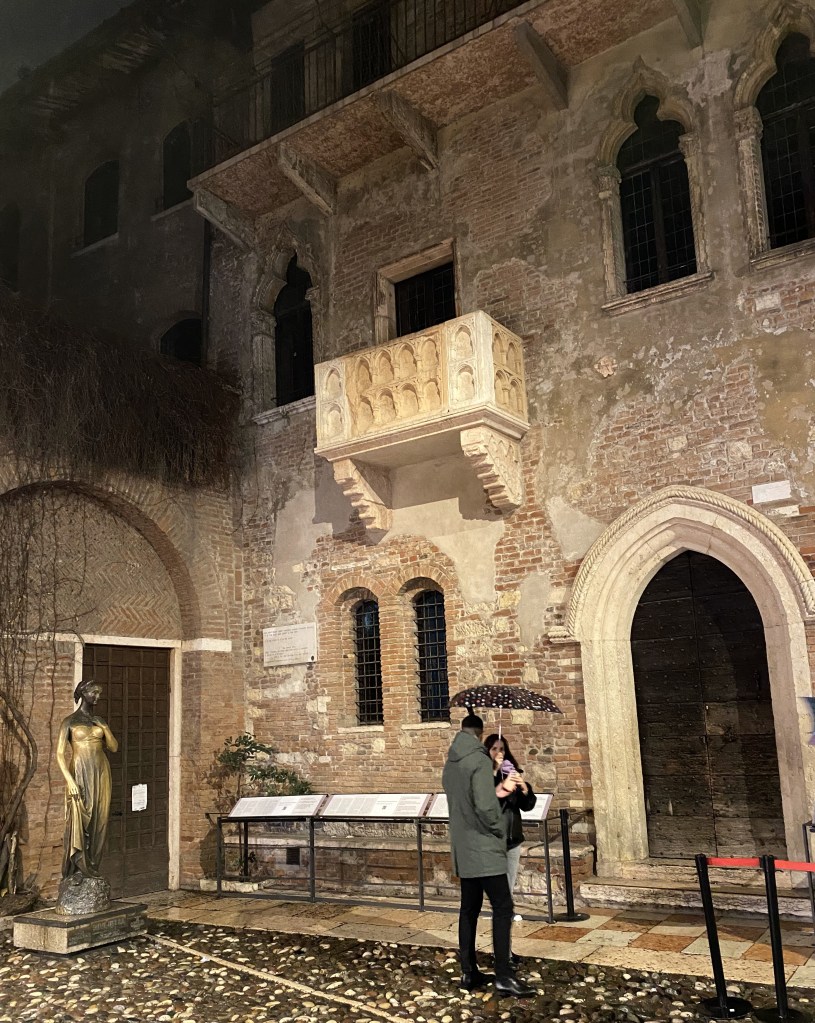
As well as beauty, culture, and fascinating history, Venice has a distinguished literary pedigree. Shakespeare set two plays in the city (Othello and The Merchant of Venice). He also set two plays in nearby Verona – Romeo and Juliet and The Two Gentlemen of Verona). We stopped for a night in Verona before heading to Venice – another truly beautiful and fascinating city – and you can visit ‘Juliet’s balcony’ (left). Scholars disagree on whether Shakespeare visited the Veneto but he certainly had a feel for the area and its stories.

A plaque in Verona commemorating Shakespeare’s connection to the city

Lord Byron, of course, famously spent a lot of time in Venice (he loved Italy), occupying a palazzo near San Marco, and referenced it in his poetry. In the nineteenth and early twentieth century American author Henry James wrote about his love of Venice, and John Ruskin wrote a three volume compendium on the art and architecture of Venice. More recently, the Russian American poet and philosopher Joseph Brodsky and American poet Ezra Pound are both buried in the island cemetery of San Michele in Venice. And finally one of my favourite books is set on the Lido – Death in Venice by Thomas Mann, also a brilliant film starring Dirk Bogarde.

So, a definite bucket list trip for me! I highly recommend Venice in the winter.

Literary sightseeing: James Joyce’s Dublin

I have been visiting Dublin for many years now as my husband is Irish and most of his family is still there. I have always wanted to visit on ‘Bloom’s Day’ (June 16th) – the date on which the whole of the events in Joyce’s seminal work Ulysses is set. However, since this falls in the middle of school term time, this has not so far been possible for me. Maybe next year! On this particular day (in fact, the whole of the week from what I gather), Joyce enthusiasts dress up in the fashions of the time and replicate Harold Bloom’s odyssey through his home town on that day.

I have visited a few of the many sites that occur in the book, however, and on our visit this summer I added a couple more to the list. Perhaps if I don’t get to ‘Bloom’s Day’ soon I’ll do my own little one day tour! Here is a broad itinerary if you happen to be in Dublin’s fair city not on 16th June.

Stop 1 – Sandycove and the Martello Tower

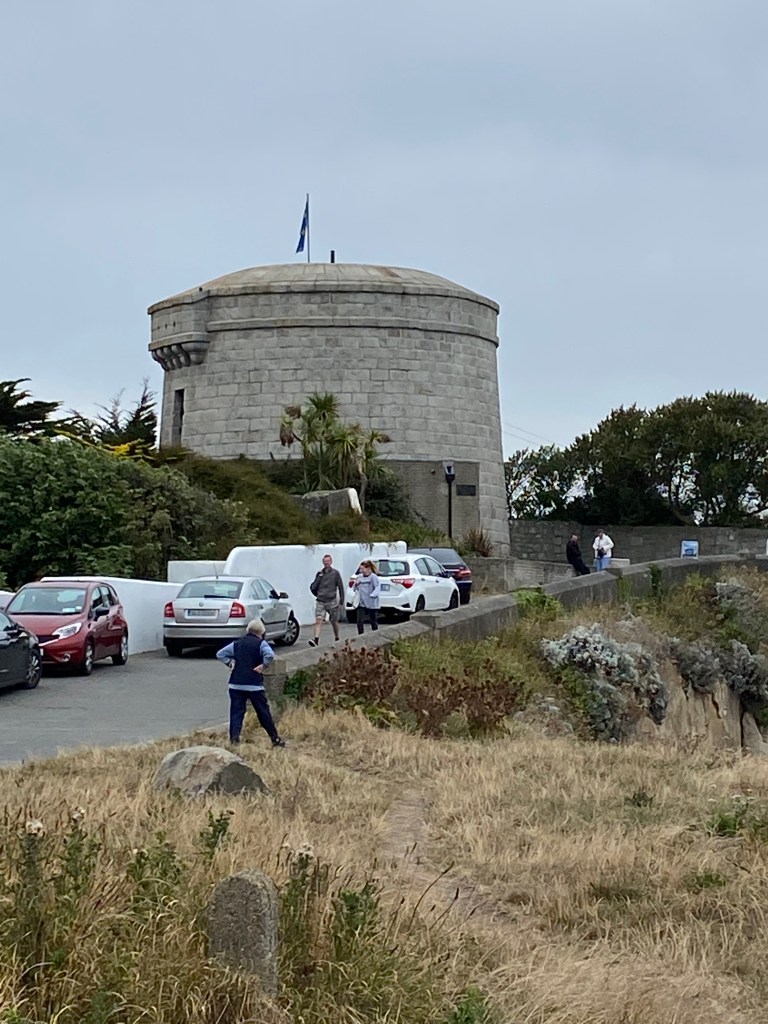
The opening scenes of Ulysses (Telemachus episode) take place in the Martello Tower (built by the British as a defence against Napoleon, who never invaded) at Sandycove. Joyce stayed here briefly when it belonged to his friend Oliver St John Gogarty. In the book, Buck Mulligan lives here and he and his two companions take breakfast following a swim in the ‘Forty Foot’, a bathing pool in the sea below the tower, which is still there.

Today, the tower houses the James Joyce museum, which has been run almost entirely by volunteers for many years, with only very limited funding. Entry is free and you can see a number of artefacts inside, as well as get a good sense of Joyce’s life and career.

Sandycove can be reached on the DART train from Dublin city centre.

Stop 2 – Sandymount Strand

Leopold Bloom takes walk here at sunset. It is a beautiful spot with fantastic views across Dublin Bay, with the iconic chimneys at Ringsend, the mouth of the Liffey. At low tide, you can walk the vast sands where work is being done here to preserve rare grasses. When the tide is in, you can walk along the promenade, along with many other Dubliners.

Sandymound Strand is a few stops north of Sandycove on the DART train.

Stop 3 – Dublin City Centre

Within the city you can walk along many of the same streets that Leopold Bloom (or Stephen Dedalus) took. I would begin at O’Connell Street (and perhaps drop in at the General Post Office while you’re there. Although not directly Joyce related, there is a fantastic museum that tells the story of the independence movement and in particular the 1916 Easter Rising, which centred on the GPO.)

From O’Connell Street you can walk south, cross the Liffey, to Trinity College (you can book tours of the famous library and view the Book of Kells), and then on to Grafton Street, Kildare Street and Merrion Square. All these locations appear in the Wandering Rocks episode.

From Merrion Square it’s a short walk then to Sweny’s Pharmacy, which I mentioned when I wrote a blog post about my visit to Dublin a few weeks ago. The shop remained a pharmacy until 2008, and the owners had changed very little of the interior from how it would have been in Joyce’s time, recognising its future tourism potential. Bloom called into Sweny’s to pick up a tonic for his wife and bought some lemon soap, a bar of which you can still purchase there today. It is run by volunteer Joyce enthusiasts, where they will chat happily to you about the author, the shop’s history, and hold weekly meetings where they read from his work.

You can get the DART from Sandymount to Connolly station, from which it is a short walk to O’Connell street. The above walking route is about 3km.

Stop 4 – Glasnevin cemetery

Glasnevin Cemetery appears in the Hades episode of Ulysses when Bloom travels there with his friends for the funeral of Paddy Dignam. It is a fascinating place with many famous Irish figures buried here including Michael Collins, Eamon De Valera, Maud Gonne, Brendan Behan and Christy Brown. Pre-booked tours are available.

The cemetery is a few kilometres out of the city centre, but there are several bus routes that pass it. Dublin buses have an excellent app where you can work out which service to get from wherever you are.

On your way there you will likely pass O’Connell Street again and can call in at the small but very interesting James Joyce cultural centre on North Great George’s Street. It is housed in one of the typical Georgian townhouses that Dublin is famous for. Another interesting stopover is the Hugh Lane Gallery. Hugh Lane was a contemporary of Joyce who established a superb art collection. He was killed in the RMS Lusitania which sank off Cork in 1915.

It is possible to visit many more Ulysses ‘sites’ than I have listed here. I can recommend the book The Ulysses Guide: Tours through Joyce’s Dublin by Robert Nicholson, which provides several detailed itineraries complete with the relevant extracts from the book.

Dublin is a fantastic city to visit with so much to see in a relatively compact area. Though Joyce spent much of his adult life outside Ireland, Dublin is at the heart of so much of his work.

Postcard from The Netherlands

We have been regular visitors to The Netherlands for twenty years now and have a small holiday home in the south of the country in the province of Zeeland. The southernmost part of the province (Zeeuws Vlanderen, or Zeelandic Flanders) is an area that has no land border with the rest of the country, being separated from it by the mighty Scheldt river, one of the primary waterways into the heart of Europe. When we first visited Zeeuws Vlanderen you reached it either by a very long detour via Antwerp in Belgium or a small car ferry between the ports of Vlissingen and Breskens. It made it feel remote. Then the opening of a 6km tunnel at the industrial town of Terneuzen transformed journey times and the economy of this part of the country. It has made Zeeuws Vlanderen more accessible and it certainly feels a little less remote these days. We tend to travel there via Calais in France, as it is less than 2 hours drive.

My daughters are both studying for exams this summer and we all needed a change of scene, so we decided to take a short break. The weather wasn’t great and the travel chaos was even less great, but it did us the world of good. This is such an under-rated part of Europe (the only visitors tend to be Dutch, Belgian or German), but for us it was like medicine for the soul!

Friday, 1 April

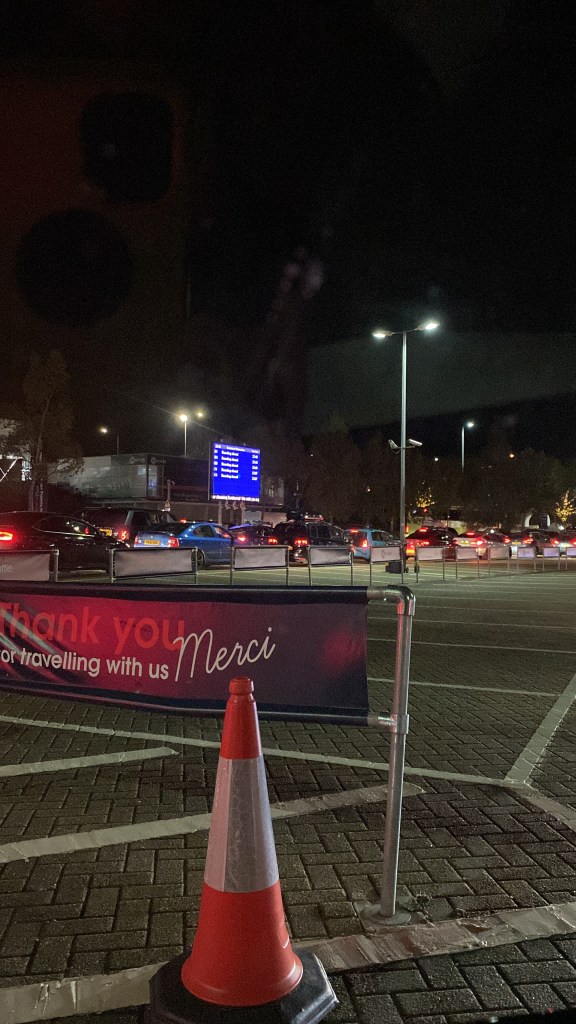
Bumper to bumper at the Eurotunnel!

We leave home straight after the end of school and drive to the Eurotunnel port at Folkestone, a journey of 275 miles. We make good progress, which stalls completely once we are diverted off the M20 (a section of which had been turned into a lorry park, under Operation Brock). The volume of traffic is such that the 2-3 mile journey from Eurotunnel motorway junction to the passenger terminal takes almost three hours! At least once we arrive in France, there is almost no traffic on the roads and we arrive at our destination in the early hours of the morning.

Saturday, 2 April

A long lie-in then a trip to the nearest supermarket in Breskens and a leisurely lunch, which must involve frites!

More vakantie apartements in Breskens

A stroll around this small town shows that since our last visit, more tourist developments have sprung up. I am happy to see this lovely place thriving, not least since it will benefit us, as we rent out our holiday home, but a part of me has mixed feelings; I’m not sure I want lots of tourists here!

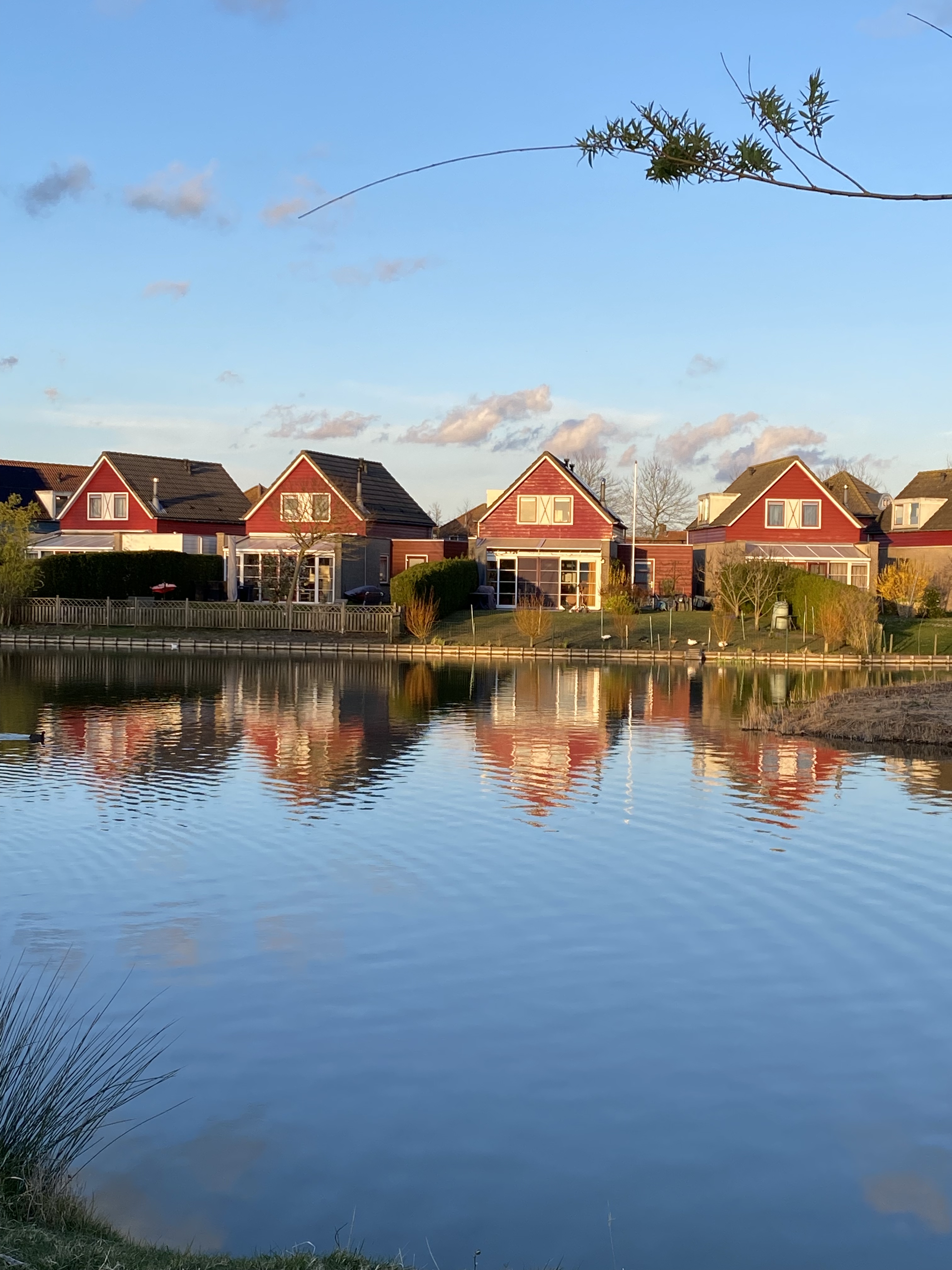
Some of the lake’s permanent residents pay us a visit!

The weather is cold, colder than I have ever experienced here in the spring, but we are just happy to be away…and enjoying the wildlife.

One of our favourite things to do here is to take an evening stroll on the dyke beside the village. The views are always rewarding.

Sunday, 3 April

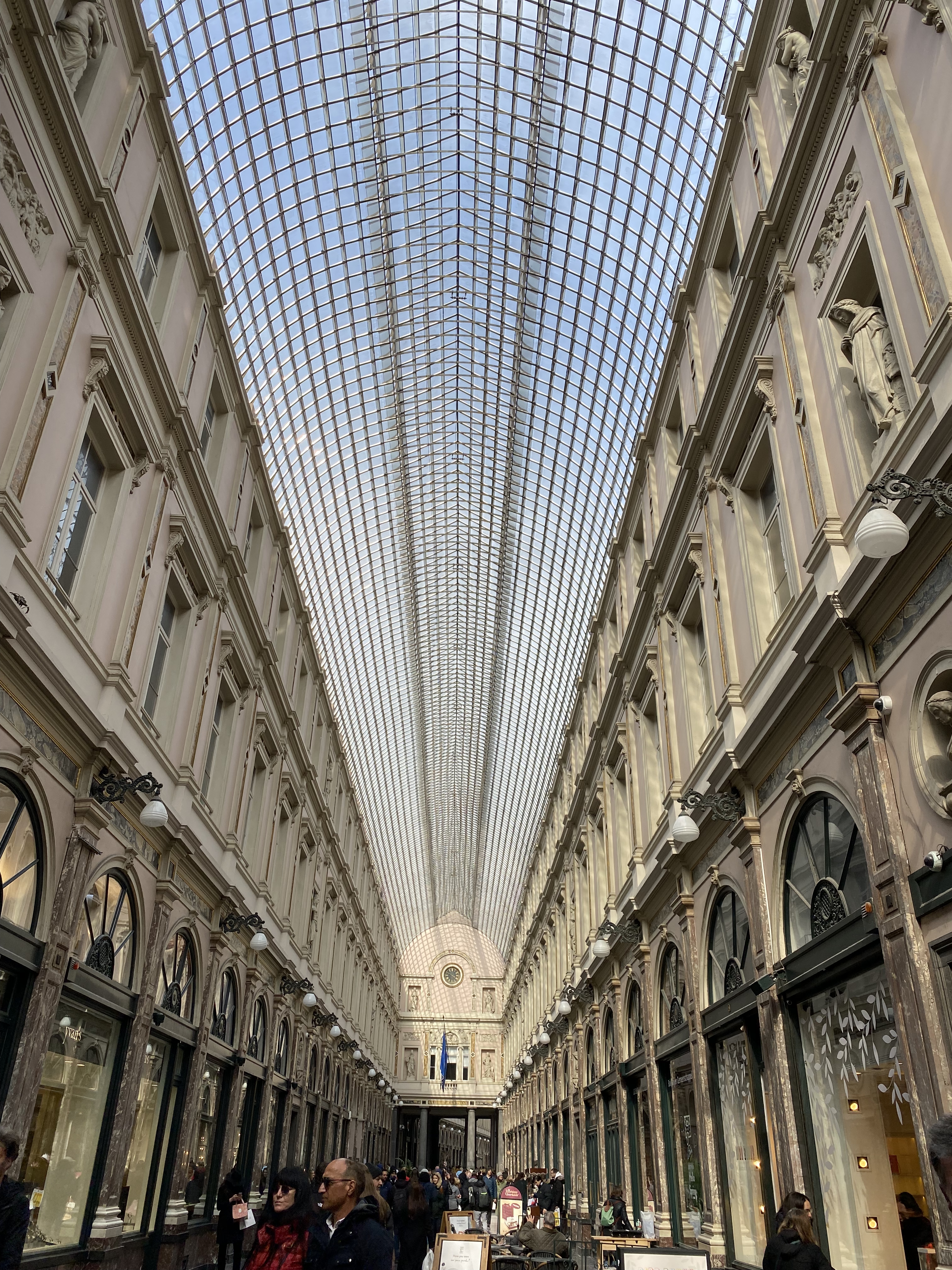
We take a trip to Brussels, to collect my husband from the airport, as he was unable to travel with us on Friday. It’s about 100km, or a 90 minute drive. I am nervous navigating the complicated ring road and finding city centre parking, but it is Sunday morning and therefore less busy. It is still cold, but it’s bright and sunny. Brussels is a beautiful city. It is also big. We stick to exploring the old town, which reminds me of Bruges minus the canals, and enjoy sipping coffee on pavement cafes, hearing clocks chiming the hour, wonderful shops, confectioners and more frites.

Monday, 4 April

No trip to Zeeland for us is complete without a day in Middelburg. This place is a hidden treasure – I’m almost afraid to mention it! This medieval town retains much of its traditional architecture and yet it has the atmosphere of an everyday working place. The quality of life here must be wonderful. My husband and I have often fantasised about renting a house here for a few months once our children have left home! There is a wonderful town square, with its spectacular town hall, edged by pavement cafes and restaurants, a museum, grand churches, picturesque canals and bridges, lovely shops, the best bookshop in southern Holland (De Drukkery), a student population and of course, coffee and frites! We often cycle here from our holiday home – we can bike to the ferry at Breskens and then cycle the 8km beside the canal, using the excellent Dutch cycle paths. But it is too cold and wet today, even for all but the hardiest of Dutch cyclists.

Tuesday, 5 April

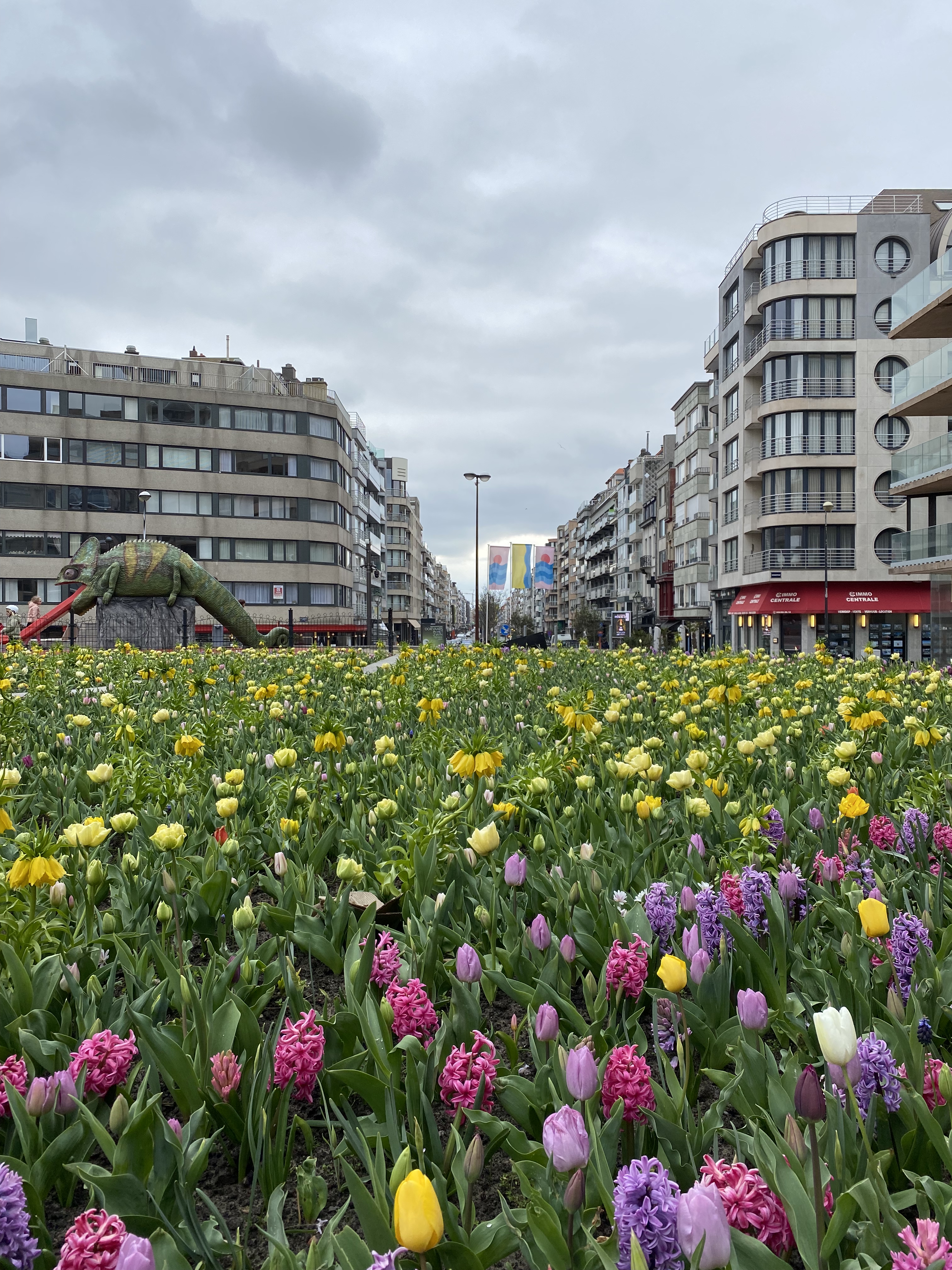
The day begins with appelflappen from the village bakery. Then we decide to head to the smart Belgian coastal town of Knokke-Heist, an attractive seaside resort which seems to consist mainly of second homes. It is quiet on a Tuesday. Most of the residential buildings are apartments, weekend homes for a wealthy Brussels elite, most likely. There are many beautiful art galleries and expensive shops, most of which only open at weekends. It has a vast beach, much of which is taken up with beach huts and cafes and bars, and a wide and long promenade. Knokke is only 30 km from our house and we have visited it often over the years. One of our favourite things to do when the children were younger was to take the Kusttram which runs for 67 km along the coast from Knokke to De Panne. You can get on and off to explore the different towns and attractions en route. Today we stayed in Knokke and just strolled around, and sampled yet more frites and ice-cream.

Wednesday, 6 April

Our short break is over and it’s time to head home. The return journey is thankfully less eventful than the one getting here. We are astonished by the size of the queue of what appear to be thousands of lorries stranded on the M20, waiting to get into Dover. My heart goes out to those drivers, who have no facilities and only the food they will have brought with them.

I did not do much reading while I was away, it being primarily a family holiday with quite a bit more packed in than we had intended.

December in pictures

A regular monthly post recalling the month past more in pictures than in words.

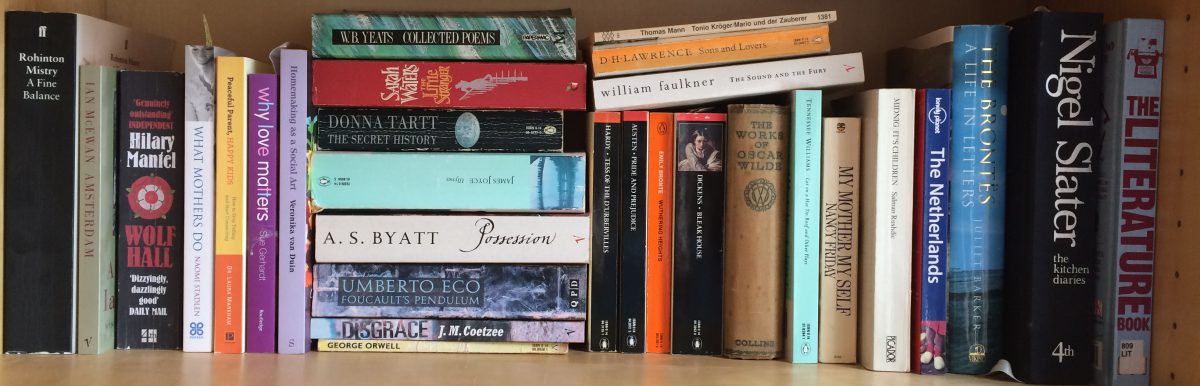
My reading in December

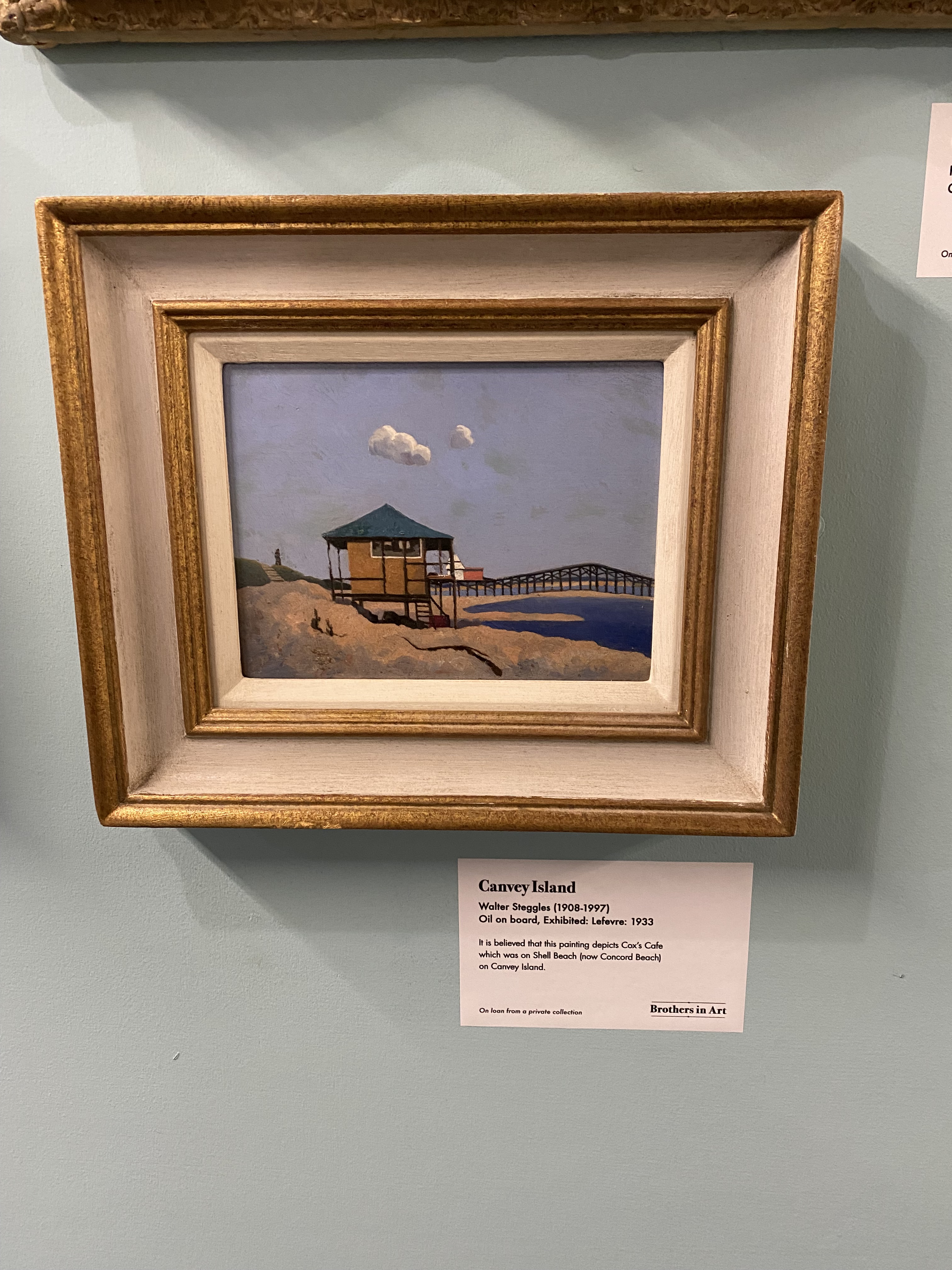
A trip to Southend and an exhibition at the Beecroft Gallery of the work of the East London Group of painters

Canvey Island, Essex. Research.

Book review: “Wild: A journey from lost to found” by Cheryl Strayed

When we first meet Cheryl, the author and narrator, she is lost. At the tender age of 26 she finds herself in a dark place, at the bottom of a downward spiral that began when she lost her 46 year-old mother to cancer four years earlier. Cheryl is one of three siblings, brought up mostly in a single parent family, the mother having left the children’s violent alcoholic father when they were still very young. The mother later married Eddie, a calm and steady influence, and they lived a humble, fairly rural and, most importantly, stable existence. With her mother’s death, however, Cheryl’s life begins to collapse in on her. She and her siblings seem unable to bond in their grief, Eddie drifts away and soon finds another partner and step-children who quickly take over the family home, and Cheryl sets off on a path of toxic behaviour (infidelity, drug-taking and serial unemployment) that will drive a wedge between her and her husband.

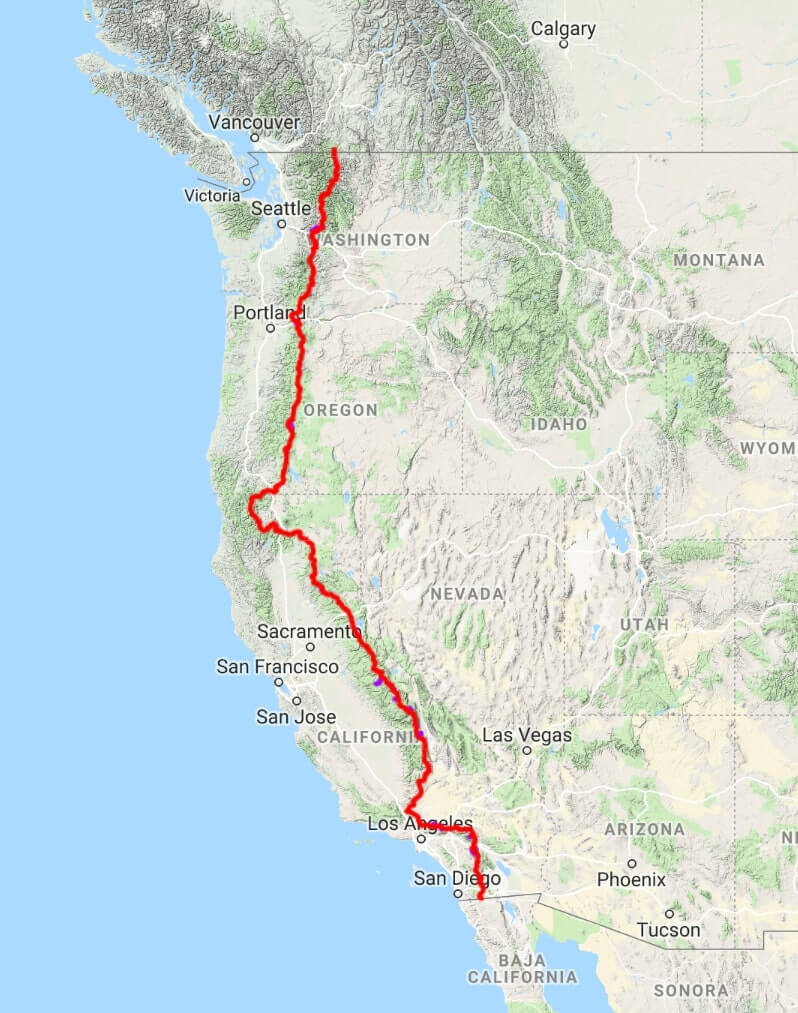
Thus the scene is set. When she has reached rock-bottom, Cheryl decides that they only thing she can possibly do is set out on a 1,100 mile solo hike on one of the toughest trails in north America. The Pacific Crest Trail runs from the Mexican border in the south, to the Canadian border in the north, through California, Oregon and Washington. The trail is, over 2,600 miles in total so the author covers only part of it, in a trip that will take her around three months. That’s enough! The terrain is inhospitable, the landscapes change from desert to snowy mountain top, which means that, since she carries almost all of what she needs with her, she requires clothing and equipment for a wide range of climatic conditions. The year that she chooses to travel happens to be one of the worst for snowfall in the mountains. The journey is treacherous enough so Cheryl decides, like all but the most intrepid of hikers, to bypass the worst affected part of the trail and rejoin lower down.

The Pacific Crest Trail

Cheryl’s constant companion on her hike is ‘Monster’, the name she gives her enormous backpack. It is monstrously heavy and carrying it gives her constant pain, from the agonies of bearing the weight, to the blisters and open wounds it wears on her hips. Her other source of pain is her boots, bought in good faith, but which turn out to be too small for a hike of this type and which lead to various foot problems, including blackened and lost toenails. But these burdens, the pains, the wounds, are a metaphor for the emotional pain that she is enduring, and as she grows fitter and stronger, and as she learns to beat her immense discomfort, so she learns to live with her grief and to make peace with her suffering. This journey is a meditation on pain. It is therapy.

The book would not be as interesting if it were a trail diary alone. Rather, it is part memoir, as the author gives us the background to her life, to the decline and fall that brought her to the momentous decision to undertake such an enormous mental and physical challenge. It is also a lesson in how sometimes the toughest things can be the most important. The author meets people on the trail with whom she develops lasting bonds and learns that she has depths of resourcefulness that she did not know she had. There are also moments of peril – when her pre-packed supply box does not arrive at the ranger station on time, when she loses a boot over the side of a mountain and has to hike for several days in her camp sandals, attached to her feet by duck tape, when she meets two suspicious characters, ostensibly out to hike and fish, but who seem to take an unnatural interest in the fact she is alone, and then ruin her water purifier to boot.

This is a fascinating story that I thoroughly enjoyed. I was on holiday when I read it and began fantasising about long-distance walking trails! Perhaps just the Trans-Pennine for me though – I don’t think I need anything on this scale!

Highly recommended.

A few days in Madrid

It has been half term in our household this week. My husband took our daughters off to visit family so I decided that I would take a trip with our eldest, to spend some quality mother and son time together. He will be taking his Spanish A level this summer so I thought it would be good to try and get him to Spain for a bit of speaking practice. I booked the flights three months ago and chose Madrid mainly because we got a fantastic price and the flight times were great. To be honest, though, I was open to going anywhere in Spain; I have been to Barcelona, San Sebastian and the Southern tip around Jerez and Tarifa, and have enjoyed my trips there very much.

Madrid, where both the grand architecture and the narrow streets bring equal pleasures.

Madrid is one of the must-see European cities. There are not too many major ‘sights’ to see, so it is not overwhelming in the same way that, say London or Paris can be (visitors to London: where do you start?), and they are mostly within a compact city centre area. You can take some great trips out of the city, for example to Toledo and Segovia, both within an hour or so, but we decided that remaining central would best suit our purpose. It is a city for walking, eating and art. We took a relaxed approach to sightseeing, soaked up the atmosphere and enjoyed it immensely.

2019-01-29-15.40.16.jpg

Our companion was the Lonely Planet guide to Madrid (I find these are consistently the best travel books). On the first day we followed the suggested walking tour of old Madrid, taking in, amongst other things, the Palacio Real, the cathedral, the Plaza Mayor and, very importantly, the iconic Chocolateria De San Gines, for the ubiquitous churros and hot chocolate (take a bottle of water with you, it is very rich!)

2019-02-19 13.51.31

2019-02-19 12.32.45
Madrid’s oldest tree, planted 1633

On the second day we walked round the wonderful Parque del Buen Retiro, the huge park to the east of the city centre, with its wonderful gardens, footpath, boating lake… and more churros! Madrid’s oldest tree, a Mexican conifer planted in 1633 and with a 52m trunk circumference, stands impressively opposite the Puerte Felipe IV entrance. Near the border of the park is the stunning Museo del Prado, which we went to in the afternoon. Most galleries of this stature need two or three visits to even begin to appreciate the collection, but if you are on a short visit it is worth just taking in the highlights, and the museum provides a handy leaflet with all of these listed. Our guidebook recommended going soon after opening to avoid the queues, but we went around lunchtime and there was no queue at all. The cafe in the museum was over-priced and not particularly good.

On the third day we went to the far west of the city centre to the Parque del Oeste. We planned to go on the Teleferico, a 2.5km cable car that travels over the vast green Casa de Campo, but sadly it was closed for maintenance (an issue with low season). We went to the tiny church of Ermita de San Antonio de la Florida (above) where there are some incredible Goya frescos, and the ancient Templo de Debod, a gift from President Nasser of Egypt, dismantled and transported brick by brick in 1968 (sadly, also closed). We walked back along Gran Via and browsed the shops. I always like to get the measure of a place by checking out its bookshops and Madrid has some fantastic ones, with plenty of foreign language books. There was even a bookshop devoted entirely to mountains (Libreria de Montana, above) in the Huertas district!

2019-02-21 12.37.24-1
Sculpture in the garden of the Centro de Arte Reine Sofia

On our final day we had plenty of time before our late afternoon flight to take in the modern art gallery of Centro de Arte Reina Sofia, not far from where we were staying. I was particularly keen to see Picasso’s Guernica, a painting I have long admired. It is truly stunning and I am thrilled to have been able to see it in the flesh, as it were. It is surely one of the finest anti-war artworks ever, and, 80 years after it was created, is as relevant as ever. It was worth the €10 entrance fee on its own just to see this, but there are many other stunning works of art to take in, including films explaining the context and history, and the main highlights are all on the second floor, again, useful if you have limited time.

My son and I are both fairly frugal by nature so I was keen to try and do the trip on a budget. We stayed in a little apartment in the Lavapies district, which was quiet and is great value. You can eat fairly cheaply, because there is so much choice and the quality is reliably good (definitely unlike London!). We spent €50-60 a day on lunches and dinners, including a glass of wine with meals. I bought a 10-journey Metro ticket, but we didn’t use it all up as we were able to walk nearly everywhere. That would no doubt have been less comfortable in the summer. February was a great time of year to go and I would definitely recommend it – the weather was mild and sunny and it wasn’t too crowded. We went to the cinema a couple of times, and I was pleasantly surprised to find tickets were only €5-6 each – that’s even cheaper than my little local cinema! My son found this very useful for his Spanish.

Madrid is a fabulous city, the people are warm and friendly, the food is incredible, it’s great value and I recommend it highly. We are completely churro-ed out though!

Have you been to Madrid – what were your highlights?


If you have enjoyed this post, I would love for you to follow my blog. You can also connect with me on social media using the buttons above.

Au revoir Brittany! Back to blogging!

Although it’s been a wonderful summer, it feels, as always, good to get back to my desk, to my computer and to my blog. I’ve had nearly 3 weeks ‘off’ – I use that term more because it is a general expression, not because I see it as any kind of chore. In truth, I have missed my blog! The reason I have posted so rarely is because I was a) doing so much reading, b) got totally sidetracked by a nearly impossible jigsaw puzzle at our holiday home (!), and c) was just having a great time with the family. When I wasn’t reading we were cooking, eating, talking, staring at the stars, a sight we are not so used to in our light-polluted Greater Manchester suburb, getting out and about, all the things you do on holiday, really. It’s been a fantastic break for all of us and we have all come back newly energised to face into the new academic year (it’s another big one for our family), ready to meet new challenges and set new goals.

974db1fd-e67b-4366-9e06-9cac492fef1b-1125-00000161832e76ce_fileI managed to read all three of the books I took on holiday with me, and enjoyed all of them immensely. They were Harvesting by Lisa Harding, Death on the Nile by Agatha Christie, the August choice for my Facebook Reading Challenge, and The Last Runaway by Tracy Chevalier. I’ll be posting reviews of them over the next few weeks.

So before I launch into the ‘new year’ (I’ve posted here before that I find September a more effective time to start things than January), I would like to close off the summer with some pictures of beautiful Brittany. We stayed in Cancale, well-known for its oysters, something I eat maybe once every couple of years – twice in a fortnight is enough!

I loved Mont-St Michel, over the border in Normandy. It was absolutely thronged, but we arrived early afternoon and by 5pm the crowds had thinned significantly.

We visited beautiful Dinan, ‘town of history and art’, a couple of times and I loved it. One tip if you go there – don’t expect to be able to get lunch after 2pm!

Another favourite was Ile-de-Brehat, a wonderful island, just off the coast near Paimpoul. It’s tiny, rugged, and there are no cars. You can hike from one end to the other, or as we chose to do, cycle all the way round.

Finally, from my holiday photo album, recognise this?

2018-08-28 16.39.09

I was delighted to be able to visit St Malo, setting of Anthony Doerr’s wonderful novel All the Light You Cannot Seea truly beautiful town.

Have you ever visited Brittany or been to any of these wonderful places?

If you have enjoyed this post, please follow my blog. I mostly post book reviews, with a few other things scattered in between!

Easter Greetings

easter-3248883_1280

Easter is falling rather early this year, and with the weather not looking great for the UK this weekend, it could be a rather chilly Spring break. Perfect for spending time with a book! My kids will be getting the usual smallish chocolate egg from the Easter mummy bunny, plus a book token, a tradition I started a couple of years ago.

I’ll be away for a few days and have been giving some thought to what reading material I will take with me. I will, as always, take far more than I will actually get through, but I do that because I get a bit nervous when I have only one book available to read! I like to have a choice and nearly always have a couple of books on the go, in any case.

I’ll be taking Paul Auster’s 4321, about which I posted here a couple of weeks ago. I started it last Autumn and have found it really hard-going. I have been pondering whether to give up on it, but I think I’m going to give it one last focussed go, to see how I get on.

I’ll also be taking Frankenstein, the 1818 classic by Mary Shelley, which celebrates its bicentenary this year. I’m reading that with my girlfriends from my book club and we have booked to see the new production that is currently running at the Royal Exchange Theatre in Manchester in a couple of weeks. Really excited about that.

That’s it. Just the two books! That demonstrates an unusual realism about my reading and my commitment to doing justice to 4321, I think. (Although I do have a couple of back up books on my e-reader. Just in case.)

I bought a couple of magazines for the journey (I can’t read a book in a car) and nearly choked when I discovered they were £4.30. Each! Is it really that long since I bought a magazine? You can buy half a book for that!

Have a wonderful Easter, with plenty of reading and chocolate!

What will you be up to this Easter? What are you reading?

If you have enjoyed this post, do follow my blog, I’d love to hear from you.