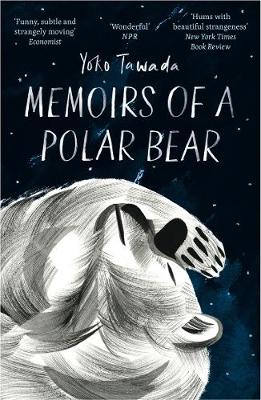
Book review: “Memoirs of a Polar Bear” by Yoko Tawada

This was April’s book in my Facebook reading challenge – I had mistakenly assumed it was a children’s book, as that was our theme for the month. It quickly became apparent to me that it definitely was not! This raises an interesting question in itself, however: why are we enchanted by our children’s books, with their talking animals, cross-species interaction, and animals mixing, seemingly without comment, in the human world, and yet, for our ‘adult’ books, we find this difficult to accept? Don’t get me wrong, I did indeed find this a really challenging read, and I’m still not really sure what I think about it, but it has made me realise that the genre of magical realism, into which I think this book falls, requires a certain openness of mind that we have to be really ready for. I think part of my problem, particularly with the opening section of the book, is that it really wasn’t what I was expecting. I felt somewhat thrown and it inhibited my engagement with the book.

Memoirs of a Polar Bear imgI’ll summarise the basic story of the novel. Part one is the most surreal and the most difficult. It is narrated by the nameless ‘grandmother polar bear’ (grandparent to Knut, star of part three). She has been reared as an attraction in the Soviet Union, by a cruel master, who, among other things, teaches her to stand on her back legs using what we would now regard as unethical methods. I think that by getting the bear to stand like a human the author justifies the morphing of her subject into something less animal. Throughout this part we are asked to suspend our disbelief: the bear escapes Soviet Russia, writes her memoirs, and flees to Germany, where she is ‘protected’ by an unscrupulous agent who simply wants to exploit her because her book has been so popular. The bear visits bookshops, makes human friends and animal enemies (the sea-lion publisher who makes ever more unreasonable demands). It’s all very tricky for us as adult readers.
I think part one is the most overtly political: there is the comment on the dehumanisation of life in the Soviet Union (thus the blurring of the boundaries between the animal and the human?), the bear as outcast (because she is foreign not because she is a bear), the futility of administrative and management practices, and about the impact of climate change – there are frequent references throughout the book to the threat to the species from the disappearance of its natural Arctic habitat. I think as a reader you just have to accept its surreal qualities.

Part two is about the polar bear’s daughter Tosca, who is a circus performer in East Germany. It is narrated by Tosca’s trainer, Barbara (although there is an interesting twist at the end of this part which I won’t spoil), and as such it feels more ‘normal’ to us as readers. Tosca and Barbara develop a very deep connection, which results in extraordinary performances, driving the greedy circus managers to demand ever more dramatic stunts. Her relationship with the polar bear leads Barbara to reflect deeply on the relationship between humans and animals and the author exposes the hypocrisy of the humans, who for example, see polar bears as aggressive and unpredictable whilst prosecuting violent wars themselves. There is also an exploration of gender inequality in this part as the trainer Barbara is as exploited as her animal charge.

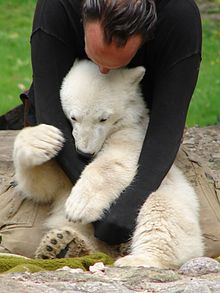
knut the polar bear
Knut the polar bear (2006-2011) with his keeper at Berlin Zoo

The final part of the book is about Knut, Tosca’s son, and is based on real events. Tosca says that she gave Knut away (in reality he was rejected by his mother, the inference being that reproduction in captivity drives unnatural behaviours), and he is raised by a human keeper, with whom, once again, he develops a very deep bond. I found this part the most moving and it is definitely more rooted in realism, even though it is narrated by the bear. I have read a little bit about Knut subsequently and it has made my reading of this part of the book more poignant. (Knut died suddenly in Berlin Zoo in 2011, aged only four years, from a brain disease). This part of the book truly challenges our attitude to animals and our use of them in captivity for entertainment, amusement and commercial gain. It also exposes most starkly our attitudes to climate change, habitat loss and species decline: we claim to raise animals in captivity (with all the inherent cruelty that entails) so that we can protect the species, without doing anything about the underlying causes of species decline.


Overall, I found this book quite difficult to engage with – I wish I’d known a bit more about it before I started it, but all the reviews I read didn’t really give much away about what the book was about. That is normal for book reviews – no-one wants to give away a spoiler. But there isn’t much to spoil in this book because there is no ‘plot’ as such. I think I could also have engaged with it more if someone had told me to read with a very open mind! That’s a lesson for me as a reader. I have enjoyed this book more in retrospect, as I have reflected on its subject matter and themes, and I am glad I have read it, even if it didn’t always keep me awake at bedtime!

Recommended if you like these themes and can be open to the surreal!

How did you get on with the surreal aspects of this novel?

If you have enjoyed this post, please subscribe to my blog by clicking on the ‘Follow’ button, and let’s connect on social media.

Women’s Prize for Fiction 2018 – shortlist announced

The shortlist for the Women’s Prize for Fiction, formerly the Bailey’s Prize, was announced last week. This prize is one of the foremost competitions for women writers and it’s one of those where every year the shortlist list looks like a box of precious jewels (unlike the Man Booker which always manages a curve ball or two, in my view!) There is NOTHING on the list this year that I don’t want to read at some point! So many books, so little time, especially as I’m giving over more of my reading time to children’s literature these days.

If you’re looking for something to read yourself, I have heard great things about all of these books, and I suspect you won’t go wrong if you pick any one of them.

This slideshow requires JavaScript.

The novels on the shortlist are:

Sight by Jessie Greengrass – a woman recounts her journey to motherhood and reflects on the relationships she had with her mother and grandmother.

Home Fire by Kamila Shamsie – Isma is studying in America, having spent years raising her two younger siblings following their mother’s death. The family becomes embroiled in London with Eamonn, the son of a high-profile Muslim politician. It’s a novel about destiny, choices and love.

Sing, Unburied, Sing by Jesmyn Ward – a story about race, drug abuse, broken masculinity and poverty in the US seen through the eyes of thirteen year old Jojo and his mother Leonie.

The Idiot by Elif Batuman – a story about language and culture set in Harvard, Massachusetts, where Selin, a Turkish-American, is studying and meets others like her, of mixed race and mixed cultures.

The Mermaid and Mrs Hancock by Imogen Hermes Gowar – a story about the power and mythology of mermaids. set in 18th century London, where the merchant Jonah Hancock learns one of his captains has sold a ship in exchange for a mermaid. News spreads and Hancock finds himself the centre of London society.

When I Hit You: Or, A Portrait of the Writer as a Young Wife by Meena Kandasamy – a novel about domestic abuse and control, and the crushing of a young woman’s hopes and ambitions by a domineering husband.

I haven’t read any of these and doubt I will manage to get through this list by the time the winner is announced on 6 June. The first and the last on this list appeal to me most, although Sing, Unburied, Sing also looks like a must-read.

I’d love to hear from you if you have read any of these – what do you recommend?

If you have enjoyed this post, do subscribe to the blog, by clicking on the Follow button, and let’s connect on social media. 

YA book review: “The Nowhere Girls” by Amy Reed

The Nowhere Girls imgThis is a very hard-hitting YA novel for older teens. It is an important book, dealing with a very current issue, misogyny, sexual violence and rape, but as a parent I found it extremely challenging to read. The story is set in Prescott, Oregon, a medium sized-town in the northwest United States. It centres on a group of three girls in high school (so about 17 or 18 years old) Grace, Erin and Rosina. Grace has moved to Prescott after her mother (an evangelical preacher) was forced out of her position in their previous home in the southern US because of hostility from the congregation towards her views. Grace finds, in her bedroom in their new home, some cryptic words scratched into the woodwork. She discovers that the previous occupant of the room was a girl called Lucy who alleged that she was raped by fellow students. No charges were brought and Lucy and her family left the town.

Grace struggles to make friends in her new school, because of her southern accent and her newness, but eventually connects up with Erin and Rosina, relative misfits in the school community. Erin has Asperger’s and her mother is over-protective and a zealous moderator of various social media groups and forums. Her obsession with this activity and her over-anxious concern to do all the right things, inhibits her from having a truly meaningful relationship with her daughter. Rosina comes from a large extended South American immigrant family and has a tempestuous relationship with her mother and her other relatives for whom she has to work for little or no pay, babysitting and waitressing.

The three girls are thrown together and Grace learns about what happened to Lucy, the author of the words scratched into the woodwork. Like her mother, Grace is earnest and a campaigner and she vows to do something about this unresolved issue. She sets up a secret group, calling it The Nowhere Girls, with a view to the young women at the school sharing their experiences and, Grace hopes, banding together to do something about the widespread misogyny. The group takes off in ways that none of its three founders could have anticipated; their secret meetings, held after dark in abandoned or remote locations, are well-attended and the young women share stories of widespread rape, and violent or coercive sexual encounters. The girls decide to go on a sex strike, to teach the boys a lesson, and as news of this spreads, the school authorities become increasingly angered and concerned about the reputation of the school and about the effect it is having on the stability of the school community.

As the book progresses events take on increasingly sinister turns. As the meetings of the Nowhere Girls expand it becomes clear that whilst misogyny and taking girls’ sexual availability for granted are widespread, the worst offences seem to have been committed by a small group of boys. Also, the Principal of the school becomes ever more extreme in her determination to stamp out the disruption caused by the Nowhere Girls, engaging in the kinds of blackmail and threats and that are effectively colluding with the perpetrators of the sexual crimes. The book is hinting at a wider social acceptance of rape and sexual violence as inevitable and quietly endorsed by those with vested interests in a storm not being created.

Once I had got past my initial doubts about the book’s basic premise, I found it a real page-turner. As a parent of teenagers I also found it a useful insight into a world I no longer know, not the sexual violence side of things, but the feelings of young women about their relationships with their parents, their relationships with each other and their hopes and desires around romantic partners. Coming back to the book’s premise, that rape and sexual violence are pretty common in high schools, accuse me of living under a rock if you like, but I found this difficult to accept as a phenomenon. Remember this is set in the US, so things may be different over there, but it painted a much more extreme view of a middle class high school community than was familiar to me. Perhaps I’m out of touch, but…

There are some sub-plots in the book, which help to lighten the load, for example, the relationships all three central characters have with their mothers, and the rather nicer romantic attachments they develop, including, in Rosina’s case, an exploration of her burgeoning homosexuality. But there is no doubt the book is at times graphic and disturbing, and therefore, I would suggest, suitable for older teens only. I think there are many important issues handled here, and they are sensitively done, but I would suggest it should be read by parents first before handing to under 18s. It may also form a useful basis for discussing these sorts of issues with your teens.

Do you think parents should ‘vet’ books before their teens read them?

If you have enjoyed this post, do subscribe to my blog by clicking ‘Follow’, and let’s connect on social media. 

Book Review: “Madame Bovary” by Gustave Flaubert

My Facebook Reading Challenge 2018 is well underway and March’s theme was a classic. I chose Madame Bovary, Gustave Flaubert’s 1857 classic, because it seemed to fit well with a lot of the women’s issues around and being discussed at the moment, particularly gender equality and sexual exploitation. It is fair to say that it had a mixed reception among the readers on the Facebook group!

2018-02-22 14.12.54I had read this book previously, but many years ago as an undergraduate, so whilst I had remembered the basic story, I had forgotten much of the detail. I had forgotten for example just how brilliant the writing is and how very like Jane Austen Flaubert can be in his use of irony. By all accounts, Flaubert was a perfectionist and spent years on this book; it is certainly masterful and for me the writing was sublime. I had also forgotten how unlikeable all the characters are! Even Emma, our supposed “heroine”, is at times unpleasant, childish, selfish, superficial and self-obsessed. When I discussed it with my husband (who speaks fluent French and read it in the original) he was surprised that I did not find Charles Bovary, Emma’s husband, sympathetic. Interesting that he felt affection for the long-suffering, betrayed husband who loved his wife to the death, despite her many faults, whereas I found him ineffectual and basically unable to connect with his wife on any level, and that was part of the problem in their marriage.
I don’t think even Flaubert liked his characters and I think it was the intention of the author that we stand with him and examine the people he puts before us, with all their flaws. I believe he wants us also to dig a little deeper and examine the French provincial society that gave rise to Emma. As a young woman she lives a dull and uninteresting life with her widowed father on a farm, until the day she marries Charles, a physician in a neighbouring town, and goes to live a dull and uninteresting life with him. Passed from one man’s home to the next. Emma would not have had expectations, but she was an intelligent woman and the kind of life she was forced to lead did not fulfil her deeper needs. She is a woman of deep passions, but there is no outlet for them, apart from the romantic novels she devours. Certainly, Charles does not really do it for her! “Charles’s conversation was as flat as any pavement.”

Flaubert hints that Emma’s lack of fulfilment may be dangerous when he observes, after she and Charles were invited to an aristocratic ball, where she glimpses how the other half live and begins to fantasise:

“This life of hers was as cold as an attic that looks north; and boredom, quiet as the spider, was spinning its web in the shadowy places of her heart.”

What a sentence! Emma is naïve and inexperienced, however. Her life has been limited and she sees events in the most superficial of ways:

“She confused in her desire, sensual luxury with true joy, elegance of manners with delicacy of sentiment.”

Flaubert doesn’t expect us to like Emma very much, but I think he wants us to see her as a product of a time and a place, not as wilful and malicious.

Seduced by romantic fantasy, Emma takes lovers, both of whom are equally selfish and unpleasant. Whilst she is clearly a willing participant in her adultery, there is no doubt that both Leon and Rodolphe exploit Emma. When Emma’s reckless behaviour leads her to run up unsustainable debts, the town’s notary, from whom she has been borrowing money, also exploits her. When he requests sexual favours in return for his continued discretion we can see how deeply lost Emma’s situation is and how as a woman she has almost no power or autonomy. Her response to him, is when we begin to see for the first time something more admirable in her spirit:

“You are taking insolent advantage of my distress, monsieur. I may be in a pitiful state, but I am not up for sale!”

Parts of the book are heavy going, but it is in Part Three that we see the tragic coming-together of events, the closing-in on Emma of all the consequences of her misguided actions, her falsehoods, and the tremendous dislike she accrued. She is not a nice woman – she betrayed her husband, who did not understand her, but loved her in his own way, rejected her daughter and treated those about her with contempt. She was the architect of her own downfall, but she was also a victim of heartless men, of social norms and conventions that failed women like her and gave them no outlet.

She is a difficult heroine for us, but one who makes us think, for sure. Recommended because it’s just one of those books you have to read!

Do you find it hard to connect with the classics? What is your favourite?

If you have enjoyed this post, do subscribe to my blog by clicking on the ‘Follow’ button, and let’s connect on social media.

Relaxing in The Netherlands

Holland is a fascinating country. My family and I have been going there for years, usually spending a week or so there in the Spring. Whenever I tell people that I am off to the Netherlands they utter an interested “Oh!” but I am sure that what they are really thinking is “Why?”!

IMGP0012.JPGWe spend our Spring break in the south of the province of Zeeland, in an area that borders Belgium and which was until very recently separated from the rest of the country by the mighty Schelde river.  The opening of a 6km vehicle tunnel in 2003 beneath the Schelde at the town of Terneuzen, brought huge economic benefits to the area. On a map, Zeeland looks like a collection of islands jutting out into the North Sea, which appear to be joined to the rest of the country by the most tenuous of links. In truth, this part of the Netherlands does indeed have a tenuous grip on the land, much of it having been reclaimed from the water by sheer force of will and human ingenuity. These tracts of land are known as polders and maintaining the dikes and the drainage systems, the sea defences and the canals, is a national preoccupation.

From time to time, the sea reasserts itself (and we will no doubt see more of this across the world as low-lying lands will be the first to be hit by climate change and rising sea levels). The last major incident was in January 1953, when a storm surge in the North Sea led to the deaths of 2,551 people, including 1,836 in the Netherlands, and 326 in eastern England and Scotland. A total of 9% of Dutch farmland was under water. (See the images below of exhibits from the wonderful Watersnoodsmuseum in Ouwekerk.)

I have only known about the 1953 flood since 2002, when we first started going to this part of the Netherlands, and every year I have learned more and am increasingly fascinated not only by the history of this and similar events, but also by the relationship the country has with the sea and mor widely with nature. Much of the landscape of Zeeland is man-made, many of the beaches where we have spent some glorious sunny days have been created, but I find there is a greater harmony between human enterprise and nature and an immense respect for the natural world that I have seen in few other places.


From where we stay in the village of Hoofdplaat, in the area known as West-Zeeuws Vlanderen (nearest town is Breskens), we are within cycling distance of many pretty Dutch towns. We are also driving distance from the Belgian towns of  Bruges, Ghent, Antwerp, even Brussels. Amsterdam and Rotterdam are even do-able on a day trip.

Our annual trip to the Netherlands is one of the most relaxing and energising weeks of my year. The biggest problem is returning to gridlocked England and making the snail’s-pace journey back up to the north via the M25 and M6. As for the potholes…! Something you seldom see on Dutch roads. I recommend Zeeland for a relaxing break…just don’t tell anybody. Please.

Which places do you find most relaxing? What quality is it that creates that feeling for you?


Book and theatre review: “Frankenstein” by Mary Shelley

I had my fill of Frankenstein last week – I read the book, saw the play and listened to Derek Jacobi narrating the audio book! My book club selected it as we were looking to read a classic, and, as it happens to be the 200th anniversary of the novel’s publication, it was also showing at the Manchester Royal Exchange Theatre in a new adaptation by April de Angelis.

2018-04-19 11.30.32It is extraordinary to think that this remarkable novel, still as popular and as shocking today as ever, was written when Mary was just 19 years old. The fact that she was such a literary talent is not surprising given that she was the offspring of the two famous intellectuals, Mary Wollstonecraft, philosopher and author of the seminal feminist work A Vindication of the Rights of Woman, and William Godwin, the radical political philosopher. In her lifetime, she was highly regarded as a radical writer and intellectual, as well as being the wife of the poet Percy Bysshe Shelley, whom she met and fell passionately in love with at the age of 17. Her reputation since her death, however, has been overshadowed by that of her husband’s, with whom she bore four children (three died in infancy), whose affairs and financial troubles she endured, and whose poems she edited both before and after his death. Percy Bysshe Shelley drowned at sea in 1822, just six years into their marriage when she was 25. She died at the age of 53 in London from a suspected brain tumour.
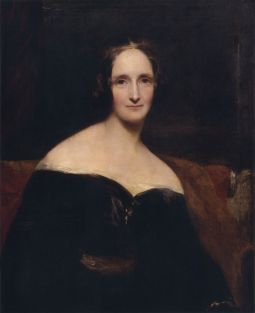
Mary ShelleyBy any standards her life was remarkable and in the last few years her reputation has been revived and she has begun to be more widely considered as a formidable talent in her own right, rather than just a ‘one-book author’. Frankenstein has been a staple of English literature GCSE and A level syllabuses for years, but most of her other works have fallen out of print. A new biography, In Search of Mary Shelley: The girl who wrote Frankenstein, by Fiona Sampson was published earlier this year, some of which I caught when it was serialised in Radio 4 recently. What I heard sounded fascinating. Sadly it is not available on the BBC iPlayer at the moment.

Frankenstein is a brilliant book. It’s not particularly long so if you are not accustomed to the classics it is not too daunting. It is extraordinarily sophisticated in the themes it explores, from ideas about religion and creation, the vanity of man (men) and moral relativism. Its structure is also interesting: it is narrated initially by Robert Walton in letters to his sister. Walton is the Captain of a ship which he is sailing to the Arctic in the hopes of making a great discovery about the North Pole. He describes his ambitions, but also his loneliness and need for companionship. He meets an unexpected friend in the form of Victor Frankenstein who is on an unlikely pursuit of a mysterious giant figure which Walton and his crew had previously spotted. Frankenstein takes over the narration and we learn about the terrible events that preceded this chase, from his early family life in Switzerland and tragic death of his mother, his relationship with his cousin Elizabeth, to his university life in Ingolstadt. It was in Ingolstadt that he first felt the pain of academic embarrassment, when his naïve ideas were exposed, and he set out on the extraordinary task of creating a human. Unfortunately for Frankenstein, he did not think it through, and once he realised the horror of what he had done, quite soon after he brought his creation to life, he disowns it and leaves to its own fate while he spends the next few years wringing his hands. Frankenstein’s procrastination is fatal.

For a time there is also narration from the ‘monster’ (relayed by Frankenstein) who manages initially to survive on vegetation whilst concealed in a hovel, from which he is able to spy on a once wealthy but now fallen French family in a small village. From them he learns language and the ways of humans, and hopes that he will be able to become friends with them, as he longs for company. Unfortunately, when he introduces himself to them, his hopes are shattered; they assume from his, presumably horrific appearance, that he means them harm and they beat him and drive him out of the cottage. Disappointed and infuriated, the monster goes in search of Frankenstein, with the intention of demanding that he make him a female companion, with the threat of death and destruction if he refuses.

I will say no more. Though the story is well known, I do not wish to give away any further spoilers for anyone unfamiliar with it. I wanted to finish the book before seeing the play, so I mixed reading it with listening to the audiobook narrated by Derek Jacobi. This was read brilliantly, as you would expect, though I have to say it gives you the impression that both Walton and Frankenstein are older, wiser men when in fact it is their naivety and youthful impetuosity that is partly responsible for the grave decisions both make.

Frankenstein play
Copyright –  Royal Exchange Theatre, Manchester

The play was also wonderful and provided a rewarding extra-curricular outing for the book club! It was visceral, shocking, truly gruesome in parts. I loved the way the complex narrative structure, and the jumping back and forth in time was handled. I also loved the way it was interpreted for a 21st century audience, particularly in drawing out the feminist undertones (Elizabeth is played more strongly than in the book, while Frankenstein is often exposed as foolish). It had thrills, spills and lots of action, and stayed very true to the book, leaving out remarkably little and using some of the really powerful passages (particularly those spoken by the monster) verbatim. It will have been a fantastic bonus for any young people studying it for exams this year.

A thoroughly enjoyable monstrous week!

April Reading Challenge

At last, it’s starting to feel a little more spring-like as we enter April, which must mean it’s time for this month’s book on the Facebook Reading Challenge group.

2018-03-29-10-08-25.jpgLast month, we battled our way through Madame Bovary, some enjoying it more than others, it has to be said. Our theme was a classic novel, and this can be a challenging genre. It can take you right back to schooldays and unhappy memories of working line by line through a text that had no relevance to your teenage life. And if you are out of the habit of reading classic, usually older, novels, the language can feel outdated, and hard work.
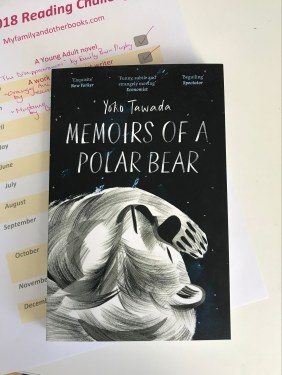
For me, the challenge was the size of the typeface in my University days edition! Not only was this a strain on my ‘mature’ eyesight, but it meant that pages were turned less frequently than I am used to. A trivial point perhaps but it gave me an insight into what motivates continued reading, and feeling like you are making progress can be a part of that. Personally, I really enjoyed it – it was all about the writing for me. Just sublime. Irony on a par with Jane Austen. I had forgotten how good a novel it is.

2018-03-29-10-28-24.jpgThis months’s challenge is something altogether different – a children’s novel and I have chosen Memoirs of a Polar Bear by Yoko Tawada. This book first came to my attention before Christmas and I have been keen to read it ever since. It is written from the perspective of three different polar bears: the first , a female, who flees her homeland in Soviet Russia, the second, her daughter, a dancing bear in a Berlin circus, and the third, the most recent, born in captivity in Germany.

The book has won high praise for its Japanese author. It’ll be the second children’s book I’ve read recently that is written, in part at least, from the perspective of an animal (the other being Pax, which I enjoyed enormously), so I’m looking forward to it. I expect it will be one of those books that blurs the boundary between ‘children’s’ and ‘adult’ fiction. Happily.

If you would like to participate in the challenge, do join us on the Facebook group, or if you have read this book and have a view on it, I would love to hear it. 

If you have enjoyed this post, why not follow the blog for more bookish chat. 

Easter Greetings

easter-3248883_1280

Easter is falling rather early this year, and with the weather not looking great for the UK this weekend, it could be a rather chilly Spring break. Perfect for spending time with a book! My kids will be getting the usual smallish chocolate egg from the Easter mummy bunny, plus a book token, a tradition I started a couple of years ago.

I’ll be away for a few days and have been giving some thought to what reading material I will take with me. I will, as always, take far more than I will actually get through, but I do that because I get a bit nervous when I have only one book available to read! I like to have a choice and nearly always have a couple of books on the go, in any case.

I’ll be taking Paul Auster’s 4321, about which I posted here a couple of weeks ago. I started it last Autumn and have found it really hard-going. I have been pondering whether to give up on it, but I think I’m going to give it one last focussed go, to see how I get on.

I’ll also be taking Frankenstein, the 1818 classic by Mary Shelley, which celebrates its bicentenary this year. I’m reading that with my girlfriends from my book club and we have booked to see the new production that is currently running at the Royal Exchange Theatre in Manchester in a couple of weeks. Really excited about that.

That’s it. Just the two books! That demonstrates an unusual realism about my reading and my commitment to doing justice to 4321, I think. (Although I do have a couple of back up books on my e-reader. Just in case.)

I bought a couple of magazines for the journey (I can’t read a book in a car) and nearly choked when I discovered they were £4.30. Each! Is it really that long since I bought a magazine? You can buy half a book for that!

Have a wonderful Easter, with plenty of reading and chocolate!

What will you be up to this Easter? What are you reading?

If you have enjoyed this post, do follow my blog, I’d love to hear from you.

Kids book review: “Red Nemesis (Young Bond)” by Steve Cole

When I was a kid, I watched all the James Bond movies, several times over, because my Dad loved them. So, I know the storylines well and have views about who is my favourite ‘Bond’ (Sean Connery, of course!). In recent years, the Bond movies have got darker, more erotic (rather than just sexy with a smile) and have greater psychological depth, more adult in other words. But there is something about the Bond marque which remains innocent, boyish and which has an appeal across the age groups, despite the inevitable multiple death toll! And it’s not just the baddies who die, which is awkward for younger viewers. However, I watched them all as a child and I think I’m okay.

Red Nemesis imgTo my shame I have never read any of the Fleming novels (my husband has and he likes them a lot), so I was delighted to pick up this book from the children’s section of my local library and if you have pre/young teens in your household, I think they might like it. Red Nemesis by Steve Cole, is the ninth novel in the ‘Young Bond’ series by Penguin Random House (under their imprint Red Fox). Five have been written by Charlie Higson (author of ‘The Enemy Novels’ – The Enemy, The Dead, The Fear, etc) and four so far by Steve Cole (famous for his Astrosaurs books). They are all closely linked to and published under the aegis of the Ian Fleming novels. In these books, we meet James Bond as a schoolboy. He already has connections with the British Secret Services, thanks to his father’s career in defence sales, and becomes involved in improbable missions and adventures. All part of the escapism! In Young Bond we get to see the life events that shape the man we know so well. (In my case through Sean, Roger, Pierce, Daniel, et al).

Red Nemesis is set in the summer of 1935 during James’s summer break from Fettes College, a smart public school in Scotland. He is about to go home with his Aunt Charmian; his parents are dead, having been killed in a skiing ‘accident’ when he was younger. The story opens a couple of years earlier in London with a mysterious Russian, Ivan Kalashnikov, deliberately breaking the legs of his daughter, Anya, in a car crash that was meant to look like an accident. Anya is a promising ballerina set for a glittering career on the international stage. Why would a father do this?

On the train back from Scotland, Charmian hands James a backpack which belonged to his father and which has been retrieved from the ice where he died. The contents are mysterious and include items which James senses are clues to an unsolved mystery in which his father may have been involved, in particular a cryptic postcard penned to his brother Max, James’s uncle and Charmian’s late husband. James also feels the contents of the backpack may bring him closer to the truth about his parents’ untimely deaths.

Following the clues, James goes to London. He first visits the Secret Intelligence Service to hand over copies of the documents in his father’s backpack to a former acquaintance of Max’s, the SIS agent Adam Elmhirst. He then goes to the Mechta Academy of Performing Arts, an international school near the SIS building. He masquerades as a prospective pupil, the son of a diplomat, pretending he has made an appointment to look around. He is given short shrift by the cold foreign authorities at the school but manages to break free of security. He conducts his own tour of the basement and finds a large stock of a powerful explosive. He is discovered and gets into a fight with a young man who is apparently a pupil. James wakes up in a cell, locked up for trespassing on the premises of the school without permission, until he is rescued by the aforementioned Elmhirst, who immediately invites James to accompany him to Moscow to help solve the mystery of the contents of the backpack, which Elmhirst says will lead them to uncover some malign Russian plot.

Most of the rest of the book is set in Moscow, as James and Elmhirst get into numerous scrapes. There are dramatic chases, villains, fights, plus of course, a bit of young love interest when James tracks down Anya Kalashnikov (he was clearly already powerfully attractive from quite a young age). Anya becomes James’s sidekick after her father is brutally killed; she realises she is not safe and has nothing to lose by getting involved with the mystery-solving activity.

There is violence, peril, quite a few deaths, unlikely villains, stereotypes and spies, but all of it in true James Bond fashion. It’s not as tongue-in-cheek as some of the earlier Bond films; there is an element of the troubled soul, the three-dimensional human we have come to see in the Daniel Craig incarnation of Bond (though not that dark), which is probably truer to the Fleming novels.

I have to say I thoroughly enjoyed this book – it has nail-biting action, problem-solving, and James feels like a well-developed character with fears, feelings and flaws as well as bravery, resilience and strong fighting instincts. There is quite a bit of violence and death, so I would recommend for 12-14 year olds. Alongside James, Anya provides a strong female character so I think both girls and boys would enjoy this. I did!

What do your kids think of the ‘Young Bond’ novels?

If you have enjoyed this post, and would like more reading recommendations for the young people in your household, follow my blog.

Book Review: “The Life and Loves of a He-Devil” by Graham Norton

I love my little book club – it’s small and very exclusive and, besides books, we specialise in popcorn, gin and tonic and extra-curricular trips. All in the name of literature, of course!

We have been meeting every month for a couple of years now and have read a wide range of books: fiction, non-fiction, YA, thrillers, classics, to name but a few of our chosen genres. Some books we have loved, some we have loved less. Some generate an enormous amount of discussion, others less.

The Life and Loves of a He Devil imgWe decided for our March meeting we’d read Graham Norton’s 2014 memoir The Life and Loves of a He Devil. We wanted to read an autobiography and felt that among the many “celebrity” memoirs out there, Graham’s might have more to offer than most. We all like him as a broadcaster and personality and thought it might be fun. We were not wrong! But when we came to meet and discuss it, we had very little to say. We’d exchanged a number of messages on our WhatsApp group in the preceding weeks, with many laughter emojis, asking each other if we’d come across the dog and condom anecdote yet, or the Dolly Parton story. Some sections of this book, which I read most of whilst on a train journey to London, were laugh-out-loud, or rather “try to suppress a laugh because I’m in public”, moments. It’s a romp and Graham writes the way he speaks, with wit, authenticity and complete honesty. His writing style is similar in his novel Holding, which I reviewed here last year, and really enjoyed. (His second novel, entitled A Keeper, is due out in the Autumn.)

It’s charming and funny, and there is such a lot of name-dropping that it’s a bit of escapism too. Reading it is a reminder of just how successful, Graham is; I lost count of the number of homes he owns and the list of people he calls friends is something to behold. I think it’s because he manages to make you feel that he is a regular guy, just like the rest of us, and just as in awe of all the celebs and their glitter. He also manages to convey a kind of naivety and innocence that make you feel he is very ordinary. He is not of course; he’s supremely talented and clearly unusually astute to have achieved what he has. That does not come from luck alone. Concealing all of that beneath a veneer of self-deprecation is a talent in itself and I admire him enormously.

Back to my book club, we had only one criticism, and that is that the opening chapter (the book is divided into chapters, each of which is about one of his ‘loves’), about the joys of being a dog-owner, was, we felt, by far the funniest, so everything that followed was not inferior exactly, but did not quite meet the same high bar.

Not much to say then, except that it’s hugely funny, and if you like Graham Norton, you’ll love this book!

Have you read this or any of Graham Norton’s other books?

If you have enjoyed this post, I would love for you to follow my blog. Let’s also connect on social media.