Book review: “Sometimes I Lie” by Alice Feeney

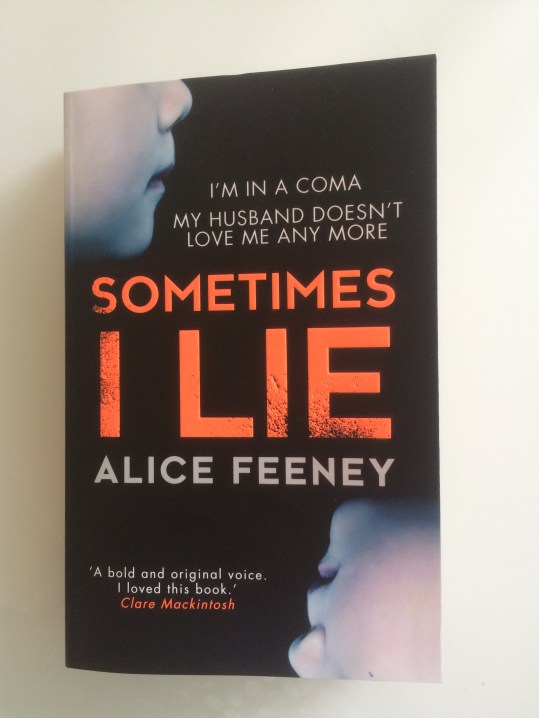
I don’t read many thrillers. They’re not usually my ‘thing’. Sometimes I think it’s simply because the covers put me off! They seem invariably to have neon writing with a black background (as in fact, does this book) and sensational taglines designed to suck you in. The tagline here reads “I’m in a coma. My husband doesn’t love me anymore.” I’m afraid that, in my experience, books that promise much on the front cover deliver somewhat less between the pages. And, yes, that could indeed be true of life in general!

2017-06-14 12.37.04

So, I approached this book with some apprehension. I probably would not have chosen it myself, but it was suggested by my book club. That said, I was open-minded, having been equally sceptical about Disclaimer by Renee Knight (also neon writing on a black background), which was suggested by a book club I used to belong to, and which I thoroughly enjoyed. (You can read my review of that book here.)

The central character is Amber, a married woman in her mid-30s, who when we first meet her, on Boxing Day 2016, is lying in hospital in a coma. She is also our narrator. The chapters alternate between ‘Now’, ie Amber lying in her hospital bed, ‘Then’, looking back over the days of the previous week and the events which have brought Amber to this position, and ‘Before’, looking back at Amber’s childhood. It is clear that Amber has been involved in some sort of car accident, although the circumstances are mysterious. As the narrative progresses we are drip-fed information about the other characters in the story and the part they have each played in bringing about Amber’s near-death.

Amber works in radio on a popular morning show called Coffee Morning with the very unpleasant but very powerful Madeline Frost, who is nothing short of a bully towards everyone else involved in the show, but who is loved by her audience. Amber is married to Paul, a struggling author, whose movements in the pre-Christmas week are suspicious. She also has a sister, the rather too-perfect Claire, who is attractive, confident, and a mother of twins, where Amber is under-achieving, stuck in a career rut and apparently infertile. There is also the sense that the relationship between Amber and Claire is not all that it seems at first; increasingly we see Claire as controlling and rather too controlled. It is clear that this dynamic has had some sort of impact on Amber’s present situation. A further character enters the book part-way through, Edward, a former boyfriend of Amber’s who she bumps into in London one evening. There is the suggestion that perhaps Amber chose the wrong guy when she married Paul.

Thus the scene is set, with our vulnerable central character and a full complement of secondary figures, each of whom could have dunnit. It’s a complex plot, which at times I found difficult to follow; perhaps this is my problem with thrillers – complexity seems to be prized above all else. There is cleverness in the way some parts of it are handled, however, I also felt there was rather too much going on. For example, not wishing to give anything away, I felt the Edward sub-plot was superfluous, and Amber’s OCD was unnecessary and rather randomly included.

I did enjoy the book, it’s certainly a page-turner, but the ending left me vaguely dissatisfied. Perhaps it is fashionable to have ambiguous conclusions, or perhaps the author is planning a sequel, but in a thriller, a genre where questions are continuously posed, I want answers, I want loose ends tied up, and I don’t want to be left hanging.

It’s a decent beach read if you’re off on your holidays soon.

Book review: “Days Without End” by Sebastian Barry

I listened to this on Audiobook, which was narrated by the wonderful Aidan Kelly. It’s a brilliant book, with the most sublime use of language, my appreciation of which was enhanced by Kelly’s fabulous reading. I had the same experience with Holding by Graham Norton, but sadly not with The Girl on the Train by Paula Hawkins, which I’m listening to at the moment, where I’m finding the narration rather irritating. Aidan Kelly’s reading brings such an authenticity to the listening experience that I actually believed I was listening to Thomas McNulty.

Days Without End img

The book is set in America in the 1850s, where our very young narrator and central character, Thomas McNulty, finds himself after fleeing devastating famine in Sligo, Ireland, and searching for a new life, any life, in the New World. He signs up as a mercenary soldier for the Government infantry in the civil war against the Confederate south. There he meets ‘handsome John Cole’, an American, with whom he develops an intimate relationship. When their time in the infantry ends the two make a living for a while as entertainers where Thomas masquerades as a woman. He finds he is comfortable playing this role with John Cole as his beau, and in the periods when the two live a settled life together, it becomes his costume of choice, as well as providing a convenient disguise in times of trouble.

The accounts of war and violence are graphic and horrific and no detail is spared, which I found difficult to listen to at times, although also strangely compelling. Thomas and John rejoin the army further on in the novel and are involved in head to head battles with native American Indians. These accounts were even more harrowing as the contrast between the two sides is exposed so starkly, the soldiers having far superior firepower. In one of these encounters, Thomas and John rescue a young girl, Winona, whom they practically adopt as their own daughter and determine to look after.

Some of the scenes in the book are brutal and hard to read (or in my case listen to). The injustice of the men’s situation, the terrible conditions in which they have to live, the way that soldiers are treated as cannon fodder and afforded very little respect by their military masters is shocking. They are forced to live a most brutal existence and for many of the men the experience is completely dehumanising. The extreme violence they both administer and experience is like nothing that most of us will ever have come across and the novel is very powerful as a result. And yet, there is also tremendous tenderness: the relationship between Thomas and John Cole is beautifully drawn, though we never hear John’s voice first hand, and never gratuitous, never titillating. Even Thomas’s cross-dressing is handled with a beautiful innocence. The love that is shared between the two young men and Winona is also very powerful; that they are capable of such care of another human being is all the more moving when you consider the extremes of violence, deprivation and injustice in which they have existed.

There is a tale here, though mostly the novel is about a time and place in history and what that was like for the people immersed in it. It is a tale not just of survival but about how people who have nothing, have love and find a way, ultimately, to live peacefully.

This is one of a series of novels about various members of the McNulty family. I haven’t read the others, but I will certainly do so after reading Days Without End. The novel won the Costa Book Award in 2016 and has been widely acclaimed.

I recommend it highly and can particularly recommend the audiobook. That said, the language of the book is so beautiful that I would also love now to go back and read it, to see those words dance on the page.

If you have read this book, I would love to hear your thoughts.

If you have enjoyed this post, it would be great if you could follow my blog by clicking the subscribe button below or to the right, depending on your device. 


‘The Vegetarian’ by Han Kang

This might be one of the strangest books I’ve ever read and certainly one of the most unsettling reads in a while. It’s the sort of book where you find yourself shifting uncomfortably in your seat as you observe some very disturbing behaviour.

The Vegetarian imgIt’s basically a book about sickness, and the various forms it takes; the sickness of the troubled central character, Yeong-hye, whose decision to renounce meat from her diet is the catalyst to a catastrophic sequence of events; the sickness of some of her relatives who simply cannot accept Yeong-hye’s decision or who use it to perpetrate their own base acts; and the sickness in the society which degrades and dehumanises Yeong-hye. The insidious and malevolent control meted out to Yeong-hye over a period of many years (a control that was legitimised by social and cultural norms) leads to her attempting to starve herself in a desperate attempt to assert her autonomy, and this has explosive consequences

The novel is written in three parts (originally each was published separately). The first part is narrated by Mr Cheong, Yeong-hye’s husband. Mr Cheong is a selfish, misogynistic fool who is completely indifferent to his wife. There is no trace of affection in their relationship. Any fondness that may have existed has disappeared and Mr Cheong is now bitter that Yeong-hye makes no effort to be the good wife: she embarrasses him in front of his boss, fails to wear a bra and does not keep the house tidy. Mr Cheong rapes his wife repeatedly and sees nothing wrong in ensuring his physical needs are met in this way. And yet, so desperate is Yeong-hye’s family to save face in what in their eyes is a good marriage, they turn against her when she decides to stop eating meat, seeing it as a kind of protest which must be seen to be crushed. There is a very disturbing family dinner scene.

The second part is narrated by Yeong-hye’s brother-in-law, her sister’s husband. At first he appears more sensitive than Mr Cheong and shows some kindness towards Yeong-hye, particularly after the events at the family dinner party. He is an artist and claims he has always been fascinated by his sister-in-law’s fragility, both physical and emotional. At first he seems to be helping her, enabling her to express herself in a new way. But, ultimately, he too will exploit and damage her.

The final part concerns the relationship between Yeong-hye and her sister, In-hye. She emerges as the strongest character in the book and through her we have a reliable witness to the events of the novel. She reflects on the period since her sister became a vegetarian and how her world, and her family’s world has turned upside down. But rather than see it as her sister’s fault (as her parents do) she understands how Yeong-hye’s mental illness has been brought about by the abuse she has experienced.

The Vegetarian img 2

This book won the Man Booker International Prize in 2016 and has had universal acclaim. It is a very poetic novel, beautifully translated by Deborah Smith; the motif of Yeong-hye’s dream and her desire to transform into a plant provides a powerful element of fantasy, although for me this was not always coherent. However, it is also deeply troubling. Not one for the faint-hearted!

‘North and South’ by Elizabeth Gaskell

I last read this book when I was doing my English degree at University. At that time, the classics were my ‘thing’, indeed I’d spent my teenage years devouring the classics and, such was my love of them, it’s mostly why I went on to study English. By the time I graduated, I was so full of books that I shunned reading anything for quite a long time. When I got back into the habit, I turned my attention more to contemporary fiction as I realised there was a huge gap in my knowledge. One of the satisfying things about favouring the classics is that they are a largely finite resource; in a few years of effort you could basically read most of them! With contemporary fiction, on the other hand, you never get caught up. So, almost all my reading in recent years has been a desperate endeavour to keep up with all the amazing books published today, and as a result I have not turned back to my beloved classics very much. So, April’s reading challenge was to re-read a classic.

2017-03-30 11.25.47

I’ve been wanting to read this novel again ever since I moved to Manchester 5 years ago and even more so after visiting Elizabeth Gaskell’s house in Plymouth Grove last year. (If you haven’t been and you’re an admirer of the Victorian novel, you really must pay a visit). I have to confess I was a little intimidated to be picking up the book – my edition is innocuous-looking enough, but, oh my goodness, paper was thinner back then and the type face is miniscule! 530 pages of closely-written text. BUT, what a joy!!!  It took me a few chapters to get back into the style, and the Victorian atmosphere, but once I did, I got totally lost, and, truly, I re-entered the world I first discovered as a young girl. I can’t remember when I last got lost in a long book, became totally absorbed by the sense of place, or was able to step into the shoes of the characters and feel their pain, their happiness, their grief their longings. Hanya Yanagihara’s A Little Life, which I read last year, has probably been the closest I have come in recent years.

In North and South, our central character, Margaret Hale, finds herself on an emotional and physical journey. When we first meet her she is living with her wealthy aunt and spoiled young cousin Edith in London; she was sent to them as a child to improve her chances in society. Margaret’s parents live humbly in rural Hampshire where her father is a country curate. Margaret has a brother, Frederick, who lives as a fugitive abroad; he is wanted in England, accused of leading a mutiny whilst serving in the navy.

When Margaret’s cousin marries, she returns to her parents only to find that her father intends to resign his post due to his religious doubt. He decides to move the family north to the city of Milton in Darkshire (for which read Manchester). There he plans to make a living from tutoring and they will rent a house from an old Oxford acquaintance of Mr Hale’s. The move comes as devastating news to Margaret and her mother, for whom the move is the last straw in her social degradation.

When the family first moves to Milton the contrast between their old and new lives is stark – their physical surroundings are completely different, the people they meet are different, and the activities that absorb their time are different. As the months pass, Margaret accepts her new life and as she is forced to confront her prejudices, so it exposes the vacuous existence she enjoyed in London. Gaskell sets about using her characters, their conversations and their confrontations to reveal certain ‘truths’ and challenge certain preconceptions held by many of the protagonists, whether it is Mrs Hale’s bias towards the south, the gentry and all the things with which she is familiar and about which she is nostalgic, or factory owner Mr Thornton’s intolerance of his workers’ strike. All the characters in this novel are in some way flawed by their prejudice (even the lowly workers at the factory despise the Irish labourers brought in to do their work when they strike). To that extent, the novel still has great relevance today, over 150 years later, as the north-south divide in England continues to have social, political and economic consequences.

Some of the characters in the book are two-dimensional, for example, the lowly Bessy Higgins, with whom Margaret develops a rather implausible friendship. It has to be remembered that these characters are merely devices through which the author is seeking simply to illustrate a point, although Gaskell’s readers at the time probably thought this was actually how poor people lived and talked. Margaret, on the other hand, is, for me, a well-rounded, credible and fully-developed character. She goes through a transformation in this novel which is both sincere and believable.

The ending of the book is entirely predictable, of course, but this is fine because the joy of this book is in the journey. Although some may find the language a barrier, for me it was sublime. Again, it took me a little while to get back into it and it made reading a little slow at first, but it was beautiful and oh so clever!

I thoroughly enjoyed re-reading North and South and I would definitely recommend picking up a classic from time to time.

Have you re-read any old favourites recently?

If you have enjoyed this post, you can follow my blog by clicking on the subscribe button below or to the right, depending on your device.

‘Stay With Me’ by Ayobami Adebayo

Stay-with-Me imgThis was April’s choice for my book club and one of the members described it as the best book we have read – she consumed it in virtually one sitting in the middle of the night when she was wide awake with jet lag! A fine endorsement indeed. It really is a marvellous book and, as I so often say on this blog, totally unfair that one so young should exhibit this much talent in a debut novel! It has also been shortlisted for the Baileys Women’s Prize for Fiction this year (winner to be annonced on 7 June), so it’s hot.


The blurb on the jacket is cryptic:

“There are things even love can’t do…if the burden is too much and stays too long, even love bends, cracks, comes close to breaking and sometimes does break. But even when it’s in a thousand pieces around your feet, that doesn’t mean it’s no longer love.”

It’s hard to provide a review without giving away too much, because the twists and turns of the plot are a joy. It’s also a very tough read at times, so be prepared for some challenging parts.

The first chapter is set in 2008 but only makes sense once you have finished the book, so do come back to it. The book starts proper in 1985 when we first meet Yejide and Akin, a young married couple living in Ilesa in Nigeria. They are a thoroughly modern couple enjoying a happy middle class life, he a successful banker, she a beautician with her own business. Their relationship is placed under severe strain, however, because they are infertile. They themselves are very much in love and seem quite happy with their lot, but their respective families have high expectations of children. Thus they come up against powerful cultural forces; both are children of polygamous households and this contrasts forcefully with their much more enlightened outlook.

There is superstition and witchcraft here too. Quite early on, under unbearable pressure, Yejide turns to traditional quackery to conceive and ends up developing what can only be described as a mental illness where she develops a phantom pregnancy that lasts nearly eighteen months. Akin, on the other hand, is under pressure from his own side to take a second wife, as it is considered the priority is to produce a child not to have a happy marriage. The tussle between modern and traditional ways of thinking create mistrust and betrayal in Akin and Yejide’s relationship where previously there was only love and passion.

This is all played out against the backdrop of social and political unrest in Nigeria in the 1980s. I was hoping this would play a bigger part in the novel having enjoyed so profoundly Half of a Yellow Sun (Chimimande Ngozi Adiche) a few years ago, but it’s not that kind of book. The political upheaval going on in the background is there more as a metaphor for transition, what happens when society is forced to evolve out of its traditions. It also helps with the plot later on.

The pace of this book is fast, but it loses nothing in quality for being so. It’s a brilliant plot, jaw-dropping even. The writing is breathtaking and at times deeply moving. So, I must say no more, only go and read it and enjoy!

Have you read this book? If so, what did you think of it?

If you have enjoyed this post and would like to subscribe to my blog, please click on the button below or to the right, depending on your device.

‘East West Street’ by Philippe Sands

I’m going a bit highbrow this week – any lawyers in the room? I’m not a big reader of non-fiction, so a few months ago I set myself the task of reading a couple of books from the shortlist of the Baillie Gifford Prize, one of the most prestigious non-fiction awards in the world. I read Negroland by Margo Jefferson, which I really enjoyed and reviewed here back in February. East West Street actually won the prize; I enjoyed this a little less than Negroland, I have to say, but it is a remarkable work and it wasn’t what I was expecting.

East West Street img

These days we take for granted the terms ‘genocide’ and ‘crimes against humanity’; they are used fairly frequently, especially since the Balkan war in the 1990s, and fairly interchangeably, it seems to me. But did you know that these were only established as legal terms at the Nuremberg trials after the Second World War? The gravity and scale of the crimes committed by the Nazis is largely undisputed, but when it came to actually bringing individuals to justice at the court of law in Nuremberg in the post-war atmosphere, charges had to be specified and evidence had to be considered. In many ways, it seems to me, it was a piece of theatre, but the legal minds at the time were severely exercised. And I guess if you are on the winning side, both militarily and morally, the pressure to maintain the moral high-ground is immense. The victors had to be seen to be following a path of rectitude and adherence to international standards of law.

“Jackson [presiding judge at the Nuremberg trial] crafted each word with care, signalling its significance. He spoke of the victors’ generosity and the responsibility of the vanquished, of the calculated, malignant, devastating wrongs that were to be condemned and punished. Civilization would not tolerate their being ignored, and they must not be repeated. ‘That four great nations, flushed with victory and stung with injury, stay the hand of vengenace and voluntarily submit their captive enemies to the judgement of the law is one of the most significant tributes that Power has ever paid to reason.'”

(p.288, quote from Judge Robert H. Jackson, opening the Nuremberg trial)

This book provides a historical account of the intellectual tussle between two of the finest legal minds of the time: Hersch Lauterpacht and Rafael Lemkin. Lauterpacht fought for the term ‘crimes against humanity’ whereas Lemkin wanted ‘genocide’. To most of us the differences between the two might seem inconsequential, but the differences are in fact, as is discussed in the book, fundamental to the basis of international law. This is not the place for me to rehearse the arguments (even if I could!). I did struggle with the legal minutiae of the book, though I was able to grasp the broad concepts and it certainly made me think about an issue which I can honestly say I have never thought about before. And it was interesting, honestly!

So far I have probably made the book seem dry and dull to the average reader (though perhaps sexy to any of you legal eagles!), but prizes are not won by being dry and uninteresting and the author is far more successful than that; by far the more engaging aspects of this book are the human stories. East West Street is a thoroughfare in the city of Lviv, in modern day Ukraine, but which has previously been part of the Austro-Hungarian Empire and of Poland. It is also a town with which both Lauterpacht and Lemkin were linked. Lviv plays a central role in the book because it provides a snapshot of the Nazis’ ambitions and methods.

The heart of this book, however, is the author’s own quest to find out about his grandparents, Leon and Malke Buchholz, a young Jewish couple from Lviv who were forced to leave their home with their baby daughter Ruth, the author’s mother. Leon and Malke have revealed little about their early life and the author has many unanswered questions. Now dead, he sets about researching his grandfather’s early life, the circumstances of his marriage and how it was he came to be in England with Malke and Ruth. The author becomes a detective investigating his own family history and confronts some difficult truths, as is often the case. He conducts this search alongside his research into the legal basis of the Nuremberg trials and finds links and parallels.

The book is broken up into distinct parts: for example, the opening chapter is about Leon and his early life and then there are similar chapters on Lauterpacht and Lemkin. These were the chapters I found most engaging and most moving. Towards the end is a very long chapter about Nuremberg itself which was fascinating as it was not something I knew very much about before. Some parts of the book were for me overly detailed and I skimmed through some of these.

Unquestionably, however, there lies at the heart of this book a deep and terrible tragedy about which it is always worth being reminded: how prejudice, ideology, lies and propaganda, stupefied a nation, and, combined with power and determination, saw the murder of millions of people and displaced or traumatised many millions more and the consequences are still being felt down the generations today.

This is a powerful book which I recommend if you have an interest in history or the law, or if you just like to read about uncovering family stories. It looks daunting but it’s actually a quicker read than you might think.

Have you read any non-fiction books that recently that you recommend?

If you have enjoyed this post and would like to follow my blog please subscribe by clicking on the button below or to the right, depending on your device.


‘Holding’ by Graham Norton

You’ve got to admire Graham Norton; he started out as a stand-up comic, first came to prominence in the classic TV comedy show Father Ted, making a handful of appearances as one of the many random priests on Craggy Island, and has since built a very successful career as a broadcaster on both radio and television, mostly in the UK. He has previously written three autobiographical books, but Holding is his first novel. People like Graham Norton are so annoying; they are really good at their chosen vocation, then they write a book…and they’re really good at that too! Most of us are just trying to be good at the one thing!


I do love Graham Norton, though, and this book does not disappoint. I listened to the Audiobook, which is narrated brilliantly by Graham himself, and I am certain this added to my enjoyment. He performs each role with such distinctiveness and brings the characters to life. The plot of the story is a straightforward whodunnit, but it has twists and turns which Norton handles deftly. The story is set in the seemingly sleepy town of Duneen in County Cork, Ireland, but beneath the surface, there stir unaccountable passions which have been and continue to be suppressed by culture and tradition.

Our central character is Sergeant PJ Collins, the local police officer, who is overweight, unmarried, and carries about him the burden of knowing that his life has been little lived. The small-town torpor is completely shaken up, however, by the discovery of human remains in a field which is being developed for a new housing estate. It is widely suspected to be the body of Tommy Burke, a young man who disappeared many years earlier in mysterious circumstances. Suspicions are immediately thrown upon two local women with whom he had romantic links: Brid Riordan, to whom he was engaged, but only, we learn, because she was set to inherit a farm when his own family’s fortunes were somewhat in decline. Brid is now middle-aged, unhappily married and an alcoholic. The other main suspect is Evelyn Ross, a spinster who lives with her two unmarried sisters in one of the largest houses in the town, who was Tommy’s true love at the time, but the relationship was largely unrequited.

Thus the scene is set and the plot thereafter takes on some impressively imaginative twists and turns. Graham Norton’s great talent, however, is clearly for character and he introduces us to a wide cast of individuals, from the swaggering and confident, but equally unfulfilled, Detective Linus Dunne from Cork (brought in to investigate the homicide), who initially patronises and sidelines PJ before gradually accepting and empathising with him, to the meek and mild Mrs Meaney, PJ’s housekeeper, who initially comes across as something of a busybody but who takes on greater depth as the story progresses. Listening to Graham Norton’s narration gave me an even more powerful sense of the cast of characters, I think, than if I had read the book, and, I repeat, he does it brilliantly!

The book is ultimately about what lies beneath, quite literally, in the body that is discovered on the building site, but also in the characters, the lives that go on behind closed doors, until a catastrophe comes along and forces them out into the open. It is also very much about the upending of old traditions (not all good), in a post-Celtic tiger, post-credit crunch world and its being replaced by new ways of being – not all of which are good either.

I loved this book – it had me driving slowly and sitting outside my house in the car, just so I could listen to the end of a chapter! It’s quite an accomplishment for a debut novel. Highly recommended.

Have you read this book? I’d love to hear your views.

If you have enjoyed reading this blog, you can follow me by clicking on the subscribe button below or to the right, depending on your device.

‘In the Dutch Mountains’ by Cees Nooteboom

As a mother of three, I find it is always a challenge to get back into the swing of things after a school holiday. I am self-employed and work from home so I tend to take the holidays ‘off’ (insofar as one is ever ‘off’ as a parent!), but it always seems to take me a week or so to restore the term-time order of things and get back into my rhythm, including my reading rhythm. The dynamic at home has also been affected by the fact that my eldest is deep in GCSE revision and now on study leave, wanting feeding during the day and everything!

We took a short family holiday to the Netherlands over Easter, a country we know well and have visited annually for many years now. We spend our time either in Amsterdam (a fab city for kids, by the way) or in the far south of the country in Zeeland, a fascinating area for which I have a very deep affection. I’m a bit reluctant to plug it because it’s authentic and unspoilt, but we love the cycling, the beaches, the space, the calm, the beautiful and historic Dutch and Belgian towns and the warm welcome we receive each time we go there.

Despite my love of Holland, its art and architecture and its people, I am ashamed to say that I know very little about its literature, so on this trip I decided to take with me a book called In the Dutch Mountains by Cees Nooteboom. He is one of the giants of not only the Dutch but also the wider European literary tradition. I picked up this book at a secondhand stall in a market in Dublin, so this particular copy is well-travelled!

Since starting this blog almost a year ago my reading habits have changed; I now find I am reading much more newly-published work than I have ever done before, which is great, but that has been at the expense of my reading of the classics or other contemporary fiction from recent years which I have wanted to read. There really are only so many hours in a day, after all! So, it felt lovely to be picking up a novel that was first published in 1984 and is widely considered to be a modern classic.

2017-04-26 13.45.25What is so immediately intriguing about the title of the novel, of course, is that Holland is very, very flat. But In the Dutch Mountains imagines a world where the Netherlands extends much further south of its modern borders to northern Spain and the Pyrenees (hence the Dutch mountains). The narrator is himself a Spaniard, a civil servant who not only relates the story, but also philosophises on the processes of writing and story-telling: a story within a story. The main characters in the tale are Kai and Lucia, a slightly other-worldly circus couple, remarkable for their physical perfection, who are relieved of their jobs (because times have moved on and audience tastes have changed) and find themsleves travelling south to look for work. Kai is kidnapped and Lucia sets out on a journey to find him, accompanied by an old woman she meets on the way who agrees to drive her to find her lover.

The book is a vivid re-telling and reinterpretation of an iconic European fairy-tale, The Ice Queen, and explores the boundaries between myth and reality, but as a 21st century reader the strongest themes that came out for me were that of migration (for work), and what it means to be one nationality or another. The author contrasts the orderly, tidy north (what we now know as Holland) and the more chaotic, but freer south. He himself is Dutch but his narrator is part of the Spanish establishment (an inspector of roads), who happens to be a part-time novelist and philosopher. Alfonso, the narrator, is writing in the quiet of a school, empty of children who are on their summer holiday, a middle-aged adult sitting at a diminutive desk and chair. Thus the novel sets up a whole series of contradictions which invite us to challenge our assumptions and expectations.

This is a short novel, but one which merits reading slowly and deeply, and I will probably re-read it at some point. It won the 1993 European Prize for Literature.  It was a curious read and I can’t exactly say I loved it, but I did find it fascinating, and it wasn’t at all what I expected. I think it’s always good to push your reading boundaries and as I read this book I certainly found myself drawn into a very different literary tradition than the one I have become used to in recent years. As a citizen of a nation that has expressed its intention to leave the European Union I feel strongly that European literature has a great deal to offer us in terms of enhancing our understanding of and empathy with our near neighbours, and I intend to read more of it in the future.

What European novels have you read? Do you think they are different in style and tone to English literature?

If you have enjoyed reading this blog you can subscribe to follow me by clicking on the link below or to the right, depending on your device. 

Easter holiday reading suggestions

2017-03-30-11-55-53.jpgI’m off on a short holiday to the Netherlands so I’m planning to take some reading with me, of course, and have decided on another book from my ‘to read’ pile (I’m in the groove now!) called In the Dutch Mountains by Cees Nooteboom. It looks delightfully weird and I love the Dutch so am very excited to be reading it at last. I’m also taking Roxane Gray’s Difficult Women, a collection of short stories which was a gift from a friend. Looking forward to that and hoping I can get some tips for my own short story writing. I’ll also take North and South which I’m re-reading this month as part of my 2017 reading challenge.
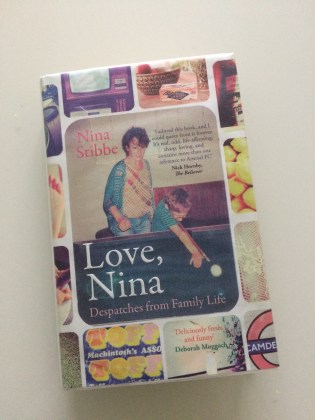
If you’re looking for ideas yourself and would like something light and amusing which you can dip in and out of, you could try Love, Nina: Despatches from Family Life by Nina Stibbe. I mentioned this book in a blog a few weeks ago; I read it whilst on a ‘break’ from a book I was finding quite heavygoing (Do Not Say We Have Nothing). It was the perfect antidote: a straightforward jolly read. It’s a series of letters from Nina, to her sister Victoria in Leicestershire and therefore readable in bitesize chunks.

Love Nina imgNina is twenty when we meet her in the early 1980s. She lives with Mary-Kay Wilmers, editor of the London Review of Books, and her two young sons, Sam and Will, to whom she is a nanny. They live at 55 Gloucester Crescent NW1, an area that was also home to other literary types, among them Alan Bennett and Claire Tomalin, who also make appearances in the book, particularly ‘AB’ who is a great friend of ‘MK’.

Nina’s letters home detail the events of daily life in the household, and are brought alive by her pithy observations on the quirkiness of her employer and the neighbours. It was particularly nice to read this after watching Alan Bennett’s The Lady in the Van over Christmas, which was also set in Gloucester Crescent and features many of the same people. Nina’s affection for the family shines through and she writes with great fondness of Sam and Will, her young charges. MK is idiosyncratic, but charming, and Alan Bennett leaps off the page. The personalities of the individuals come across strongly; Nina clearly has a talent for this since much of what we learn about them is through the conversations she reproduces in the letters as extracts of dialogue. She manages to pick out the little details or the nuances and word choices that reveal so much.

The letters cover a couple of years, and at the end of the book Nina is part way through her degree in English literature at Thames Polytechnic. By this stage you can see she herself is becoming a more accomplished chronicler, although the later letters, many of which are about her university friends, I found less endearing than the earlier ones.

Nina, now in her 50s, eventually became a writer, and had two children with Nunney, one of the other inhabitants of Gloucester Crescent (though they got together much later), and has subsequently published two novels in addition to this memoir: Man at the Helm and Paradise Lodge, which I’d be interested in reading. Love, Nina was also adapted for television by Nick Hornby, and starred Helena Bonham Carter. I think that could be fun to watch.

So, a good little read, perfect if you’re going away this Easter holiday.

What are you reading this Spring?

If you have enjoyed this post I would love for you to subscribe to my blog by clicking on the follow button below or to the right, depending on your device.

Just Kids

JUst kids imgI’ve been an admirer of Patti Smith for a number of years now. I’m a bit young to have been a fan of hers when she first broke onto the music scene in the mid-1970s. I became aware of her much later when I picked up a sale copy of her debut album Horses. I was also aware of Robert Mapplethorpe, the late artist-photographer who was her lover and then close friend when they were both very young. Mapplethorpe died of AIDS in 1989 and it must have been in the 1990s that I saw an exhibition of his work in London (I had an interest in photography at the time). Later on again I learned about the connection between the two and how Patti had been, if you like, Mapplethorpe’s ‘muse’ when he was first discovering his art.

I’d known about this book for a while, having heard Patti Smith talking about it in a radio interview, but I picked this up, ironically, in New York, when I was there on holiday last summer, from the famous Strand Bookstore. I’d hoped to read it whilst there (and perhaps visit some of the places she mentions in the book) but that didn’t happen. I decided to read it as part of my 2017 reading challenge; March’s challenge is to read something from my ‘to read’ pile, which, as I have written here recently, is substantial! And it has been a real pleasure to read.

The book is an account of her and Mapplethorpe’s early artistic development. They found each other by accident in New York City in the late 1960s when they had both arrived there in search of a more meaningful life. Their early life together was marked by poverty and the struggle to be recognised. In many ways their life was pretty ordinary, were it not for all the incredible people they meet and hang out with – Andy Warhol, Jimi Hendrix, William Burroughs – and if you are familiar with New York City, particularly the lower Manhattan and Greenwich Village areas, you will enjoy the mentions of different places, particularly the infamous Chelsea Hotel where many a star has risen and fallen.

But the book is so much more than that; it is an account of how artists find their voice and their medium, but it is also a love story. Patti writes tenderly and affectionately of her love for Mapplethorpe and the profound mutual respect that lay at the heart of their relationship. You don’t need to be admirers of them to appreciate this. It is also an account of how love changes; Mapplethorpe loved Patti deeply but he eventually came out as homosexual. He had been brought up a Roman Catholic and this was a long and difficult process for him. Patti later married a musician Fred Smith, and they lived a happy humdrum family life together in Michigan with their children until he died at the age of 45 in 1994. To that extent the book is also about what happens when love moves on, and how former lovers can evolve their relationship and grow as a result.

I thoroughly enjoyed reading this book, particularly the escape into bohemian New York in the 1970s. Some books you read of this nature can make you feel your own life is rather dull and insignificant, but at the centre of this book is not glamour and sensationalism, but the day to day human love that we all need and hopefully most of us experience at some point in our lives. To that extent it is a story we could all identify with.