When I was a kid, I watched all the James Bond movies, several times over, because my Dad loved them. So, I know the storylines well and have views about who is my favourite ‘Bond’ (Sean Connery, of course!). In recent years, the Bond movies have got darker, more erotic (rather than just sexy with a smile) and have greater psychological depth, more adult in other words. But there is something about the Bond marque which remains innocent, boyish and which has an appeal across the age groups, despite the inevitable multiple death toll! And it’s not just the baddies who die, which is awkward for younger viewers. However, I watched them all as a child and I think I’m okay.
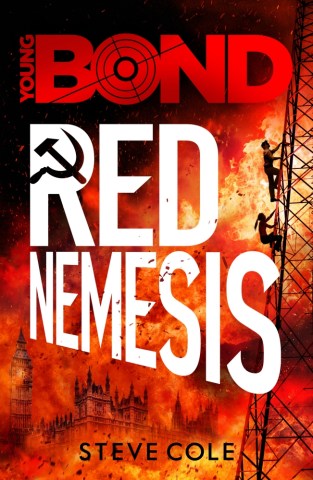 To my shame I have never read any of the Fleming novels (my husband has and he likes them a lot), so I was delighted to pick up this book from the children’s section of my local library and if you have pre/young teens in your household, I think they might like it. Red Nemesis by Steve Cole, is the ninth novel in the ‘Young Bond’ series by Penguin Random House (under their imprint Red Fox). Five have been written by Charlie Higson (author of ‘The Enemy Novels’ – The Enemy, The Dead, The Fear, etc) and four so far by Steve Cole (famous for his Astrosaurs books). They are all closely linked to and published under the aegis of the Ian Fleming novels. In these books, we meet James Bond as a schoolboy. He already has connections with the British Secret Services, thanks to his father’s career in defence sales, and becomes involved in improbable missions and adventures. All part of the escapism! In Young Bond we get to see the life events that shape the man we know so well. (In my case through Sean, Roger, Pierce, Daniel, et al).
Red Nemesis is set in the summer of 1935 during James’s summer break from Fettes College, a smart public school in Scotland. He is about to go home with his Aunt Charmian; his parents are dead, having been killed in a skiing ‘accident’ when he was younger. The story opens a couple of years earlier in London with a mysterious Russian, Ivan Kalashnikov, deliberately breaking the legs of his daughter, Anya, in a car crash that was meant to look like an accident. Anya is a promising ballerina set for a glittering career on the international stage. Why would a father do this?
On the train back from Scotland, Charmian hands James a backpack which belonged to his father and which has been retrieved from the ice where he died. The contents are mysterious and include items which James senses are clues to an unsolved mystery in which his father may have been involved, in particular a cryptic postcard penned to his brother Max, James’s uncle and Charmian’s late husband. James also feels the contents of the backpack may bring him closer to the truth about his parents’ untimely deaths.
Following the clues, James goes to London. He first visits the Secret Intelligence Service to hand over copies of the documents in his father’s backpack to a former acquaintance of Max’s, the SIS agent Adam Elmhirst. He then goes to the Mechta Academy of Performing Arts, an international school near the SIS building. He masquerades as a prospective pupil, the son of a diplomat, pretending he has made an appointment to look around. He is given short shrift by the cold foreign authorities at the school but manages to break free of security. He conducts his own tour of the basement and finds a large stock of a powerful explosive. He is discovered and gets into a fight with a young man who is apparently a pupil. James wakes up in a cell, locked up for trespassing on the premises of the school without permission, until he is rescued by the aforementioned Elmhirst, who immediately invites James to accompany him to Moscow to help solve the mystery of the contents of the backpack, which Elmhirst says will lead them to uncover some malign Russian plot.
Most of the rest of the book is set in Moscow, as James and Elmhirst get into numerous scrapes. There are dramatic chases, villains, fights, plus of course, a bit of young love interest when James tracks down Anya Kalashnikov (he was clearly already powerfully attractive from quite a young age). Anya becomes James’s sidekick after her father is brutally killed; she realises she is not safe and has nothing to lose by getting involved with the mystery-solving activity.
There is violence, peril, quite a few deaths, unlikely villains, stereotypes and spies, but all of it in true James Bond fashion. It’s not as tongue-in-cheek as some of the earlier Bond films; there is an element of the troubled soul, the three-dimensional human we have come to see in the Daniel Craig incarnation of Bond (though not that dark), which is probably truer to the Fleming novels.
I have to say I thoroughly enjoyed this book – it has nail-biting action, problem-solving, and James feels like a well-developed character with fears, feelings and flaws as well as bravery, resilience and strong fighting instincts. There is quite a bit of violence and death, so I would recommend for 12-14 year olds. Alongside James, Anya provides a strong female character so I think both girls and boys would enjoy this. I did!
What do your kids think of the ‘Young Bond’ novels?
If you have enjoyed this post, and would like more reading recommendations for the young people in your household, follow my blog.
 We decided for our March meeting we’d read Graham Norton’s 2014 memoir The Life and Loves of a He Devil. We wanted to read an autobiography and felt that among the many “celebrity” memoirs out there, Graham’s might have more to offer than most. We all like him as a broadcaster and personality and thought it might be fun. We were not wrong! But when we came to meet and discuss it, we had very little to say. We’d exchanged a number of messages on our WhatsApp group in the preceding weeks, with many laughter emojis, asking each other if we’d come across the dog and condom anecdote yet, or the Dolly Parton story. Some sections of this book, which I read most of whilst on a train journey to London, were laugh-out-loud, or rather “try to suppress a laugh because I’m in public”, moments. It’s a romp and Graham writes the way he speaks, with wit, authenticity and complete honesty. His writing style is similar in his novel
 The central character, Hildy, is a slightly quirky, slightly awkward 17 year-old. She has two close friends – her best friend is Max, who is gay and fairly camp with it, and her other good friend, Xiu is much more astute, confident and successful in affairs of the heart. She confides in them extensively about her feelings and worries. Hildy has not had a boyfriend for some time and so, out of a degree of desperation signs up for a research programme which is exploring whether it is possible to facilitate a romantic relationship between two people by making them ask and answer a specific set of (36) questions. Hildy’s ‘partner’ in the programme is Paul, who, from the outset, makes it quite clear that he is only in it for the $40 fee and who is a nonchalant and frustrating participant to begin with; where Hildy makes an effort to answer the questions truthfully and fully, Paul is uninterested and uncooperative, and obfuscates throughout. Their first session ends with Hildy throwing a tropical fish at Paul that she had bought for her younger brother on the way to the meeting.

 Juno is a widely-published author, Queen of Teen 2014 and member of the LGBT community. The story begins with a funeral, for Eliza, girlfriend of central character, Samuel. Eliza was killed in a car accident in which Samuel was driving. He is grief-stricken and finds himself in conflict with his family, who do not understand his torment. Samuel seeks out the estranged sister of his vicar father, with whom he cut off contact after she began to dabble in the supernatural. Through his Aunt Marie, Samuel enters a world where he can bring Eliza back to life, but at a deadly price.
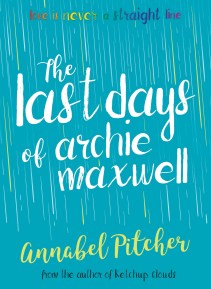 I found this grittier and rather more challenging than Grave Matter. It would suit teens who enjoy social realism or who may be coming to terms with difficult family relationships or with issues around sexuality. The book opens with Archie’s parents announcing they are to separate. Archie’s sister suspects it is because their father is gay. This is going on in the background, but Archie also has issues at school. He is part of a gang with some of the cooler kids, but who are actually unpleasant bullies. He befriends one of the more desirable girls at school, Tia, about which he is mercilessly teased by the other lads. Tia’s brother committed suicide on the railway line near Archie’s house, a year earlier, and he finds himself telling her that he saw her brother just before the day he killed himself, because she seems to need this to comfort her in her grief. As a result they become close. Thus, Archie finds himself sucked into lying, whilst his own home life seems to be falling apart.


 The central character in the story is Budi, a football-mad eleven year-old boy whose hero is an English footballer called Keiran Wakefield, who plays for Real Madrid. Budi and his friends spend all their free time playing football, role-playing their favourite teams and stars. One of Budi’s friends has an old television and they sometimes watch matches together too, late at night Indonesia time. To that extent Budi and his friends are like any other boys their age and your children will be able to identify with their passions and their aspirations. The similarities end, however, when you compare the daily lives of these children with ours in the developed world; Budi and his friends work in factories, mainly sweat shops, where the conditions are poor and where the manager is cruel and exercises discipline through the use of corporal punishment. Budi makes football boots that are shipped off to Europe. They work for a pittance and, despite both Budi and his Dad working, the family still does not have enough income to eat a meal every day. Budi’s best friend is Rochy who lives with his mother and two sisters (his father is dead). Budi tells us that Rochy is the cleverest person he knows but that he had to withdraw from school because he needed to work to support his family. His existence is altogether darker – his mother barely communicates (depression?) and there is the suggestion that the two sisters are involved with the sex industry, although younger readers will not pick this up.
 This was February’s choice for my
  This book is set in a familiar country (England) but in a future time where life has changed and the world is very different: bus journeys cost hundreds of pounds, many routine tasks and jobs are carried out (not very well) by robots and everyone carries a QWERTY, which it seems is some next generation pocket computer. Auden Dare is an eleven year-old school boy who lives with his mother in Forest Gate in east London. When we first meet him we learn that his father is away fighting in the war in Europe. Climate change has taken hold and water is scarce. Indeed, water, or the lack of it, seems to be the root cause of the conflict in which Auden’s father is involved. Auden has a condition called achromatopsia, which means he is unable to see colours, only shades of grey.
 Julia's books