This book took me straight back to being a teenager, not so much because I empathised with the central characters, but because reading it felt like a complete guilty pleasure. And I loved it!
 The central character, Hildy, is a slightly quirky, slightly awkward 17 year-old. She has two close friends – her best friend is Max, who is gay and fairly camp with it, and her other good friend, Xiu is much more astute, confident and successful in affairs of the heart. She confides in them extensively about her feelings and worries. Hildy has not had a boyfriend for some time and so, out of a degree of desperation signs up for a research programme which is exploring whether it is possible to facilitate a romantic relationship between two people by making them ask and answer a specific set of (36) questions. Hildy’s ‘partner’ in the programme is Paul, who, from the outset, makes it quite clear that he is only in it for the $40 fee and who is a nonchalant and frustrating participant to begin with; where Hildy makes an effort to answer the questions truthfully and fully, Paul is uninterested and uncooperative, and obfuscates throughout. Their first session ends with Hildy throwing a tropical fish at Paul that she had bought for her younger brother on the way to the meeting.
Hildy’s violent reaction to Paul’s behaviour is clearly sobering to him and he contacts her afterwards to apologise. They continue their interaction and to work through the questions via social media messaging and eventually agree to meet. Hildy’s home life is complicated, however; her parents are going through a difficult time in their marriage (she doesn’t realise why at first, although this is revealed towards the end). Her mother is a hospital emergency doctor and her father the Principal of her school. She has an older brother, with whom her relationship is somewhat distant, and a 12 year-old younger brother, towards whom she is very protective, especially as she feels he is suffering most from the troubles at home.
Slight spoiler alert….if you don’t want to know any more about the plot don’t read the next two paragraphs, though I won’t give away the full ending.
Paul also has his fair share of troubles; as their relationship develops, he confides in Hildy that his mother (who was a single parent) died in a car accident when he was young, and that he carries some guilt for this.
A crisis at home means that Hildy fails to make the coffee shop meeting with Paul they had arranged after carefully rebuilding the rapport between them after the fish incident. Since one of Paul’s most hated things is lateness, this causes another major setback. Hildy had no way of contacting Paul because he does not carry a mobile phone. She then has to set about tracking him down, knowing very few actual facts about him.
The usual question of whether the boy gets the girl/girl gets the boy, hangs over the rest of the book right to the final page.
The book has an interesting style, which I think will appeal to the target audience (13-15 year olds), with some chapters written in prose style, while those sections which make up the interactions between Paul and Hildy are written like dialogue in a drama. This writing style variation seems to be quite common now in YA books, I guess because it makes them a bit easier to read for an age group traditionally seen as having more limited attention spans. It does indeed make it an easy quick-fire read.
It is a romance, but it does deal with some of the issues teens face – peer pressure, how to deal with worries at home, social anxiety, awkwardness interacting with others in whom you are romantically interested.
I thoroughly enjoyed reading this book and recommend if your teenager would like something light and unchallenging to read. Will probably appeal more to girls.
How do you feel about your teens reading light romantic novels? Is it okay or do you wish they read weightier material?
If you have enjoyed this post, please follow my blog and connect with me on social media.


 This was February’s choice for my
  This book is set in a familiar country (England) but in a future time where life has changed and the world is very different: bus journeys cost hundreds of pounds, many routine tasks and jobs are carried out (not very well) by robots and everyone carries a QWERTY, which it seems is some next generation pocket computer. Auden Dare is an eleven year-old school boy who lives with his mother in Forest Gate in east London. When we first meet him we learn that his father is away fighting in the war in Europe. Climate change has taken hold and water is scarce. Indeed, water, or the lack of it, seems to be the root cause of the conflict in which Auden’s father is involved. Auden has a condition called achromatopsia, which means he is unable to see colours, only shades of grey.
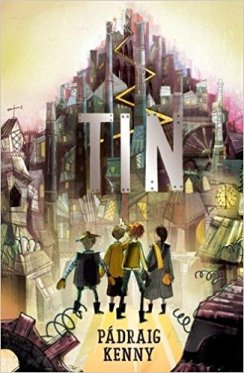 Tin by Padraig Kenny
 The Light Jar by Lisa Thompson
 The Unpredictability of Being Human by Linni Ingemundsen
 The Final Six by Alexandra Monir
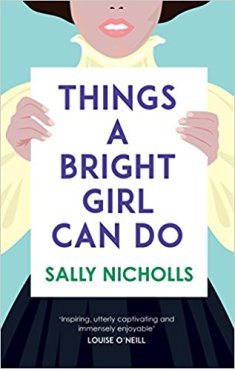 Things A Bright Girl Can Do by Sally Nicholls
 However, with autonomy comes power – if they are having an ‘at home’ day they can simply slip under the radar and spend a great deal of quality time with their phones and tablets (oh for the days when I only worried about how much Balamory they watched!) They can secrete themselves in their bedrooms while I lose myself in all my usual activity. At their age, sure I watched a lot of telly while my parents were out at work in the school holidays, but I also spent plenty of time with my nose in a book. Digital distractions were fewer and less powerful.

 I Am, I Am, I Am by Maggie O’Farrell
 How to Stop Time by Matt Haig
 The book is set in Connecticut in 1942-43. Aila, is 16 years old when we first meet her and she has a younger brother Miles. Their mother, Juliet, has just died and their father has been called away to fight in the war. Aila and Miles are sent to live in Sterling (their mother’s birthplace) with Matilda Cliffton and her family; Matilda was Juliet’s childhood best friend. Aila is keen to take something of her mother’s with her and she finds a volume of Shakespeare’s complete works, much scribbled in, into the back of which has been placed an envelope, containing a ring Juliet always wore, and a mysterious note to an unknown person, Stefen, at the end of which Juliet signs herself ‘Viola’.
 Julia's books