Book review – “Shuggie Bain” by Douglas Stuart *Booker Prize Winner*

I was delighted when it was announced in November that Shuggie Bain had won the Booker Prize. I had only read two of the shortlisted books, and this was one of them, which made me feel very ‘on top of literary events’! I had chosen this one to tackle first from the shortlist purely because it was the longest and I planned to listed on audio so I thought I’d have a good chance of getting through it. I have not done well with previous Booker nominees who have written very long books – it took me weeks to finish The Overstory by Richard Powers (shortlisted in 2018), although I absolutely loved that book and slightly preferred it to the winner (which was Milkman); I never finished Paul Auster’s 4 3 2 1 from 2017; and I haven’t yet even got around to buying Ducks, Newburyport by Lucy Ellman, nominated last year. I really want to read it, but I’m not sure I have space in my life for over 1,000 pages of unbroken prose at the moment (45 hours on audio!)!

Anyway, back to Shuggie Bain. It is brilliant. It is conventionally written (which, actually, is quite nice) and it is a cracker of a story with beautifully drawn characters, a wonderful sense of place (the rougher ends of 1980s Glasgow) and the most real, colourful and vivid passages of dialogue I have come across in a long while. The audiobook was read brilliantly by Angus King – the range of voices he conjures is quite exceptional.

Shuggie, short for Hugh, is the third and youngest child of Agnes Bain. She is married to Shug (also Hugh) Bain, a philandering taxi driver, and has two other children, Catherine and Leek, from her earlier marriage to a safe and steady Catholic. Agnes left her first husband because he never excited her enough. Agnes is beautiful and vivacious and her guiding philosophy in life is always to present her best face to the world. This remains true for her even in the darkest of times, of which there are many.

When we first meet the family they are living with Agnes’s parents in a tower block. Shuggie and his mother are extremely close. He adores her. Shuggie himself is something of a misfit in this part of the world. He is delicate, sensitive and effeminate and has inherited his mother’s fastidious attention to outward appearance, her attraction to beautiful things. Agnes loves to dress Shuggie in smart new clothes from the catalogue, which she can ill afford, and, knowing that her boy is ‘different’ to his peers, she encourages him to at all times hold his head high and to rise above the jealousies of others.

It becomes clear from quite an early stage that Shug has become uninterested in a future life with Agnes and the children. He promises to organise a new home for the family, which he does, in a pleasant suburb of the city, which they are all excited about. For Agnes, this will be to live the dream she had always imagined for herself. As they are driving through the streets of the new suburb, however, the car fails to stop at any of the neat little houses with their manicured gardens. Instead, they continue through to a far-off collection of dreary run-down properties around a declining coal pit. The gap between expectation and reality could not be greater and the high-tension scene is brilliantly written. As the family enters their new home, Agnes realises that it does not have enough bedrooms for them all, which is what Shug had promised. Shug also chooses this moment to announce to Agnes that he is leaving her. The realisation that they are on their own, they have been abandoned, dumped in a grimy hell-hole, is shocking.

From here on in we observe Agnes’s ‘drink problem’ develop into full-blown alcoholism. Her ‘man problem’ becomes equally demeaning and self-destructive. Her older children leave her eventually too. Only Shuggie, much younger though he is, stays. Shuggie has his own problems, and we explore this too – in our more diverse and open-minded society (mostly) we forget what it was like for children like Shuggie, children who were a bit different, to be growing up in these brutalised, deprived, closed communities. The violent bullying he endures is shocking, but he somehow learns a kind of resilience to this from his mother. It is the agony of the relationship he has with Agnes that is actually much harder for him to bear.

This novel is at once heartbreaking and uplifting. It is beautifully constructed and written and I cannot think of a better one I have read this year.

Highly recommended.

Facebook Reading Challenge – December Choice

I am thoroughly enjoying November’s reading challenge choice – The Girl with the Louding Voice by Abi Daré. I have not yet completed it (nothing new there then!), but it is reminiscent of our June choice, which was of course The Secret Lives of Baba Segi’s Wives by Lola Shoneyin. That’s not a problem as I loved that one too. The Girl with the Louding Voice is a slower read because it is narrated by Adunni, the fifteen year old central character, and therefore written very much in the natural style of her speech. A non-African reader may find this takes a bit of getting used to, but the richness of the narrative is very rewarding.

Chimamanda Ngozi Adiche wins the Women’s Prize ‘Best of the Best’

Both the above novels are set in Nigeria and it is great to see that country at the head of literary news at the moment, with voters in the Women’s Prize for Fiction awarding the prize of prizes to Half of A Yellow Sun by Chimamanda Ngozi Adiche (it got my vote – one of the best novels I’ve ever read). I have a complete girl crush on this woman – she is incredible! For many fiction readers she has put Nigeria on the literary map, but of course that nation has a rich literary history in the likes of Wole Soyinka, Ken Saro-Wiwa and Ben Okri. I feel sure that Abi Daré will be adding her name to that list in the near future. But more of that next week when I finish and review the book.

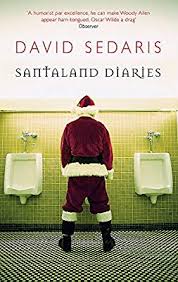
What of this month’s choice? Well, the theme is a book for winter. I wanted to avoid the theme of a book for Christmas. I don’t know about you but by the time we get to the middle of December I am sometimes a little bit ‘over’ Christmas already. Christmas this year, however, has felt somewhat on hold up to now, due to Lockdown 2.0, and definitely lower key. We have had some very serious books recently so I think it’s time for a bit of a Christmas laugh. I’ve chosen a humorous seasonal book by North American comedian David Sedaris. You may have heard him on his occasional Radio 4 show. He is extremely funny.

I’ve chosen Santaland Diaries (some editions called Holidays on Ice), which is a slimmish volume of six essays about his experiences as ‘Santa’ working in Macy’s. I think I’m going to go for this one on audio – I could do with a chuckle as I head out on my morning runs this month! I love Sedaris’s deadpan delivery and it will take my mind of the cold and wet!

I hope you will join me on the challenge this month. I think it will be a fun one.

Happy reading!

Booker Prize 2020 – winner announced tonight!

In previous years I have set myself the task of trying to read the Booker Prize shortlist between the time that it is released, usually mid-September, and the announcement of the winner. This is usually a month or so later in mid-October, so it is a tall order – six books in a little over four weeks. I have never succeeded in this endeavour – I’m usually still working my way through the list at Christmas. How do the judges get through so many books in the time that they do? I doubt they are even paid much to do it!

Last year, the Booker Prize was far from the forefront of my mind as my mother died in mid-September and her funeral coincided with the week of the announcement of the winner. I did subsequently read both of the books that won the prize jointly (remember that extremely unusual outcome?) – Bernardine Evaristo’s Girl, Woman, Other and Margaret Atwood’s The Testaments – as well as Elif Shafak’s 10 Minutes 38 Seconds in This Strange World. I still have Salman Rushdie’s Quichotte and Lucy Ellman’s Ducks, Newburyport on my TBR list.

This year the announcement of the winning book is a month later than usual. I assume this is all down to ‘the pandemic’ though I’ve heard of no official reason being given. Perhaps the committee has decided to be a bit kinder to the judges this year. Once again, I decided against trying to get through the shortlist, but have in fact read two of the books, one of which I loved and one of which has left me wondering if I missed something!

The book I loved was Douglas Stuart’s Shuggie Bain, a superb debut novel. Set in early 1980s Glasgow it is a visceral account of a young boy growing up in an atmosphere of poverty and his beloved mother’s alcoholism. The working-class community in which he lives is being ground down by the searing devastation of the Thatcherite era. Shuggie is ‘unusual’ – he is effeminate and naive, but his relationship with his mother is an portrait of love stretched to its very limits by the strain of addiction. I plan to write a longer review of this book so I will say no more at this stage. Let’s see if it wins!

The other book I read, and which I’m afraid I didn’t love, was Burnt Sugar by Avni Doshi. It is the story of a strained mother-daughter relationship. The mother, Tara, has dementia and her daughter, Antara, is finds she is forced increasingly to care for the woman who failed to care for her properly as a child. Tara left her husband with her daugher to join an ashram when the child was still very young. Their ‘bohemian’ lifestyle included some time spent begging, and also living with an artist who it is clear did not really care for either Tara or her young child. Antara experienced a degree of neglect as a child, for example receiving very little formal early education, and her mother’s attitude to her has been one largely of indifference.

As a mature woman, Antara struggles with the demands placed upon her by her mother. Tara can be cruel – is that the disease or is that how she has always behaved towards her daughter? She is engaged to be married to Dilip, an Indian-American, who cannot fully empathise with Antara’s dilemma. This book reminded me a little of Everything Under by Daisy Johnson, which has a similar storyline and which I also struggled to enjoy (though I think it was a better book). Everything Under was shortlisted for the Booker in 2018. Burnt Sugar has also been compared to Deborah Levy’s Hot Milk – I cannot concur . I loved that book. I’m afraid that, for me, what Burnt Sugar lacks is a story. Even after reading it, I’m afraid I’m not sure what it is really about, or what it is trying to say, apart from dementia is a horrible disease that throws family relationships into turmoil. Even the ending leaves you hanging. There is no narrative question that is resolved, which, for me, is one of the fundamentals of fiction.

I don’t like giving negative reviews and I have seen so many positive statements about this book; am I missing something? This one just did not do it for me. And my fellow book club members seem to agree – a pretty resounding thumbs-down! Perhaps it is just that Shuggie Bain is such a fabulous story, that this book felt wanting.

I am about to start another book on the shortlist – The New Wilderness by American author Diane Cook, another novel about motherhood, but this time in the shadow of climate change.

We will see what happens at the announcement tonight. One thing is for sure, it will not be the usual black-tie dinner!

#KeepKidsReading…and how this can be a joy for you too

To conclude this series of posts on my #KeepKidsReading theme I would like to tell you about two moments of joy I had last week, one of the head and one of the heart. Last weekend, I sat and read a little book that has been on my TBR shelf for a few months, Why you should read children’s books, even though you are so old and wise by “children’s” author Katherine Rundell. This is a little number that was sitting on the counter when I was in my local bookshop a while back – the literary equivalent of chocolate bars at the checkout! Given my interest in children’s literature I was bound to pick it up, plus I had not long read Katherine Rundell’s wonderful book The Explorer about a group of children stranded in the rainforest when the light plane they are travelling in crashes.

Rundell makes the grown-up case for reading children’s literature not just as a child (or perhaps because of a child) but for its own sake. I have to say that reading it in the middle of the current pandemic and after, frankly, the drama and protracted uncertainty of the US Presidential election, children’s books offer us not so much escapism, as a way of dealing with challenges. Good children’s characters discover a resourcefulness they usually didn’t know they had and develop a resilience which can give all of us an idea of how to ‘be’ in the world. It may not offer us the perfect happy ending but it can show us how to come to terms with reality; in the book review I posted earlier this week of Michelle Magorian’s Goodnight Mister Tom, yes it has a happy ending, but let’s not forget there was carnage along the way – a war, child abuse, a dead mother and baby, a friend killed, and a lost wife and child. But somehow, William, and indeed Tom, learn how to accept and grow from their experiences. Tragedy and loss will, at some point, befall all of us and somehow we need to learn how to cope with it. The best of children’s literature can show us some ways.

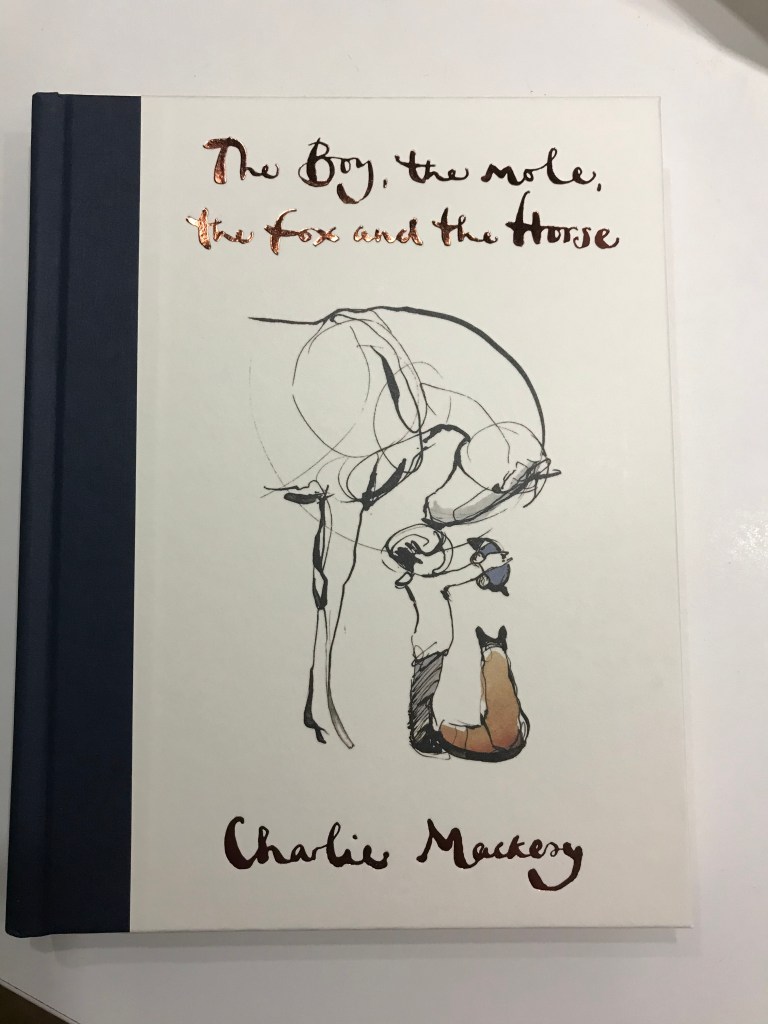
So, now for the heart moment. A few months ago I bought a copy of The Boy, The Mole, The Fox and The Horse by Charlie Mackesy, which was heavily promoted in bookshops after it was named Waterstones Book of the Year in 2019. I bought a copy because I’d heard such good things about it and liked the illustration style and the quotes I’d read. Somehow, though, I never got around to reading it, which is a terrible shame because it is magical and wondrous. It’s a gentle and moving tribute to the values of kindness and compassion, and an exhortation to embrace the differences between us. At its heart lies a belief in the magical power of love to lift us out of any darkness. And I can’t think of a sentiment more appropriate to our times than that. It has the power to induce a kind of inner silence, you will smile, and your heart rate will drop. It is also very beautiful to look at and to touch.

If you haven’t already got a copy, please get one and read this extraordinary book. It will take no more than half an hour of your time, although you may find, like me, that it keeps drawing you back. Please give copies of it as gifts this Christmas. We associate this time of year with peace and joy, and this book embodies it.

I can think of no finer book than The Boy, The Mole, The Fox and The Horse to endorse Katherine Rundell’s thesis. We should all be reading more children’s books.

#KeepKidsReading book review – “Goodnight Mister Tom” by Michelle Magorian

This book was my October choice for my Facebook Reading Challenge, the theme of which was a children’s book. I read it during half term, when I also posted one of my occasional #KeepKidsReading series on building a children’s library. This book had been on my radar for years; I think my son read it in school so we have had a copy around the house for some time. It is set around the time of the outbreak of the Second World War and so I imagined it dated from the 1950s or ‘60s, but in fact it was first published in 1981 and won a number of prizes around the world, including the Guardian Children’s Fiction Prize. It was made into a film starring John Thaw in 1998 which I am told is excellent – I have just bought the DVD and can’t wait to watch it.

A scene from the 1999 film adaptation starring John Thaw

When you read the book you quickly see how it could not have been written much before the 1980s, although even then it would have been quite ground-breaking; it deals with child abuse, amongst other things, pretty remarkable in a children’s book.

Londoner William Beech is eight years old when he first arrives at the home of ageing widower Tom Oakley. The novel is set in the rural village of Little Weirwold, but the county is not specified. I imagined Sussex or Hampshire – not too far from the capital. War has not yet broken out, though it seems inevitable, and children are being evacuated as a precautionary measure in anticipation of Nazi bombing. William is thin, sickly and covered in bruises, a timid, frightened character with poor literacy for his age. We soon learn why. His mother, a single parent, is an extremely religious woman who has controlled William through severe physical punishment and has kept him from school because she believes it to be a godless place. He lacks any confidence and self-belief because he has been told all his life that he is worthless. Tom Oakley is a gentle, patient man and seems instinctively to know how to deal with William’s problems, such as his persistent bed-wetting, which he handles with calm and grace. He quickly realises how fragile his young charge is and when William reveals, quite innocently, the way his mother has treated him, Tom is shocked but also determined that he will show him a different kind of life.

As William begins to thrive, so we learn a little more about Tom’s fragility too. As a young man, he lost his wife and their baby to scarlatina, a loss that affected him so deeply that he became almost a recluse, living in a small cottage beside the village graveyard with his dog Sam. His growing fondness for William leads him not only back into the arms of the Little Weirwold community, but also to question his continued self-imposed isolation. William is growing in confidence as he catches up academically and, for the first time in his life, makes a group of firm friends, particularly the flamboyant Jewish boy Zach, a fellow-evacuee, whose parents work in the theatre.

Some months into his stay with Tom, William receives a letter from his mother saying that she wants him to return home to London for a visit. William is reluctant and full of trepidation, but Tom persuades him that it is important he sees her, even though he has his own doubts about the wisdom of such a visit.

SPOILER ALERT:

If you want to give this to your children to read, it is important you know what happens in the story, but if you’re reading the book for yourself and prefer the suspense, don’t read any further.

On his return to London, William’s mother behaves strangely and after an initial, encouraging show of slight warmth, she soon returns to her old critical and abusive habits. When they finally return to the house in Deptford William learns that his mother has given birth to a baby girl while he’s been away. While going out to collect William she left the baby alone in the flat with her mouth taped so the neighbours did not hear her crying. It is bleak and upsetting at this point.

Meanwhile, Tom, preoccupied with worry about William, decides, on an impulse, to go to London, sensing the boy might be in danger. It is an arduous journey, but he finally finds William. After a spell in hospital, where we learn that William’s mother has taken her own life, Tom effectively ‘kidnaps’ William after being told that the boy will most likely have to go into a children’s home following his discharge.

There is another sad thread to the plot involving Zach, something else to be aware of, but I’ll save that one from here.

I read the second half of this book in practically one sitting; I could not put it down! It is a tough read, though it does have a happy ending. It is quite dark in parts, but not in a frightening way. It will give young readers an insight into what life was, IS, like for some children, and an idea of the different ways abuse can manifest itself. It also shows that children can develop resilience and hope, and find happiness after even the most difficult start.

For that reason, I would recommend for no younger than 10-11, and to read it with your child, or at least in advance so you can handle any questions they might have. Twelve to thirteen year olds might like it too. It is plainly written with accessible language.

Highly recommended for adult readers!

Facebook Reading Challenge – November choice

I thoroughly enjoyed October’s choice for the Facebook Reading Challenge, the theme of which was children’s fiction. I chose Michelle Magorian’s prize-winning 1981 novel Goodnight Mister Tom which had me in tears in more than one place. Beautifully written, dealing with difficult subjects for children, in a sensitive and straightforward way. I’ll post a more detailed review later in the week in the concluding posts in my #KeepKidsReading themed series.

As it’s already 5th November, however, I wanted to post this month’s choice for the Facebook Reading Challenge. Our theme is a book from the new decade; you may recall that back in January my theme was something from the last decade. I chose Gillian Flynn’s Gone Girl which I absolutely loved. There seem to have been some truly landmark books published this year, some of which I have already read, for example Hilary Mantel’s The Mirror and the Light, Maggie O’Farell’s Hamnet (look out for my review of that one soon), and some that are on my TBR list, such as the final part in Ali Smith’s seasonal quartet Summer and Elena Ferrante’s The Lying Life of Adults. There have also been a clutch of very exciting first novels, and it is one of these that I have chosen for this month on the reading challenge.

Abi Daré’s The Girl with the Louding Voice was published at the beginning of October, so it’s pretty hot off the presses (but happily already available in paperback). It has had some fantastic reviews and keeps popping up on my suggested reads from various bookseller’s newsletters I subscribe to. I normally eschew these as intensive sales pitches, but I think this one will be worth it. The main character is Adunni, a 14 year old Nigerian girl living in a small village, who dreams of getting an education and creating the life she wants for herself. As a young girl, however, she is considered little more than property to be traded in this patriarchal society, and is sold by her father to an older man in Lagos who abuses her sexually and where she is enslaved in his household. It is a story of how she escapes from this seemingly impossible situation through courage and tenacity.

This book is an international bestseller already and has had some amazing reviews, so it is one I cannot overlook. In these challenging times, when people of colour are having to fight for their rights and are doing so under the banner of the #BlackLivesMatter movement and where women cannot rest on their laurels, assuming equality has been won, this feels like an important book. Globally (according to the UN), little more than a third of girls receive a secondary education, one of the key drivers of public health and economic growth. This cause has been somewhat forgotten in the high-octane news environment we are living in right now, but the problem has by no means gone away. Perhaps stories can keep it at the top of the agenda.

So, I will step down from my soapbox now and go back to some quiet reading.

Do join me in this month’s challenge – I think it’s going to be another good one!

Elizabeth Gaskell’s house, Manchester

As I write this, it looks very much as if Greater Manchester, where I live, will be placed in the highest, Tier 3, level of restrictions in the coming days. There’s a lot of politics about, but let me tell you there is also a lot of frustration and anger about too. There is also a lot of division, differing perspectives, conflicting interpretations of data and statistics. But around me the human cost is evident – businesses are closing, I know people who have lost work, people under strain from not seeing their loved ones, and others paralysed by fear of the virus. One person’s asymptomatic response is another’s death sentence. We find ourselves at a difficult moment and we all have to find our way through this conundrum as best we can.

In the midst of all this confusion and anxiety, I took myself back in time last week to one of my favourite places in Manchester, but one which I have not visited for some time – the former home of Elizabeth Gaskell in Plymouth Grove, Rusholme, Manchester. It is close to the Manchester Royal Infirmary, The University of Manchester, and the Pankhurst Centre, a little house, in the middle of the hospital campus, that was the birthplace of the Suffragette movement (also now a museum).

Elizabeth Gaskell’s house is a fairly modest property that has had a chequered history. Elizabeth’s unmarried daughters Meta and Julia lived there until they died, and after Meta’s death in 1913, an attempt to preserve it as a memorial to the author was unsuccessful and it was sold and its contents dispersed. It continued to be occupied as a family home until it was bought by Manchester University in 1968 who used it as accommodation for overseas students. It fell into some disrepair (though thankfully not too much irreversible ‘renovation’ was done) but was finally purchased by the Manchester Historic Buildings Trust in 2004 and a project was set up to restore it as a museum to Elizabeth Gaskell.

It is still a work in progress and it is really only the ground floor rooms that have been set up as they would have been in Gaskell’s time. While I was there, I was shown work underway to restore what is believed to have been Elizabeth’s bedroom, but other rooms have been given over to research, educational spaces and meeting rooms. There is currently a very interesting exhibition about John Ruskin on display until the end of the year. The rooms have been painstakingly restored and furniture and artefacts either belonged to the family or are the Trusts’s best guess at what they would have had around them.

I was looking for some peace, tranquility and inspiration there and I found it. I was the only visitor that afternoon, and whilst it saddens me that so few people are going out to see the many interesting and beautiful places that remain open to visitors and safe, I had to admit that having the place to myself felt like a treat. Numbers are controlled and all the volunteer guides are well protected with PPE. You have to book your slot online and the £5.50 admission price gives you access for a full year. There is a tea room and a huge selection of secondhand books for sale.

Most of all there is a sense of dedication, to the memory of the author and her remarkable achievements (she died suddenly at the age of 55).

I recommend a visit to this wonderful house. The arts and culture are suffering terribly at this difficult time with opening restrictions, the cost of being Covid-safe, and reduced (or in many cases zero) numbers. Book a visit, you won’t regret it.

https://elizabethgaskellhouse.co.uk/

Book review – “Unorthodox” by Deborah Feldman

We are living in an age where minorities are beginning to find their voices. Many people who have experienced discrimination are angry. Their talents have been undervalued, their lives and their health have been damaged, their daily lived experience has, for many, been characterised by fear and by acts of hostility. The #BlackLivesMatter movement is rocking the United States to its very foundations and leading to some intense friction between people who have been historically oppressed and who are saying enough is enough, and people who fear what they might lose. Some of these, no doubt, subscribe to the view that the oppressed somehow deserve their lesser status. The movement has taken hold in the UK and throughout Europe too, although it does not appear to be quite as toxic as in the USA. The conversation we all now need to engage in will be a difficult one.

In the last week or two, we have seen a resurgence of another discrimination issue which is much more long-standing, that of anti-semitism; the UK Labour Party is currently considering a report by the Equality and Human Rights Commission on anti-semitism in its recent past. The full report will not be published for some time yet, but this will be a painful period for a party which has tolerance and plurality at its heart. The rapper Wiley was (eventually) banned from various social media platforms after making posting anti-semitic remarks recently, repeating discredited conspiracy theories. Several celebrities and public figures boycotted Twitter in protest at the failure of the social media giant to take down Wiley immediately.

Unorthodox imgIt therefore seems timely that I recently read the memoir Unorthodox by Deborah Feldman. Deborah is in her mid-thirties and lives in Berlin, with her young son. However, she grew up in Williamsburg, Brooklyn as a member of the Satmar sect of Hasidic Jews. She was brought up by her grandparents; her parents separated when she was very young. Her father was a man with sub-normal intelligence, though the precise nature of his disability or illness was never identified. Deborah’s mother was English, the daughter of poor divorced Jewish parents (though not Hasidic), who was unlikely ever to be able to marry well. The marriage was effectively one of convenience for both of them and Deborah was born soon after. The marriage broke down quite quickly, however, and Deborah’s mother was compelled to leave. The community put enough pressure on to ensure she left her child behind.


Unorthodox is the story of Deborah’s childhood and teenage years as a member of this closed community. It provides a fascinating insight into the norms of this ultra-orthodox group. The Hasidis have separate schools and girls are not permitted to have a full education. In fact, boys aren’t either really, they are just educated to a different end. The girls are expected to marry young, very young, and have many children. From this book I learned that Hasidis (and I hope I am representing this accurately), are opposed to the state of Israel, it being a secular state. They also believe that the Holocaust was a punishment (divine punishment?) for Zionism and by the assimilation of non-orthodox Jews with other societies. I realise the differences are probably far more complex than this, so I hope any Jewish readers will forgive any simplification – I am happy to be corrected.

The Satmar sect to which Deborah and her family belong, continue to follow centuries-old customs, which include, for example, arranged marriage, separation of the sexes and the requirement for women to wear wigs. Menstruating women and girls are considered unclean and must endure cleansing rituals before they are permitted to have sex again. Young people are taught nothing about sex, however. When she is married to a shy and inept young man at the age of seventeen, Deborah does not even know what her body parts are supposed to do. The marriage is disastrous, for both of them, and is not consummated for a year. When, finally, Deborah and her husband manage to have sex, she becomes pregnant very quickly and gives birth to a son at the age of nineteen.

To a western European reader, of no particular religious persuasion, the account of life in the community is both jaw-dropping and enlightening. It is genuinely hard to imagine how such a sect can continue to exist, particularly in the melting-pot of New York. This book, however, is not political, rather it is intensely personal. Deborah develops a curiosity from a very young age; she is interested in books by, for example Jane Austen and Roald Dahl, but she is forced to read them in secret. Her reading opens her eyes to other possibilities, however, and she glimpses a vision of a life outside the community. Her good fortune is that in some ways she never felt fully integrated, her parents having separated and her mother having come from outside the community; we are witnessing discrimination within discrimination within discrimination. This is quite telling in itself.

As she grows older, Deborah sees the cracks in the community – the absurdity of some of the customs, the cruelty these can give rise to, how the women conspire in misguided ways against one another to perpetuate their misery, and the hypocrisy in the political power struggles in the community. Deborah finally escapes the sect. You would think that a curious and intelligent girl on the doorstep of one of the most cosmopolitan cities in the world find it easy to leave, but reading the book gave me an insight into the degree of control the elders hold over the young people, particularly the young women, disempowering them psychologically, financially and intellectually. Perhaps this comes from a place of fear, but that is not the subject of this book – it is one woman’s story of escaping a kind of captivity and finding her own mind.

It is a gripping account which I recommend highly. It has also been adapted and made into a television series by Netflix – something else to go on my ‘must-watch’ list!

Discrimination and its effects are common literary themes – what are your recommendations for books on this topic?


Feeling lucky to have such a wealth of great television

A the beginning of lockdown it seemed there was no end to challenges published on social media as most of us stared into an abyss of being confined in our homes for an indeterminate period. Whether it was fitness, craft, cooking, or reading, there was a challenge for everyone. For others, just staying alive and/or sane was enough of a challenge, and for many, of course, endless unfilled days were a luxury they could only dream of; health and care workers, key workers in supermarkets and delivery drivers all found their work was busier than ever. I got sucked in too, thinking that I was suddenly going to have lots of time on my hands to do all sorts of jobs I had not got around to doing for months, as well as reading more (SO much more!), being really creative, sorting out my garden, etc, etc. The reality was somewhat different. I, and many others, had not factored in the emotional toll of this period we called lockdown; it was not like a staycation AT ALL, it was really stressful! I was relatively lucky: some people were worried about dying and others were painfully lonely, some were locked up with abusive partners, others confined in an apartment with young, bored children who needed home-schooling. I only had a working from home husband and three teenagers to contend with. But still, I found it difficult to settle to very much at all.

I have posted on here before about how valuable I found the streaming of National Theatre Live performances, the Hay Festival channel, and the BBC Glastonbury channel was great (if anyone has ever wondered whether the TV license fee is worth it I hope their question has been answered well and truly in the affirmative these last few months). I have also been watching a lot more television than ever before and it has been such a treat. I finally watched the amazingly incredible His Dark Materials in full – Dafne Keen as Lyra Belacqua was simply the stand-out performance and she’s only 15! Season two is coming soon – the trailer alone is thrilling. I also enjoyed Normal People, the much-acclaimed adaptation of Sally Rooney’s much-acclaimed novel. I loved the book and was so excited to watch the television series. I thought it was very faithful to the book, and the acting performances (again from two very young actors) were outstanding, but it did not move me as much as the book. Perhaps my expectations were too high, or the book was just too good? I have also watched a couple of the new versions of Alan Bennett’s Talking Heads. They are brilliant! There are twelve to watch altogether and every one of them will be fantastic I am sure as the casting is extremely high calibre.

Despite all this ‘extra time on my hands’ there are a few things I still have not got around to that are on my must-watch list: Noughts and Crosses, the series based on the Malorie Blackman novels, and My Brilliant Friend, the Italian adaptation of the first novel in Elena Ferrante’s Neapolitan series, which is now available on YouTube! I can’t wait to watch it, as it’s one of the best things I’ve read in the last few years. I also haven’t even started on the epic series The Luminaries yet, which has been screening on Sunday evenings on BBC1 for the last few weeks. It has finished now and its slot has been swiftly taken by A Suitable Boy, Vikram Seth’s epic novel from 1993, and still one of my all-time favourite books. Since I read Gone Girl in January I’ve also been wanting to watch the film – that’s another one on the list.

So, lockdown has not been the reading/film-watching/sewing/baking/decorating/ exercising bonanza that I thought it would be. Maybe in six months I’ll be asking myself what on earth I did with all that ‘spare’ time. Maybe I’ll just say to myself that I kept my family safe and well, I helped some people, I walked a lot, I kept my head together (ish) and I did enough.

NAMASTE

om-1281790_1920
(Image by Benjamin Balazs on Pixabay)

What are your reflections on your life in lockdown?


Book review – “The ABC Murders” by Agatha Christie

This was the title I chose for May in my Facebook Reading Challenge, the theme of which was classic crime fiction. I’ve read a few Agatha Christie’s in the last couple of years, having never much delved into this genre for most of my reading life. I loved the escapism of Death on the Nile and Murder on the Orient Express and I wanted to see if I would enjoy just as much a murder mystery set in the more prosaic location of London. I had also seen a little of the television adaptation from 2018 starring John Malkovich (though I think I only caught a couple of episodes) and it seemed altogether more grounded in the grim reality of its criminal subject. I’d love to watch it, actually, now that I’ve read the book, but sadly it’s not available at the moment. The film and television adaptations I have watched of Agatha Christie works have been more like costume dramas with more than a hint of comedy. I think I might prefer that to the darker readings of more recent years (rather like my late grandmother who was a voracious reader and loved nothing more than losing herself for a day in “a good murder”!)

The ABC Murders imgIn The ABC Murders Poirot is involved in a cat and mouse game with a serial killer, someone who warns in advance where and when he will strike, taunting our Belgian hero; the murderer begins with middle-aged shopkeeper Mrs Alice Ascher in Andover, then flirty young waitress Betty Barnard in Bexhill-on-sea, and so on. In this novel Poirot is past his career peak and his approach is challenged as somewhat old-fashioned in the form of Inspector Crome, an ambitious young detective who prefers more modern methods in his investigation. The murderer, however, pits himself squarely against our ageing Belgian hero; it is, unusually for the Poirot novels (it seems to me), a psychological game between perpetrator and hunter.

I also found Christie much more philosophical here than in the other Poirot novels I have read, on the criminal mind and on human nature and society more generally, such as in the following quote from Poirot:

“Speech, so a wise old Frenchman said to me once, is an invention of man’s to prevent him from thinking. It is also an infallible means of discovering that which he wishes to hide.”

I thoroughly enjoyed this book. Like so many before me I have come to love the character of Poirot, though in my mind, I can only ever see him as David Suchet! This was the quintessential book to curl up in a chair with and lose myself for an hour or so. As such, it was the perfect antidote to the continuous grim news about Coronavirus which dominated this Spring for most of us. Every time I read a Christie novel I want to run away and just read more. That might take me years since she was so prolific! I have been exploring the official Agatha Christie website with interest and it has fantastic recommendations on screen adaptations of her work, though I might need another lockdown to get through them!

If you are an Agatha Christie fan, what are your favourite novels and screen adaptations?