
 This book has been on my to-read list for some time now, ever since it caught my eye over a year ago when it was published. I recommended it as a hot new read for Spring last year, in fact! Following in my footsteps (he must have read my blog post!) Barack Obama recommended it as one of his Summer reads last year and he is quoted on the cover as saying this is “A moving portrayal of the effects of a wrongful conviction on a young African-American couple.” Notably, it also won the Women’s Prize for Fiction in June.
Let me get my cards on the table straight away – I loved this book, and it completely lived up to the hype it has had. It is such an interesting topic for a novel and yet one in which very little actually ‘happens’. It is a tender account of a relationship and the effect that one single event has upon them. It does not once get sentimental, does not set out actively to campaign about the injustice of the one event, and does not take sides. It just lays everything bare for the reader to draw their own conclusions. It will break your heart and fill you with hope at the same time.
Roy and Celestial are a young African-American couple, living in Atlanta, Georgia and their lives are on the up. They come from rather different backgrounds: Celestial is the daughter of a teacher and an academic, and is hoping to forge a career as an artist. Roy is the only son of Olive and Big Roy (who is not his biological father), decidedly more blue-collar but with strong values, pride, and deep Christian faith. They met through a mutual friend, Andre, who has lived next door to Celestial’s parents since they were children. Roy and Celestial are very much in love, but it is still early days in their marriage and they have their ups and downs.
They visit Roy’s parents in Louisiana one weekend and decide to stay in a motel; Olive has a slight suspicion about her daughter-in-law’s commitment to her son and it is more comfortable for both women if the couple do not stay in the family home. Roy and Celestial have an argument and Roy storms out of their motel room. He meets with a white woman whilst fetching ice and the two get talking. He tells her about the argument with his wife. Later that night, the police storm Roy and Celestial’s room whilst they are sleeping and arrest Roy on suspicion of rape of the woman he had chatted with earlier in the evening. At the trial, the woman testifies with certainty against Roy and it is quite apparent that Roy has little chance of escaping a guilty verdict, even though his innocence is clear to all who know him. Roy is sentenced to twelve years in prison.
The early chapters set the scene, switching between first person accounts by Roy and Celestial of their backgrounds, how they met and their recollections of the fateful night. The following chapters are an exchange of letters between the couple whilst Roy is in jail. Although Celestial visits him every month from Atlanta, the letters are an important way for them to keep their love alive. Just a couple of years into Roy’s sentence, however (and only 80 pages into the book), Celestial tells Roy that she can no longer go on being his wife, that they have spent longer apart than they were together, and that the situation is intolerable for her. We learn that Celestial was pregnant at the time of Roy’s trial but that they decided she should have an abortion as neither wanted their child to grow up with its father in prison. It is a metaphor for the doomed future of their marriage. Their correspondence ceases, and the remaining letters in this section are between Roy and his lawyer, Robert Banks, a family friend of Celestial’s parents, both about Roy’s appeal, which seems futile at this stage, and the status of his marriage.
This might seem the like the end of the thing. What we know about the couple at this stage is that Celestial is a strong-willed, independent woman who knows her own mind, and that Roy is proud, stubborn and conservative. The situation seems hopeless.
Roy spends five years in jail altogether, during which time he learns things about the status of African-Americans in the penal system he had no concept of before. He also, by chance, meets and shares a cell with his biological father, Walter. Also, Roy’s mother, Olive dies of lung cancer, never to see her son walk free. Eventually, Roy’s appeal succeeds and he is released, but he is by now broken, alone, his career in ruins. The remainder of the book is about Roy’s reunion with his old life, his hometown, Big Roy, and most importantly, with Celestial. Can their relationship be salvaged?
I don’t want to give any spoilers here, but I would just suggest that if you are looking for a romantic ending this book, thankfully, chooses not go (entirely!) down that route. It is a fine and up-close examination of the real human impact of judicial complacency, institutional racism, social prejudice and how some sectors of American society just get fewer life chances. It is also about a clash of values, between the more conservative older generation and the younger, educated, more metropolitan groups who assume there is equality.
This book is fascinating, beautiful, gripping and challenging and I recommend it highly.
If you have already read this book I would love to know your thoughts.
Follow my blog if you have enjoyed this review, and get regular updates on my posts.
 However, the full diary will be emptying out a little as this month progresses, so I’m hopeful I’ll be able to restore my daily reading hour. My selection for the Facebook Reading Challenge this month will also help. The theme is contemporary crime fiction and I’ve chosen the latest book by north-west (England) crime writer Cath Staincliffe, Fear of Fallling, which was published last year. I met Cath at a writer’s conference a couple of years ago and she was such a lovely, warm, down to earth person that she really inspired me to think that I too might be able to pursue a writing life. Crime is not usually my genre of choice, but I read a couple of her books, including
  The story begins when 15 year-old Michael, off school for many months after contracting hepatitis, seeks out Hanna Schmitz, a woman who had been passing when he found himself being sick in the street and who had helped him. Once he is well again, Michael’s mother sends him off to find the mystery good Samaritan in order that he can thank her. Hanna is twenty years Michael’s senior and employed as a bus conductor, but despite the social and age gap between them, they begin a passionate affair, both parties equally consenting. One of the more intimate aspects of their relationship is that Michael reads aloud to Hanna, after sex and in the bath mainly, although never the other way around. Michael never questions Hanna’s desire to have him read to her, he just accepts it. This makes up the first part of the book and perhaps it is a testament to events that have occurred since the time of its writing that all of us (mothers of teenagers!) found the prose rather discomfiting, and not a little implausible. Hanna disappears mysteriously out of Michael’s life, leaving him heartbroken and perhaps also rather damaged.
 This book is Angie Thomas’s debut novel and it caused a sensation when it was first published in the United States in February 2017. It enjoyed both critical and popular acclaim, remaining at the top of the New York Times YA best seller list for almost a year. It was made into a film which was released last Autumn. The novel came out of a short story Thomas wrote in college following the police shooting of a young black man in 2009.
 The book is about a young newly-married couple, Celestial and Roy, and is set in the American Deep South. Their lives appear full of potential until Roy is accused of a crime he did not commit. He is convicted and sentenced to twelve years in prison. The book concerns the effect of the separation on their marriage, how Celestial copes alone and what this means for their shared dreams.
 There was a decidedly political, Brexit-y feel to events this year, perhaps that is because of the looming Tory party leadership contest and the European elections last week. Also, there is a sense that the world of arts and culture is beginning to assert its feeling about the Brexit issue more vociferously as the UK’s departure draws nearer. I saw Keir Starmer on Saturday and found him extremely impressive (surely a future leader of the Labour Party?). He was thoughtful and candid, whilst also remaining tactful about current political events. He was gracious about Theresa May and less so about many of her colleagues. He was being interviewed by Philippe Sands, author of
 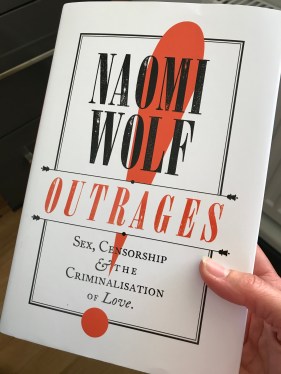 I also saw Naomi Wolf, a woman whose work I have admired for years. She was talking about her latest book, Outrages: Sex, Censorship and the Criminalisation of Love in which she traces the evolution of attitudes to sex, particularly homosexual activity, from the mid-19th century on, through the writings of John Addington Symonds. There has been a lot of controversy in the press about an error in her book (which she has acknowledged and plans to correct in the next edition), which in my view, has been somewhat overblown; I truly doubt whether a male author would have experienced the same opprobrium. Naomi Wolf was warm and articulate, and gracious about the cultural and political turmoil in the UK, reflecting also on similar events in the US too. I was glad to have heard her speak.
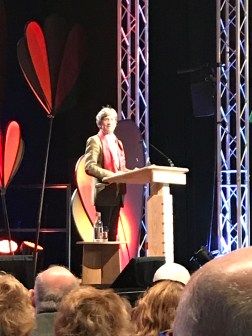 On Sunday, I went to a panel discussion led by Ed Vaizey MP, talking about branding with a number of business-people. It was interesting, and Ed Vaizey is very witty, but, to be honest, didn’t feel very “Hay”. I also saw Melvyn Bragg speak about his new novel Love Without End: A Story of Heloise and Abelard. I enjoy listening to his BBC Radio 4 show In Our Time and am always impressed by his ability to cut through to the core of so many topics. Can you believe this is his 22nd novel!!! He has also written seventeen non-fiction books. Surely, he is approaching national treasure status!
 So my reading time has been severely curtailed. I managed to finish Why Mummy Drinks just after the book club meeting, just as well it was a quick read and did not require too much mental investment. My other big read for last month, however, did. Colin Thubron’s To A Mountain in Tibet was the April title for my


 Julia's books