I’m travelling to Dublin on the ferry from Holyhead, north Wales as I write this, making our annual summer visit to see family and friends. I love Dublin and think of it as a second home, having visited the place several times a year for about two decades now. I haven’t seen all the ‘sights’, although Dublin Zoo, the art gallery, Powerscourt, and the Natural History Museum have all been well and truly ‘done’! When we visit we seem to spend much of our time just hanging out, visiting people, sharing meals, etc. For me, it’s only when you do that, after visiting a place so many times that you really get to the heart of it.
 It seems appropriate that I should be posting a review of Normal People this week, a book so very much about Ireland, the challenges and contradictions at the heart of a nation that has transformed itself in recent years. It is not just about Ireland, but about what it means to be young in Ireland and about class. It is also about identity and, in common with some of the issues faced in the UK and many other societies I am sure, the draw away from regional towns and cities, towards a centre, a capital, where there is perceived to be more opportunity, and what that means both for the individual and for society in the wider sense.
Connell and Marianne are two teenagers attending the same high school in Carricklea in the west of Ireland. Both are very bright and hopes about their future prospects are high, but that is where the similarities end; their lives couldn’t be more different. Connell is the much-loved only child of a young single Mum. The live together in a small house and Connell’s mother cleans for Marianne’s family. Although academically a high achiever, Connell still manages to be popular and admired. Marianne is much more of a loner and lives with her working Mum and brother (a threatening figure who becomes increasingly violent towards her). She is remote from her family, not well-liked at school, and has a spiky personality.
Despite their differences, Connell and Marianne develop a closeness which soon blossoms into an intense and sexual relationship. The author portrays skilfully the subtle differences in their perspectives, which will at times lead to difficulties of communication and understanding throughout their young lives and the ebb and flow of their relationship.
The pair both end up with outstanding exam results which means that both secure a place at the prestigious Trinity College, Dublin. We follow them to college and here their positions are reversed – it is Marianne now who finds her ‘tribe’ amongst the affluent, the elite, the middle classes, and Connell who struggles to feel at home, whose financial and social background contrasts so markedly with that of his peers.
Despite this, Connell and Marianne continue to have an on-off relationship for the duration of their university careers and beyond. At times their relationship is passionate and sexual, at others it is more platonic, mutually protective. But always it is intense, even where there is little contact between them, such as the period Marianne spends on a Scandinavian scholarship with the abusive artist she has for a boyfriend at the time.
It is a fascinating and compelling book, part elegiac romance, part social commentary, where there is very little in the way of plot, but an abundance of humanity that is acutely observed and intimately drawn. The book has rightly earned its young author widespread plaudits and praise and was shortlisted for this year’s Women’s Prize for Fiction. (The winner, An American Marriage by Tayari Jones, which I reviewed on here recently, was a worthy victor but I don’t envy the judges having to choose between these two outstanding novels.)
Normal People is a beautiful, clever book that will at times break your heart and at other times lift it, and I heartily recommend it. The only pity is that it’s relatively short!
Normal People has been widely read and reviewed – what did you think of it?
If you have enjoyed this post I would love for you to follow my blog. Let’s also connect on social media.
 The centre of the story is the relationship between two women, Bel and Lydia, who meet at a New Year’s party in 1985, when they are both sixth-formers although at different schools in Yorkshire. They are very different people – Lydia is reserved, generally quite sensible, and from a secure and ordinary family. Bel is wilder, her family rather more bohemian and she has a difficult relationship with her parents. Bel grew up in France and then London and it is her father’s job that has brought them to northern England, where she is something of an outsider. Bel and Lydia are drawn to one another, despite their very different personalities; for Lydia, Bel represents spontenaiety, excitement, danger even. For Bel, Lydia represents security, a steady point in a turning world.
 Milton the Mighty by Emma Read
 The Dog Who Saved the World by Ross Welford

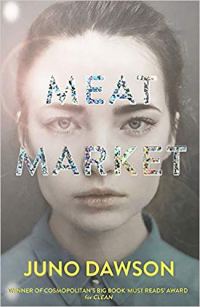 Meat Market by Juno Dawson
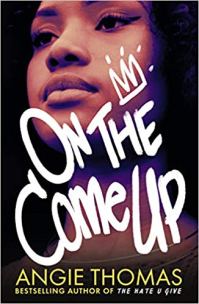 On The Come Up by Angie Thomas
 This book has been on my to-read list for some time now, ever since it caught my eye over a year ago when it was published. I recommended it as a
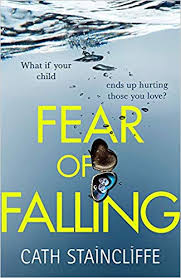
  However, the full diary will be emptying out a little as this month progresses, so I’m hopeful I’ll be able to restore my daily reading hour. My selection for the Facebook Reading Challenge this month will also help. The theme is contemporary crime fiction and I’ve chosen the latest book by north-west (England) crime writer Cath Staincliffe, Fear of Fallling, which was published last year. I met Cath at a writer’s conference a couple of years ago and she was such a lovely, warm, down to earth person that she really inspired me to think that I too might be able to pursue a writing life. Crime is not usually my genre of choice, but I read a couple of her books, including
 This book is Angie Thomas’s debut novel and it caused a sensation when it was first published in the United States in February 2017. It enjoyed both critical and popular acclaim, remaining at the top of the New York Times YA best seller list for almost a year. It was made into a film which was released last Autumn. The novel came out of a short story Thomas wrote in college following the police shooting of a young black man in 2009.
 The book is about a young newly-married couple, Celestial and Roy, and is set in the American Deep South. Their lives appear full of potential until Roy is accused of a crime he did not commit. He is convicted and sentenced to twelve years in prison. The book concerns the effect of the separation on their marriage, how Celestial copes alone and what this means for their shared dreams.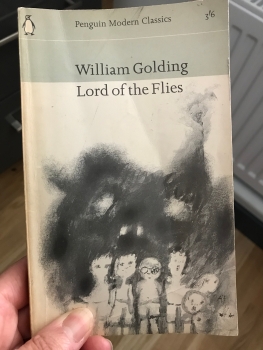
 There was a decidedly political, Brexit-y feel to events this year, perhaps that is because of the looming Tory party leadership contest and the European elections last week. Also, there is a sense that the world of arts and culture is beginning to assert its feeling about the Brexit issue more vociferously as the UK’s departure draws nearer. I saw Keir Starmer on Saturday and found him extremely impressive (surely a future leader of the Labour Party?). He was thoughtful and candid, whilst also remaining tactful about current political events. He was gracious about Theresa May and less so about many of her colleagues. He was being interviewed by Philippe Sands, author of
 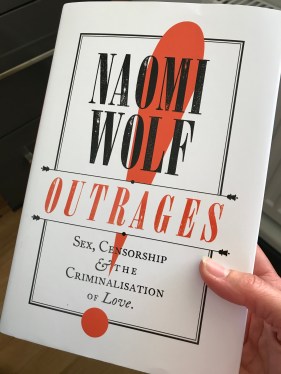 I also saw Naomi Wolf, a woman whose work I have admired for years. She was talking about her latest book, Outrages: Sex, Censorship and the Criminalisation of Love in which she traces the evolution of attitudes to sex, particularly homosexual activity, from the mid-19th century on, through the writings of John Addington Symonds. There has been a lot of controversy in the press about an error in her book (which she has acknowledged and plans to correct in the next edition), which in my view, has been somewhat overblown; I truly doubt whether a male author would have experienced the same opprobrium. Naomi Wolf was warm and articulate, and gracious about the cultural and political turmoil in the UK, reflecting also on similar events in the US too. I was glad to have heard her speak.
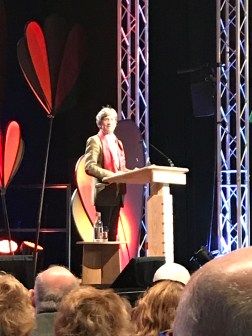 On Sunday, I went to a panel discussion led by Ed Vaizey MP, talking about branding with a number of business-people. It was interesting, and Ed Vaizey is very witty, but, to be honest, didn’t feel very “Hay”. I also saw Melvyn Bragg speak about his new novel Love Without End: A Story of Heloise and Abelard. I enjoy listening to his BBC Radio 4 show In Our Time and am always impressed by his ability to cut through to the core of so many topics. Can you believe this is his 22nd novel!!! He has also written seventeen non-fiction books. Surely, he is approaching national treasure status!
 Julia's books