 Last week I launched my 2020 Facebook Reading Challenge and promised I would post this week, my thoughts on the final book of 2019 – The Prime of Miss Jean Brodie by Muriel Spark. The theme for December was a novella – I wanted something short as I know it is a busy time of year and I never get as much reading done as I think I’m going to! In some ways, though, this does not do full justice to what is a highly complex, multi-layered and thematically dense piece of work. You simply have to read every word on its 127 pages and read them at the measured pace of how you imagine Miss Brodie might speak.
Dame Muriel Spark is considered one of the finest writers in English and one of Scotland’s finest writers. She won many glittering international literary awards in her life, and was made a Dame in 1993. She was married briefly, just prior to the outbreak of the Second World War, during which time she gave birth to a son, from whom she later became bitterly estranged. In the 1960s she lived in New York and in Rome, where she met her long-term female partner. The couple settled in Italy, where Dame Muriel died in 2006 at the age of 88. Quite a life!
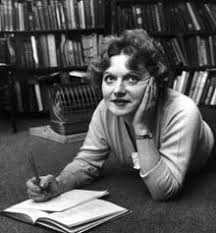
I think the author’s background makes this novella all the more interesting because it is such an ‘Edinburgh’ book – I say this as a non-Scot, so please forgive me if you disagree! – or at least, an Edinburgh of a certain time (pre-war). Spark left Scotland quite early in her adult life and her father was a Lithuanian Jew. Perhaps this makes her acute observation of Miss Brodie and her other characters even more profound.
You will probably know the basic plot of the book; the 1969 film starring Maggie Smith is widely considered a classic. There was also a television series made in the late ‘70s starring Geraldine McEwan, which I vaguely recall having seen, though I was very young at the time – I definitely would not have ‘got’ it; although the book is set in a girls’ school, Malory Towers it most definitely is not! Miss Brodie initially cuts a dominant and impressive figure – determined to influence a selected group of pre-pubescent girls about the broader aspects of life which she feels the school curriculum neglects, such as genuine appreciation of art, social and cultural awareness and matters of the heart (or, more accurately, matters of sex). The strictures of the girls’ school, with its emphasis on knowledge, facts required to pass the exam for the secondary level, and the protestant ethos are seen by Miss Brodie (so she tells us) as narrow and not a true preparation for life. She tells the girls:
“I have no doubt Miss Mackay [the headmistress] wishes to question my methods of instruction. It has happened before. It will happen again. Meanwhile, I follow my principles of education and give of my best in my prime. The word “education” comes from the root e from ex, out, and duco, I lead. It means a leading out. To me education is a leading out of what is already there in the pupil’s soul. To Miss Mackay it is a putting in of something that is not there, and that is not what I call education, I call it intrusion, from the Latin root prefix in meaning and the stem trudo, I thrust. Miss Mackay’s method is to thrust a lot of information into the pupil’s head; mine is a leading out of knowledge, and that is true education as is proved by the root meaning.”

At first, we may see these girls as lucky to have such a dynamic, interesting and strong female personality in their young lives who, for example, is prepared to take them to the theatre off her own bat. What we gradually learn, however, is that the girls are merely Miss Brodie’s ‘project’, that it is not altruism and genuine care that drive her, rather it is her ego. She manipulates the girls, in some cases to their tragic detriment, and they become a vicarious extension of her own ambitions and disappointments, particularly in the matter of sex. Here, she acts as little more than a ‘pimp’, though I am aware this may be a 21st century reading of what may have been regarded at the time as less shocking (a sexual relationship between one of the girls and the married one-armed art master with whom Miss Brodie is herself in love).
In the end we can only see Miss Brodie as disappointed, disappointing, manipulative and manipulated, a deceiver and ultimately deluded. She becomes increasingly troublesome morally, as she expresses her admiration for Mussolini and fascism, and the various fates of the girls she once sought to educate are laid out before us.
This is such a clever book which I would encourage anyone to read. And read again once you’ve got to the ending!
Recommended.
If you have enjoyed this post, I would love for you to follow my blog. Let’s also connect on social media.
 It is truly a groundbreaking novel, but curiously, in my view, less in its own right than as an extension, a continuation of, the work started with the publication of The Handmaid’s Tale in 1985. What is also partly so extraordinary about The Testaments is how relevant its story remains over thirty years on from The Handmaid’s Tale. In spite of equality legislation, human rights legislation, more women in positions of power and authority, we still have world leaders able to express their misogyny openly and with impunity, and violence against women and girls seems as rife as ever. Atwood is Canadian, but her novel is a dystopian vision set in the United States, where, in the last year, we have seen the erosion of women’s reproductive and therefore health rights in some states and the substantial threat of more to come. This novel seems so urgent and necessary.


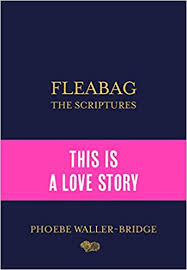 Fleabag: The Scriptures by Phoebe Waller-Bridge £20.00
 Who Am I Again? by Lenny Henry £20.00
 Wilding by Isabella Tree £9.99
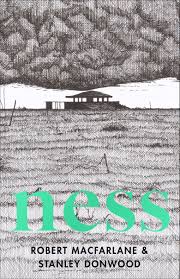 Ness by Robert Macfarlane and Stanley Donwood £14.99
 Twas the Nightshift before Christmas by Adam Kay £9.99
 The Jewish Cookbook by Leah Koenig £35.00
 Mother: A Human Love Story by Matt Hopwood £9.99
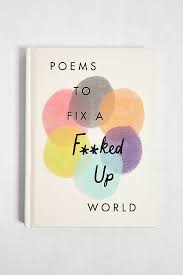 Poems to Fix a F**ked Up World by Various £9.99
 Fucking Good Manners by Simon Griffin £9.99
 The Boy, the Mole, the Fox and the Horse by Charlie Mackesy £16.99
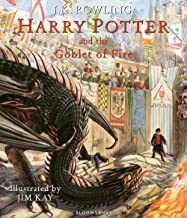 Harry Potter and the Goblet of Fire (Illustrated edition) by JK Rowling and Jim Kay £32.00

 Diary of a Dyslexic School Kid by Alais Winton and Zac Millard £9.99


 The Book of Dust Volume Two: The Secret Commonwealth by Philip Pulman £20.00
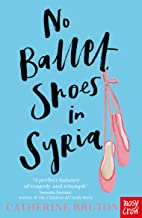 No Ballet Shoes in Syria by Catherine Bruton £6.99
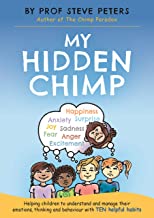 My Hidden Chimp by Steve Peters £12.99
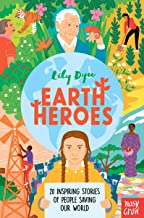 Earth Heroes: Twenty Inspiring Stories of People Saving Our World by Lily Dyu £9.99
 I remember when this book was published in 2006. It was widely acclaimed, but also controversial; there were some questions marks over its historical accuracy (one senior rabbi argued that nine year-old boys were not kept in concentration camps, all were gassed because they could not work and were therefore of no use, though this argument also been disputed) and others have questioned whether such a relationship, between a young inmate and the son of the camp commandant, could have gone on for so long undetected, particularly when Bruno slips under the fence. Whatever its problems, the book has sold millions of copies worldwide and was made into a successful film within two years of publication.
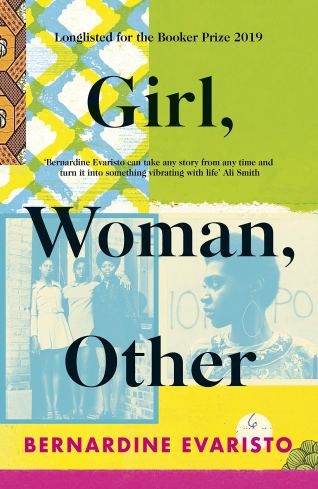 What I liked about it, however, was less this grander aspect, but rather the quality of its story-telling. I must admit that 50 or so pages in, I was not overwhelmed! There are twelve characters in the book, all women bar one (who is trans), all black or mixed race. They are broken down into four groups of three, and each threesome is strongly connected in some way (eg mother/daughter). Each group is also connected with the others, even if only in a tenuous way (eg teacher and former pupil) and almost all are in some way connected to Amma, the first character we meet. Amma has written a play which is having its debut performance at the National and this provides the framework of the novel. Many of the characters are present at the penultimate chapter of the book, the after-party, where the differences between them and their lives are laid bare. This is interesting because the author is not only trying to draw out the similarities between the characters and their life experiences, suggested by their common characteristic of being mixed race and female, but she is also, I think, railing against the notion of such women/people being homogeneous; they are all far more than just their race or gender.
 I’ve just finished a lovely little book The Umbrella Mouse by Anna Fargher. When I was browsing in my local bookshop a few months ago, one of the assistants recommended it to me and said it had had her in tears. I knew then it was a ‘must-read’! I got my copy secondhand online and it’s signed!
 The Lathe of Heaven was written in 1971, but was set in ‘the future’ – Portland Oregon in 2002. This future world is one in which the global population is out of control, climate change has wrought irreparable damage and war in the Middle East threatens geopolitical stability. The most alarming (and engaging) thing about the book, for me, was how prophetic it was; in 1971 did readers think this was some dystopian world? Worryingly, many of the problems envisaged by Le Guin are recognisable features of our environment in 2019.
