According to my Goodreads account, I started this book on 4 December. It was the final book I tackled on last year’s Man Booker Shortlist. I have only just finished it. It has taken me well over six weeks. I have read a couple of other books alongside it, mainly because it is currently only available in hardback and at 502 pages it does not slip readily into the handbag. It is also a book that demands to be read slowly, almost at the pace of a tree growing, so it requires something of an investment. If you are put off already, read on, because I must balance that by saying that it is a quite extraordinary book and every hour I have spent with it has been time well spent. It is not a book that rewards being read a few pages at a time, it is best approached with an hour or so in hand.
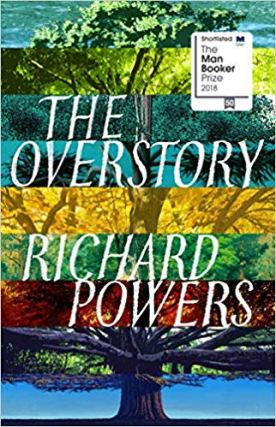
It is hard to know where to begin to describe it so I will give you the New York Times quote from inside the dustjacket:
“A monumental novel about reimagining our place in the living world.”
After reading it you cannot help but feel that the human race is bent on a suicidal mission, that we will take most of nature down with us and that our tenure as a species on this earth has been wild and reckless and over in the blink of an eye (in evolutionary terms). We’re on the way out I’m afraid. The author’s framework for exploring this is the life of trees. The number and range of trees on the planet was once phenomenal, and humans have systematically destroyed most of them, in the pursuit of so-called ‘progress’, grazing land and space for short-term cash crops, a grossly selfish and short-sighted error of judgement:
“We’re cashing in on a billion years of planetary savings bonds and blowing it on assorted bling.” (p386)
This is the essential powerful message of the book and his method of telling it is also extraordinary. The first part ‘Roots’ is made up of individual chapters about nine individuals, their background, how they came to be at whatever stage of life they are at and, for some, how their families came to be in America. For each individual, trees represent some significant event in their lives. For example, Douglas Pavlicek served in Vietnam and after his plane was hit, he parachuted out and his landing in a banyan tree saved his life.
The second part of the book ‘Trunk’ is the most substantial and details how each of the individuals lives proceed. For example, Neelay, badly paralysed after a childhood fall from a tree becomes a powerful computer games entrepreneur when he invents an extraordinary virtual world. Patricia, an introverted sight and hearing impaired young girl, whose father invested in her a love of nature, becomes an academic but her book about the secret language of trees is derided and she retreats to a reclusive life as a ranger. Many years later, others will agree with her and her thesis becomes fashionable and influential. Olivia, who almost died in part one, becomes an activist, and hooks up with Nicholas, who lost his entire family in part one after they were accidentally poisoned with gas in the family home. The two of them occupy a giant redwood tree in forest threatened by loggers for many months, though ultimately their protest proves futile (this is a metaphor). Many of the characters’ lives intersect, while others remain firmly parallel, for example Dorothy and her quadriplegic husband Ray; it is not clear until close to the end how their story is relevant.
The third part of the book ‘Crown’ is a coming together of all these separate stories, the logical conclusion to the each of the individuals’ stories and the fourth part ‘Seeds’ is about the legacy they leave behind. The end is anti-climactic in some ways, but I think that is the point; for all our ego and self-importance, the mark that humans will leave is pretty insignificant in the long-term. We will simply destroy ourselves. As the book progresses the pace also picks up, as does the switching between the individuals and their stories and the sense is created of humans accelerating towards their decline.
It is hard to do justice to the book in a short review. It is a book which merits deep reading. It is a remarkable concept and remarkable in execution and the writing is sublime, possibly the finest prose I have read in years. In some ways it has left me profoundly depressed about the direction the world is going on – it would be easy to focus on the events of recent years for examples of this but the reality is we have been crafting our own demise for decades, since the Industrial Revolution. Despite all the evidence, we continue to press on with our self-destruction, although there are a few people out there trying desperately to make their voices heard, the author being one of them – I’ve heard him a few times on the radio making the case for paying attention. The non-depressing thing about the book is the realisation that human beings are actually just a miniscule episode in the natural history of this particular planet, and it will prevail, with or without us. This is the ‘overstory’, the picture that is much bigger than us. In this respect our arrogance, particularly that of some of our world leaders, is really rather laughable. What is fascinating is the why, what drives us humans to behave the way we do, and this book sets about trying to explore that.
Though I really loved Anna Burns’ Milkman and felt it was a worthy winner of the Man Booker, I am also rather desperate for a serious realisation of the impact we are having on the world around us, and feel that greater publicity for this book could at least have contributed something to that debate.
One thing is for sure, I will never look at trees the same way again.
Highly recommended, your patience will be rewarded.
If you have read The Overstory, do you agree with my take on it?
If you have enjoyed this post, I would love for you to follow my blog. Let’s also connect on social media.

 The Five by Hallie Rubenhold
 Bookworm: a memoir of childhood reading by Lucy Mangan
 Spring by Ali Smith
 Girl, Balancing by Helen Dunmore
 Lanny by Max Porter
 The time span of the novel is the duration of Tish’s pregnancy, during which time the couple’s two families set about trying to free Fonny, liaising with his lawyer and pulling together all the money they can to pay Fonny’s legal costs. The lion’s share of this task falls to Tish’s family, who see it as their duty to support their daughter and the father of their grandchild. Fonny’s family, on the other hand is divided; his mother and sisters are deeply confused, ambivalent and disturbed by events effectively disown him. Fonny’s father does engage, supported by Tish’s father, but it is clear he is not really strong enough to cope with the pressure. It falls to Tish’s family to take charge and her mother, Sharon even goes to Peurto Rico, to where the raped woman has fled, to appeal to her to change her testimony, the suspicion being that Fonny was simply served up to her by corrupt police officers. As Tish’s pregnancy progresses, so we follow the legal machinations, the financial pressures faced by all concerned, the effect of prison on Fonny, the artistic soul tortured by his incarceration, and the toll that events take on both families.
 A dear friend gave me Helen Dunmore’s final novel, published posthumously, Birdcage Walk, for my birthday last year and I have only just got around to reading it. I had read some quite mixed reactions, some feeling it wasn’t her best or that it had not been as well edited as it might have been, which is understandable. I am not familiar with Dunmore’s other novels so don’t have a view on how it compares. It meant I approached it with some trepidation, however.
 Roll of Thunder, Hear My Cry is the first of three novels by Mildred D Taylor about the Logan family, black farmers in Mississippi, set in the 1930s. They are poor, but they own their own small piece of land, Grandfather Logan having bought it in the 1880s from local landowner Harlan Granger, much to the chagrin of some of the white locals who still cannot accept the social changes giving black people greater autonomy and rights. Grandfather Logan is now dead and the central character, Cassie, lives on the farm with her parents, her grandmother and three brothers. Despite owning 400 acres, the family still struggles to make ends meet, which is why Cassie’s father works away much of the year, on the railroad construction, and her mother works as a teacher at the local (black) school. All the family contributes to the running of the farm and the income it generates.
 This third book picks up precisely where volume two left off, at a small book launch for Elena’s first book, a mildly sexual novel which has caused a stir, and where she is being questioned in a patronising way by an obnoxious critic. A familiar face from Naples walks into the room – Nino Sarratore – and Elena’s confidence is restored. Nino has been a friend since childhood, and there is a complicated triangular relationship between him, Elena and Lila, the main but elusive protagonist of all the books. Elena has been in love with Nino since they were young, but this has not been reciprocated. Like Elena, Nino proved to be a successful student, despite the disadvantages of background and upbringing, and would go on to achieve great things academically, though both know that neither is as brilliant as their mutual friend Lila, with whom Nino was once in a relationship, but who would never reach the academic heights of the other two.
 In summary, this book is set in the late ‘60s, early 70s and is about Freda and Brenda, two young women who work together in a London factory where Italian wine is bottled. They also live together in a pokey bedsit, and share a double bed at nights. Freda is blonde, buxom and outgoing, sexually frustrated and of a romantic inclination. She has the hots for Vittorio, the nephew of the factory’s Italian owner, and fantasises about being seduced by him, contriving situations to enable this. Brenda is a redhead, but mousey in personality, timid and sexually repressed. She has left her drunken husband Stanley in the Yorkshire farmhouse which they shared with his domineering mother. Freda and Brenda met after Brenda had a tearful outburst in a butcher’s shop. Freda took her in and got her a job at the factory. Freda can be kind but also cruel and the book is as much about the complex nature of relationships between women as anything else.
 Julia's books