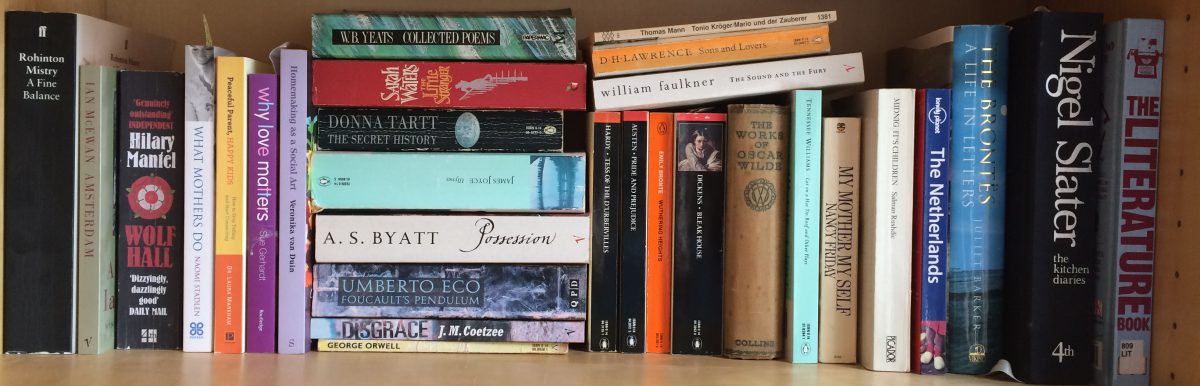
Last week I posted a review of Agatha Christie’s Murder on the Orient Express, the first of two crime fiction novels I read over the Christmas holidays. The Girl in the Green Dress could hardly be more different, despite also being a crime novel and it is indicative of how the way we entertain ourselves has changed in the eighty odd years that separate the publication of these two books. Where Agatha Christie provided escapism, upper class characters, exotic locations and traditional murder mystery with the big reveal at the end, Cath Staincliffe’s book provides gritty realism, some repellent characters, familiar locations and a limited amount of mystery. There is no job here for the reader to play the detective, spot the clues and guess the outcome. The job of the reader is to engage with the characters at a deep level.
 The book starts with 18 year-old Allie Kennaway, and her friends heading out for their college prom night. They are at Allie’s home with her father Steve and younger sister Teagan. Steve is a single parent, his wife, the girls’ mother, Sarah, having died a couple of years earlier from cancer. Allie, we learn is a transgender woman, formerly Aled.
We meet the other characters who will form the main part of the drama, in quite quick succession: Donna, the workaholic Detective Inspector, who has four children and a less than happy marriage; Jade, a new detective, Asian, and whose mental health problems are hinted at early on; Martin, a long-standing colleague of Donna’s, a horny-handed old-fashioned copper. The murder takes place quite early on; Allie’s body is discovered in a deserted street near the nightclub where the prom was being held. Soon after, we meet Sonia, single mother of the feckless youth Oliver, who spends his days eating junk food, hanging out with his mates and playing online games. His culpability for the crime is fairly obvious.
If we know whodunnit, then what is the story about? Well, there is a fairly major and dramatic plot twist, which, of course, I shan’t reveal. Mostly, though, it’s about the characters and their internal lives, their hopes, dreams, motivations and frustrations. The police (Donna, Jade and Martin) are all flawed in their own individual ways and are trying to deal in a systematic and process-orientated way with a terrible event, trying to set aside their personal selves, and yet completely unable to do so. Work and ‘home’ cross over in the most challenging ways. Much like the crime shows I watch on television (I’m thinking Happy Valley, Morse, Prime Suspect), the issues of the central character are part of and not separate from the story. Although, for Agatha Christie, Poirot’s personality is key to the narrative, it does not form part of the plot in the way that more modern crime fiction does. Or perhaps you would disagree?
There is also the storyline of transgender young people and their experiences, which the author handles deftly with great care and sensitivity. It is a huge and topical issue to tackle and the result is commendable.
I struggled to get into this at first. The clipped writing style, which reminded of the way police officers narrate radio dramas, ie not in fully-formed sentences, was off-putting to me, and I found the structure, short chapters within chapters focussing on a different character in turn, meant it did not flow so easily. Having just read Agatha Christie, however, knowing the murderer from the outset seemed odd and I wondered what on earth the rest of the book was going to be about! There is that twist, of course, and as I got to know the characters, so I began to engage with them and their stories more.
I did get hooked and enjoyed the book immensely. It’s a quick read, though its grittiness makes it hard-going in places; the reader is not spared any detail! I’d recommend this book, though, and I will definitely read more of Cath Staincliffe’s work.
If you are a reader of crime fiction do you prefer the modern or the more old-fashioned Christie-style writing?
If you have enjoyed this post, I would love for you to subscribe to the blog by clicking on the ‘Follow’ button. Let’s also connect on social media.
 To my shame, I have not read anything by Agatha Christie before, although I have stayed at the Old Swan Hotel in Harrogate, to which Agatha famously disappeared for nearly two weeks in 1926 after a row with her husband! She is quite extraordinary when you look at the stats: said to be the best-selling author of all time, her books have sold around two billion copies (yes two billion!) worldwide, second only to Shakespeare and the Bible. She wrote 72 novels, 14 short story collections, and one play, The Mousetrap, the longest-running in the world. Miss Marple and Hercule Poirot are perhaps two of the best-known literary characters of all time, and her work has been adapted for film and television countless times. She is truly a literary giant.

 The first book in the challenge (the theme is a Young Adult novel) will I hope be a nice one to start with – The Disappearances by Emily Bain Murphy. It’s part science fiction/fantasy, part coming to terms with love and loss.

 I plan to spend the time eating, sleeping, walking, watching movies, playing games and, of course, reading. I’m planning to tackle the enormous 4321, the Man Booker nominated tome by Paul Auster, and the only one on the shortlist I have not yet managed to read.
 So, it’s my final reading challenge post of 2017, and this month it’s a short story. Just as well, because there isn’t very much month left! The reason I picked this genre for December is that I predicted, correctly, that it would be a busy month and my reading would slacken off. It is taking me ages to get through the book I am currently reading (the book club’s choice of Norwegian Wood by Haruki Murakami).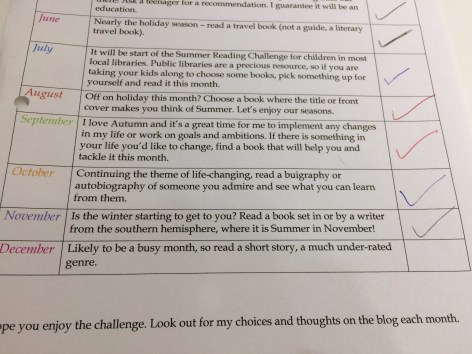







 The Disappearances by Emily Bain Murphy – suitable for 12-14 year olds
 Do You Speak Chocolate? by Cas Lester – suitable for 10-12 year olds
