Booker Prize shortlist 2023

For me, few things herald the arrival of autumn in the literary sphere more than the announcement of the Booker Prize shortlist, one of the world’s foremost literary prize for novels written in English. For a few years now I have attempted to read my way through the shortlist and predict the winner ahead of the awarding of the prize, which is usually sometime in October. It generally works out at one book a week, which for me, in the last couple of years has been a tall order. I never usually manage to read all six books on the shortlist in time; I think my best performance to date has been about five. For some reason we have been given a little longer this year – the winner of the Prize will be announced on 26 November, well over two months from now – so I feel I am in with a fighting chance!

I did not agree with the judges last year – the winner, The Seven Moons of Maali Almeida by Shehan Karunatilaka, was among my least favourite on the shortlist. I am not familiar with any of the authors on this year’s shortlist. Facts I have gleaned about the shortlist are: there is a two-thirds/one third gender split (guess the proportions); half the authors are called Paul; there is one very long and one very short novel; half the novelists are north American, one is African, and the two Europeans are both Irish!

I am not familiar with any of the shortlisted authors. I was disappointed not to see Sebastian Barry’s Old God’s Time make the shortlist, having been on the longlist. I have just finished that book so look out for my review soon. I also wanted to see Ayobami Adebayo’s A Spell of Good Things make the shortlist as my book club loved her 2017 novel Stay With Me. However, that is the Booker – it never fails to surprise or to be bold and brave and not follow the crowd.

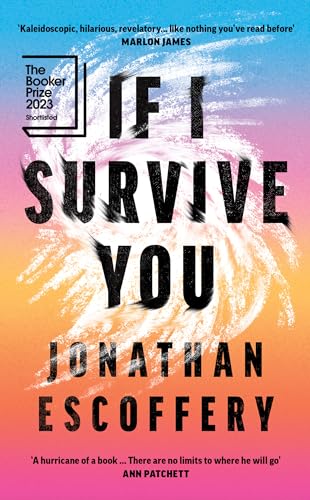
I’m going to kick off my reading marathon with Jonathan Escoffery’s If I Survive You and build up to Paul Murray’s The Bee Sting, which at 656 pages represents the greatest threat to my not completing the shortlist!

Ready, Set, Go…

Women’s Prize book review #5 – “Demon Copperhead” by Barbara Kingsolver

I had a strange reading summer – rather than go sequentially through the various titles I planned to read, I was juggling half a dozen or so simultaneously. It sort of worked – I had different books for different moods – but it meant that it took me a long time to get through each one. Hence, it’s taken me a while to get through all six books on the Women’s prize shortlist. Demon Copperhead felt like a fairly constant companion. I listened to it on audio and it’s long. But that was okay, because it’s stunning and I didn’t want it to end. You know when you get one of those books that you grieve for once the reading experience is over? Well, Demon Copperhead was one of those for me. It’s a well-deserved winner of this year’s Women’s Prize for Fiction, a stand-out piece of work in what was a very strong field. This was my penultimate read from the six shortlisted titles so I hadn’t read it when it was announced as the winner.

Demon Copperhead is a modern-day re-telling of the Charles Dickens classic David Copperfield. The broad plot of that novel, as you may be aware, is that we follow our hero from infancy to maturity, from inauspicious beginnings, fatherless and later orphaned. David is sent to various schools and institutions where he is treated badly, but somehow survives due to his own determination and intelligence. David marries early, but his young wife dies soon after. Only then does he realise his love for the daughter of one of the few benign guardians in his life.

Barbara Kingsolver turns this Victorian bildungsroman into a story of a modern American tragedy setting her novel in Virginia, one of the most deprived and left-behind parts of the United States (and where she has made her home). Demon lives with his drug and alcohol addicted mother in a trailer, his father having died before his birth. The trailer is on land owned by the Peggot family, whose son ‘Maggot’ is Demon’s close childhood friend. The Peggots take Demon on a short break to visit their daughter June in Tennessee, one of their few children who has made something of herself and therefore a rare role-model for Demon. On their return home, Demon finds that his mother has married her cruel and violent lover Stoner. 

Demon’s mother relapses and he is sent to a foster-carer, a tobacco farmer whose motives for fostering are dubious at best, though it is convenient for the social services department to overlook this because he takes on their most difficult to place cases and has several other teenage boys living with him. After the death of his mother, Demon is sent to a different foster family, the feckless McCobbs who have entered into fostering merely to obtain income to meet their significant debts. They fail to meet Demon’s most basic needs for food and clothing and force him to sleep on a mattress in their laundry room. Eventually, Demon decides to run away from the McCobbs and finds his way to his paternal grandmother’s home, a woman he has never met. She undertakes to ensure he is cared for, however, and arranges for him to live with the husband of one of her former foster-children (who died of cancer) and his daughter Agnes.

Demon finally seems to have found himself in a good situation with decent people who care about him…but we are only halfway through the book. Hard to believe, but the worst is still to come. There have been hints throughout of what is to befall our hero: his mother’s addiction problems, the drug-dealing of the much-admired leader of boys at the tobacco farm, ‘Fast Forward’, and the portrayal of a certain hopelessness about life in this part of the country. Demon will inevitably become sucked into what is surely one of the most heinous scandals perpetrated by the pharmaceutical industry, the oxycontin crisis that continues to wreak havoc and destroy lives on an industrial scale in parts of the USA. 

The story continues, darkens further. It is not a read for the faint-hearted and yet you cannot stop because as the reader you have become invested in this powerful central character, our narrator who speaks directly to us. We feel his pain. 

Kingsolver follows the plot of David Copperfield faithfully, keeping many of the names and adapting others, the cleverest for me is U-Haul, the modern-day Uriah Heep who Kingsolver imbues with similarly odious characteristics. It is heartbreaking to think that things we thought belonged to a past century, cruelty and neglect towards children, the suffering of people born poor, are still with us.

Taking on a re-telling of a book like David Copperfield, considered by many to be Dickens’s finest novel, was an act of awesome ambition but Kingsolver has accomplished her task with aplomb and created a true tour de force of a novel.

Highly recommended.

Goodbye summer, hello autumn

Conkers might just be one of my favourite things – I cannot walk past one on the ground without picking it up! Image by Alex Pearson from Pixabay

I’ve had a very long summer blogging break – the longest, I think, since I started blogging about a million years ago! It’s been another intense year in my household, not least because all three of my children were at fairly crucial points in their academic lives, and I felt that a complete break from the demands of my usual routine was in order. Like the school summer break of childhood, a chance to recharge the work and blogging batteries.

My break was extended by the unexpected and very welcome arrival of something resembling ‘summer’ last week, so I spent it prioritising getting outside, gardening and laundry – practically everything textile in my house has been through the washing machine!

The break was worth it. I went to Ireland to visit family as usual, but also managed to fulfil a long-held ambition of visiting the north west of the country. Despite having been to Ireland several times a year for more than two decades (with the exception of the Covid hiatus), I have never managed to venture as far as that. When I was at university studying for my Bachelor’s degree in English literature, I fell in love with the poetry of WB Yeats and always wanted to go to Sligo, the place where he spent much of his youth and which inspired so much of his work. His grave is also there, lying in the shadow of Ben Bulben, the distinctive mountain he revered and which was the subject of one of his final poems. Back then, Sligo seemed so far away.

My fascination with the county has been reawakened in recent years as I have grown to love the work of Sebastian Barry; Sligo is one of the settings he evokes so brilliantly in his novels. It was therefore a complete joy for me to go there this August. See some of my holiday snaps below. I also went to County Fermanagh in Northern Ireland ( a very much under-visited and very beautiful part of the world, which I encourage you to visit), and County Donegal, which I found even more beautiful than Sligo, if I’m honest.

Views across Lough Erne, Co. Fermanagh, from Cuilcagh mountain
Castle Coole, Enniskillen
Sliabh Liag mountains, Co. Donegal

Busy days on the beaches and highways of Donegal!

The colours of Donegal – they don’t call it the Emerald Isle for nothing!

Stunning Co. Sligo – Castle Classiebawn (former home of the the Earl of Mountbatten) on the Mullaghmore peninsula, with Ben Bulben just visible in the background

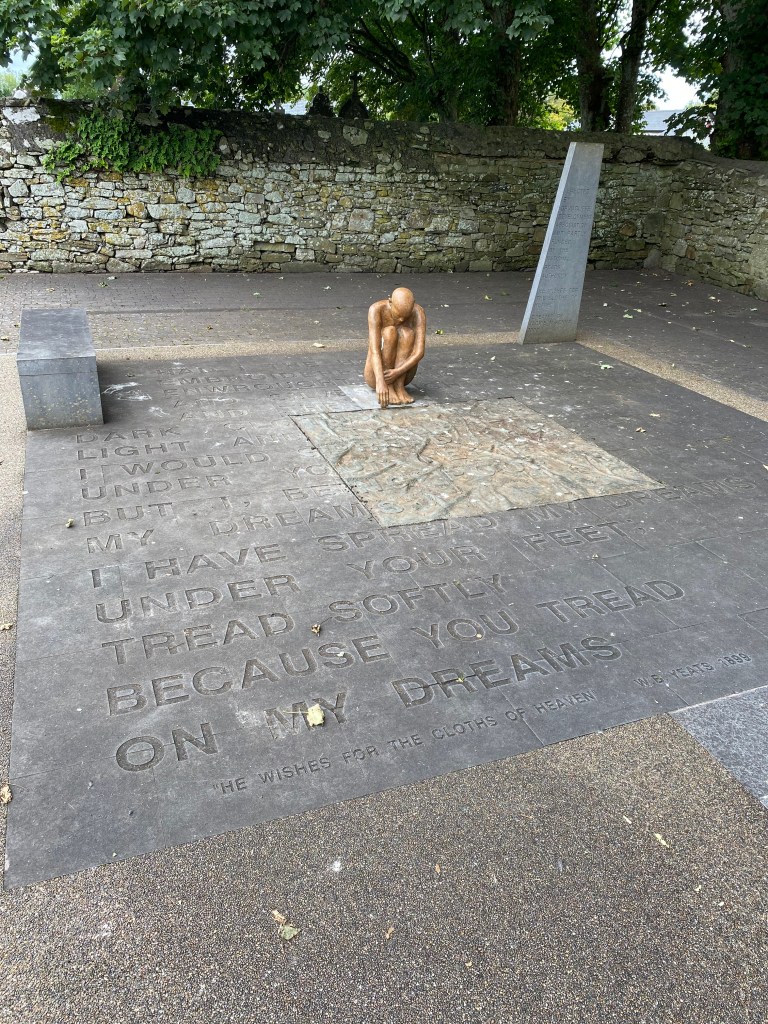
The grave of WB Yeats in Drumcliffe churchyard and a memorial which stands outside bearing the text of his poem ‘He Wishes for the Cloths of Heaven’

The subjects of two of Yeats’s most famous poems, Ben Bulben…
…and the Lake Isle of Innisfree.

So, that was my slightly literary-themed sojourn in the north west of Ireland. I would encourage anyone to add this stunning part of the world to their travel bucket list.

And now thoughts turn to autumn, to new ventures and the year ahead (as I have written on here many times before I love the ‘back to school’ feeling and the sense of new beginnings it gives me). I am taking on a some major new training for my day job (so it really is back to school for me, as a mature student at university!) I have almost completed my second novel and will be submitting it to competitions, agents and publishers. And of course, I will keep reading as much as I can and blogging about my thoughts.

Enjoy the fruits of this very special time of the year!

#KeepKidsReading book review #3 – “Quiet Storm” by Kimberly Whittam

For my final #KeepKidsReading book review I would love to share with you a really wonderful book by a debut author, published by Usborne, who also happens to be local to me – Manchester based. Kimberly Whittam is a school teacher who has written a book for and about quieter shy children:

“Children who don’t raise their hand in class even though they know the answer, who don’t join in class discussion even though they’ve got something to say and children who are so, so talented and want to try out for the school play or join the school sports team and who are just too afraid to join in.”

Kimberly Whittam https://youtu.be/I8gtYq9zXu8

Many of us will recognise this child – that was me and it has at times been my own children, and certainly many children I know. Everyone is encouraged now to be loud and proud, to speak their truth and not be afraid of offending anyone, nor crave to be liked. But too often the people who say this have no idea how agonisingly difficult that can be. They were not “that” child. 

Storm Williams is twelve years old and in year seven at Daisy Mill Academy. She likes to keep a low profile and has clearly found settling in very challenging. Her best friend from primary school, Zarrish, was placed in a different form, leaving Storm feeling bereft, and she lives for the lessons where forms are mixed, such as PE, and they can be together. To make matters worse, Storm’s elder brother Isaiah is in year eleven and is an outgoing high-achiever, Head Boy and heavily involved in extra-curricular activity. All the teachers refer to Storm at “Isaiah’s little sister”; she has a lot to live up to. At the start of the book, Storm’s family faces a domestic drama – kitchen renovations lead to a burst pipe which makes their house uninhabitable – and the family has to move in with Storm’s grandma. 

It is during one of the PE lessons that Storm finds she has a previously undiscovered talent that she enjoys. The group begins athletics lessons and Storm finds that she is a very fast sprinter. The PE teacher encourages her to attend athletics practice and tells her he wants her to participate in an inter-school competition. The thought of going alone makes Storm feel queasy, but she decides that she will do it if her friend Zarrish comes along too. At first Zarrish says she will, but lets her friend down. Zarrish has become increasingly involved with a new girl at school, Melissa, who she was initially asked to ‘buddy’. But Melissa is sullen, manipulative and difficult and it soon becomes clear that she is pulling Zarrish away from Storm, persuading her into rule-breaking at school and deceitful and unkind behaviour. 

Storm finds herself in turmoil; lacking the confidence to participate in athletics without her friend’s support, but also finding for the first time that she excels at something and enjoys it, makes her reassess all of her assumptions about school life up to that point. 

Storm does find her voice and her niche and the difficult challenges she faces turn out to be a true turning point for her. She faces them with courage and with the support of her family and finds the strength of character to turn her back on what she knows to be wrong (treating people badly) and embracing doing what she loves, finding out a lot about herself along the way.

Storm is a lovely character and the situations she faces in this super book, the people around her at school, the teachers and the family situations (being mortified by her parents’ very public sense of fun!) will be familiar to lots of young people. 

Highly recommended for 9-12 year olds, or even a little older. 

#KeepKidsReading book review #2 – “The Dolls’ House” by Rumer Godden

I have a vague recollection of reading some books by Rumer Godden when I was a child, though unfortunately I cannot remember any specific titles. I was reminded of her a couple of years ago when reading fellow blogger Brona’s Books, who had a Rumer Godden reading week around the time of the author’s birthday. By coincidence I had happened to pick up an early edition of The Doll’s House in my local secondhand bookshop around the same time. Unfortunately, I did not get around to reading the book then and it has been sitting on my TBR shelf for too long. I decided to make it my ‘Off the TBR shelf’ book for June and now seems like a good time to review it as I am focusing on my #KeepKidsReading week. 

Rumer Godden was prolific and published over sixty books in a writing career that spanned seven decades. She wrote for both adults and children and also wrote poetry and non-fiction. A number of her books were adapted for film and television, most recently Black Narcissus which was released as a BBC mini-series in 2020. She was born in Britain but grew up in India where her father worked for a shipping company. 

The Doll’s House was Godden’s first book for children (published in 1947) and was turned into a film for children’s television in 1984. Godden wrote a series of books about dolls drawing parallels between their plight as passive and without agency, and the life of children, for whom adults make decisions, without necessarily consulting them. 

The Dolls’ House is a short book, easily consumed by an adult in one sitting, but I tried to read as a child would, or as a child might have it read to them, one short chapter at a time. The story concerns the fate of four dolls who live together as a family – Mr Plantaganet, Birdie, his ‘wife’, Tottie, a girl-child doll, and Apple, a younger boy-child doll. They are the toys of sisters Emily and Charlotte, and live in shoe boxes, but wish for a house of their own. Their wishes come true and the two sisters acquire an old Victorian dolls’ house which once belonged to their grandmother. With the help of a family friend they clean, repair and update the interior and the furnishings. Unfortunately, the dolls’ house comes with an unwelcome addition, a china doll called Marchpane, who is also very old. Marchpane would have been an expensive and precious doll in her day, unlike the Plantaganets, and is both haughty and cruel. When she is brought to live with them all she seems to cast a spell over the elder of the two sisters, Emily, and gradually, the Plantaganets are sidelined and ousted from the better rooms in their new home. 

On the surface, this is a simple story, but it explores notions of class, fairness, kindness and justice in ways that will be easily understood by children. It was a real throw-back reading this charming little book. The language is a bit old-fashioned, but I think it could still appeal to younger children, between about five and seven years old, perhaps shared with a grandparent, who will be able to bring their own memories into a telling of the story. 

“It is an anxious, sometimes a dangerous thing, to be a doll. Dolls cannot choose; they can only be chosen; they cannot ‘do’; they can only be done by; children who do not understand this, often do wrong things and then the dolls are hurt and abused and lost; and when this happens dolls cannot speak, nor do anything except be hurt and abused and lost. If you have any dolls, you should remember that.”

Chapter 1, ‘The Dolls’ House’ by Rumer Godden

#KeepKidsReading book review – “Stolen History” by Sathnam Sanghera

I am starting my #KeepKidsReading week book reviews with a newly-published non-fiction title that caught my eye. Sathnam Sangera published his best-selling book fort adults Empireland: How imperialism has shaped modern Britain in 2021. He is a journalist and has long campaigned for a more grown-up debate about the UK’s history of empire-building, what this means for us today and how it can help us manage some of the issues that arise from our multi-cultural society. Sathnam was part of a panel at the Hay Festival in a debate I saw there about Britain’s stately homes, the riches within them and how we as a society might engage with or view them in the modern era. It was fascinating.

The topic is certainly gaining traction (not before time, many would argue) and it is encouraging to see a book aimed at children on the subject. Sathnam Sanghera acknowledges the wonderful Horrible Histories series (books and television) for changing the way certain topics are taught to young people, making them accessible as well as entertaining. Sanghera sets out to do the same here, though it is a little heavier on the education than the entertainment side.

The author begins by explaining what the British Empire was and how Britain came to be perhaps the most powerful nation on earth. I learned quite a lot! I did not know, for example, that the British Empire was actually seven times larger than the Roman Empire and endured for a similar period of time.

He goes on to talk about some of the things we think of as ‘British’ that we actually imported from other parts of the Empire, not least tea! There are a number of pen-portraits of Empire figures, from the controversial explorers and colonisers, such as Robert Clive, to the many black and brown skinned individuals whose place in history has been minimised, such as Mary Seacole (who played just as big a role in the Crimean War as her white counterpart Florence Nightingale).

Sanghera does not shy away from controversial topics in this book and I think he handles them very well. For example, a theme running throughout is how objects (and indeed natural resources and human labour) were forcibly removed from their countries of origin. He alludes to the debate currently ongoing about the return of precious artefacts to their original owners. He also busts plenty of myths! For example, in the debate about whether British museums should return looted artefacts Sanghera points out that less than 1% of the British Museum’s current collection is on display so the place would hardly be hollowed out if even a lot of items were returned.

The author addresses head-on the fact that to many people the concept of ‘the British Empire’ remains sacred. He explains carefully why some people are made angry by discussions about it, without taking up a polar position himself. I think he manages quite successfully to explain why it remains important to people, whilst also equipping his readers with factual information and even a few strategies for handling discussions. He even explains terms such as ‘exceptionalism’ and ‘jingoism’ in simple but effective terms, which is quite something.

As you can probably guess, I rather liked this book and would recommend it to any parent keen for their child to have a grasp of this topic (which would probably be better than very many adults’ grasp!). It is definitely not just for families with multi-cultural heritage. I had some slight reservations about the title, because it suggests a ‘position’ that is actually much more nuanced in the book. But it turns heads I suppose.

Highly recommended (and for adults too!). It is published in paperback by the always wonderful Puffin Books, is very well illustrated and is set out in highly digestible chunks.

#KeepKidsReading – the summer holidays are here!

It’s too long since I did one of my periodic #KeepKidsReading weeks, where I write about what is currently happening in the world of children’s literature and post reviews of kids’ books that have caught my eye.

The premise of these themed weeks is to try and encourage people to spread the word about children’s books and perhaps even consider reading some themselves! It’s always such a treat to open a book that has been written with children in mind – it’s as good a min-retreat! We bookbloggers love reading – of course we do! – but when you get caught up in your stats, your reading speed (that feature on the e-reader is surely a thief of joy!) and how your ‘number of books read’ on Goodreads compares to last year, you can easily forget that reading is, at its most basic, just pure pleasure.

Generation Alpha (ie people born between 2010-24), aka ‘kids today’, have more competing pressures on their time than ever and, I would argue, more things to worry about. Reading educates, creates bonds, promotes wellbeing and empowers – as adults, parents and grandparents it is imperative that we do not allow this simple but oh so valuable pastime to slip away from them.

So, this is my teeny tiny little personal campaign!

If you know any children and they have not yet signed up for this year’s UK summer reading challenge, then get them along to the local library or point them in the direction of the website (Gen Alpha is, of course, digitally native!). This annual initiative is run by The Reading Agency and delivered in partnership with public libraries (because even though they are all digital natives, they don’t all have the hardware at home). Each year, the challenge has a theme and this year it’s Ready, Set, Read, with a sporting theme.

Later in the week I will be posting a few reviews of book suggestions for children, so look out for those.

In the meantime, happy reading and spread the word!

#KeepKidsReading

Audiobook review – “Red Notice” by Bill Browder

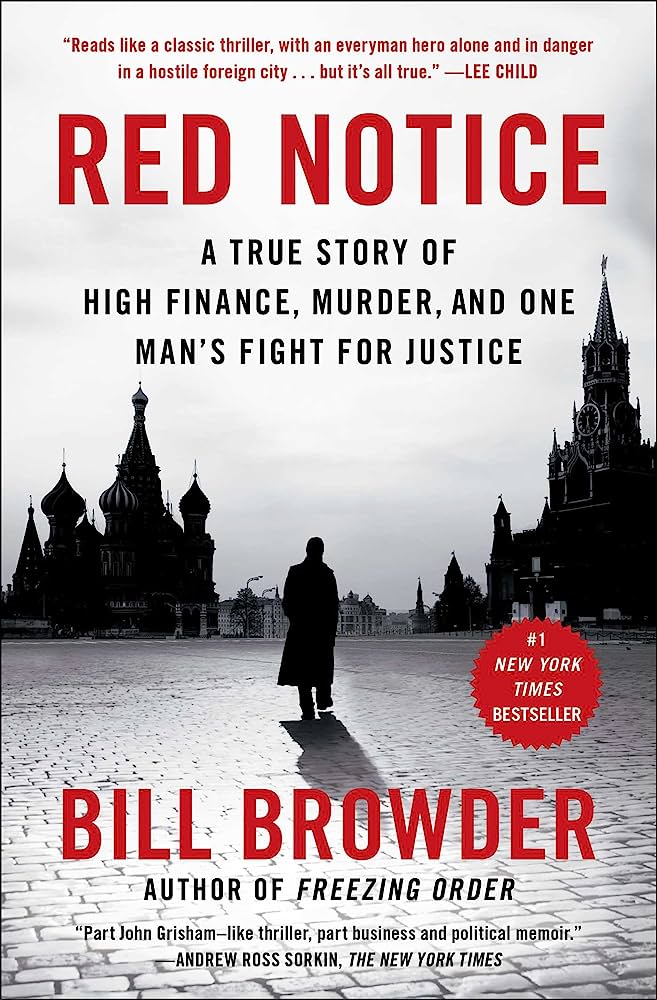
This was my book club’s June read. It wasn’t a title I suggested but I was happy to go along with it even though the blurb didn’t appeal that strongly. A true-life thriller about high finance and espionage did not seem like the kind of book I would normally read, but then isn’t that the joy of a book club, to make new discoveries? The book opens with the narrator (the author) giving a detailed account of his being detained at a Moscow airport without explanation, being held for endless hours without food or water. Attempts to contact friends, family, contacts in the British Embassy bear no fruit and finally his phone battery gives out. The intention of the Russian authorities seems to be to terrify their detainees, keeping them guessing about what might happen to them.

Finally, the author is allowed to leave and is put on a plane back to London, where he lives. This happened in the early 2000s, but there is a long history leading up to this event. Bill Browder then takes us on the long journey to explain how he came to be in this situation, beginning with his childhood in Chicago as the lowest-achieving child in a highly academic family. Young Bill clearly had something of the entrepreneur about him and despite his early difficulties in education (exclusion, boarding school, severe bullying) he eventually wins a place at Stamford business school. 

After completing his college education and a stint at a couple of consultancy firms he decides on an adventure, following somewhat in the footsteps of his eastern European grandparents. From an early age he shows clearly his entrepreneurial streak and a nose for an opportunity. He moves to Russia in the 1990s, as that country is emerging into the post-Soviet Union era. Browder begins to see the huge financial benefits that can be secured by being an early investor in the privatisation of national industries and he persuades a number of wealthy individuals to come on board with him. His Hermitage investment fund is extremely successful and he makes a lot of money, for himself and his investors. 

[Spoilers below]

Browder bases himself between Moscow and London, where he also starts a family, but it is clear that the pressures and demands of his lifestyle take their toll on his marriage. Eventually, he and his wife divorce – there is a lot of very personal material in this book too. Browder will eventually meet and marry a Russian woman with whom he has two daughters.

To support his finance business, Browder has to set up a strong team of lawyers and advisors, as well as colleagues with connections and insights into Russian society. In the time that Browder is operating in Russia, the country changes dramatically and a small number of people begin to make a lot of money – the rise of the oligarchs. Corruption was always part of the system, but now becomes endemic. As a foreigner (even worse, an American) profiting handsomely from Russia’s embrace of capitalism, Browder becomes a marked man. His life becomes endangered (hence the detainment at the airport) and he has good reason to believe that Putin himself is behind efforts to eliminate him. The ‘red notice’ of the title refers to the Interpol arrest warrant that the Russians tried to have exercised on him (which was eventually  withdrawn, much to the ire of the Russian authorities for whom this is a huge embarrassment). Browder realises that the Russians might attempt to get at him through his associates. He persuades most of them to flee the country, sometimes under cover, but one of his lawyers, Sergei Magnitsky, refuses. Browder tells us that he simply “loved his country too much”. Magnitsky is arrested, charged with trumped-up accusations of fraud, and imprisoned in a labour camp. His treatment there, including beatings, eventually leads to his death. 

This event shapes Browder’s life from then on and occupies the final third or so of the book. The author’s attempts to fight his friend’s case, and then to seek justice for him become the cause of his life. He devotes his time to raising awareness of human rights abuses in Russia and eventually succeeds in persuading the American Congress to pass ‘Magnitsky’s law’, with the help of key politicians such as the late John McCain, which permits sanctions against those guilty of human rights abuses, such as freezing of overseas assets and refusal of visas. Bill Browder continues to devote his life to persuading other countries to adopt similar legislation. 

This is a fascinating story and after my initial scepticism I have to say that I was completely hooked. In the context of Russia’s current behaviour it has extra resonance and gives an insight into the psyche of those in power in that country. I had heard of Magnitsky’s law, but had no idea of the background. Browder and his team were one of the first to use the then new platform YouTube to great effect as a publicity tool to raise awareness of their cause, when Sergei Magnitsky was still alive. The videos can still be seen on there and are powerful. Also, powerful, is the final chapter of the book, narrated on the audio version by the author himself. It is chilling when he tells us that if he is killed, we the readers will know who did it. 

A stunning and unique story, highly recommended.

Winner of the Women’s Prize for Fiction announced tonight

Well, I did not hot my target, but I had fun trying! When the shortlist for this year’s Women’s Prize was announced a few weeks ago, I set myself the goal of reading all six titles, much as I do with the Booker Prize in the autumn. The Women’s Prize is at least as big as the Booker now, so why not. (Dare I say it is also a bit more accessible?)

I’ve read three out of the six novels and have posted reviews on Fire Rush by Jacqueline Crooks, Black Butterflies by Priscilla Morris, and The Marriage Portrait by Maggie O’Farrell. I have almost finished my fourth, Trespasses by Louise Kennedy. I have not yet started Demon Copperhead by Barbara Kingsolver or Pod by Laline Paull, although I will definitely read both of them.

I have loved all the books I have either finished or am reading. Two are debut novels, and in only one instance (Maggie O’Farrell) have I read anything previously by the author. I have heard a great deal of praise for Kingsolver, but have not heard much about Pod, though it sounds a very unusual and innovative work.

The winner will be announced this evening at 7.10pm by Chair of Judges Louise Minchin, and it can be watched live on YouTube.

Of the four that I have read or am reading, all would be a worthy winner. They are fantastic novels. For me, the one that has stood out though is Fire Rush. It has such a raw energy and the author creates a world that draws you in and is completely compelling.

Only a few hours to go – let’s see if the judges agree with me!

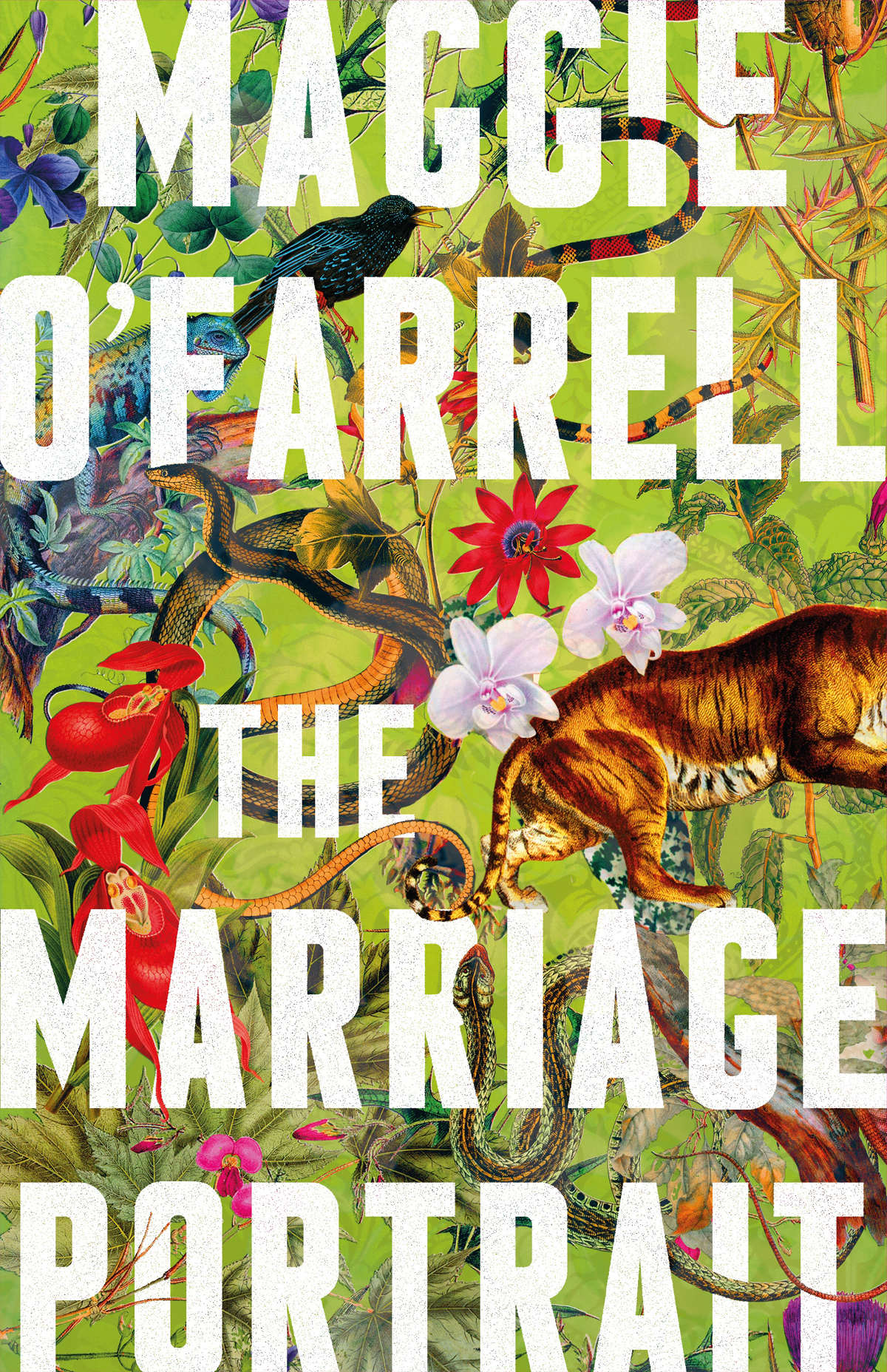
Women’s Prize shortlist review #3 – “The Marriage Portrait” by Maggie O’Farrell

Maggie O’Farrell won the Women’s Prize in 2020 with her eighth novel, Hamnet. It would be quite a coup if she won the prize again in 2023 with her ninth novel. Hamnet is without doubt one of my favourite novels of recent years. Beautifully written, moving, and an astonishing subject. In The Marriage Portrait O’Farrell takes a somewhat similar approach: taking a real historical figure, about which very little is known, and inventing their back story. This time, O’Farrell takes us to 16th century Italy. 

The main character in the novel is Lucrezia de Medici who lived a short life from 1545-1561. She was the daughter of the then Duke of Florence and his noble Spanish wife. She was their fifth child, and is portrayed in O’Farrell’s novel as somewhat unruly. Little was really expected of her, apart from a decent marriage, but as the third daughter, she would not have been considered for the highest ranking match. Her brothers, of course, were schooled in the arts of ruling. Lucrezia is portrayed as sensitive, and passionate about art and nature. She is taught to paint, since she shows some aptitude for it and it at least keeps her out of trouble. Painting is the one activity in which she finds true happiness.

Lucrezia’s elder sister Maria is matched with the nobleman Alfonso, the heir to the Duke of Ferrara, but when Maria dies suddenly, Lucrezia is forced to step in as a substitute. The children’s nurse, Sofia, sensing Lucrezia’s horror at the prospect, manages to persuade the Duke to hold back from marrying his daughter off, on the basis that she is still a child and not yet begun to menstruate. There is only so long that Sofia can protect her charge, however, and at the tender age of 15, Lucrezia is married to Alfonso, who, by then, is Duke of Ferrara. 

Lucrezia is terrified to leave her family. Initially, she is taken to her husband’s country residence, the delizia, where, as Duchess, she enjoys a little more freedom than she had in Florence. Her husband Alfonso, is constantly preoccupied with matters of state and a schism in his own family and largely abandons her. It is clear, however, that her expected role is to bear heirs and Lucrezia endures the consummation of their marriage with fear and horror. 

When the couple return to court to begin married life proper, Lucrezia becomes increasingly aware of a more sinister side to her husband. It is clear that her initial fear of him was not simply girlish trepidation, but a deeper sixth sense. Very soon she begins to fear for her safety. 

The novel opens at a banquet, where Lucrezia is being fed various delicacies by Alfonso. It is 1561, the year that she died and Lucrezia tells the reader that she believes her husband wishes her dead. Thereafter, the novel flits back and forth between Lucrezia’s early childhood, giving a sense of how her character and her place in the household evolved, and 1560-61 and the progress of her brief marriage. 

Having enjoyed Hamnet so much, I was really looking forward to this book and treated myself to a signed hardback copy. It moves at a much slower pace than Hamnet and I found it quite difficult to get into at first. There is more scene-setting and building of character than there is plot, but then we are talking about a very short span of time in the life of a person who did not have very much to do with their days! About halfway through, once Lucrezia is married, I think it improved – the sense of threat builds, the insular nature of courtly life becomes more apparent, and Lucrezia’s isolation all add to the feeling of danger for her. Even those she might reasonably think of as ‘friends’ – her husband Alfonso, his sisters, the servants – all in fact represent a potential threat. Her only confidante is her ladies maid Emilia, but she is also powerless and vulnerable. It is only when a group of artists arrives to set about making a commemorative portrait  of her (the marriage portrait) that Lucrezia realises the deep peril of her situation. As the novel darkens, it improves.

I would recommend this novel although for me it did not have the powerful impact of Hamnet, but then it must be very difficult to follow something that brilliant.