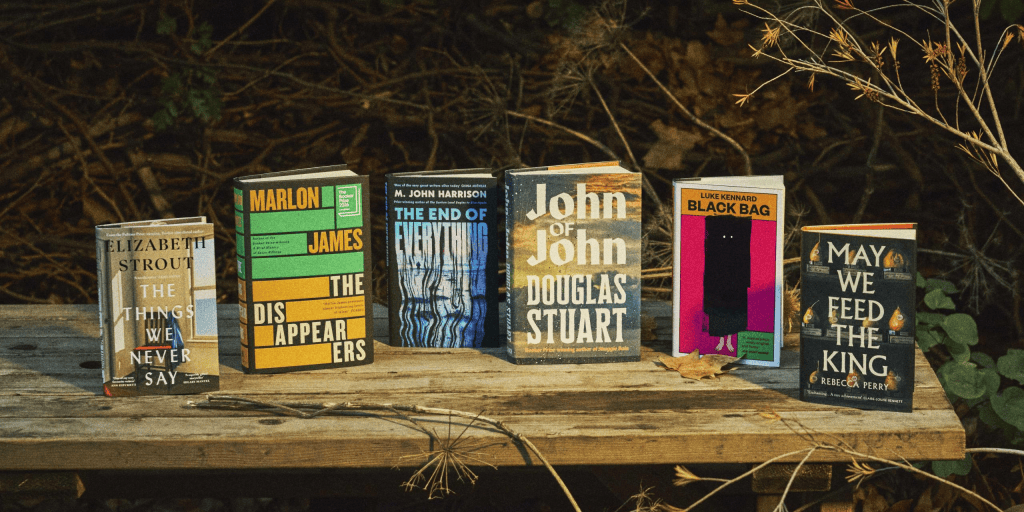
Booker Prize 2026 shortlist

Image courtesy of bookerprizes.com

It always feels like the sure start of Autumn when the Booker Prize shortlist is announced – kids have gone back to school, college and university, the evenings are getting darker earlier and, certainly in my part of northern England as I look out on the pouring rain, all thoughts of yellow grass and hosepipe bans have vanished from our minds. And Marks and Spencer has shelves full of Christmas confectionery!

Each year, since I began writing this blog ten years ago, I have attempted to read the shortlist and predict the winner by the time of the final announcement, which will be on Monday the 9th of November this year. That’s just over six weeks, so a book a week. I think I have only managed this feat one year in the last ten – how the judges get through upwards of 150 in a few months is beyond me! I haven’t even completed the Women’s Prize shortlist yet, and the winner of that was announced in June! I was reading a piece by chair of judges this year, classicist Professor Mary Beard who said she found it required more energy than writing a book – isn’t reading supposed to be relaxing?!

I am delighted to say I have a bit of a head start, having just completed one of the shortlisted books – I felt after reading it that if it wasn’t shortlisted, then something was seriously amiss – Douglas Stuart’s John of John. It is also one of the longest books on the shortlist, so that’s a double win! I read this book because I spent a couple of weeks in Scotland in August and visited the Isle of Harris and Lewis, where this book is set. Look out for my review of that soon, as well as some pictures of beautiful Scotland.

I will also look forward to reading Elizabeth Strout’s The Things We Never Say. I have grown to love her gentle and insightful writing the more that I have read it and thoroughly enjoyed her last novel before this one, Tell Me Everything. I wonder if the similarity in the titles is significant.

Marlon James makes an appearance on the shortlist once again with The Disappearers about the persecution of gay men in Jamaica in the 1980s. He is, of course, like Douglas Stuart, a previous winner with his 2014 novel A Brief History of Seven Killings. I’m ashamed to say that I have not read any of his work before, so I’m looking forward to rectifying that with this novel.

M. John Harrison is perhaps the most experienced author on the shortlist and I have heard that if he wins, he will be the oldest ever (he is in his 80s). Bravo! His novel The End of Everything is set in a post-apocalyptic coastal area in Kent (that seems significant) where Phillip survives by collecting artefacts from the sea. It feels like it might be a novel for our times.

Rebecca Perry is the only debut novelist on the shortlist with her first published work of fiction May We Feed the King. The novel is part modern commentary and part historical fiction as a museum curator encounters the story of a past monarch who was a reluctant ruler, thrust onto the throne after the deaths of his older brothers.

Finally, Luke Kennard’s novel Black Bag is described as the only comic novel on the shortlist (therefore unlikely to win?). An actor takes on a job where, as part of a psychological experiment he is required to wear nothing but a black leather bag. It sounds intriguing!

So, as usual, an interesting list. One down, five to go, about 1,700 pages in 6 weeks. Here we go!
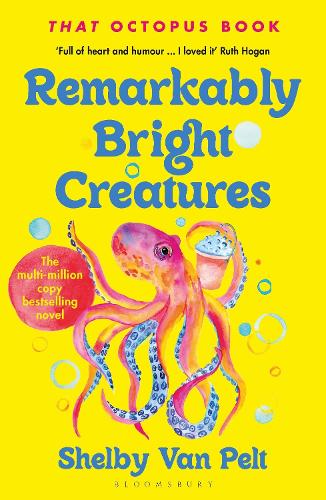
“Remarkably Bright Creatures” by Shelby Van Pelt

This was an early summer pick by my book club. We were looking for something easy and uplifting and we’d heard that this one might fit the bill. First published in the US in 2022 it became a New York Times bestseller, remarkable considering it is Shelby Van Pelt’s debut novel. I think it was written as a young adult novel although that categorisation is meaningless now as it is said to have sold two million copies, so it has definitely garnered appeal across all age groups. It was also made into a film starring Sally Field and released earlier this year on Netflix. I haven’t seen it yet, but it has received positive reviews and scored 85% on Rotten Tomatoes. BREAKING NEWS – at this year’s Emmy Awards last Monday evening (14th September), Sally Field in fact won the Emmy for Outstanding Lead Actress in a Limited Series or Movie. You may have missed that item among all the headlines for Matthew Rhys’s double Emmy-winning record, and the fact that Sally Field gave outspoken support for Canada in her acceptance speech!

The central character in the novel is actually…an octopus. He is called Marcellus and lives in an aquarium in Sowell Bay, a (fictional) coastal town in Washington state in the US, having been captured when he was young. The opening chapter is Marcellus telling us that humans have described him as a “remarkably bright creature”, something he scoffs at, as if this should be a surprise. He genuinely believes himself to be much smarter than humans and demonstrates his intellectual prowess throughout the novel. In the opening chapter Marcellus is also counting down the rest of his life; he has been in captivity for 1,299 days and knows that the life span of a giant Pacific octopus is four years, or 1,460 days. 

The main human character in the novel is Tova Sullivan, a cleaner at the aquarium. She considers the sea creatures her friends, having lost both her husband to cancer and her son, many years prior, when he was a teenager. She is alone, lonely and ageing. Rather like Marcellus, with whom she develops a curious bond. Their relationship deepens one evening when Tova discovers that Marcellus has escaped his tank and wandered around the aquarium, something he has been doing regularly for some time, but has hitherto gone undetected. When Tova discovers him inadvertently trapped and close to death (because he cannot be out of the water for too long), she rescues him and returns him to his tank. This gives her the realisation that Marcellus is no ordinary sea creature.

The other main character is Cameron Cassmore, a young man living in California who has lost his way in life. He was brought up by his single parent mother, a woman who had many mental health problems, including addiction. After his mother disappeared, he was looked after by his aunt, a loving but clueless woman who gives Cameron financial support when he decides to go on a mission to find his father. A journey that will take him to Sowell Bay and a chance encounter with Tova, when he finds himself covering her cleaning job after she injures her foot and must take enforced rest.

The characters in this novel are well-developed and likeable, even the minor characters are distinctive and thought through – I particularly liked Ethan Mack, the quirky Scotsman who runs the local grocery store, giving Cameron a place to park the van he lives in, and who harbours a romantic but unrequited interest in Tova. The plot is unusual. I was a little put off initially by the anthropomorphising of the octopus and found a few elements a little contrived, but I had to keep reminding myself that this was a feel-good novel, and sometimes you need to engineer things in certain ways to make the outcomes credible. The novel is not without its dark moments however; it deals with many challenging themes – bereavement, loneliness, poverty, elder care, addiction and both the loss of a child and the loss of a parent. It is the novel’s willingness to take on some of these deeper social issues that keeps it from being sentimental. 

An enjoyable and easy read (with trigger warnings) that is indeed ultimately uplifting.