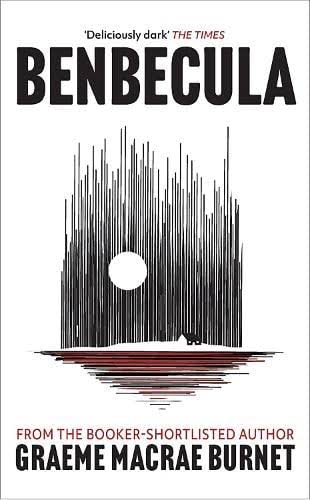
I bought this book from a gorgeous bookshop in Portree on the Isle of Skye. When I’m travelling I always like to pick up something “local” and although the author is actually from Kilmarnock, this novel is set in the Outer Hebrides where, as I wrote earlier in the week, I had the good fortune to spend part of my holiday this summer. There were, of course, far too many great Scottish books to choose from, but I was very impressed with Graeme Macrae Burnet’s 2016 Booker Prize shortlisted novel His Bloody Project so I was keen to try this one. As with the earlier book, and others he has written, I understand, his novels are often based on real life cases, murder mysteries. In the Afterword to Benbecula, the author writes extensively of his research and his own conclusions about the case.
This story concerns a brutal triple murder that took place on the remote Scottish island of Benbecula in 1857. Angus McPhee, the second son of four siblings, killed, seemingly in cold blood, his mother, father and aunt. The story is narrated by the elder brother Malcolm, a man who now lives alone, his two other siblings having abandoned the island and the desolate life that apparently lay ahead of them, tended only by a local woman who cooks and cleans for him and takes some care over his personal hygiene.
The author creates a powerful sense of remote island life in the middle of the nineteenth century, where it is hard for labouring families like the McPhees to make any sort of a living. They manage a small croft and collect seaweed from the shore for fertiliser, providing barely enough income to feed them all. In addition to Malcolm and his brother Angus, there is a sister Marion and a younger brother John, who appears to have learning difficulties. They are a family of loners; none of the siblings seems to get on well with any of the other islanders, or have any love interest. Malcolm describes his sister Marion as being plain at best and Angus’s lascivious behaviour towards other local young girls marks him out as a person to be avoided. Malcolm worries that there is something genetically faulty in the family.
Angus has unpredictable and sometimes violent outbursts which make it necessary to restrain him physically, sometimes for days at a time. Whilst he is clearly considered, by the local church elders and the governing authorities, a danger to the public, no-one predicts that he will murder members of his own family.
Malcolm narrates the story and his is a dark and troubled soul, bearing the scars of his family shame, but also the burden of loneliness that must inevitably attend someone in that position in a small community where everyone knows you, your family and the horror that your sibling has visited on his own flesh and blood. Malcolm reflects on his own life, both in the present and the past, and on the events he has borne witness to. We see the devastating impact that a brother’s crimes have had on the one left behind. The island itself is a key part of the novel – the loneliness and isolation reflect Malcolm’s own, the deeply religious nature of the community judges Angus directly, and Malcolm indirectly.
This is a deeply researched and thoughtful novel where the author has attempted to get inside the head of his main protagonist, whilst also interrogating the facts of a deeply horrifying incident that must have shaken a small community to its core.
A good read, recommended.


