Book and theatre review: “Frankenstein” by Mary Shelley

I had my fill of Frankenstein last week – I read the book, saw the play and listened to Derek Jacobi narrating the audio book! My book club selected it as we were looking to read a classic, and, as it happens to be the 200th anniversary of the novel’s publication, it was also showing at the Manchester Royal Exchange Theatre in a new adaptation by April de Angelis.

2018-04-19 11.30.32It is extraordinary to think that this remarkable novel, still as popular and as shocking today as ever, was written when Mary was just 19 years old. The fact that she was such a literary talent is not surprising given that she was the offspring of the two famous intellectuals, Mary Wollstonecraft, philosopher and author of the seminal feminist work A Vindication of the Rights of Woman, and William Godwin, the radical political philosopher. In her lifetime, she was highly regarded as a radical writer and intellectual, as well as being the wife of the poet Percy Bysshe Shelley, whom she met and fell passionately in love with at the age of 17. Her reputation since her death, however, has been overshadowed by that of her husband’s, with whom she bore four children (three died in infancy), whose affairs and financial troubles she endured, and whose poems she edited both before and after his death. Percy Bysshe Shelley drowned at sea in 1822, just six years into their marriage when she was 25. She died at the age of 53 in London from a suspected brain tumour.

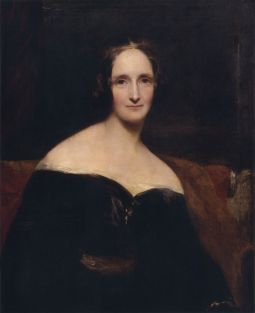
Mary ShelleyBy any standards her life was remarkable and in the last few years her reputation has been revived and she has begun to be more widely considered as a formidable talent in her own right, rather than just a ‘one-book author’. Frankenstein has been a staple of English literature GCSE and A level syllabuses for years, but most of her other works have fallen out of print. A new biography, In Search of Mary Shelley: The girl who wrote Frankenstein, by Fiona Sampson was published earlier this year, some of which I caught when it was serialised in Radio 4 recently. What I heard sounded fascinating. Sadly it is not available on the BBC iPlayer at the moment.

Frankenstein is a brilliant book. It’s not particularly long so if you are not accustomed to the classics it is not too daunting. It is extraordinarily sophisticated in the themes it explores, from ideas about religion and creation, the vanity of man (men) and moral relativism. Its structure is also interesting: it is narrated initially by Robert Walton in letters to his sister. Walton is the Captain of a ship which he is sailing to the Arctic in the hopes of making a great discovery about the North Pole. He describes his ambitions, but also his loneliness and need for companionship. He meets an unexpected friend in the form of Victor Frankenstein who is on an unlikely pursuit of a mysterious giant figure which Walton and his crew had previously spotted. Frankenstein takes over the narration and we learn about the terrible events that preceded this chase, from his early family life in Switzerland and tragic death of his mother, his relationship with his cousin Elizabeth, to his university life in Ingolstadt. It was in Ingolstadt that he first felt the pain of academic embarrassment, when his naïve ideas were exposed, and he set out on the extraordinary task of creating a human. Unfortunately for Frankenstein, he did not think it through, and once he realised the horror of what he had done, quite soon after he brought his creation to life, he disowns it and leaves to its own fate while he spends the next few years wringing his hands. Frankenstein’s procrastination is fatal.

For a time there is also narration from the ‘monster’ (relayed by Frankenstein) who manages initially to survive on vegetation whilst concealed in a hovel, from which he is able to spy on a once wealthy but now fallen French family in a small village. From them he learns language and the ways of humans, and hopes that he will be able to become friends with them, as he longs for company. Unfortunately, when he introduces himself to them, his hopes are shattered; they assume from his, presumably horrific appearance, that he means them harm and they beat him and drive him out of the cottage. Disappointed and infuriated, the monster goes in search of Frankenstein, with the intention of demanding that he make him a female companion, with the threat of death and destruction if he refuses.

I will say no more. Though the story is well known, I do not wish to give away any further spoilers for anyone unfamiliar with it. I wanted to finish the book before seeing the play, so I mixed reading it with listening to the audiobook narrated by Derek Jacobi. This was read brilliantly, as you would expect, though I have to say it gives you the impression that both Walton and Frankenstein are older, wiser men when in fact it is their naivety and youthful impetuosity that is partly responsible for the grave decisions both make.

Frankenstein play
Copyright –  Royal Exchange Theatre, Manchester

The play was also wonderful and provided a rewarding extra-curricular outing for the book club! It was visceral, shocking, truly gruesome in parts. I loved the way the complex narrative structure, and the jumping back and forth in time was handled. I also loved the way it was interpreted for a 21st century audience, particularly in drawing out the feminist undertones (Elizabeth is played more strongly than in the book, while Frankenstein is often exposed as foolish). It had thrills, spills and lots of action, and stayed very true to the book, leaving out remarkably little and using some of the really powerful passages (particularly those spoken by the monster) verbatim. It will have been a fantastic bonus for any young people studying it for exams this year.

A thoroughly enjoyable monstrous week!

Advice wanted on Paul Auster’s “4321” please!

Around the middle of September, the six-book shortlist for the Man Booker Prize, the foremost literary award in the UK, and one of the top prizes globally, is published. I usually clear the reading decks for the next five or so weeks and set myself the goal of trying to read all of them before the winner is announced in mid-October.

Last year, I did pretty well, managing almost five before making my (incorrect!) prediction. Amongst many book bloggers, and reading groups, things become a bit competitive, and some years the books are long and it can become a real slog. In 2016, I struggled to get through Madeleine Thien’s Do Not Say We Have Nothing, which I found very sludgy at first, but thoroughly enjoyed by the end. I finally published my review of it this time last year, about six months after the Man Booker shortlist was published.

Alas, I have beaten that particular record… six months on and I have still failed to complete Paul Auster’s 4321. And this is making me a bit gloomy. It’s not that I’m not enjoying it, I sort of am, but to say it could do with some robust editing is an understatement. I crawled through the first 200 pages (which, incidentally, in a normal book with a normal typeface and normal line spacing would, I am convinced, be at least 300 pages), but I still have 650 pages to go! And it’s been so long since I read any of it that I’ll probably have to go back and start again.

It’s really heavy to carry around – definitely not one that slips in your handbag – and the audiobook is 37 hours long, which would still take me weeks to get through!

So, what to do? The reviews I have read say it’s great, which makes me want to continue, but it also feels like a huge commitment.

If you have managed to finish this book, do you recommend I continue?

My top ten literary film adaptations

serving the Oscars is a bit of a guilty pleasure for me. Don’t get me wrong, I’m aware of the froth and fakeness of it all – the ostentatious outfits, the overly emotional speeches, the elitism, the hangers-on – but there is something about the pictures and the footage which just sucks me in. I’m not a film buff, but I do love a film and am always interested in any with a literary connection. This year’s Oscars were a much-discussed affair; I have only seen one of the big contenders (Phantom Thread), but I feel I know all the others having heard so much about them. Oddly, the winner of the Best Film, The Shape of Water, is the only one that I probably won’t be rushing out to see.

Look in the Best Adapted Screenplay category for literary connections; in 2016 we had The Danish Girl, The Revenant, Room, Brooklyn and Carol among the big winners. That was a high point, as this year none of the big winners had a literary connection. James Ivory (so well-known for A Room With A View, Howard’s End  and The Remains of the Day adaptations) won the Best Adapted Screenplay award for Call Me By Your Name, based on a novel of the same name by Andre Aciman. This year, it felt to me as if the Academy Awards were more about the politics than the art.

So, the Oscars make me hunger for a good film based on a book. Here are my top ten favourites, in no particular order. They are not my favourite books (Ten! I couldn’t possibly choose just ten!) they are film adaptations that have stuck in my mind as most memorable and enjoyable – and no doubt in the days after posting this I’ll think of another half dozen that I should have included!

  1. The Wizard of Oz (1939) – based on a novel by L. Frank Baum.
  2. To Kill A Mockingbird (1962) – a favourite book and a favourite film, based on the Pulitzer prize winning novel by Harper Lee. Gregory Peck is just stunning.
  3. Macbeth (2015) – my favourite Shakespeare play, this is a brilliant film that conveys the passion, the grime and the extreme violence in a way that makes the Bard completely relevant to a contemporary audience and very accessible.
  4. Brooklyn (2016) – this was one of the first ‘grown-up’ films I took my two daughters to see (they are now 13 and 11). They have Irish heritage and we visited family in New York City the same year, so it felt highly relevant and they were able to empathise with the story quite deeply. Saoirse Ronan is stunning and it’s just a sheer pleasure to watch.
  5. Great Expectations (1946) – I am a huge Dickens fan and watch most of the film and television adaptations. I usually love them all, but this film is a classic. Directed by David Lean and starring John Mills and Alec Guinness.
  6. Apocalypse Now (1979) – based on the Heart of Darkness, the novel by Joseph Conrad, but relocated to the Vietnam War. The film was directed by Francis Ford Coppola and stars Marlon Brando, Robert Duvall and Martin Sheen. Incredible book, incredible film in its own right. The 1991 documentary about the making of the film is also a must-watch, as it was beset by disasters both natural and man-made.
  7. No Country for Old Men (2007) – based on the novel of the same name by Cormac McCarthy this is a brilliant film by the Coen brothers, though parts of it I watched from behind a cushion!
  8. Wuthering Heights (1939) – possibly my favourite book ever (if I had to choose only one) it is hard to leave this wonderful film starring Laurence Olivier off a best anything.
  9. Gone With The Wind (1939) – haven’t read the book, but I love this film.
  10. Sense and Sensibility (1995) – I couldn’t not have a Jane Austen in my list and this is my favourite. It also stars some of my favourite British actors – Emma Thompson, Kate Winslet, the late great Alan Rickman and Hugh Grant.

Having re-read this list, I’ve just realised what an incredible year 1939 was – extraordinary when you think of everything else that was going on.


What are your favourite film adaptations of books?

If you have enjoyed this post, do subscribe to the blog and let’s hook up on social media. 


Book review: “Oranges Are Not the Only Fruit” by Jeanette Winterson

Oranges are not the only fruitThis was February’s choice for my Facebook Reading Challenge. The theme was a feminist novel, in part to mark the 100th anniversary of the extension of the vote to a section of the female population in Britain. This book is normally considered a classic of the LGBT genre rather than feminist fiction, but, for me, Winterson is one of the most eloquent and interesting feminist authors around today, so I definitely felt this book was a worthy choice for the theme.

Oranges Are Not The Only Fruit was Winterson’s first published work and proved a stellar launch to what has become a brilliant writing career. It was published in 1985 and won the Whitbread Prize (now known as the Costa book Awards) for a first novel that same year. I was a teenager at the time and can’t say for sure that I was particularly aware of it. I remember more vividly the 1990 television adaptation (written by Winterson herself) starring the late Charlotte Coleman (Marmalade Atkins, Four Weddings and a Funeral) which also won a BAFTA. This is a book with quite a pedigree.

Although Winterson insists this is a novel, it has strong autobiographical elements: the central character is adopted and called Jeanette, it is set in a northern industrial town, (the author grew up in Accrington), and it concerns a young woman’s discovery of her sexuality against a backdrop of religious zealotry. Winterson makes no apologies for this and writes in the Introduction to the 2014 Vintage edition that she “wanted to use myself as a fictional character – an expanded ‘I’.” She points to her 2011 memoir Why Be Happy When You Could Be Normal? as being more authentically autobiograpical.

I had not read this book before but my memories of the television series were of something bleak and dark (and Charlotte Coleman’s brilliant orange hair!). I was expecting a sombre book with an overriding feeling of cruelty and oppression. In fact, it was lighter than I expected (Jeanette escapes, of course) with a great deal of humour, particularly in the characters, or rather caricatures, the author creates.

I’ll outline the story briefly. Jeanette is an only child, adopted as a baby. Her mother is a maniacal Pentecostal Christian “Old Testament through and through”, and her father, who has only a vague presence in the book, goes along with it, for a quiet life you suspect. In bringing up Jeanette, the mother attempts to instil in her daughter her own extreme religious views, keeping her as far away as possible from all other influences, including school. Every aspect of daily life is dominated by the church and all values and principles are predicated on the Bible teachings.

“The Heathen were a daily household preoccupation. My Mother found them everywhere, particularly Next Door.”

It is assumed that Jeanette will become a missionary when she grows up, like the charismatic Pastor Spratt, for whose work Jeanette’s mother raises substantial amounts of money, and for whom she harbours strong feelings which she would not describe as sexual, but which undoubtedly are.

There is cruelty in Jeanette’s childhood, in the way she is initially prevented from going to school, in the way her mother controls all aspects of her daily life, and attempts to control her mind, and in the way she denies her normal social interactions. This is tempered by the pithy and humorous observations the author makes about the church community, the hypocrisy, the characters she creates, and the naivety of some Jeanette’s observations. The following is an example – not long after Jeanette has started school, she reads out an essay in front of the class about what she did during the summer holidays:

‘”This holiday I went to Colwyn Bay with our church camp.”‘ The teacher nodded and smiled. ‘”It was very hot and Aunty Betty whose leg was loose anyway, got sunstroke and we thought she might die.”‘ The teacher began to look a bit worried but the class perked up. ‘”But she got better, thanks to my mother who stayed up all night struggling mightily.”‘ ‘Is your mother a nurse?’ asked the teacher with quiet sympathy. ‘No, she just heals the sick.’

There are passages in this book which are truly hilarious and it’s hard to pick out the best ones.

The level of cruelty, however, intensifies in Jeanette’s teenage years. This is the stage that her mother sees the greatest threat to the control she exercises over her daughter, and when the measures she adopts to keep her become the most extreme. Jeanette discovers she has feelings for a girl who has a Saturday job at the fish stall in the market. She contrives to spend time with her (in Bible study) but they become intimate. When this is discovered, Jeanette is forced to undergo a degrading ‘cleansing’ process, a kind of exorcism. At this stage the book becomes much darker.

Jeanette’s mother, although a frightening and unforgiveable bully, is of course a victim herself, driven to religious fanaticism, as the outlet for the frustration she has endured in her own life. Her bitterness and her need to oppress others, stems from her own anger and feelings of repression, and the author knows this. That is where I think a more feminist reading of the book can be taken. The men here are weak, pathetic, complacent, or downright creepy. The women are unfulfilled, frustrated or resigned. And it is this which has created the environment in which the promise of something more interesting and more empowering, albeit in the most dysfunctional of ways, through blind religious fervour, can thrive.

This is such a clever book, incredibly well-written, but complex. There are elements which are vaguely unsatisfying – the author tells a great story, but to some degree it is left unfinished. I found myself wanting more, wanting some answers. For me, it did fizzle out a bit at the end, but I can forgive this because the first half of the book is just glorious.

Highly recommended, but whatever preconceptions you might have about this book, set them to one side.

I’d love to hear your thoughts about this book, if you have read it.

If you have enjoyed this post, please subscribe to the blog by clicking the ‘Follow’ button, to get news of future posts.
 

Book review: “Murder on the Orient Express” by Agatha Christie

I am not a big reader of crime fiction, but I read two over the Christmas holidays, as I feel this has been something of a gap in my education. I read Murder on the Orient Express by Agatha Christie, first published in 1934, and The Girl in the Green Dress by Cath Staincliffe who gave an excellent talk at the Northern Lights Writers Conference which I attended last year. Separated in terms of their publication by over 80 years the two titles are so different they could hardly be said to be part of the same genre but I don’t know enough about crime fiction to understand the path that links the two. I enjoyed both, but for very different reasons. I’ll start by reviewing the older of the two books.

Murder on the Orient Express img  To my shame, I have not read anything by Agatha Christie before, although I have stayed at the Old Swan Hotel in Harrogate, to which Agatha famously disappeared for nearly two weeks in 1926 after a row with her husband! She is quite extraordinary when you look at the stats: said to be the best-selling author of all time, her books have sold around two billion copies (yes two billion!) worldwide, second only to Shakespeare and the Bible. She wrote 72 novels, 14 short story collections, and one play, The Mousetrap, the longest-running in the world. Miss Marple and Hercule Poirot are perhaps two of the best-known literary characters of all time, and her work has been adapted for film and television countless times. She is truly a literary giant.

Murder on the Orient Express was released as a film once again last year, directed by and starring Kenneth Branagh, and a clutch of other huge names including Johnny Depp, Judi Dench and Penelope Cruz, although it has not been well-received critically. The release of the film prompted my book club to give this title a go. We subsequently watched the 1974 film adaptation starring Albert Finney as Poirot, and an equally stellar cast including Lauren Bacall, Ingrid Bergman and Sean Connery. The film was very close to the book and we thoroughly enjoyed it. It was true escapism.

The book, also, was true escapism, though I’m glad I read it before watching the film. The structure is linear and to us would seem quite old-fashioned, but it’s a joy. It is split into three distinct parts: the facts, which sets the scene on the train, and gives us the background to the tragic Armstrong child abduction and killing case in America five years earlier. In part two Poirot hears evidence from each of the characters on the train, one of whom MUST have committed the crime, and the final part is Poirot’s analysis and conclusion, a set-piece beautifully played out in the film.

The plot is genius (I don’t want to reveal any spoilers, though I think most people who know anything about the book will know the ending – this will not detract from your enjoyment), but the way that Poirot makes his intellectual leaps is at times, totally contrived. For example, I am still not clear how he could have made the connection with the Armstrong case on such an insignificant piece of evidence. This matters not a jot, however, because it is Poirot’s cross-examinations, his exposition of ‘the facts’ and his closing revelatory monologue, which provide the real pleasure for the reader. The writing is also joyous, laced with irony, brilliant characterisation and the evocation of place….sublime! On this latter point this was the real escapism for me. I have always fantasised about travelling on the Orient Express in the golden age of steam (as long as I can travel fist class!) and this book took me right there. The opening scene of the book is set in Aleppo, which was rather poignant.

I’ll definitely be reading more Agatha Christie. This was quite a quick read, in just a couple of sittings, because it flows so beautifully and once you start it is hard to put down. Highly recommended.

If you are a fan of Christie, which of her books would you recommend I read next?

If you have enjoyed this post, please subscribe to the blog by clicking on the ‘Follow’ button. Let’s also connect on social media.

Book review: “Norwegian Wood” & “The Strange Library” by Haruki Murakami

2018-01-10 14.18.01-1
Gorgeous covers

Murakami is a giant of Japanese literature, and it was Norwegian Wood that sealed his international fame. Prior to its publication (in Japan in 1987) his reputation and readership were more modest, but when he became internationally famous with this book, he fled the country and eschewed all publicity (oh for that luxury!). I had read nothing by Murakami before this although a friend told me (when I’d only just started it) that Norwegian Wood was his favourite book of all time and after reading he went out and got hold of everything else Murakami had written.

It’s a book that really defies description. To say it’s a love story (which it is) does not do justice to the complex interweaving of themes, the darkness, the painterly portrayal of intimate relationships and the forensic examination of the dilemmas of youth and coming of age.

Toru Watanabe is on a plane at the age of 37, about to land at Hamburg airport, when the song Norwegian Wood by The Beatles is played on the aircraft’s PA system. It takes him immediately back to his youth, when he was at university in 1969. His girlfriend at that time was Naoko, a fragile young woman with whom he used to walk miles around Tokyo. Naoko was, previously, the girlfriend of his best friend Kizuki, who committed suicide. Thus the scene is set that this novel is going to explore some challenging themes.

Naoko and Toru become lovers, but their relationship stalls when Naoko is admitted to long-term psychiatric care for severe mental health issues. Toru remains loyal to Naoko, visits her occasionally at the special hospital where she lives, some distance from Tokyo, and also strikes up a friendship with Naoko’s roommate Reiko, who, because of the very close relationship she has with Naoko, appears to know everything about Toru. A further character then enters and places Toru in something of a love triangle; Midori is a feisty, passionate fellow student to whom Toru is immediately attracted. They become friends but nothing more, mainly because of Toru’s loyalty to Naoko. Midori also has a boyfriend, although she says is not in love with him.

It is a novel in which nothing very much happens, so I don’t want to say more about the ‘plot’, and I have had some difficulty explaining to myself what is so engaging about it; I had high expectations after my friend’s endorsement. When we discussed it in my book club, we all said we found it a slow read; it is not a book you can read quickly. In a weird sort of way it forces you to read at reading out loud pace. You have to take in and savour every word, and every word has been written to be savoured. The level of detail in the observations is extraordinary. The main characters, especially Toru and Naoko, are so gentle and sensitive, that it almost has the same effect as when you hold a newborn baby – they are so fragile that all your movements become softer, your heart and breathing seem to slow down. The purpose of this, I think, is to try to take the reader deeply into the private worlds of the characters, to feel what they feel, see what they see.

There are some brash peripheral characters in the novel, such as Toru’s dorm mates, and there is a strong sense of time and place – student revolts in Japan in the late ‘60s – which serve to highlight the quietness and sensitivity of the main characters, even Midori, who comes across initially as a strong personality, but who is masking deeper insecurities.

It is a novel about coming of age, about growing up, but also about the deep darkness of depression and suicide. Insofar as it is a love story, it asks the reader what the limits of human beings’ commitments to one another are, but it will not give you a straightforward answer.

After reading Norwegian Wood I was given a copy of another of Murakami’s works, published in the UK in 2014, The Strange Library. This is a work of short fiction, a very surreal and fascinating story about a young boy who is imprisoned in the bowels of his local library after being tricked into following a strange old man in search of a reference book about tax collection in the Ottoman Empire. Whilst trapped inside he meets a collection of other weird and wonderful characters also trapped in a kind of time and space limbo. Like much short fiction it concludes in a way that leaves more questions than answers. The edition I read is beautifully illustrated, which added to my appreciation of it immensely, and it has left me wanting to explore more of Murakami’s work.

Norwegian Wood is a strange and powerful novel that will certainly leave its mark. It stays with you long after you finish it. Highly recommended.

If you are familiar with Murakami, which of his books would you recommend?

If you have enjoyed this post, I would love for you to follow my blog. Please click the ‘Follow’ button, and let’s connect on social media too. 

Happy New Year!

new-year-3039802_1920

After a two-week break from blogging, writing, and working generally, I’m returning to my desk today refreshed and with a renewed sense of vigour. I had a proper rest over Christmas, mostly spending time with friends and family. The build-up to Christmas is always a crazily busy time, I never seem to get to the end of the to-do list, and the things that normally sustain me – nutritious food, quality sleep, exercise, and reading, of course – are all compromised as there is always another event to attend, party to host, gift to purchase. Don’t get me wrong, I love all the excitement, the sparkle, the dressing-up and going out, the shopping, etc, but I can only keep it up for so long. For me, this Christmas, all of that stopped at the Winter Solstice on the 22nd, fittingly perhaps. At that point, school ended, and time spent with those closest to me began. It would also have been my late father’s 74th birthday so is always a time when I pause to reflect. Two weeks of rest ensued and I now feel ready to face all the challenges that 2018 will no doubt bring.

My biggest goal this year will be to complete the first full draft of my book. I’ve been working pretty hard on it over the last three or four months and I’m hoping to finish it by the Spring. I’ve also been giving a great deal of thought to this blog and have decided that my passion really lies with children’s literacy, so I will be doing a lot more this year focussing on books for kids. After the posts I put out before Christmas with literary gift ideas for children, I had so many conversations with other parents desperate to support their children’s literacy, and looking for ideas on how to motivate a good reading habit, that I feel there is a real hunger out there for more on this topic.

January is a tough month in my view, long, cold (in northern England), damp and dark, so I’m always wary of making too many ‘resolutions’ (I find Autumn a much more fruitful time for me). It is also the month of my birthday and this year I am having one with a zero so that will be challenge enough! At our family New Year’s Eve celebration we were each asked what we would be letting go of, what we would be bringing more of into our lives. I will be trying to let go of ‘busy-ness’ – it doesn’t suit me, I lose my sense of myself and I get irritated with those around me. Yes, we are all busy at least some of the time, but I will try instead to focus on priorities and to let go of what I don’t need to do. I will try to bring more music into my life, listening, playing, singing and dancing. It is a primal human expression of our self and our creativity and allows us to connect with others on a deeper level. I also have a very narrow range of music I listen to (mostly Radiohead!) so I’ll be attempting to broaden my scope.

I will also, of course, try hard to maintain my reading habit. I had a great year of reading in 2017, thanks to this blog, my book club and to the Reading Challenge I set myself at the start of the year. I’ll be posting later in the week with another Reading Challenge for 2018, so look out for that if you’d like to join me.

Whatever your goals and aspirations for 2018 I wish you well in them. The sun is shining as I write this and life feels good!

What are your reading goals for 2018?

If you have enjoyed this post, do click on the link to follow my blog and let’s hook up on social media.

Book Review: “Portrait in Sepia” by Isabel Allende


2017-12-13 13.57.52

My Reading Challenge for November, was to read a book by a writer from the southern hemisphere. The reason for this was to try to distract me from any midwinter misery! As I write this, the light dusting of snow which made everything look so pretty these last few days, has given way to a persistent rain and I feel plunged into dark greyness once again. I swear it stayed night until about 11am today! Less than two weeks to the Winter solstice and we can start to look forward to longer days again.

2017-11-14 16.26.50
Stunning front cover

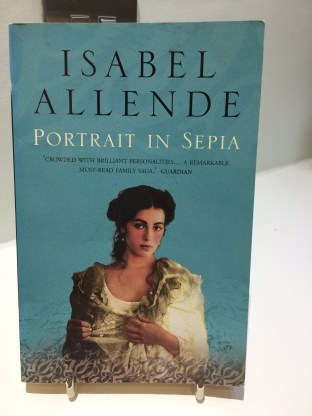
Chilean author Isabel Allende has to be one of the finest writers alive today. As in most of her books, the central characters are strong females. This novel tells the story of Aurora del Valle, who was born in Chinatown, San Francisco in 1880. Her mother was a spectacularly beautiful but fatally naïve young woman, Lynn Sommers, who was duped into sleeping with the wealthy and wayward Matias Rodriguez de Santa Cruz. Lynn is the daughter of Eliza Sommers, and Matias the son of Paulina del Valle. Both these women were central characters in the forerunner to this book, Daughter of Fortune. Severo del Valle, Matias’s cousin, marries Lynn to spare her honour (though the marriage is never consummated) and becomes Aurora’s legal guardian. Lynn dies from a haemorrhage just after her daughter is born so when Severo returns to Chile to fight in the war he leaves the child in the care of her maternal grandparents, Eliza and her husband Tao Chi’en. Aurora spends her first five years with them, happy and much-loved. When Tao Chi’en dies, Eliza fulfils a promise to return her husband’s body to his native China and leaves the child with her paternal grandmother, the indomitable Paulina del Valle. Paulina agrees to this on the basis that Eliza sever all ties with the child.

Thus, Aurora grows up with Paulina and the rest of the story follows her life, from her early years growing up amidst the pomp and wealth of her voracious grandmother’s vast household, such a contrast from the modest life she led in Chinatown, through to her early adulthood as the family moves to Chile. Allende gives a stunning account of the Chilean civil war, and the effect this had on the family, particularly Severo del Valle, who has now married his cousin Nivea, and with whom he goes on to have fifteen children. Nivea is another strong woman in the book, an idealist with fierce views on women’s rights, who does not let childbirth get in the way of her campaigning. She is devoted to Severo and their marriage provides a powerful model of spousal partnership for Aurora. Her grandmother Paulina is also a strong role model, teaching her about business and about feminine power.

In the latter part of the book, the adult Aurora becomes a photographer and enters into a disastrous marriage with Diego Dominguez. Lacking the wilfulness of Paulina and the inner confidence of Eliza, Aurora’s life is miserable, stuck on a farm in a rural part of Chile with a husband who does not love her. She feels as if her fate is not in her own hands.

The novel is classic Allende, an epic saga, covering the period 1862 (before Aurora’s birth) to 1910 with a beautifully drawn cast of characters. Yet despite its scale, the novel digs deep into the human condition – what it is to love and be loved, romantic love, marriage, the love between child, parent and grandparent, blood ties, and the pain and the pleasure that family can bring. The meaning of the title is cryptic, but it is revealed beautifully by the author at the end, in such a way that made me want to go straight back and read it all again! It’s a novel to get lost in, and Allende has this immense talent for drawing the reader in to the extraordinary world she creates.

A flawless book, highly recommended.

Have you read this book? How does it compare with Allende’s other works?

If you have enjoyed this post, please follow my blog by clicking the ‘Follow’ button, and connect with me on social media.

Kids’s books for Christmas – fiction

I posted last week with some suggestions for non-fiction books for children for Christmas. Today, I’ve got some fiction ideas for you. Here is my round-up of some of the best books around at the moment, which I recommend for children. I’ve given you an idea of the age range too. As a rule of thumb, the central character in a book is generally a year or two older than the age of the children the book is aimed at. Kids like reading about people who are slightly older than them.

Pax img

Pax by Sara Pennypacker – suitable for 10-11 year olds

I reviewed this book here a few weeks ago. I loved it. Set in America, it concerns 12 year old Peter and a ‘pet’ fox he has raised from a cub. Peter is forced to release Pax into the wild when his father is called up to serve in the army. Peter’s mother is dead and he is sent to live with his grandfather. He runs away to search for Pax after realising what a terrible mistake he has made, and meets Vola, who lives on an isolated farm. Vola nurses Peter after he breaks his ankle and the two form an unlikely friendship which sets them both on a journey of self-discovery. Some challenging themes, but ultimately a heart-warming tale, with some lovely illustrations.

33126922

Memoirs of a Polar Bear by Yoko Tawada – suitable for 11-13 year olds

Perfect for pre-teens whose reading tastes and skills are maturing but who still love their animals. Narrated in three parts by three generations of a polar bear family who find themselves in different parts of the world: beginning with the matriarch in the Soviet Union, her daughter Tosca in East Germany, and her grandson, Knut, raised in Leipzig zoo. Very quirky and gently political. It is translated from the original Japanese so will also give children a taste of a quite different style of writing.


9781406371680

Lucky Button by Michael Morpurgo – suitable for 9-12 year olds

I love a book with illustrations and I love Michael Morpurgo. This entry-level Morpurgo is a perfect Christmas offering. It concerns Jonah Trelawney who is the victim of school bullies and a carer for his mother. an accidental encounter gives him a life-changing insight to life in a Foundling Hospital in the 18th century (the original Foundling Museum was the inspiration for the story). Lovers of Jacqueline Wilson’s Hetty Feather will enjoy this.


The Adventures of John Blake: Mystery of the Ghost Ship by Philip Pullman – suitable for 10-13 year olds

Pullman’s The Book of Dust, part of the Lyra trilogy, is possibly the biggest children’s literature event of the year. Fans will already have bought it, so I’m not going to mention it here. Instead, I draw your attention to this graphic novel by the same author, which may encourage more reluctant readers, particularly boys. Just because it has pictures, does not mean it is for younger ones, who may find the storyline complex and the themes quite dark. John Blake is a seafaring time traveller. He rescues a young girl from a shipwreck, but his efforts to return her to her own time place them both in grave danger.


35529075The Disappearances by Emily Bain Murphy – suitable for 12-14 year olds

This debut has been very well-reviewed. It concerns Aila and her younger brother Miles who are sent to live in the rural town of Sterling, after their enigmatic mother, Juliet dies. The town carries a mysterious affliction: every seven years certain memories, experiences that people share in common, vanish. The locals believe that Aila’s dead mother, is somehow responsible and Aila must bear the brunt of their prejudice and hostility. A long book with some challenging themes which will suit keen readers who like a bit of depth.


2017-12-11 12.05.07Do You Speak Chocolate? by Cas Lester – suitable for 10-12 year olds

Friendship between girls is explored in this novel, which has been compared to Jacqueline Wilson. It is also a story about how friendship can transcend the bounds of language. Nadima is a new girl at school, recently arrived from Syria, and speaks no English. Jaz is a strong personality, and becomes friends with Nadima after the two share some confectionery. Their relationship does not always go smoothly and this book explores the ups and downs via themes of integration, community, and the things that bring us together.


Do you have any recommendations for children’s fiction this Christmas? I’d love to hear your suggestions.

If you have enjoyed this post, I would love for you to follow my blog and for us to connect on social media. You can do this by clicking on the various buttons on this page.

Book review: “The Bastard of Istanbul” by Elif Shafak

As I write this, it is being announced on the radio news that Ratko Mladic has been convicted of genocide and crimes against humanity at the International Criminal Court in the The Hague, for his orchestration of the Srebrenica massacre in 1995 where as many as 8,000 Bosnian muslims were killed. It is ironic then that my book review this week concerns a novel, at the heart of which lies the Armenian genocide of 1915. It is believed that up to 1.2 million ethnic Armenians were systematically killed by the Ottoman Turks in 1915-16. A few thousand managed to escape, mostly to America. This atrocity is considered to be the first genocide of the twentieth century and led ultimately to the establishment of the concept of ‘genocide’ in international law after World War II, which was considered at length by Philippe Sands in his book East West Street, which I reviewed here last year after it won the Baillie Gifford Prize for non-fiction.

2017-11-14 14.33.12The Bastard of Istanbul is a curious book, which my fellow book club members found disappointing. At the heart of the novel is the Kazanci family, living in Istanbul. The household is exclusively female and comprises Asya, (the eponymous ‘Bastard’) her three aunts and her mother (whom she also calls ‘Auntie’), her grandmother and ‘Petite-Ma’ who I think is her great-grandmother (more of that later, it’s part of the problem with the book). There is an uncle, who moved to America as a young man and has never returned. All the men in the family are afflicted by early death. Mustafa, the prodigal son, is in his 30s.


There is a second family to get to grips with, living in Arizona. Teenager Armanoush is the product of Rose (a southern gal) and Barsam Tchakhmakhchian, the son of an Armenian family, part of the Armenian diaspora. Rose and Barsam separated when Armanoush (also called ‘Amy’) was a toddler, and Rose then bumped into and married Mustafa (the prodigal Kazanci son). Still with me? Armanoush, curious to learn about her Armenian forebears’ early life in Istanbul, contrives to travel to the city and stay with her stepfather Mustafa’s family (the Kazanci women) without her parents knowing (they would not have approved.)

The novel opens with a bang – Zeliha, the most flamboyant and wayward of the quirky Kazanci sisters, arrives at a clinic demanding an abortion. At the very last minute, however, she does not go through with it. Enter Asya. The first half of the book is setting the scene of both Asya’s life (she is now a slightly surly teenager) and the Kazanci household as well as Armanoush’s life in the US. The second half is mainly concerned with the two young women and their developing relationship in Istanbul, and gradually the connection between them unfolds. Throughout the novel, the history of the Armenian genocide is woven in, particularly as it relates to the Turkish Kazancis and the Armenian Tchakhmakhchians.

Let me tell you what’s good about this book: I loved the sense of place – I have never been to Istanbul but am fascinated by it and by this part of the world generally and it’s on my bucket-list. I loved the characters: they are interesting and credible and the way the author builds our impression of them is beautifully done. Elif Shafak can write, and she can write with humour; there are some laugh-out loud moments, although knowing what I now do about the Armenian genocide, I’m wondering if it was fitting.

However, there are also some problems with the book, mainly it is over-written. For me, it needed some skilful editing. There is a large cast-list here and I’m afraid I rather lost track of some of the peripheral characters (Petite-Ma, for example), who are actually rather important to the story because you need to understand the ancestor relationships in order to fully appreciate the plot. There are some superfluous chunks that could easily have been stripped out and this would have given the plot lines (and later twists) greater force. Also, the historical thread, the background on the genocide, would have been given greater prominence.

The author states in the Acknowledgements that she was put on trial in 2006 for “denigrating Turkishness” with this novel (charges were later dropped). For that reason, and for the historical detail, it is worth a read, but I’m afraid, for me, it was a novel that did not quite live up to its potential.

If you have read The Bastard of Istanbul I’d love to hear your views.

If you have enjoyed this post, do follow my blog by clicking on the ‘Follow’ button. Let’s also connect on social media.