This was a recent choice for my book club. It was not a title I was familiar with although I had a vague recollection about a film adaptation coming out a few years ago. It was adapted for the screen in 2008, starring Kate Winslet and Ralph Fiennes. I had high hopes for the book and was excited at the prospect of reading it, especially since the comments on the cover of my edition were extremely enthusiastic. I’m afraid we were all slightly disappointed. The following review contains some spoilers.
 The story begins when 15 year-old Michael, off school for many months after contracting hepatitis, seeks out Hanna Schmitz, a woman who had been passing when he found himself being sick in the street and who had helped him. Once he is well again, Michael’s mother sends him off to find the mystery good Samaritan in order that he can thank her. Hanna is twenty years Michael’s senior and employed as a bus conductor, but despite the social and age gap between them, they begin a passionate affair, both parties equally consenting. One of the more intimate aspects of their relationship is that Michael reads aloud to Hanna, after sex and in the bath mainly, although never the other way around. Michael never questions Hanna’s desire to have him read to her, he just accepts it. This makes up the first part of the book and perhaps it is a testament to events that have occurred since the time of its writing that all of us (mothers of teenagers!) found the prose rather discomfiting, and not a little implausible. Hanna disappears mysteriously out of Michael’s life, leaving him heartbroken and perhaps also rather damaged.
In part two, Michael is older, now at law school, when, as part of his studies, he is sent off to observe the trials of a number of former female guards of a concentration camp who are being charged with allowing the deaths of dozens of Jews, locked in a church when it was hit by a bomb and destroyed by fire. Michael is horrified to discover that Hanna is one of those on trial. There is a detailed report of the events that Hanna is accused of writing, thereby implicating her as the main guard responsible for the atrocity, a charge she does not deny. Michael observes the trial in horror unable to come to terms with the back-story of the woman he once loved. Only at the end of the trial, does he realise Hanna’s secret, that she is illiterate (and therefore could not have written the report), and he finds himself with the dilemma of whether to intervene and tell the judge, with all the implications that would have. He elects not to, realising that Hanna confessed in order to conceal her illiteracy and for him to expose her would breach her autonomy, even if it means there has been a miscarriage of justice.
The final part of the book is about Michael’s life after the trial, his failed marriage, and his eventual decision to make contact with Hanna in prison. He sends her cassette tapes of himself reading aloud although he never includes any personal messages or letters. Eventually, he sees Hanna again, as she is about to be released at the end of her sentence, and helps to set her up with work and accommodation for when she is released. Hanna never gets out though as she hangs herself in her cell on the night before her release.
Set in the late 1950s and 1960s, the novel is said to be about Germany coming to terms with its wartime past; there is Hanna’s trial, the account of the events in which she was involved, the opportunity for the survivors of the camps to give an account of their experiences, and for the German judiciary to rightfully punish those responsible and be seen to dispense justice. On the cover of the book, the late Sir Peter Hall is quoted as saying “[This] is the German novel I have been waiting for: it objectifies the Holocaust and legitimately makes all mankind responsible.” I’m afraid, I just don’t think it reaches these heights. Yes, it is quite well-written and is arguably an interesting story, though one which my fellow book club members and I found deeply uncomfortable since we saw the relationship between Michael and Hanna as borderline child sexual abuse. The fact that this is in no way acknowledged is a problem. The story for me, though, just didn’t go anywhere; I reached the end and had nothing to say, no great realisation or revelation, or even closure. I just don’t think the book really knew what it was about.
So, a disappointing read, I’m afraid and not one I can recommend. I’d quite like to see the film, to see what Director Stephen Daldry (of Billy Elliot fame) made of it.
I’d love to know what you thought, if you have read it – did something different come out for you? And how are we to view works of literature written at times when societal norms, or our understanding of them, are different?
If you have enjoyed this post, I would love for you to follow my blog. Let’s also connect on social media.

 This book is Angie Thomas’s debut novel and it caused a sensation when it was first published in the United States in February 2017. It enjoyed both critical and popular acclaim, remaining at the top of the New York Times YA best seller list for almost a year. It was made into a film which was released last Autumn. The novel came out of a short story Thomas wrote in college following the police shooting of a young black man in 2009.
 The book is about a young newly-married couple, Celestial and Roy, and is set in the American Deep South. Their lives appear full of potential until Roy is accused of a crime he did not commit. He is convicted and sentenced to twelve years in prison. The book concerns the effect of the separation on their marriage, how Celestial copes alone and what this means for their shared dreams.
 There was a decidedly political, Brexit-y feel to events this year, perhaps that is because of the looming Tory party leadership contest and the European elections last week. Also, there is a sense that the world of arts and culture is beginning to assert its feeling about the Brexit issue more vociferously as the UK’s departure draws nearer. I saw Keir Starmer on Saturday and found him extremely impressive (surely a future leader of the Labour Party?). He was thoughtful and candid, whilst also remaining tactful about current political events. He was gracious about Theresa May and less so about many of her colleagues. He was being interviewed by Philippe Sands, author of
 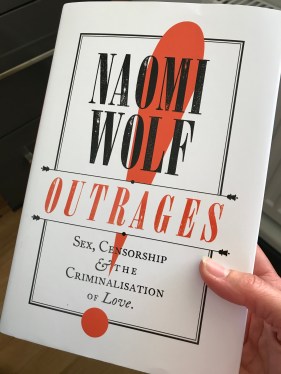 I also saw Naomi Wolf, a woman whose work I have admired for years. She was talking about her latest book, Outrages: Sex, Censorship and the Criminalisation of Love in which she traces the evolution of attitudes to sex, particularly homosexual activity, from the mid-19th century on, through the writings of John Addington Symonds. There has been a lot of controversy in the press about an error in her book (which she has acknowledged and plans to correct in the next edition), which in my view, has been somewhat overblown; I truly doubt whether a male author would have experienced the same opprobrium. Naomi Wolf was warm and articulate, and gracious about the cultural and political turmoil in the UK, reflecting also on similar events in the US too. I was glad to have heard her speak.
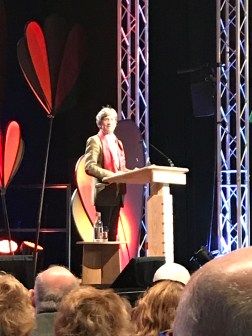 On Sunday, I went to a panel discussion led by Ed Vaizey MP, talking about branding with a number of business-people. It was interesting, and Ed Vaizey is very witty, but, to be honest, didn’t feel very “Hay”. I also saw Melvyn Bragg speak about his new novel Love Without End: A Story of Heloise and Abelard. I enjoy listening to his BBC Radio 4 show In Our Time and am always impressed by his ability to cut through to the core of so many topics. Can you believe this is his 22nd novel!!! He has also written seventeen non-fiction books. Surely, he is approaching national treasure status!
 So my reading time has been severely curtailed. I managed to finish Why Mummy Drinks just after the book club meeting, just as well it was a quick read and did not require too much mental investment. My other big read for last month, however, did. Colin Thubron’s To A Mountain in Tibet was the April title for my