Audiobooks can be a great way to access books if you’re time-poor

I know so many people who love reading, but find it hard to find the time to do so – when you have a family, work and find yourself under pressure to provide taxi services, help with homework, cook interesting and nutritious meals, check emails….the list goes on. Reading often drops off the list. And how many of you do your reading at bedtime and find you fall asleep before you’ve even finished a chapter?

It’s a common problem. I am a great believer in two things, however. First, if you want your kids to read they have to see you doing it too – so you’re actually being a good parent by finding time to read. Second, reading can be a wonderful way of escaping all the chores and pressures of life, so you will benefit from even 10-15 minutes here and there.

glass-2557577_1920I’m a big fan of audiobooks as a way of passing otherwise dead time in a more constructive way  – for me it’s car journeys, or whilst exercising. It might also be while you’re waiting for swimming lessons to finish or at the supermarket. You have to choose your titles carefully though, because it’s not just about what you listen to, but the narrator is really key to the enjoyment. For example, audiobooks I have enjoyed have been Holding, narrated brilliantly by the author Graham Norton, Frankenstein, narrated by Derek Jacobi and 1984, narrated by Andrew Wincott (Adam from The Archers). Their reading styles enhanced my enjoyment. A title I enjoyed less because of the narration was The Girl on the Train, where I felt the male voices were not done well.

the story of a new nameI have recently finished listening to The Story of a New Name by Elena Ferrante, Book Two in her Neapolitan Novels series. I have listened to and reviewed here, Book One, My Brilliant Friend, and the narration by American actor Hilary Huber is sublime. The Story of a New Name continues where Book One left off, with Lila marrying the grocery-store owner Stefano Caracci. Lila acquires a new social standing and some material wealth, but it is a loveless affair, and the marriage soon deteriorates into violence and enmity.

Lila’s childhood friend Elena, chooses a different path; she continues her education and though at first she barely scrapes through with adequate grades, she eventually graduates and is accepted at the university in Pisa. While Lila’s life is coming apart (despite her many talents, her beauty and her magnetic appeal), Elena’s eventually triumphant academic trajectory comes as a surprise to many as her abilities and potential were not thought to be as great (especially by herself).

This book has the same wonderful setting, 1960s Naples, the same cast of fascinating characters, mostly sinister and flawed, and develops the themes of friendship, and its many complex facets, jealousy, family feuds, conflict, love, hatred and the position of women in society.

The book is long (over eighteen hours worth of listening, or nearly 500 pages in paperback), but it is epic in scale and epic in achievement. On my audiobook app you can select a faster reading speed; I tried listening at 1.25 speed, but I went back to standard speed, because Hilary Huber’s American drawl is a treat for the ears and brilliantly suited to the story.

I would highly recommend this audiobook – the cast of characters is complicated and sometimes I forgot who was who, especially when shortened or ‘pet’ names are used in the dialogue. I found it helpful to look up a cast of characters online so I could keep track. There are two more books in the series – Those Who Leave and Those Who Stay and The Story of the Lost Child. I will certainly stick with the series and get both of these – even though it might take another year to get through listening to them!

Does the narration style affect your enjoyment of an audiobook?

If you have enjoyed this post, keep up to date with my blog by clicking on the Follow button. Let’s also connect on social media.

Science writing: “Catching Breath: the making and unmaking of tuberculosis” by Kathryn Lougheed

Regular readers of this blog will know that I have been working on my first book for just under a year now. It’s a long process! I finished my first draft just before Easter, but even though it was gratifying to reach that milestone, to be able to type “The End” I was aware that, in many ways it was just that – a milestone, not the end. It was the end of the beginning.

In the last few weeks of writing I had begun to build up a list of gaps, things I still needed to research, passages or chapters that I knew would not read the way I wanted and tweaks that may be necessary with the structure. I conducted my first full read through a couple of weeks ago and found it reassuring that I was indeed right – there were gaps, bits that did not flow and the non-linear structure I was so excited about, well, perhaps that did not work as well as I thought. I wasn’t down about it though. I have a long list of tasks again, but feel generally positive.

Emily Bronte, John Keats and George Orwell are among the many artists who died young from TB, giving the disease a ‘romantic’ image

An area where I felt I needed more information was in understanding tuberculosis (TB). This disease was rife in Britain in the nineteenth and early twentieth centuries. The numbers are astonishing: in England and Wales about four million people are thought to have died from TB between 1851 and 1910. TB-related deaths began to fall from this point onwards but were still shocking: in 1913, there were 36,500 deaths from TB in England and Wales (reaching a peak of 46,200 in 1918, at the time of the European Spanish ‘flu pandemic). By 2013, there were just 280, down from a rate of almost 100 per 100,000 population in 1913, to 0.5 per 100,000 a century later. (Source: Office for National Statistics)

The decline in the mortality rate for the disease can be put down to a number of factors: mainly improved living conditions and sanitation, but also better understanding of the disease (it was once thought to be hereditary, not contagious), the discovery of an effective antibiotic treatment in the late 1940s and, latterly, a nationwide vaccination programme (remember the BCG?). The virtual eradication of the disease in this country is a cause for celebration, but, worldwide, it remains a devastating killer: 1.4 million people a year die from TB.

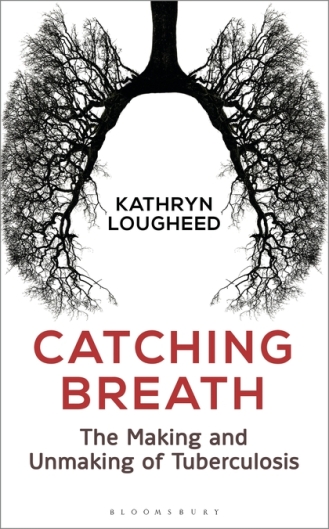
Catching Breath imgOne of the books I consulted as part of my research into understanding more about the disease, its symptoms and its effects, was published very recently, in 2017. It’s called Catching Breath: the making and unmaking of tuberculosis by Kathryn Lougheed. The author is a former scientific researcher and is now a journalist and science writer. The book is excellent. It is fantastically well-written, even funny in parts (the author has an interesting sense of humour – her Twitter handle is @ilovebacteria!). She is out to make some serious points, however, about this, one of the oldest diseases known to humanity, which has so successfully mutated, crossed species and diversified and which just keeps on winning. Her main argument is that TB remains a disease of poverty and inequality. Globally, it affects the weakest – the young, the old, the poor or those who are already sick.  She argues that, although it is a complex disease, if there was sufficient political will, many more lives could be saved. If there was as much resource and international effort put into tackling TB as there has been, say, to addressing AIDS, there would have been far greater success to date. In 2015 the World Health Organisation (WHO) announced its ‘End TB strategy‘, which set a goal to reduce worldwide deaths from the disease by 95% by 2035, although it would seem that nothing short of a heroic research effort will be required to meet this.

If you are at all interested in the politics of health and disease, inequality between the developed and the developing world, and about humanity’s ongoing battles with diseases old and new, this is a fascinating and engaging read. I had intended merely to dip into the bits that interested me for my own research, but I have ended up reading the whole book. In Kathryn Lougheed, science’s loss is the publishing world’s gain. I hope this book gets nominated for some non-fiction or science-writing prizes.

Have you read any good science or non-fiction books recently?

If you have enjoyed this post, do subscribe to my blog by clicking the ‘Follow’ button. Let’s also connect on social media.

Why book ratings are pointless!

If  you have read any of the book reviews I publish on this blog, you will note that I do not give star ratings, marks out of ten or anything like that. I will recommend or not (usually the former – even if I have not enjoyed something, I will try to think about who might like it) and, particularly in the case of the children’s books I review, I will say what age group I think it’s appropriate for and any issues parents might like to be aware of. For example, books marketed for, say, 11-13 year olds might contain references to violence or death, which will be okay for some kids, but not if they’ve just lost a pet, grandparent or are on the sensitive side. Star ratings, on the other hand, are a blunt instrument.

I am a keen member of the Goodreads website and I write short reviews of most things I read (haven’t caught up on the back catalogue I listed when I joined, though!). I hate giving the star rating and find even my own ratings are inconsistent from one book to the next, so how on earth can a reader compare a 4-star rating one person has given to a 2-star rating from someone else? If you read the review, I guess that gives you the reader’s justification for their rating, but the trouble with star ratings is that you are immediately drawn to the high level score rather than the longer-form explanation.

(The erotic thriller Fifty Shades of Grey gets the same score of 3.66 on Goodreads as Anne Bronte’s Agnes Grey! But are they comparable?)

What justifies a star-rating anyway? Is it how much you’ve enjoyed something? Or how GOOD you think it is? They are not necessarily the same thing. For example, I recently reviewed Gustave Flaubert’s Madame Bovary on this blog and on Goodreads, after I set it as the book for March on my Facebook Reading Challenge. I think it is fair to say that most people involved in the Challenge did not love the book, and yet it is one of the great classics of world literature. I loved it (but then I love the classics generally), but I cannot say, hand on heart, that I sat wrapt for every moment I was reading it. This 19th century novel was definitely hard work in places for a 21st century reader. Yet, there are plenty of books I’ve read recently which I could not put down. One that comes to mind is The Secret Life of Bees by Sue Monk Kidd, but you would probably not say it was a classic; it’s the sort of book you’ll find in the hospital League of Friends bookstall! The Goodreads rating for Madame Bovary is 3.65 and for The Secret Life of Bees is 4.02, but will the latter still be in print in 150 years time?

I’m not really sure what this very unscientific comparison tells us, except that readers’ tastes change all the time. I gave Madame Bovary 5 stars because I recognise it as a great book, and acknowledge its longevity and its place in world literature, but others who hated it will have given it 1 star. But my enjoyment of it was a different kind of pleasure to reading The Secret Life of Bees.

I recognise the inconsistencies in my own ratings too – I am more likely to give a book a higher rating if it has met my expectations or if it was appropriate for the time I was reading it. This would explain the 1 star I gave to George Saunders’s Man Booker Prize winning Lincoln in The Bardo and the 4 stars I gave to Jo Cox: More in Common by Brendan Cox – the latter struck a political chord and moved me, but it’s not literary. And when I’m reviewing a children’s book, I try to rate it from the point of view of how much I think the target audience might enjoy it. But children’s tastes can be difficult to predict!

So, the answer really is to ignore the star rating and read the review – would you agree?

If you have enjoyed this post, I would love for you to follow my blog. You can also connect with me on social media via the tabs above.


Film review: The Guernsey Literary and Potato Peel Pie Society

I was feeling a bit glum last week (two teenagers and one in training, need I say more?!) so I decided that an afternoon at the cinema with a feel-good movie was in order. I’d heard about The Guernsey Literary and Potato Peel Pie Society (hereafter shortened to The GLPPPS) on Front Row a few weeks ago and it sounded interesting. It is a really lovely movie, and there is much more to it than just “feel-good” with a bit of romance; it covers historical events about which I’m ashamed to say I knew very little, and it is very engaging.

Successful, beautiful young author Juliet Ashton appears to have it all; she lives in London, where she is planning to buy a new flat, which she can well afford from her fabulous authorly earnings, and is romantically involved with an American military officer, who wants to whisk her off to New York to be his wife. But a dark shadow looms over her existence and she knows there is something missing in her life. Bored with her book tours she accepts a commission from The Times to write an article when, out of the blue, she receives a letter from a farmer in Guernsey, Dawsey Adams, which intrigues her. He has by chance come across a copy of Charles Lamb’s Tales from Shakespeare with her name and former London address written in it. Her past home was destroyed in the War, and both her parents were killed, so the contact marks an emotional moment for her. In his letter, Dawsey writes briefly about the GLPPPS and asks if she might forward another book for the group to read (books were very difficult for them to get hold of when the Nazis occupied the island).

Juliet is intrigued, not only by the request, but also by the strange name of the Society. We have already learned a little of the Society’s origins – its five members were apprehended by a Nazi patrol after curfew after they had shared a roast pork dinner from an illegally concealed pig. At the time of the occupation, locals were forbidden to keep hold of their livestock as all meat was confiscated for the benefit of the German soldiers. As a result the islanders were nearly starved, hence living on delights such as Potato Peel Pie (“no flour, no butter, just potato peel”). The shared meal marks a connection and coming together for the five lonely individuals looking for some togetherness at a very dark time. The Society is ‘authorised’ by the Germans and they continue to meet. It becomes their lifeline. The instigator of the Society, Elizabeth McKenna, is the best friend of Jane, daughter of Amelia Maugery, another of the Society’s founding members.

Juliet decides to go to Guernsey to write about the Society and when she arrives she is immediately won over by their passion for literature, their humanity and their story. She tells them, naively, that she would like to write about them for her article in The Times and assumes they will be only too delighted to give her their blessing. Juliet encounters unexpected hostility, however, in particular from Amelia (played by the marvellous Penelope Wilton), who believes that Juliet, with her London ways, has merely come to gawp at these unsophisticated islanders and that she understands nothing of their lives.

Juliet is horrified that her new friends should be offended by her proposal and desires to dig a little deeper, to understand better and to uncover the truth about what they endured in the occupation. Thus, her weekend stay becomes indefinitely extended, much to the annoyance of Juliet’s fiance, Mark Reynolds. Juliet develops close relationships with other Society members Isola and, of course, the handsome Dawsey. She learns from them that Amelia has never recovered from the death of her daughter Jane, and the unborn child she was carrying, from German bombing at the time of the invasion. She also learns more about Dawsey’s young daughter Kit, and about what has happened to Elizabeth.

I will say no more as it’s a cracking story and I don’t want to spoil it. Multiple plot lines are maintained throughout, and the flashbacks to the origins of the Society and the events that befell them in the War are very well done. The dimension of Juliet’s engagement to her American lover, and her long-standing friendship with her protective publisher, provide interesting side stories.  It has a super cast, the characters are well-played, and the Guernsey scenery is stunning – I predict this film will do much for Channel Islands tourism!

Highly recommended and definitely improved my week!

If you get to see this film I’d love to hear what you thought of it.

If you have enjoyed this post, do subscribe to my blog and connect with me on social media. 


Women’s Prize for Fiction 2018 – shortlist announced

The shortlist for the Women’s Prize for Fiction, formerly the Bailey’s Prize, was announced last week. This prize is one of the foremost competitions for women writers and it’s one of those where every year the shortlist list looks like a box of precious jewels (unlike the Man Booker which always manages a curve ball or two, in my view!) There is NOTHING on the list this year that I don’t want to read at some point! So many books, so little time, especially as I’m giving over more of my reading time to children’s literature these days.

If you’re looking for something to read yourself, I have heard great things about all of these books, and I suspect you won’t go wrong if you pick any one of them.

This slideshow requires JavaScript.

The novels on the shortlist are:

Sight by Jessie Greengrass – a woman recounts her journey to motherhood and reflects on the relationships she had with her mother and grandmother.

Home Fire by Kamila Shamsie – Isma is studying in America, having spent years raising her two younger siblings following their mother’s death. The family becomes embroiled in London with Eamonn, the son of a high-profile Muslim politician. It’s a novel about destiny, choices and love.

Sing, Unburied, Sing by Jesmyn Ward – a story about race, drug abuse, broken masculinity and poverty in the US seen through the eyes of thirteen year old Jojo and his mother Leonie.

The Idiot by Elif Batuman – a story about language and culture set in Harvard, Massachusetts, where Selin, a Turkish-American, is studying and meets others like her, of mixed race and mixed cultures.

The Mermaid and Mrs Hancock by Imogen Hermes Gowar – a story about the power and mythology of mermaids. set in 18th century London, where the merchant Jonah Hancock learns one of his captains has sold a ship in exchange for a mermaid. News spreads and Hancock finds himself the centre of London society.

When I Hit You: Or, A Portrait of the Writer as a Young Wife by Meena Kandasamy – a novel about domestic abuse and control, and the crushing of a young woman’s hopes and ambitions by a domineering husband.

I haven’t read any of these and doubt I will manage to get through this list by the time the winner is announced on 6 June. The first and the last on this list appeal to me most, although Sing, Unburied, Sing also looks like a must-read.

I’d love to hear from you if you have read any of these – what do you recommend?

If you have enjoyed this post, do subscribe to the blog, by clicking on the Follow button, and let’s connect on social media. 

Book and theatre review: “Frankenstein” by Mary Shelley

I had my fill of Frankenstein last week – I read the book, saw the play and listened to Derek Jacobi narrating the audio book! My book club selected it as we were looking to read a classic, and, as it happens to be the 200th anniversary of the novel’s publication, it was also showing at the Manchester Royal Exchange Theatre in a new adaptation by April de Angelis.

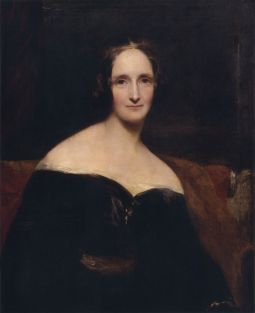
2018-04-19 11.30.32It is extraordinary to think that this remarkable novel, still as popular and as shocking today as ever, was written when Mary was just 19 years old. The fact that she was such a literary talent is not surprising given that she was the offspring of the two famous intellectuals, Mary Wollstonecraft, philosopher and author of the seminal feminist work A Vindication of the Rights of Woman, and William Godwin, the radical political philosopher. In her lifetime, she was highly regarded as a radical writer and intellectual, as well as being the wife of the poet Percy Bysshe Shelley, whom she met and fell passionately in love with at the age of 17. Her reputation since her death, however, has been overshadowed by that of her husband’s, with whom she bore four children (three died in infancy), whose affairs and financial troubles she endured, and whose poems she edited both before and after his death. Percy Bysshe Shelley drowned at sea in 1822, just six years into their marriage when she was 25. She died at the age of 53 in London from a suspected brain tumour.

Mary ShelleyBy any standards her life was remarkable and in the last few years her reputation has been revived and she has begun to be more widely considered as a formidable talent in her own right, rather than just a ‘one-book author’. Frankenstein has been a staple of English literature GCSE and A level syllabuses for years, but most of her other works have fallen out of print. A new biography, In Search of Mary Shelley: The girl who wrote Frankenstein, by Fiona Sampson was published earlier this year, some of which I caught when it was serialised in Radio 4 recently. What I heard sounded fascinating. Sadly it is not available on the BBC iPlayer at the moment.

Frankenstein is a brilliant book. It’s not particularly long so if you are not accustomed to the classics it is not too daunting. It is extraordinarily sophisticated in the themes it explores, from ideas about religion and creation, the vanity of man (men) and moral relativism. Its structure is also interesting: it is narrated initially by Robert Walton in letters to his sister. Walton is the Captain of a ship which he is sailing to the Arctic in the hopes of making a great discovery about the North Pole. He describes his ambitions, but also his loneliness and need for companionship. He meets an unexpected friend in the form of Victor Frankenstein who is on an unlikely pursuit of a mysterious giant figure which Walton and his crew had previously spotted. Frankenstein takes over the narration and we learn about the terrible events that preceded this chase, from his early family life in Switzerland and tragic death of his mother, his relationship with his cousin Elizabeth, to his university life in Ingolstadt. It was in Ingolstadt that he first felt the pain of academic embarrassment, when his naïve ideas were exposed, and he set out on the extraordinary task of creating a human. Unfortunately for Frankenstein, he did not think it through, and once he realised the horror of what he had done, quite soon after he brought his creation to life, he disowns it and leaves to its own fate while he spends the next few years wringing his hands. Frankenstein’s procrastination is fatal.

For a time there is also narration from the ‘monster’ (relayed by Frankenstein) who manages initially to survive on vegetation whilst concealed in a hovel, from which he is able to spy on a once wealthy but now fallen French family in a small village. From them he learns language and the ways of humans, and hopes that he will be able to become friends with them, as he longs for company. Unfortunately, when he introduces himself to them, his hopes are shattered; they assume from his, presumably horrific appearance, that he means them harm and they beat him and drive him out of the cottage. Disappointed and infuriated, the monster goes in search of Frankenstein, with the intention of demanding that he make him a female companion, with the threat of death and destruction if he refuses.

I will say no more. Though the story is well known, I do not wish to give away any further spoilers for anyone unfamiliar with it. I wanted to finish the book before seeing the play, so I mixed reading it with listening to the audiobook narrated by Derek Jacobi. This was read brilliantly, as you would expect, though I have to say it gives you the impression that both Walton and Frankenstein are older, wiser men when in fact it is their naivety and youthful impetuosity that is partly responsible for the grave decisions both make.

Frankenstein play
Copyright –  Royal Exchange Theatre, Manchester

The play was also wonderful and provided a rewarding extra-curricular outing for the book club! It was visceral, shocking, truly gruesome in parts. I loved the way the complex narrative structure, and the jumping back and forth in time was handled. I also loved the way it was interpreted for a 21st century audience, particularly in drawing out the feminist undertones (Elizabeth is played more strongly than in the book, while Frankenstein is often exposed as foolish). It had thrills, spills and lots of action, and stayed very true to the book, leaving out remarkably little and using some of the really powerful passages (particularly those spoken by the monster) verbatim. It will have been a fantastic bonus for any young people studying it for exams this year.

A thoroughly enjoyable monstrous week!

April Reading Challenge

At last, it’s starting to feel a little more spring-like as we enter April, which must mean it’s time for this month’s book on the Facebook Reading Challenge group.

2018-03-29-10-08-25.jpgLast month, we battled our way through Madame Bovary, some enjoying it more than others, it has to be said. Our theme was a classic novel, and this can be a challenging genre. It can take you right back to schooldays and unhappy memories of working line by line through a text that had no relevance to your teenage life. And if you are out of the habit of reading classic, usually older, novels, the language can feel outdated, and hard work.

For me, the challenge was the size of the typeface in my University days edition! Not only was this a strain on my ‘mature’ eyesight, but it meant that pages were turned less frequently than I am used to. A trivial point perhaps but it gave me an insight into what motivates continued reading, and feeling like you are making progress can be a part of that. Personally, I really enjoyed it – it was all about the writing for me. Just sublime. Irony on a par with Jane Austen. I had forgotten how good a novel it is.

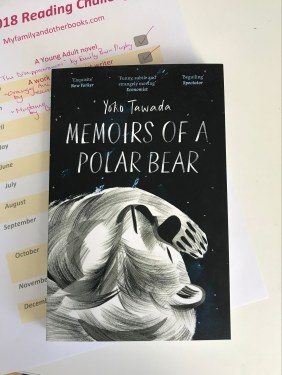
2018-03-29-10-28-24.jpgThis months’s challenge is something altogether different – a children’s novel and I have chosen Memoirs of a Polar Bear by Yoko Tawada. This book first came to my attention before Christmas and I have been keen to read it ever since. It is written from the perspective of three different polar bears: the first , a female, who flees her homeland in Soviet Russia, the second, her daughter, a dancing bear in a Berlin circus, and the third, the most recent, born in captivity in Germany.

The book has won high praise for its Japanese author. It’ll be the second children’s book I’ve read recently that is written, in part at least, from the perspective of an animal (the other being Pax, which I enjoyed enormously), so I’m looking forward to it. I expect it will be one of those books that blurs the boundary between ‘children’s’ and ‘adult’ fiction. Happily.

If you would like to participate in the challenge, do join us on the Facebook group, or if you have read this book and have a view on it, I would love to hear it. 

If you have enjoyed this post, why not follow the blog for more bookish chat. 

Easter Greetings

easter-3248883_1280

Easter is falling rather early this year, and with the weather not looking great for the UK this weekend, it could be a rather chilly Spring break. Perfect for spending time with a book! My kids will be getting the usual smallish chocolate egg from the Easter mummy bunny, plus a book token, a tradition I started a couple of years ago.

I’ll be away for a few days and have been giving some thought to what reading material I will take with me. I will, as always, take far more than I will actually get through, but I do that because I get a bit nervous when I have only one book available to read! I like to have a choice and nearly always have a couple of books on the go, in any case.

I’ll be taking Paul Auster’s 4321, about which I posted here a couple of weeks ago. I started it last Autumn and have found it really hard-going. I have been pondering whether to give up on it, but I think I’m going to give it one last focussed go, to see how I get on.

I’ll also be taking Frankenstein, the 1818 classic by Mary Shelley, which celebrates its bicentenary this year. I’m reading that with my girlfriends from my book club and we have booked to see the new production that is currently running at the Royal Exchange Theatre in Manchester in a couple of weeks. Really excited about that.

That’s it. Just the two books! That demonstrates an unusual realism about my reading and my commitment to doing justice to 4321, I think. (Although I do have a couple of back up books on my e-reader. Just in case.)

I bought a couple of magazines for the journey (I can’t read a book in a car) and nearly choked when I discovered they were £4.30. Each! Is it really that long since I bought a magazine? You can buy half a book for that!

Have a wonderful Easter, with plenty of reading and chocolate!

What will you be up to this Easter? What are you reading?

If you have enjoyed this post, do follow my blog, I’d love to hear from you.

Book Review: “The Life and Loves of a He-Devil” by Graham Norton

I love my little book club – it’s small and very exclusive and, besides books, we specialise in popcorn, gin and tonic and extra-curricular trips. All in the name of literature, of course!

We have been meeting every month for a couple of years now and have read a wide range of books: fiction, non-fiction, YA, thrillers, classics, to name but a few of our chosen genres. Some books we have loved, some we have loved less. Some generate an enormous amount of discussion, others less.

The Life and Loves of a He Devil imgWe decided for our March meeting we’d read Graham Norton’s 2014 memoir The Life and Loves of a He Devil. We wanted to read an autobiography and felt that among the many “celebrity” memoirs out there, Graham’s might have more to offer than most. We all like him as a broadcaster and personality and thought it might be fun. We were not wrong! But when we came to meet and discuss it, we had very little to say. We’d exchanged a number of messages on our WhatsApp group in the preceding weeks, with many laughter emojis, asking each other if we’d come across the dog and condom anecdote yet, or the Dolly Parton story. Some sections of this book, which I read most of whilst on a train journey to London, were laugh-out-loud, or rather “try to suppress a laugh because I’m in public”, moments. It’s a romp and Graham writes the way he speaks, with wit, authenticity and complete honesty. His writing style is similar in his novel Holding, which I reviewed here last year, and really enjoyed. (His second novel, entitled A Keeper, is due out in the Autumn.)

It’s charming and funny, and there is such a lot of name-dropping that it’s a bit of escapism too. Reading it is a reminder of just how successful, Graham is; I lost count of the number of homes he owns and the list of people he calls friends is something to behold. I think it’s because he manages to make you feel that he is a regular guy, just like the rest of us, and just as in awe of all the celebs and their glitter. He also manages to convey a kind of naivety and innocence that make you feel he is very ordinary. He is not of course; he’s supremely talented and clearly unusually astute to have achieved what he has. That does not come from luck alone. Concealing all of that beneath a veneer of self-deprecation is a talent in itself and I admire him enormously.

Back to my book club, we had only one criticism, and that is that the opening chapter (the book is divided into chapters, each of which is about one of his ‘loves’), about the joys of being a dog-owner, was, we felt, by far the funniest, so everything that followed was not inferior exactly, but did not quite meet the same high bar.

Not much to say then, except that it’s hugely funny, and if you like Graham Norton, you’ll love this book!

Have you read this or any of Graham Norton’s other books?

If you have enjoyed this post, I would love for you to follow my blog. Let’s also connect on social media.
Waiting for Spring…

…feels a bit like Waiting for Godot this year!

Tomorrow it’s the Vernal Equinox, the mid-point on the calendar between the Winter and Summer Solstices, when the number of hours of day and night are equal. It may be the official start of spring in meteorological terms, but, here in the UK, it still feels very much like winter! The daffodils in my garden are putting a brave face on it, but we have just had a weekend of snow-related disruption in many parts of the country and the strong winds blowing in from the east mean it is freezing out.

2018-03-19 14.58.03
Spring bulbs are flowering in the sunshine, but it’s freezing out!

It is at this time of year that many of us start to get itchy feet, desperate to get outside after the long winter, and yet the weather is making that quite challenging. I’m keen to blow the winter cobwebs away, but not to get blown away! We have been relatively lucky here in Manchester, in the north west of England, with very little snow settling, particularly compared to other parts of the country. Temperatures look set to improve by the middle of the week.

The downsides of this protracted winter are obvious: less fresh air, less getting out and about, less exercise and more hours with the heating on! I’ve written here before about my reluctance to make New Year’s resolutions, but at this time of year, I start to get some energy and motivation back. So I’m trying this year to see more of the positive in events, to default to ‘Yes’ and to see a glass half full. In that spirit, I’m trying to think about the upsides of this unexpected weather and one definite bonus is more time for reading: I can still justify curling up with a blanket and a book when it’s too cold to go out!

I’ve almost finished Madame Bovary, the March title in my 2018 Reading Challenge, and am looking forward to starting our children’s book for April, which I’ll be announcing next week. After blogging here about my difficulties with 4321 last week, I’ve resolved to give it another go and take it on holiday over Easter. I’m also looking forward to reading my next book from the children’s library, Red Nemesis by Steve Cole, a Young Bond adventure set during the Cold War. Very topical!

What are you reading at the moment?

If you have enjoyed this post, I would love for you to follow my blog by clicking on the subscribe button. Let’s also connect on social media.