Book review: “The Last Runaway” by Tracy Chevalier

This was one of my holidays reads and one of two books my book club chose for our summer break. It’s only my third Tracy Chevalier novel, but each time I read her I just want more! I read Girl with a Pearl Earring years ago when it was first published and then The Lady and the Unicorn a year or so ago, which I thought was wonderful. I have since picked up Virgin Blue from my local secondhand bookshop so that will be next on my list.

The Last Runaway imgOne thing that is so impressive about Chevalier is how beautifully she creates the  historical setting: the two novels I have read so far have been set in 17th century Holland and 15th century Paris and Brussels and I can only begin to imagine the amount of research she has to undertake. The Last Runaway is set in the United States in the mid-nineteenth century when parts of the country were only just being settled. Honor Bright, our main character is a young Quaker woman from Dorset in England. She has led a modest and sheltered life, but her world was turned upside down when her fiancé left her and their close-knit Quaker community for another woman. This was not only a scandal but it left Honor distraught and in a very difficult position. When her sister, Grace, is persuaded by her fiancé that they should move to America, Honor decides she must go with her, not only to support her sister, but to escape the oppression of her situation and have some chance of making a life for herself.

Their journey from Bristol to New York is arduous and Honor suffers with debilitating seasickness. As they travel the long distance from New York to Ohio, Grace contracts Yellow Fever and dies. This places Honor in a further difficult position: not only must she tell Adam Cox, Grace’s fiancé, that she is dead, but she is also in fear about where that leaves her as he, of course, has no obligation to support her. Honor, however, cannot face going back to England either because of the journey or the shame.

On the final leg of her journey, Honor has a frightening encounter with a local slave-hunter, Donovan. Honor is appalled both by his profession and his dangerous air, and yet also finds herself strangely drawn to him when he seems to flirt with her. This also sends her into a tailspin as it conflicts with her Quaker outlook and moral code.

Honor arrives in the small town of Wellington, close to Faithwell, her intended destination. There, she finds quarters with Belle Mills, the local milliner, who, it transpires, is also the half-sister of the mysterious Donovan. Belle warns Honor about him and it is clear there is a tension between these siblings. During her stay with Belle, Honor adapts her talent for quilting (quilting, its traditions, the patterns and its place in Quaker culture, are a strong and fascinating motif running through the novel) and shows promise as a hat-maker, endearing her to Belle and her many customers. Belle’s designs are often flamboyant, which is an anathema to Honor, who, as a Quaker, must observe plainness and modesty in all forms of dress. The two women develop a firm friendship, however, and Honor begins to feel more confident.

Honor first realises there is something strange going on when she finds a black man under a woodpile in the yard of Belle’s home. Honor is aware of the existence of the slave trade, indeed, the Quakers were an important part of the movement calling for its abolition, but this is the first time she has come so close to an escapee. She is terrified, particularly when Donovan comes searching at his sister’s property, sensing the presence of the runaway. Honor later learns that Belle is part of a network of citizens who provided the means of escape, food and shelter for runaway slaves fleeing the South to states which had already outlawed slavery – the ‘underground railroad’. Belle was what was known as a ‘station-master’.

Honor is collected from Belle’s by Adam Cox, Grace’s fiancé, and taken back to Faithwell, to live with him and his sister-in-law (also widowed) and to work in their shop. The domestic situation is uncomfortable for Honor, however, and her prospects only  brighten when she is wooed and then married to fellow Quaker Jack Haymaker. At first it seems like a good marriage that will improve Honor’s situation, but her mother-in-law proves to be a formidable presence, who does not conceal her contempt for her daughter-in-law and how little she has to offer when Honor goes to live with them on their isolated farm. At first, Jack is attentive and loving, but quickly becomes complacent and Honor grows increasingly miserable, despite her efforts to feel and appropriate degree of godly gratitude. Tensions deepen when Honor decides she will provide support for runaway slaves passing through their property. This is against the expressed wishes of the Haymakers. A law has been passed which makes it illegal for anyone to help a runaway, and the penalties are severe. Whilst the Quakers are against slavery, they are also against law-breaking and Honor’s actions are seen as a threat to their livelihood. Honor finds herself increasingly in conflict with the family until the point where her position becomes untenable. All the while, Donovan hovers in the background, stalking Honor and sniffing out runaways.

I will say no more as the events of the story then take quite dramatic turns. I loved the unexpected twists of the plot. I also love the way the author wove in details about the slave trade and the underground railroad (which I confess I knew very little about). Colson Whitehead’s 2016 novel The Underground Railroad brought the existence of this movement to the attention of many readers for the first time, I think. I was not aware that Tracy Chevalier had also written this novel about it. I also loved the domesticity of this novel, its femaleness and the feminine craft of homemaking, particularly in relation to the skills required for good quilting. This seems to be a common theme in Chevalier’s work. I loved how strong the women were in this novel; the men do not come out looking so good!

I recommend this book highly. It’s a great story, a fascinating read and will give you an insight into worlds you may not know much about.

If you have read this book, I would love to hear your views.

If you have enjoyed this post, do follow my blog and let’s connect on social media.

Book review: “American Pastoral” by Philip Roth

2018-08-08-16-30-02.jpg

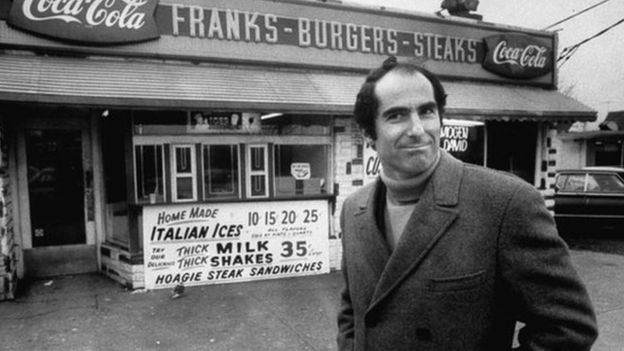
The theme for July in my Facebook Reading Challenge was an American novel. It was a tough choice as I wanted to select something that captured the American ‘story’. I at first thought about The Color Purple, which had been on my shortlist for February (a work by a feminist writer) but I felt it was too similar to June’s choice of I Know Why The Caged Bird Sings, the first volume of Maya Angelou’s autobiography. I also thought about The Bonfire of the Vanities, but decided it was a bit long and my fellow readers on the Challenge would not thank me! So, I finally alighted on Philip Roth’s American Pastoral, which seemed appropriate in terms of both subject matter and timing, since Roth died just a couple of months ago. I’m not sure how other readers on the challenge got on, but I’m afraid I failed to complete it within the month – it’s not overly long at 423 pages, but the writing is so rich that it was almost impossible to read at any pace. I had to (and wanted to!) savour every word. That gives you an idea of my overall feeling about the book – it is tremendous, epic, glorious and tragic. If you want to understand anything about the American experience, especially the immigrant experience over the last hundred years or so and the effect that has had on the mindset of American-born second and third generation immigrants, it is essential reading.

2018-07-23 16.19.23The plot is not complicated: ‘Swede’ Levov is a third generation Jewish immigrant whose grandfather came to America from Europe. He was a glovemaker and set up a business in Newark, New Jersey which became highly successful. Swede’s father continued the business, which peaked in the 1950s and 1960s when glove-wearing for respectable women was the norm and most would have several pairs. (There is more information on gloves in this book than you will ever need to know, but it’s fascinating!) Swede inherited the business from his father, while his more wayward brother became a cardiac surgeon.
Swede Levov pursued the quintessential ‘American dream’ – he excelled in sports at school, served in the military, followed his father into the business, and learned the glove trade, married an Irish-American Catholic former beauty queen, with whom he had a daughter, Merry. From the outside everything seems perfect except for one small flaw – Merry has a stammer, which no amount of expensive medical or therapeutic treatment seems to be able to fix. This is the first indication that Merry perhaps represents some flaw which will undermine the Levovs and all that they represent.

Slight spoiler alert (though not really because you learn of the event quite early in the book): as a teenager Merry becomes obsessed with opposition to the Vietnam war. She becomes increasingly frustrated and rebellious. Her parents lose control and it culminates in her planting a bomb in the general store of Old Rimrock, the solid New Jersey semi-rural idyll in which the family has settled. The bomb kills the local doctor.

Swede’s world begins to fall apart; he cannot accept that his daughter has committed this crime, believing that she must have been put up to it by others, or indeed that others did it and are allowing her to take the blame. For a number of years Swede lives in the hope that he will be able to find his daughter, that the truth will come out and that she will be exonerated, and that their life will return to ‘normal’. For a time, it appears that he might find be able to find Merry, when a woman known as Rita Cohen contacts him saying she knows Merry’s whereabouts. Swede becomes convinced that she is in fact the real bomber because she is cruel and threatening and extorts money from him.

The Rita Cohen thread is all part of Swede’s self-deception, however, and this is the central theme of the book – Swede, his wife and his family, represent the ‘American dream’, which is in fact, just that, a fantasy, a mirage. Merry’s actions put Swede on a path where everything he held dear, which he believed to be real, unravels and is exposed as a sham.

As I have already said, the plot is not complex because it is not a novel so much about events as it is a deep exploration of the American psyche. The structure of the book is quite complex, however, but so brilliantly done that it is not hard to follow. It flits effortlessly between different stages, between different characters and their individual stories and the handling can only be described as masterful. No wonder it won the Pulitzer Prize (1998)! It explores notions of religion in America, particularly the Jewish experience as told through the Levov family, and through the eyes of our first narrator, former schoolmate of Swede’s and now author Nathan ‘Skip’ Zuckerman, the Catholic experience (through Dawn Levov) and the American Protestant experience through the residents of Old Rimrock. The decline of the glove industry and its craft, and also the city of Newark where the Levov family business was based, is a metaphor for the gradual collapse of the concept of the American dream which now seems to lie degraded and in ruins. A further metaphor is the Garden of Eden story, itself Old Testament fiction. The book is written in three parts (Paradise Remembered, The Fall and Paradise Lost) echoing Milton’s epic poem Paradise Lost, because for Swede Levov the experience is truly a destruction of all that he once understood to be real and to be good.

Philip roth
In American Pastoral Roth explodes the idea of the ‘American dream’.

This is the longest review I’ve written in a while and yet I feel I have only scratched the surface in telling you about this book. I have only just completed it so I may write more in a few weeks once it has had a chance to sit with me! Truly, as I savoured the last few pages I was open-mouthed at the unravelling. It is truly an American tragedy (the title is a kind of oxymoron), and it reminded me of Long Day’s Journey Into Night, Who’s Afraid of Virgina Woolf similar examples of the collapse of an American dream happening in slow motion before our very eyes. The final dinner party scene is quite spectacular.

Needless to say I recommend this book highly. It’s not an easy read but it rewards in spades.

If you have read this book I would love to hear your thoughts.

Book review: “I Know Why The Caged Bird Sings” by Maya Angelou

When Maya Angelou died in 2014 at the age of 86, she was one of the towering figures of American culture and politics. Poet, author, civil rights activist, speaker, friend and advisor to figures of national and international importance, her career was, by any standards, glittering. And yet, her start was a decidedly inauspicious one. In the late 1960s she was persuaded to begin writing an autobiography and she went on to publish it in seven volumes, the latest one appearing in 2013, just a year before her death. I Know Why The Caged Bird Sings is the first volume and covers her childhood and coming of age. Her early life in Arkansas featured parental abandonment, overt racism, sexual abuse, discrimination and poverty. It is a sobering tale, and a testament to her immense ability, that someone with that kind of background could become such a great and important figure, well-known not just in the United States, but throughout the world.

I Know Why The Caged Bird Sings imgI chose this book for my 2018 Facebook Reading Challenge. The June theme was an autobiography, a tricky category since enjoyment can often depend on your feelings about the author. I also wanted to avoid titles that would most likely have been ghost-written. After thinking about it for some time, I chose this, the first volume in Angelou’s memoir series, and the one which is often considered to be the best. It can be read as a stand-alone.

I had read it myself many years ago; I have written on here before that at some point in my teens, I resolved to work my way along my local library bookshelves starting at ‘A’! I read the first five volumes (the fifth was published in 1986 when I would have been 18, so I imagine I did not read them all consecutively). I remember I enjoyed the book at the time, and parts of it were familiar, coming back to it so many years later, not least the horrific scene where she is raped by her mother’s lover. This aspect of Maya’s story, like all the other terrible instances of injustice she experienced, is told without self-pity (apart, perhaps from the toothache!) or sentimentality, and this, I think, is the mark of her greatness as a writer.

I loved also, the evocation of the setting – 1930s Arkansas is set out vividly before us, particularly the evangelical Christianity of the black community, the tense relations with their white neighbours on the other side of town, and the poverty of the community, scraping a meagre living in the most challenging of circumstances, from cotton-picking, domestic service or, in the case of Maya’s grandmother “Momma”, from running a small business.

I also loved the language – the Deep South comes across so profoundly in the words and phrases used by the author, such as the wonderful term “powhitetrash” to refer to the prejudiced white townspeople of Stamps who blight the lives of the black community with their bullying, their cruelty and their vulgar behaviour. And I loved the characters, from the young Maya, to her elder brother Bailey, whom she adored, to Momma, the starched Christian woman of steadfast values and brilliant business acumen. The author brings them alive so skilfully that they walk the pages of this book.

I Know Why The Caged Bird Sings is a must-read. I trust that it is on academic reading lists throughout the United States, but it should also form part of the historical context for any student of American history. It is not an easy read and the nature of the language definitely slows the pace (it took me twice as long to read as any other book of this size), but you would do well to read it slowly as the pace draws you into the languid lifestyle of the setting. Someone on the Facebook group listened to the audiobook, narrated by Angelou, herself, which sounds like a must-listen. Coincidentally, the book was also abridged for Radio 4’s book of the week recently, and that should still be available online. It was very good.

Highly recommended, should probably even be on everyone’s books bucket list.

If you have read Maya Angelou’s memoirs what impact did they have on you?

If you have enjoyed this post I would love for you to follow my blog and for us to connect on social media.

The NHS at 70: 9 books with medical themes

There is a great deal of debate and attention on the UK National Health Service at the moment as it celebrates its 70th anniversary this year. If you live in Britain, you can’t move for television, radio and newspaper commentaries at the moment. But the talk is not just about celebration, but about what we want and expect public services to provide in the way of healthcare, and, just as important, how the immense costs of it all should be met. The challenges are mind-boggling: we have an ageing population, advanced medicines come at a high price, the long-term nature of public health investment, not to mention dealing with developed world problems such as obesity, addiction and mental illness. The issues are massive.

The NHS was described by politician Nigel Lawson as “the closest thing the English people have to a religion” and it is indeed dear to the hearts of many. Observe the profile it enjoyed at the opening ceremony to the London 2012 Olympics and the influence the promise of extra cash for the NHS most likely had on the Brexit debate.

I have no intention of starting a political debate here, but if health is on your mind, you might want to dip into some books with a medical theme. Here are some of my suggestions (not all of which I have read, I should add):

  1. Still Alice by Lisa Genova – a moving account of a 50 year-old woman’s development of early onset Alzheimers. Made into a film starring Julianne Moore.
  2. Everything Everything by Nicola Yoon – a YA book about a young woman suffering from a rare condition which means her immune system is dangerously impaired.
  3. The Diving Bell and the Butterfly by Jean-Dominique Bauby – a harrowing true story where the author developed locked-in syndrome after a car accident. He was initially thought to be in a coma, but was in fact fully conscious. He was eventually able to communicate through blinking, and wrote this book using only this tool. Incredible and reminds you of the fragility of life.
  4. The Fault in Our Stars by John Green – another YA novel, both my daughters love this book, about teenage terminal illness. Also made into a tear-jerker of a film.
  5. This Is Going to Hurt by Adam Kay – award-winning non-fiction writing from a junior doctor telling it like it is on the NHS front-line.
  6. Call the Midwife by Jennifer Worth – love the TV show, currently reading the follow-up Farewell to the East End, Worth was a young midwife in East London in the 1950s so for a taste of the early days of the NHS look no further.
  7. Eleanor Oliphant is Completely Fine by Gail Honeyman – a young Scottish woman’s mental illness, compounded by loneliness, detachment and the harshness of modern life.
  8. The Curious Incident of the Dog in the Night-time by Mark Haddon – challenging life events, seen through the eyes of a young man with Asperger’s Syndrome. A must-read.
  9. Two Girls, Fat and Thin by Mary Gaitskill – I have recommended this book so many times. It’s an intense novel about eating disorders, mental health and sexuality.


If you have suggestions for any other books with a medical theme that you have enjoyed, I would love to hear them.

If you have enjoyed this post, do follow my blog or connect with me on social media.


Book review: “Sight” by Jessie Greengrass

Sight is the debut novel from British author Jessie Greengrass and was shortlisted for the Women’s Prize for Fiction, which was won recently by Kamila Shamsie. This was the first novel I have read from this year’s Women’s Prize shortlist, and the one which appealed most strongly to my fellow book club members and I. We love the Women’s Prize and always try to get through a couple on the shortlist. We are all mothers, spend way too much time talking about our kids and so the blurb, about one woman’s journey to parenthood, spoke directly to us.

It is a very curious book. I had to keep reminding myself that it’s a novel as we become so deeply embedded in the internal world of the unnamed first person narrator that it feels as if it is an autobiography.

Sight img
Strange book, stranger cover!

We know very little of the narrator, except that she is a young woman of indeterminate age, though probably in her early thirties. Her partner is Johannes, whom she meets shortly after the death of her mother. The book begins with her account of her mother’s decline and death and the time she spent caring for her. It is clearly a traumatic time for her and she struggles with all the challenges it represents – emotional, physical and administrative. It is an account of what it is like to be a daughter and an only child and to lose your only parent, your only link with your birth, with your early life and with that part of your life of which you have no memory.


She seems to drift into the relationship with Johannes at a time when she is emotionally vulnerable. He seems to offer her stability and comfort. The issue of having a child is clearly something that looms large in their relationship and eventually she agrees, but she remains unsure about the wisdom of this step.

This is not a story. It is an internal monologue, an account of one woman’s ambivalence about having a child. In fact she seems very ambivalent about all her close relationships – with her mother, with Johannes and with the only other significant character in the book, her late grandmother, a psychotherapist who lived alone and practised in a large house in Hampstead, and with whom she spent a few weeks each summer as a child. I suppose this ambivalence is present because we are getting the narrator’s unfettered, unmediated thoughts, but I found it confusing to marry this with any notion of love. For me, love was missing from the book. I understand well that for many women, it is not easy to bond with the foetus they carry, even the baby they give birth to. I can also accept relationships with a parent can be fraught and complex, even where there is familial love on both sides. Our narrator is deeply moved by the suffering of her mother in the final stages of her life; the actions she takes, the things she tells us about, sleeping beside her in the hospice, reading to her, suggest deep love, but she does not seem to me to express it. And when she writes about her grief and her loss, it is more a loss of a role, or a relation, rather than a person. There is something very cold about her feelings, which are captured in the following quote:

“Then I was faced with the problem of what to do with all my mother’s things. I felt that I was expected, somehow, to keep them, to make myself curator, but the thought of storing this detritus of an ended lifetime, of dragging it behind me like a deadened limb, turning myself into little more than a conduit for memory, was horrifying; and so in the end I gave away what I could to anyone who wanted it and hired a skip for the weekend to deal with the rest.”

What I found most difficult was that there seemed to be little real love in her relationship with Johannes. This was the man she chose to be the father of her child and although she finds great comfort in their easy companionship, their shared interests and the great care he shows for her, there is also at times a kind of contempt.

Perhaps my reading of it is too simplistic or too literal – perhaps if my internal thoughts were this closely mapped they would also reveal ambivalences in my feelings for the people I love most in the world. Our thoughts are closed to everyone but ourselves, and even to ourselves sometimes.

This is not a linear narrative – it jumps back and forth from her childhood, to the present, the antenatal appointments, to her mother’s death. In that sense it bears similarities to a ‘stream of consciousness’ style. Woven through it are accounts of three scientific figures – Rontgen and his discovery of the X-ray, Sigmund Freud and his psychoanalytic relationship with his daughter Anna, and John Hunter and the development of early surgery in the 18th century.

What I liked about this book was the remarkable writing, the intensity of the observation, particularly of her relationship with her own young daughter:

“When my daughter throws her arms with thoughtless grace around my neck, I respond with an agonising gratitude that I must hide from her in case, feeling the heft of it, she might become encumbered and not do that she was born for, which is to go away from me.”

There is profound insight in this book, not necessarily to the human condition – there was much here that I could not empathise with – but I mean in terms of the self-awareness. The deep introspection has given her a powerful knowledge of her own nature, of the events that have shaped her existence and of the impact of her relationships upon her.

This is a long review for a book in which very little happens! It was not an easy read and it sometimes frustrated me. It’s an extraordinary achievement for a first novel and offers a fresh approach to much-explored themes, even if at times it feels rather dislocated.

Recommended if you prefer psychology to plot.

If you have read Sight, what did you make of it, and how does it compare to the other novels on the Women’s Prize shortlist?

If you have enjoyed this post, I would love for you to follow my blog and for us to connect on social media.

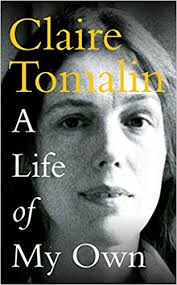
Audiobook review: “A Life of My Own” by Claire Tomalin

I first became aware of Claire Tomalin a few years ago when her biography of Samuel Pepys (Samuel Pepys: the unequalled self) won the Whitbread Book Award (predecessor to the Costa Book Award) in 2002. I remember the story was quite newsworthy because her husband, the novelist and playwright Michael Frayn, was also shortlisted the same year for his novel Spies. He won the prize for the novel. She won the biography prize plus the overall best book. Tomalin has written a number of well-received biographies, including of Jane Austen, Mary Wollstonecraft and Thomas Hardy. Her most recent was Charles Dickens: A Life, published in 2011.

A life of my own imgBrowsing in the bookshop last year, I noticed that she had published her own autobiography, at the age of 83 – I note with some pleasure that her 84th birthday is in fact today! Many happy returns! Reading the blurb whetted my appetite – I was not aware of her life as a groundbreaking Literary Editor at the Sunday Times, or that she had five children, including one boy who died as a baby, and another son who was born with severe disabilities, nor that her first husband, fellow journalist Nicholas Tomalin, was killed in 1973, when her children were still very young. It sounded like a very interesting read.

Anticipating some long drives, I got hold of the audiobook (the reserve list at the library was long and I knew it would be many weeks before I got it), and the fact that it was narrated by Dame Penelope Wilton was a bonus.

At first, I’m afraid to say, I did not enjoy it; I found it quite irritating. Claire was born in 1933. Her father was French and her mother from Liverpool, a talented composer. Her early life was troubled, not least because her parents divorced when she was still quite young. However, she still secured a very good education, first at Hitchin Girls Grammar School and then at the progressive Dartington boarding school in Devon, before going to Cambridge. Through her parents she came into contact with very many high-profile artists, writers and musicians, so though there may have been a shortage of material wealth (though I can only imagine this is relative) there was no shortage of cultural wealth. And I’m afraid this is what I found irritating. I don’t think the author wants us to feel sorry for her, but I found myself with the sense that she really had no idea what the lives of her working class contemporaries, many of whom would have no less ability,  were like compared to her own.

The book became less irritating. Once she had graduated, I found the young adult Claire more interesting, although there was still way too much name-dropping for my liking. I think I expect biographies, and in particular autobiographies, to provide insight, reflection and self-awareness; I have, for example, enjoyed Patti Smith’s Just Kids and Anjelica Huston’s A Story Lately Told: Coming of Age in Ireland very much. However, for me this just did not happen with Claire Tomalin until the final quarter or so of the book. As we learn about the death of her husband Nick (he was hit by a shell whilst reporting on the Yom Kippur War in 1973) and how she had to cope with life as a widowed mother of four children, I found I became more sympathetic. She also faced challenges that most will never have to, thankfully, in relation to her children and these parts were both incredibly touching and immensely readable. She lived in a house in Gloucester Crescent, north London, and mentions neighbour Nina Stibbe, whose tales of nannying to the editor of the London Review of Books in the 1980s are recorded in another book I’ve reviewed here, Love, Nina. It was quite a bohemian lifestyle and engaging to read about.

There is much to enjoy in this book, and the last few chapters are poignant, but overall, I was disappointed. Although it was not smug or self-congratulatory, there were certainly parts which lacked a sense of the privileged life the author had led and that for me was a flaw. You will recognize many of the names mentioned, the anecdotes about Andrew Neil and Rupert Murdoch and the industrial disputes that beset The Times provide a fascinating perspective, and here is a life that has been long-lived, so it spans a vast range of time. For me, though, the book was little too much chronological account and not quite enough personal insight.

Recommended if you’re an admirer of the author or have an interest in the mid-20th century cultural life of London.

Which biographies or autobiographies have you enjoyed recently?

If you have enjoyed this post, do subscribe to my blog and connect with me on social media.

Book review: “The Birth of Venus” by Sarah Dunant

I first knew Sarah Dunant as a broadcaster on late-night arts shows in the late 1990s. It’s funny how you remember some people – she always had very distinctive glasses. I was conscious that she seemed to disappear off the scene and for a while there I got her mixed up with Sarah Waters…until I saw Sarah W speak at the Manchester Literature Festival a few years ago and realised they were not the same! But Sarah D had in fact reinvented herself as an author, as I was to discover a year or so ago when I saw her speak at a writer’s conference. (I should add that 2000-2012 were lean reading years for me – I was knee-deep in children and totally out of the literary loop).

I’ve read a few historical novels, notably Deborah Moggach and Tracy Chevalier, and loved them, though it’s not a genre I often choose. I decided on this as a theme for my Facebook Reading Challenge 2018, and when I saw The Birth of Venus in my local Oxfam bookshop it seemed an obvious choice. It’s wonderful, I loved it, and it seems to have gone down pretty well with the other participants on the Reading Challenge.

The Birth of Venus imgThe novel is set in Renaissance Florence; the sense of time and place is profound. You can almost smell the streets wafting from the pages! Dunant is a meticulous researcher and the novel feels very authentic. The central character is Alessandra, the fifteen year-old daughter of a wealthy cloth merchant. Much to the frustration of her family Alessandra is a precociously intelligent young woman, a talented artist, a strong personality and has a deep desire to be out in the world. These are all traits which are highly inconvenient for the family and not compatible with the kind of life she will be expected to lead.

As a mark of their wealth, Alessandro’s parents commission a Flemish artist to paint the chapel in their home, incorporating the family’s portraits. Though she has very limited opportunity to communicate with him, his presence produces a stirring effect in Alessandra. She is attracted both by his artistic ability and his mysterious nocturnal wanderings into the city.

Alessandra is destined to be married off as soon as she starts menstruating and the husband selected for her is an older man, a long-standing family acquaintance. At first it seems the marriage will set Alessandra on the same path that her mother and sister before her have followed – moving from one zone of subjugation to another and endless child-bearing. In fact, Alessandra’s husband, Cristoforo, is the lover of her brother Tomaso and the marriage is merely one of convenience to provide him with the cover of a wife and child. At first, Alessandra is distraught and feels betrayed, but it soon becomes apparent that this frees her more than she could ever have imagined, to pursue some of her own dreams, to be more sexually liberated, and to be mistress of her own time and activity. In the background to the domestic tumult is the political upheaval in the city; first, the invasion of the French, then the rule of Savonarola, a fierce reactionary monk who preaches a severe brand of Christianity. The old certainties of corruption, sleaze and vice in the Church and politics are being brutally flushed out in favour of a strict religious fervour, and a new atmosphere of fear, surveillance, severe torture and punishment for misdemeanours has replaced it.

I will say no more as it’s a cracking story and events unfold dramatically. The plot is so well thought-through and maintains momentum right to the end. The characters are well-rounded and believable, not just Alessandra, but her mother and husband, her brother and sister, the painter and her loyal maid, African slave Erila.

The book is ambitious in scope, in its portrayal of the period and the way it weaves the political upheavals and realities of the era into what is essentially one young woman’s story of coming of age, of emotional and sexual maturing and of finding fulfilment in the most constrained of circumstances.

Highly recommended, great for any holidays you might have coming up and I’ll certainly be looking out for more Sarah Dunant for future reads.

Do you enjoy historical fiction? What are your recommendations?

If you have enjoyed this post, please subscribe to my blog by clicking the ‘Follow’ button. You can also follow me on social media.

What are your favourite films of kids’ books?

I am currently compiling a list of books that every child’s bookshelf should contain (look out for a future post). There are a lot of kids out there who love to read and the only problem their parents have is keeping up with consumption. But for many of us, keeping our kids reading in the face of so many other assaults on their time is like waging a war on multiple fronts and it’s not always easy to keep them interested in books once they get past 11 or 12 years old.

If you recognise this, then a film adaptation can be a good way of sustaining their interest, supplementing the act of reading with some visual stimulation and sharing the engagement with them (some kids just need more social interaction and books generally mean being on your own). So here are my top picks. They may not be the best film adaptations (such a list would be incomplete without The Wizard of Oz, in my view, but the L Frank Baum book on which it is based would not top most people’s reading lists), rather it is a list where I think both the film and the book complement each other and which may help kids with or lead them to the book. The order is in roughly increasing age appropriateness (my opinion).

  1. Charlie and the Chocolate Factory  by Roald Dahl – I could probably populate a whole list with Roald Dahl adaptations, but the two films that have been made of this book are both superb and very different, which just goes to show how differently books can be interpreted. Personally, I prefer the 1971 version Willy Wonka and the Chocolate Factory starring Gene Wilder, but the 2005 version with Johnny Depp is also excellent.
  2.  Matilda by Roald Dahl – the 1996 film stars Danny DeVito and his wife Rhea Perlman as Matilda’s appalling parents.
  3. Alice’s Adventures in Wonderland by Lewis Carroll – there have been many film and television adaptations of this and its follow-up Alice Through the Looking Glass.  I love the 2010 version by Tim Burton which stars Anne Hathaway, Helena Bonham Carter and Johnny Depp.
  4. The Chronicles of Narnia by CS Lewis – again, there have been many adaptations of the five books in the series. I love the big 2005 production which stars Tilda Swinton as the White Witch and Liam Neeson as the voice of Aslan.
  5. How to Train Your Dragon by Cressida Cowell – the three films (2010-17) may be rather more well-known than the books, but if your kids liked the films try and get them into the books.
  6. The Sheep-Pig by Dick King-Smith – you can’t not love the 1995 film Babe based on this book.
  7. Madame Doubtfire by Anne Fine – Robin Williams is on classic form in the 1994 film version Mrs Doubtfire.
  8. The Spiderwick Chronicles by Tony DeTerlizzi and Holly Black – my son loved the movie and then went on to read all the books.
  9. Little Women by Louisa May Alcott – a classic book, and the 1933 film version with Katharine Hepburn is a classic also. There is also a 1994 film with Susan Sarandon, Winona Ryder and Kirsten Dunst, among other big names.
  10. Northern Lights by Philip Pullman – The Golden Compass (2007) is based on the first book in the His Dark Materials trilogy and stars Nicole Kidman, Daniel Craig and Ian McKellen among others.
  11. Coraline by Neil Gaiman – I haven’t read the book, but I love the 2009 movie. Gaiman will appeal to a certain kind of child who likes dark fantasy.
  12. A Series of Unfortunate Events by Lemony Snickett – I love the 2004 film starring Jim Carrey.
  13. The Book Thief by Markus Zusak – a challenging book and a challenging film, released in 2013, but well worth the effort. Recommended for 11-13 year olds. Younger kids will need you to watch this with them.
  14. The Fault in our Stars by John Green – my daughters, aged, 12 and 14, love John Green. They love the high emotion! The film is pretty good, but a weepie, so tissues at the ready.
  15. Holes by Louis Sachar – a superb book. The film is rather more comic than the book, in my view, but a good one for teenage boys I would suggest.
  16. Watership Down by Richard Adams – another classic weepie the 1978 film was voiced by a big-name cast and who could forget the score and theme song, Bright Eyes by Art Garfunkel. Written in 1972, teenagers will recognise the issue of environmental destruction.

Have you spotted the glaring omission? Yes, the Harry Potter series. Left out simply because it needs no introduction. Most kids, it seems to me, have read or watched all of them, or both.

Are there any that you would add to this list? I would love to hear of your favourites.

If you have enjoyed this post, please subscribe to my blog by clicking on the ‘Follow’ button. You can also follow me on social media.

Women’s Prize for Fiction 2018 – shortlist announced

The shortlist for the Women’s Prize for Fiction, formerly the Bailey’s Prize, was announced last week. This prize is one of the foremost competitions for women writers and it’s one of those where every year the shortlist list looks like a box of precious jewels (unlike the Man Booker which always manages a curve ball or two, in my view!) There is NOTHING on the list this year that I don’t want to read at some point! So many books, so little time, especially as I’m giving over more of my reading time to children’s literature these days.

If you’re looking for something to read yourself, I have heard great things about all of these books, and I suspect you won’t go wrong if you pick any one of them.

This slideshow requires JavaScript.

The novels on the shortlist are:

Sight by Jessie Greengrass – a woman recounts her journey to motherhood and reflects on the relationships she had with her mother and grandmother.

Home Fire by Kamila Shamsie – Isma is studying in America, having spent years raising her two younger siblings following their mother’s death. The family becomes embroiled in London with Eamonn, the son of a high-profile Muslim politician. It’s a novel about destiny, choices and love.

Sing, Unburied, Sing by Jesmyn Ward – a story about race, drug abuse, broken masculinity and poverty in the US seen through the eyes of thirteen year old Jojo and his mother Leonie.

The Idiot by Elif Batuman – a story about language and culture set in Harvard, Massachusetts, where Selin, a Turkish-American, is studying and meets others like her, of mixed race and mixed cultures.

The Mermaid and Mrs Hancock by Imogen Hermes Gowar – a story about the power and mythology of mermaids. set in 18th century London, where the merchant Jonah Hancock learns one of his captains has sold a ship in exchange for a mermaid. News spreads and Hancock finds himself the centre of London society.

When I Hit You: Or, A Portrait of the Writer as a Young Wife by Meena Kandasamy – a novel about domestic abuse and control, and the crushing of a young woman’s hopes and ambitions by a domineering husband.

I haven’t read any of these and doubt I will manage to get through this list by the time the winner is announced on 6 June. The first and the last on this list appeal to me most, although Sing, Unburied, Sing also looks like a must-read.

I’d love to hear from you if you have read any of these – what do you recommend?

If you have enjoyed this post, do subscribe to the blog, by clicking on the Follow button, and let’s connect on social media. 

Book Review: “Madame Bovary” by Gustave Flaubert

My Facebook Reading Challenge 2018 is well underway and March’s theme was a classic. I chose Madame Bovary, Gustave Flaubert’s 1857 classic, because it seemed to fit well with a lot of the women’s issues around and being discussed at the moment, particularly gender equality and sexual exploitation. It is fair to say that it had a mixed reception among the readers on the Facebook group!

2018-02-22 14.12.54I had read this book previously, but many years ago as an undergraduate, so whilst I had remembered the basic story, I had forgotten much of the detail. I had forgotten for example just how brilliant the writing is and how very like Jane Austen Flaubert can be in his use of irony. By all accounts, Flaubert was a perfectionist and spent years on this book; it is certainly masterful and for me the writing was sublime. I had also forgotten how unlikeable all the characters are! Even Emma, our supposed “heroine”, is at times unpleasant, childish, selfish, superficial and self-obsessed. When I discussed it with my husband (who speaks fluent French and read it in the original) he was surprised that I did not find Charles Bovary, Emma’s husband, sympathetic. Interesting that he felt affection for the long-suffering, betrayed husband who loved his wife to the death, despite her many faults, whereas I found him ineffectual and basically unable to connect with his wife on any level, and that was part of the problem in their marriage.

I don’t think even Flaubert liked his characters and I think it was the intention of the author that we stand with him and examine the people he puts before us, with all their flaws. I believe he wants us also to dig a little deeper and examine the French provincial society that gave rise to Emma. As a young woman she lives a dull and uninteresting life with her widowed father on a farm, until the day she marries Charles, a physician in a neighbouring town, and goes to live a dull and uninteresting life with him. Passed from one man’s home to the next. Emma would not have had expectations, but she was an intelligent woman and the kind of life she was forced to lead did not fulfil her deeper needs. She is a woman of deep passions, but there is no outlet for them, apart from the romantic novels she devours. Certainly, Charles does not really do it for her! “Charles’s conversation was as flat as any pavement.”

Flaubert hints that Emma’s lack of fulfilment may be dangerous when he observes, after she and Charles were invited to an aristocratic ball, where she glimpses how the other half live and begins to fantasise:

“This life of hers was as cold as an attic that looks north; and boredom, quiet as the spider, was spinning its web in the shadowy places of her heart.”

What a sentence! Emma is naïve and inexperienced, however. Her life has been limited and she sees events in the most superficial of ways:

“She confused in her desire, sensual luxury with true joy, elegance of manners with delicacy of sentiment.”

Flaubert doesn’t expect us to like Emma very much, but I think he wants us to see her as a product of a time and a place, not as wilful and malicious.

Seduced by romantic fantasy, Emma takes lovers, both of whom are equally selfish and unpleasant. Whilst she is clearly a willing participant in her adultery, there is no doubt that both Leon and Rodolphe exploit Emma. When Emma’s reckless behaviour leads her to run up unsustainable debts, the town’s notary, from whom she has been borrowing money, also exploits her. When he requests sexual favours in return for his continued discretion we can see how deeply lost Emma’s situation is and how as a woman she has almost no power or autonomy. Her response to him, is when we begin to see for the first time something more admirable in her spirit:

“You are taking insolent advantage of my distress, monsieur. I may be in a pitiful state, but I am not up for sale!”

Parts of the book are heavy going, but it is in Part Three that we see the tragic coming-together of events, the closing-in on Emma of all the consequences of her misguided actions, her falsehoods, and the tremendous dislike she accrued. She is not a nice woman – she betrayed her husband, who did not understand her, but loved her in his own way, rejected her daughter and treated those about her with contempt. She was the architect of her own downfall, but she was also a victim of heartless men, of social norms and conventions that failed women like her and gave them no outlet.

She is a difficult heroine for us, but one who makes us think, for sure. Recommended because it’s just one of those books you have to read!

Do you find it hard to connect with the classics? What is your favourite?

If you have enjoyed this post, do subscribe to my blog by clicking on the ‘Follow’ button, and let’s connect on social media.