Science fiction has never really been my thing but, ever keen to push my reading boundaries, I included it as a theme for my Facebook Reading Challenge in October. It’s a genre I know little about, so picking an author or title might have been tricky, but I had in fact known for some time who I would select, having become aware of Le Guin after she died in January last year at the age of 88. The obituaries talked about how she had for years been under-rated, the inference being that as a woman she was overlooked in this male-dominated genre, but that she had a devoted critical following and has been cited as an influence by the likes of Margaret Atwood, Salman Rushdie, Neil Gaiman and Iain Banks.
She was prolific, producing nineteen novels, as well as short story collections, poetry and non-fiction during a writing career that spanned six decades. (I note that her first full-length novel was published when she was 37, which gives me some hope!) Many of her novels form part of her Earthsea series, so I chose The Lathe of Heaven as it is a stand-alone novel.
 The Lathe of Heaven was written in 1971, but was set in ‘the future’ – Portland Oregon in 2002. This future world is one in which the global population is out of control, climate change has wrought irreparable damage and war in the Middle East threatens geopolitical stability. The most alarming (and engaging) thing about the book, for me, was how prophetic it was; in 1971 did readers think this was some dystopian world? Worryingly, many of the problems envisaged by Le Guin are recognisable features of our environment in 2019.
The main character is George Orr who has an unusual affliction – he is able to change reality through his dreams. It is a difficult concept to get hold of, but when he dreams a new situation, all history is also altered to facilitate the revised present and no-one but he is able to recall how it was before. For example, in 1998, a nuclear war virtually destroyed life on earth, but George ‘dreamed it back’ and in the new iteration the nuclear war never happened.
George is disturbed by these dreams and turns to prescription drug abuse to stop himself from entering deep sleep when these ‘effective dreams’ happen. He has to break the law to get sufficient supplies, however, and when he is caught he is forced to see a psychiatrist, Dr William Haber, to help him wean off the drugs. When George explains his problems to Haber, the ambitious but under-achieving doctor quickly sees the potential for using hypnosis to ‘suggest’ dreams to George which will organise the world the way Haber wants it. Haber’s intentions are not entirely malign; he wants world peace and widespread good health, for example, though he is careful also to ensure he benefits financially and in terms of academic status as a side-consequence. The problem is, Haber’s suggestions are not always interpreted by George’s brain in the way Haber intended. So, when Haber suggests a dream for the elimination of racism, the result is not, as Haber thought, that people become universally open-minded and accepting, rather everyone’s skin colour changes to grey, ie there is no longer any visible indicator of race.
Events become ever more bizarre and George, desperate and realising that Haber is using him for his own ends, which George is worried will have devastating consequences, ultimately, turns to a lawyer to try and get out of the therapy and stop Haber. The lawyer, Heather, becomes George’s ally and partner and he ultimately falls in love with her. But as realities keep changing, she is at times, farther and farther away from him.
It is a fascinating story and I enjoyed the philosophical journey, the question of the extent to which we are in control of our destiny, as well as the very relevant themes of global warming and the locus of power in society. I won’t give away any spoilers, but the ending lost me a little – at that point it felt more ‘of its time’, though I can also see where Le Guin was coming from. Don’t forget this was published not long after the moon landing so the concept of outer space, whether there was anyone else out there, were, I imagine seen somewhat differently than they are today.
Recommended, if you’d like to try something a little different.
If you are a fan of science fiction, what other authors would you recommend?
If you have enjoyed this post, I would love for you to follow my blog. Let’s also connect on social media.
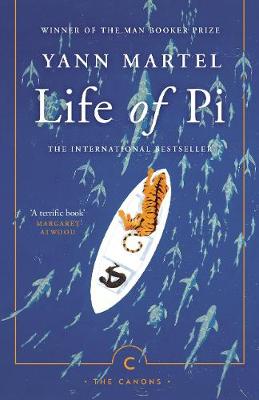 The story is well-known: a young Indian boy, Piscine “Pi” Patel (a name he adopts to get back at the school bullies who taunt him with the nickname ‘Pissing’) grows up in the territory of Pondicherry where his parents own a zoo. The first part of the story gives us a detailed account of the family’s life there, including enormous detail about life for the animals in a zoo setting (I was fascinated by this and it changed my perspective on zoos). We learn in particular about the fierce Bengal tiger, Richard Parker, who is the zoo’s prized possession. I love the use of ‘naming’ in this book – the story of how Richard Parker came to be given this name is brilliant and a sign of the author’s ingenuity and creativity. The other important feature of this part of the novel is that we learn of Pi’s deeply philosophical nature, his decision to adopt three religions (Hinduism, in which he has been brought up, Islam and Christianity), much to his family’s dismay, because he can see benefits in all of them.

 So now it is time top get back on track and announce the book for November. Our theme is a children’s book; we are winding down towards the end of the year, but I am not going to make it too easy, because this book is a challenging one – John Boyne’s The Boy in the Striped Pyjamas. I have been meaning to read this ever since it was published to great acclaim in 2006. My elder daughter read it recently and has been nagging me to follow suit. She found it very moving so I am looking forward to it.
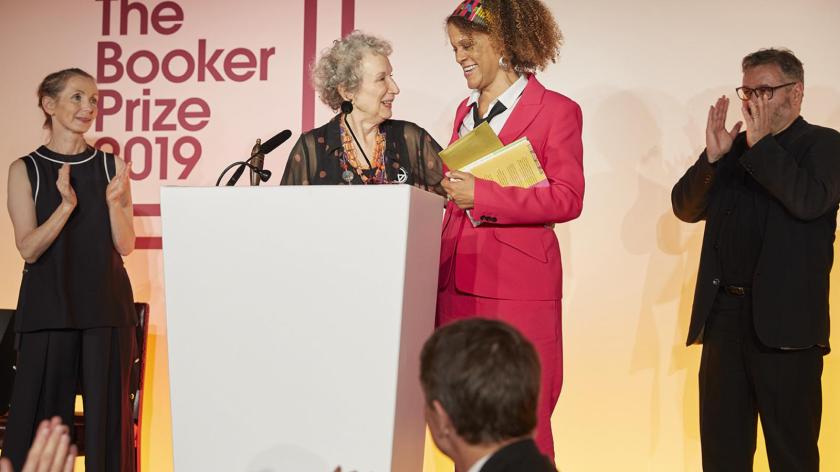 The Booker prize winner(s) were announced last week and for the first time in years, and against the explicit rules of the contest, the judges awarded the prize jointly to Margaret Atwood and Bernardine Evaristo. I have not read either book yet, though I am currently listening to The Testaments on the excellent BBC Sounds and enjoying it enormously, though it is extremely dark. There has been so much publicity around Atwood and The Testaments that I was wondering how on earth the Booker prize judges were going to be able to not award it to her! So, I think the judges probably made the right decision. By now, I would probably have worked my way through at least two thirds of the shortlist (I’ve never managed all six in the period between shortlist and winner), but, for obvious reasons, I have not read that much so far this year.
 It is somewhat and sadly ironic that I was reading Elif Shafak’s 10 Minutes 38 Seconds in This Strange World at the time of my mother’s death, a novel about a woman, Leila, an Istanbul prostitute known as Tequila Leila, who is brutally murdered in a back alley by street thugs. Rather than death being an instant occurrence, however, the author explores the idea of it as a transition from the world of the living to the ‘other’ (with a duration, for Leila, of ten minutes and thirty-eight seconds) during which time her whole life flashes before her. Leila’s life story is told through a series of recollections about her five closest friends, how and when she met them and what impact they have had on her life. We learn that Leila came from a relatively affluent family. Her father was anxious for heirs, but when his wife proved incapable of having any he took a second wife, Binnaz, a much younger woman from a lowly family, who gave birth to Leila. Binnaz was forced to give up the child to the first wife to bring up as if she were her own, whilst Binnaz, who never recovered mentally from the trauma of that event, was thereafter known to Leila as ‘Auntie’.
 The book concerns two women, Rosemary, an 86 year-old widow, and Kate, a 26 year-old journalist, and how they are brought together by chance when the Brixton lido is threatened with closure. Their relationship evolves as together they mount a campaign to keep the pool open, drawing in other local people and reviving a community spirit that everyone involved thought had been lost. In some ways the two women could not be more different: Rosemary is nearing the end of her life, now alone having lost her beloved husband, and has lived in this area of South London all her life. Kate, on the other hand, is young and bright, and has moved to the city from Bristol to begin her journalistic career on the local paper. Kate too, though, is lonely; unlike Rosemary she has not lost anyone, but she has not found anyone either, and she grapples with panic attacks, anxiety and low self-esteem. She shares a house with a number of similarly isolated flatmates, none of whom she knows, and stays alive thanks to ready meals.
 It seems appropriate that I should be posting a review of Normal People this week, a book so very much about Ireland, the challenges and contradictions at the heart of a nation that has transformed itself in recent years. It is not just about Ireland, but about what it means to be young in Ireland and about class. It is also about identity and, in common with some of the issues faced in the UK and many other societies I am sure, the draw away from regional towns and cities, towards a centre, a capital, where there is perceived to be more opportunity, and what that means both for the individual and for society in the wider sense.
 The centre of the story is the relationship between two women, Bel and Lydia, who meet at a New Year’s party in 1985, when they are both sixth-formers although at different schools in Yorkshire. They are very different people – Lydia is reserved, generally quite sensible, and from a secure and ordinary family. Bel is wilder, her family rather more bohemian and she has a difficult relationship with her parents. Bel grew up in France and then London and it is her father’s job that has brought them to northern England, where she is something of an outsider. Bel and Lydia are drawn to one another, despite their very different personalities; for Lydia, Bel represents spontenaiety, excitement, danger even. For Bel, Lydia represents security, a steady point in a turning world.
 This book has been on my to-read list for some time now, ever since it caught my eye over a year ago when it was published. I recommended it as a
  The story begins when 15 year-old Michael, off school for many months after contracting hepatitis, seeks out Hanna Schmitz, a woman who had been passing when he found himself being sick in the street and who had helped him. Once he is well again, Michael’s mother sends him off to find the mystery good Samaritan in order that he can thank her. Hanna is twenty years Michael’s senior and employed as a bus conductor, but despite the social and age gap between them, they begin a passionate affair, both parties equally consenting. One of the more intimate aspects of their relationship is that Michael reads aloud to Hanna, after sex and in the bath mainly, although never the other way around. Michael never questions Hanna’s desire to have him read to her, he just accepts it. This makes up the first part of the book and perhaps it is a testament to events that have occurred since the time of its writing that all of us (mothers of teenagers!) found the prose rather discomfiting, and not a little implausible. Hanna disappears mysteriously out of Michael’s life, leaving him heartbroken and perhaps also rather damaged.
 This book is Angie Thomas’s debut novel and it caused a sensation when it was first published in the United States in February 2017. It enjoyed both critical and popular acclaim, remaining at the top of the New York Times YA best seller list for almost a year. It was made into a film which was released last Autumn. The novel came out of a short story Thomas wrote in college following the police shooting of a young black man in 2009.
 Julia's books