
Regular followers of this blog will know that I have recently been reviewing each of the Man Booker shortlisted books. It’s a month since the winner, Anna Burns’s Milkman, was announced, and I still haven’t finished all six books – I don’t know how on earth I thought I’d get them all read before the gala dinner! I’ve found them all pretty heavy going, to be honest, which is perhaps why it has taken me so long. And, I have to say, it’s been a bit bleak too!
 So much so that I had to have a break from all the heaviness to read something a little more uplifting and which didn’t tax my brain quite so much. I wasn’t very well last week and simply couldn’t face into The Mars Room (next on my Man Booker list) – if you have heard it is bleak, well it is! So far (not quite finished it yet). So, with my blanket, hot water bottle and cups of tea to hand I settled onto the sofa and read Rachel Joyce’s The Music Shop cover to cover in one day. I simply could not put it down.
 This book came to my attention last year. I really liked the sound of it and recommended it in one of my ‘what to look our for this season’ blogs, so it was on my TBR list. Then I saw Rachel speak at a Writers & Artists Conference I was at in September. She was such a wonderful speaker, really warm, authentic and engaging, that I had to get a copy of this book and have been eager to start it. It was a joy and just what I needed, when I was feeling unwell and when my brain was starting to hurt from the Man Booker. Look out for my review of The Music Shop next week.
The Mars Room is quite good, but, for me, just unremittingly bleak. Yes, good fiction should challenge us, but sometimes you just need something that makes you feel up rather than down. I’ve found it quite a dark shortlist this year and I haven’t even started The Overstory yet which, since it is meant to be about climate change, I am fully expecting to be a sobering if not depressing read. Maybe that reflects the times we find ourselves in. It’s not just the subject matter though; some of the books, though I have admired them, have, at times, felt like wading through treacle. I felt like that about Everything Under, and I’m rather getting that feeling about The Mars Room. It is only the colourful prose style, with its American prison vernacular, that is keeping my attention at the moment, because it has little story to speak of, it seems to me.
The Music Shop on the other hand, was all story, all character, all cliffhanger, all page-turner. This high-brow literature, which, don’t get me wrong, I dearly love and support, is all very well, but sometimes you just need a jolly good read. Especially when your sinuses are blocked and your head hurts!
So it’s more Rachel Joyce on the TBR list for me, and a second wind to finish The Mars Room and complete that shortlist.
Happy reading everyone!
Are you drawn to literature that is dark or do you feel reading should always be about pleasure?
If you have enjoyed this post, I would love for you to follow my blog. Let’s also connect on social media.
 My youngest daughter, a keen singer, started getting into the show a year or so ago. She has been listening to and singing along to the soundtrack almost continuously ever since. When it was her birthday earlier this year I decided to get her tickets. I was astonished to discover how difficult these were to obtain (and how expensive!), so she has been waiting patiently for almost six months to enjoy her birthday gift. Last week, during half term, we travelled to London to see the show. It was worth the wait and she promptly declared that it was the best experience of her life. For me, seeing her enjoying something so much and how she has engaged so wholeheartedly with the story, the music and the ethos of the production, has the been the greatest pleasure.
 Washington Black’s life is turned around, however, when Erasmus’s younger brother, Christopher, or ‘Titch’, arrives at the plantation. He is an inventor, a man of science like his father, who does not share his brother’s views on slavery. Titch has come to Barbados in order to work on a flying machine he has designed and asks his brother for a helper. Erasmus loans him Washington Black and the boy goes to live in Titch’s quarters, helping him with drawings and experiments as well as practical household tasks. Titch discovers that Washington has considerable artistic talent as well as abilities which will be useful in his science projects and he teaches him to read. This change in Wash’s circumstances means he can probably never go back to being with the other slaves and the question is posed whether Titch has served his protégé well.
 Gretel is a 32 year old woman living alone in Oxford. She works as a lexicographer, a natural career for her as her life has been dominated by words – their invention, their use, and, perhaps also, their lack. She had an unconventional upbringing with an eccentric mother on a canal boat. In her early years, Gretel and her mother developed their own language, a succession of private words for things for which a single expressive term did not exist, for example “sheesh time” refers to a desire to spend time alone, and “Bonak” will come to mean something to be afraid of, something threatening.
 The central character is Walker, a man from rural Nova Scotia, who fought with the Allied forces in the D-Day landings. He has seen and experienced terrible events, death and injury that most of us can barely even imagine, and he survived. After the end of the war, he goes back to the United States and finds himself living among the homeless in New York City. The book is divided into four sections: 1946, 1948, 1951 and 1953 each set in a different US city (though Los Angeles is the setting for both 1948 and 1953). As he reflects on his experiences, it becomes clear that it was impossible for him to return home to Canada. He reminisces about the quiet, gentle life he led there, where the rhythms of the seasons, the dependence on the harvests of the seas, and community events (such as village hall dances) dominate everyone’s existence. It’s as if the contrast between that life and the brutality he witnessed in the war means he fears contaminating the innocence of those he has left behind. He can never go back, never unsee what he has seen, and those he once loved will never be able to understand how he has been changed.
 Milkman is set in Belfast during the Troubles in Northern Ireland and the central character and narrator is a young Catholic woman who finds herself drawn unwillingly into a relationship with a local paramilitary leader. It is not clear when the book is set, but I am guessing around the late 1970s, early ‘80s. Northern Ireland is known to be socially conservative, but the general sense of the place of women in society suggests to me that it dates back quite some time. Our central character (not named, I’ll come onto this) is from a large family. Her father is dead and she has several siblings, both older and younger. She is in a “maybe-relationship” with a local young man, who she has been seeing for about a year, though they have not made a commitment to one another. She is keen on running as a hobby and shares this with “third brother-in-law”. Whilst out running one day in a local park she finds that she is observed by a man in a white van. Over subsequent weeks he infiltrates her life by stealth, indicating that he expects her to have a relationship with him. He is known only as “Milkman”. It becomes clear to her that he is quite a powerful local figure in the paramilitary world, so not only does she have little choice about whether to become involved with him or not, it is made quite clear to her that as long as she goes along with him no harm will come to her “Maybe-boyfriend”.


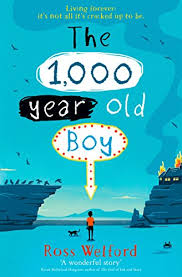 This book, like Welford’s others, is set in North Tyneside (where I used to live, so it resonates with me for that reason too), on the coast east of Newcastle. Alfie Monk is over 1,000 years old, having been born at the time of the Danish invasions of Britain. When he was young, his father was custodian of some ‘life pearls’ within which were stored an elixir of eternal life. To access the elixir the life pearls had to be smashed and the liquid consumed. Alfie’s father was involved in a fight with someone who tried to steal the life pearls, and he was killed. Alfie (unfortunately?) smashed two of them accidentally; he and his mother (and their cat!) drank the liquid, meaning they will never age and therefore never die of natural causes. The curse can only be lifted by drinking another dose of liquid, but there is only one life pearl left. This is hidden on a remote island off the Northumberland coast.
 Julia's books