This was November’s book on my Facebook Reading Challenge, the theme of which was a children’s novel. It has very mature themes and requires a grasp of irony as well as some knowledge of history to fully appreciate, but it renders a difficult and complex subject accessible to a young audience in the same way as The Book Thief, so although it is not recommended for young children, it is entirely appropriate for the early secondary school age group.
 I remember when this book was published in 2006. It was widely acclaimed, but also controversial; there were some questions marks over its historical accuracy (one senior rabbi argued that nine year-old boys were not kept in concentration camps, all were gassed because they could not work and were therefore of no use, though this argument also been disputed) and others have questioned whether such a relationship, between a young inmate and the son of the camp commandant, could have gone on for so long undetected, particularly when Bruno slips under the fence. Whatever its problems, the book has sold millions of copies worldwide and was made into a successful film within two years of publication.
The central character is Bruno, the nine year-old son of a senior Nazi. He lives happily with his parents, twelve year-old sister, and their maid Maria in a large house in Berlin. Until, that is, “the Fury” comes to visit and shortly afterwards the family is forced to move to a much less nice and isolated house in “Out With”, where Bruno’s father has an important new job. One of the charms of the book is Bruno’s habitual mis-naming and his innocent perspective on events, even though it is clear to the reader what the true facts are. An example of this is Bruno’s observations about changes in his mother’s behaviour, suggesting first her flirtation and possible affair with a young lieutenant, then her depression, and tensions in his parents’ marriage brought about by the family posting.
Bruno’s bedroom window faces the camp, though he has no idea what it is. Arguably, given his curious nature, it is perhaps a little surprising that he is not more questioning about the camp, the fences and the people he sees inside, all of whom wear the same uniform (the striped pyjamas). It must be remembered, however, that Bruno has almost no-one to talk to; his relationship with his parents is remote, he has no friends, he and his sister share a mutual contempt (he calls her the “Hopeless Case”) and the other adults around are involved in a conspiracy of silence that keeps him completely in the dark. The sense of fear, unwillingness to speak up or out, anxiety about the world, and intimidation are palpable.
Lonely and bored, Bruno eventually decides to go exploring and at the boundary of the camp one day he meets another boy of his own age, Shmuel, who is interred at the camp. Bruno is thrilled to at last have someone his own age to talk to and the two boys strike up a friendship. As readers, we are meant to see this friendship as in some ways unlikely, and in others completely obvious – why would two young boys be bothered about such differences as clothing, housing, status? They are just children. The author also comments on the transience of friendship at this age (in Berlin Bruno has three “friends for life”, whom he misses terribly, but after a few months he cannot even remember their names) and I think this helps address some of the credibility difficulties of the plot; friendship between young boys is mainly superficial. Bruno wonders about some aspects of Shmuel’s lifestyle, but Shmuel explains very little, which perhaps would not be surprising if the child was deeply traumatised.
No spoilers here, but there is a brilliant denouement to the story. Although it is a book that has been much discussed, and I have almost watched the film a couple of times, I had managed to avoid knowing the ending as I was determined to read it one day. I am so glad because there is a brilliant inevitability to it – there is a point where you just know what is going to happen and the author places you in this incredible state of suspense and dread, despite Bruno’s innocence. I have said enough!
It’s a short book, and the writing carries you along at a pace that feels like the mind of a child – no real sense of time. I think it’s also a book where you have to suspend the sorts of (adult) questions that would make the events improbable, in favour of the bigger picture, which is a fundamental questioning of the forces that create fascism, terror and discrimination; if only we could see all these things through the eyes of a child they could not exist.
A powerful and engaging novel which pulls off the trick of being both important and highly readable. Recommended for grown-ups and kids of 12+ alike.
How did you feel reading this book?
If you have enjoyed this post, I would love for you to follow my blog. Let’s also connect on social media.
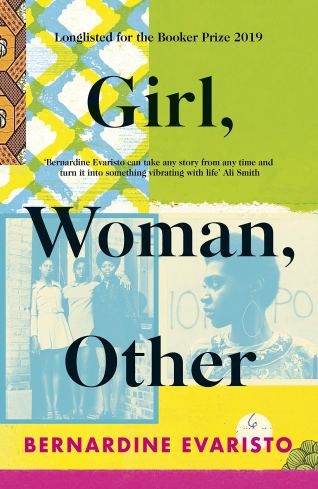 What I liked about it, however, was less this grander aspect, but rather the quality of its story-telling. I must admit that 50 or so pages in, I was not overwhelmed! There are twelve characters in the book, all women bar one (who is trans), all black or mixed race. They are broken down into four groups of three, and each threesome is strongly connected in some way (eg mother/daughter). Each group is also connected with the others, even if only in a tenuous way (eg teacher and former pupil) and almost all are in some way connected to Amma, the first character we meet. Amma has written a play which is having its debut performance at the National and this provides the framework of the novel. Many of the characters are present at the penultimate chapter of the book, the after-party, where the differences between them and their lives are laid bare. This is interesting because the author is not only trying to draw out the similarities between the characters and their life experiences, suggested by their common characteristic of being mixed race and female, but she is also, I think, railing against the notion of such women/people being homogeneous; they are all far more than just their race or gender.
 I’ve just finished a lovely little book The Umbrella Mouse by Anna Fargher. When I was browsing in my local bookshop a few months ago, one of the assistants recommended it to me and said it had had her in tears. I knew then it was a ‘must-read’! I got my copy secondhand online and it’s signed!
 The Lathe of Heaven was written in 1971, but was set in ‘the future’ – Portland Oregon in 2002. This future world is one in which the global population is out of control, climate change has wrought irreparable damage and war in the Middle East threatens geopolitical stability. The most alarming (and engaging) thing about the book, for me, was how prophetic it was; in 1971 did readers think this was some dystopian world? Worryingly, many of the problems envisaged by Le Guin are recognisable features of our environment in 2019.
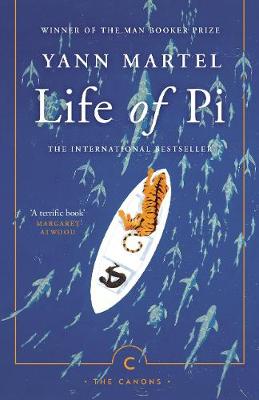 The story is well-known: a young Indian boy, Piscine “Pi” Patel (a name he adopts to get back at the school bullies who taunt him with the nickname ‘Pissing’) grows up in the territory of Pondicherry where his parents own a zoo. The first part of the story gives us a detailed account of the family’s life there, including enormous detail about life for the animals in a zoo setting (I was fascinated by this and it changed my perspective on zoos). We learn in particular about the fierce Bengal tiger, Richard Parker, who is the zoo’s prized possession. I love the use of ‘naming’ in this book – the story of how Richard Parker came to be given this name is brilliant and a sign of the author’s ingenuity and creativity. The other important feature of this part of the novel is that we learn of Pi’s deeply philosophical nature, his decision to adopt three religions (Hinduism, in which he has been brought up, Islam and Christianity), much to his family’s dismay, because he can see benefits in all of them.

 So now it is time top get back on track and announce the book for November. Our theme is a children’s book; we are winding down towards the end of the year, but I am not going to make it too easy, because this book is a challenging one – John Boyne’s The Boy in the Striped Pyjamas. I have been meaning to read this ever since it was published to great acclaim in 2006. My elder daughter read it recently and has been nagging me to follow suit. She found it very moving so I am looking forward to it.
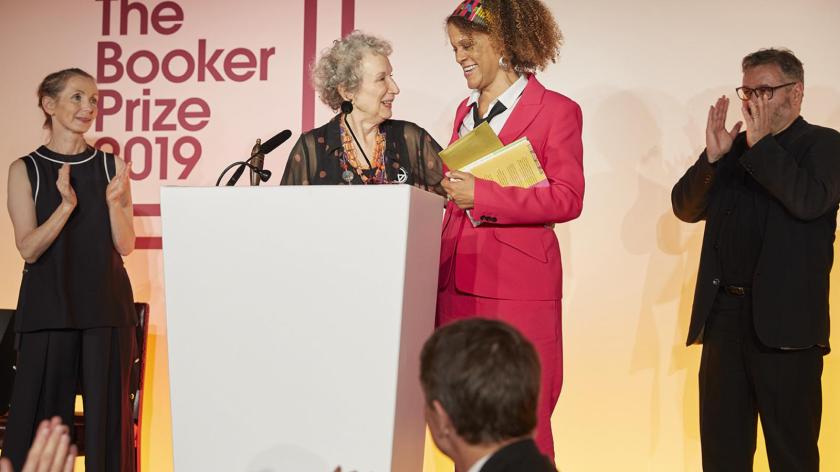 The Booker prize winner(s) were announced last week and for the first time in years, and against the explicit rules of the contest, the judges awarded the prize jointly to Margaret Atwood and Bernardine Evaristo. I have not read either book yet, though I am currently listening to The Testaments on the excellent BBC Sounds and enjoying it enormously, though it is extremely dark. There has been so much publicity around Atwood and The Testaments that I was wondering how on earth the Booker prize judges were going to be able to not award it to her! So, I think the judges probably made the right decision. By now, I would probably have worked my way through at least two thirds of the shortlist (I’ve never managed all six in the period between shortlist and winner), but, for obvious reasons, I have not read that much so far this year.
 It is somewhat and sadly ironic that I was reading Elif Shafak’s 10 Minutes 38 Seconds in This Strange World at the time of my mother’s death, a novel about a woman, Leila, an Istanbul prostitute known as Tequila Leila, who is brutally murdered in a back alley by street thugs. Rather than death being an instant occurrence, however, the author explores the idea of it as a transition from the world of the living to the ‘other’ (with a duration, for Leila, of ten minutes and thirty-eight seconds) during which time her whole life flashes before her. Leila’s life story is told through a series of recollections about her five closest friends, how and when she met them and what impact they have had on her life. We learn that Leila came from a relatively affluent family. Her father was anxious for heirs, but when his wife proved incapable of having any he took a second wife, Binnaz, a much younger woman from a lowly family, who gave birth to Leila. Binnaz was forced to give up the child to the first wife to bring up as if she were her own, whilst Binnaz, who never recovered mentally from the trauma of that event, was thereafter known to Leila as ‘Auntie’.
 It seems appropriate that I should be posting a review of Normal People this week, a book so very much about Ireland, the challenges and contradictions at the heart of a nation that has transformed itself in recent years. It is not just about Ireland, but about what it means to be young in Ireland and about class. It is also about identity and, in common with some of the issues faced in the UK and many other societies I am sure, the draw away from regional towns and cities, towards a centre, a capital, where there is perceived to be more opportunity, and what that means both for the individual and for society in the wider sense.
 I have chosen a book which caught my eye a couple of months ago – The Lido by Libby Page. It concerns a friendship between two women, 86 year-old widow Rosemary and 26 year-old Kate, who strike up a bond when their local outdoor swimming pool in Brixton, south London, is threatened with closure. The two women have different reasons for wanting to campaign to keep the lido open, but they are brought together in a common cause.
 Julia's books