Blog number two on book recommendations for the young people in your life…or perhaps the not so young! I read this week that about a third of books sold in the UK are those aimed at the children and young adult market. It seems that the golden age of children’s literature that we are in is prompting adults to turn to kids books as well. I think that’s fantastic. As with so many things in life now, boundaries imposed on us about what we should be/read/wear/do are being constantly challenged.
With so many truly fantastic children’s fiction titles about, it seems rash to pick a handful, but I’m going to anyway! You could pick almost anything for keener readers, including a book token which will be double joy to a book loving kid, so I’ve picked books that I think will have an appeal to those who may be a bit more reluctant. As ever, the age recommendations are fluid, it’s more about emotional maturity and awareness of issues discussed than it is about reading ability. Here are some books that have caught my eye.
Primary school age
Ella on the Outside – Cathy Howe & The Boy at the Back of the Class – Onjali Q Rauf

I’ve grouped these two together since they both deal with the complex issue of childhood friendships and are both about children who find themselves on the ‘outside’. Ella is a new girl at school and is isolated at first, but then finds herself being befriended by the most popular girl in school, whose motives she does not understand. Ahmet is a refugee in The Boy at the Back of the Class and the story is about the challenge of integration and how other children who are at first wary, become interested in his story.
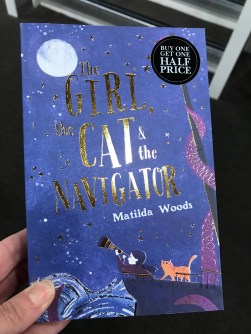 The Girl, the Cat and the Navigator – Matilda Woods
Beautifully illustrated and a magical story about smart, imaginative Oona who dreams of an exciting life at sea, on a voyage of discovery. Perfect for winter bedtime reading.
 Ladybird Tales of Adventurous Girls
A collection of short stories, some of which are a retelling of traditional fairy tales, where girls are the heroes who save the day (Gretel and Hansel?). Perfect for challenging some of the stereotypes that abound in fiction for children.
 Dog Man Lord of the Fleas – Dav Pilkey
This is the fifth book in the Dog Man series, from the author who brought us Captain Underpants (which was a favourite of my 17 year old when he was younger), a new hero for a new generation. Love these books!
 Flamingo Boy – Michael Morpurgo
Michael Morpurgo needs no introduction, and this is his latest book, published in October. Set in France during World War Two its central character is a young autistic boy. When the Nazis invade he makes a connection with a German soldier who has a son at home the same age.
Late primary/early secondary
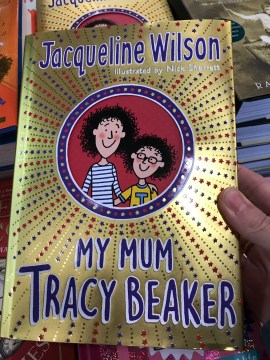
My Mum Tracy Beaker – Jacqueline Wilson
Tracy is all grown up and is now a Mum herself. She is a single parent, and is devoted to her daughter. This book will I am sure be a thrill for youngsters who read (or watched) Tracy Beaker when they were younger.

The Guggenheim Mystery – Robin Stevens
The second mystery to be solved by young sleuth Ted Spark. Whilst in New York visiting his aunt and cousin, Ted has to solve the mystery of a painting stolen from the Guggenheim Museum when Aunt Gloria is accused of the theft. Kids love series, so this is a good one to get them started on.

The Graveyard Book Graphic Novels – Neil Gaiman
Death, ghosts, an eccentric childhood and a hunt for a murderer! Neil Gaiman’s book was a sensation when it was first published ten years ago. It is great to see it now in graphic novel form, a brilliant medium for reluctant readers, and a genre that has expanded hugely for all age groups in the last couple of years. This book is also available in two volumes if you want something slimmer and/or cheaper.
Teens
 Dumplin’ – Julie Murphy
This book was published last year, but is set to be released as a film on Netflix next year. Willowdean Dixon is a brilliant heroine who starts a relationship with handsome and popular local lad Bo, whom she never thought could be attracted to her. She is then beset by self-doubt and to overcome she takes part in her town’s beauty pageant, busting all sorts of myths about what is meant by beauty.

Obsidio: The Illuminae Files 3 – Amie Kaufman & Jay Kristoff
The third book in the Illuminae Files series, the first and second being Illuminae and Gemina. The books are set 500 years in the future in a dystopian universe, it is about warring factions, survival, has loads of action and is presented in an unconventional style that many teenagers may find a bit more engaging than the traditional chapter format.

Scythe – Neal Shusterman
Another sci-fi novel set in the future where death from disease, crime and war have been eliminated and the only way left to die is to be randomly taken by professional ‘scythes’. Citra and Rowan are teenagers who have been chosen as reluctant scythe apprentices who must come to terms with their new roles.

I Am Thunder And I Won’t Keep Quiet – Muhammad Khan
Muzna is a young Muslim teenager who starts a relationship with Arif, a handsome and popular boy. However, Muzna learns that Arif has a dark secret and is forced to confront a choice that challenges her integrity and beliefs. This proves very difficult for the girl who is normally very reserved and not used to pushing herself out of the shadows.
I would just love to read all of these myself!
If you have any other recommendations, I would love to hear them. Or, if you buy any of these books, I would love to get your feedback.
If you have enjoyed this post, please follow my blog. Let’s also connect on social media.


 My book club chose this for our pre-Christmas read (I’ve only just finished it!) and we all thoroughly enjoyed it. It’s long, and perhaps could have been edited somewhat, but I imagine the main buyers of this book will be Michelle-fans who want as much detail as possible. The first part of the book was, for me, the least engaging. My fellow readers and I were a little surprised to learn that Michelle Robinson did not in fact come from an affluent background. She was a ‘Southsider’ – from a part of Chicago that was fairly blue-collar and largely African-American, and became more so as she grew older and some of the white residents moved out. A picture is painted of a family with strong values around hard work, doing the right thing, caring for others and loyalty to family. Michelle excelled in school through hard work, determination and the support of her parents and attended both Princeton and Harvard Law School. She has never forgotten her humble beginnings, however, and this underpins her commitment to equality and social justice. However, I did feel this part of the book was most descriptive; in the context of the book as a whole I can see why it would have been important to her to put her politics in perspective, but it was a tiny bit…pedestrian?
 Despite being outside skiing all day I did get a fair bit of reading done and managed finally to break the back of a book I have been reading for some time now – The Overstory by Richard Powers, the final one of the
  Over the holiday I also completed Michelle Obama’s Becoming. This is a much faster read and very different, though also thoroughly enjoyable. Look out for my reviews of both books over the next couple of weeks.
 For little ones there’s We’re Going on a Bear Hunt on Christmas Eve on Channel 4 (might have to watch that even though mine are now teenagers!). Or the wonderful Paddington movie on 30th December on Channel 4.
 Thomas Hardy’s Far From the Madding Crowd (one of my favourite Hardy novels) is on BBC2 on 23 December, Jane Austen’s Emma (with Gwyneth Paltrow) is on BBC2 on 28 December, Pride and Prejudice (starring Keira Knightley) is on More4 on Christmas Day, and the brilliant 2011 version of Charlotte Bronte’s Jane Eyre (the one with Michael Fassbender as Mr Rochester) is on BBC1 on 2 January.

 Finally, for something a little more up to date, you could try
 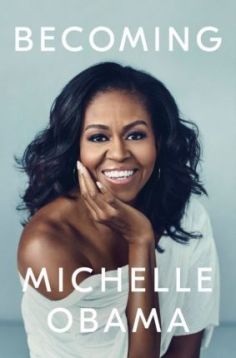 Becoming by Michelle Obama


 Ottolenghi Simple by Yotam Ottolenghi



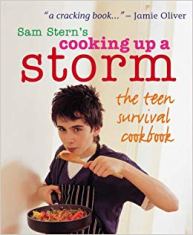 Cooking Up a Storm: The teen survival cookbook – Sam Stern & Susan Stern
 Nell is in her late teens and lives with her father, a very religious alcoholic, and her sister, Harper, who has cancer. They are from Manchester but moved to Norway, ostensibly for Harper’s medical treatment. The girls’ mother, we learn, left when they were young and they have had no contact since. Nell is a confused young woman; she is the primary carer for her sister, their father either working or incapable most of the time, and she wants to be a singer-songwriter back in Britain, but finds herself cut off from any possibility of making a career in that field. She attends a local school where she experiences bullying and isolation. She decides to go back to the UK, without her family’s knowledge, for an audition, but gets into a spot of bother en route and meets Lukas, a handsome but mysterious boy. At first it appears he rescues her but we learn later that he in fact engineered the whole episode in order to entrap her.
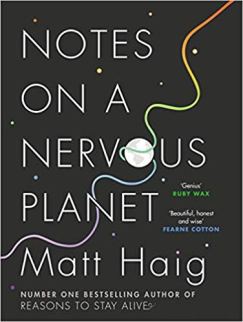 I have made an exception and decided to read Notes on a Nervous Planet again. I’m surprised at how different the reading experience is versus listening. Firstly, the author has a wonderful reading voice and I suppose because it is non-fiction and is very much about his experiences of anxiety and depression, you can sense that it comes straight from the heart. I really think that the narrator of an audiobook plays such an important role in the experience. For example, I loved Hilary Huber’s narration of Elena Ferrante’s Neapolitan Novels, but I struggled with the reading of 1984 by Andrew Wincott…who is Adam in The Archers. I just couldn’t get Adam out of my head!
 Julia's books