You know summer is on its way when the local library announces the annual Summer Reading Challenge! Aimed at children of primary school age in the UK it is a great way of getting kids engaged in books (any books!) and giving them rewards for achieving certain reading goals. I love the way the organisers come up with different themes each year, and interesting activity packs that provide a surprising amount of diversion. This year the theme is Animal Agents and it’s being launched next week, so do look out for it if you have primary age children. I’ll be writing more about it once it’s launched so look out for a future blog on the topic.

In the meantime, it’s the beginning of the month so it must be time for this month’s reading challenge! With the holiday season upon us, June’s challenge was to read a literary travel book. I chose On a Shoestring to Coorg by Dervla Murphy, and posted my review earlier this week, which you can read here.
This month’s challenge is to go to the local library and pick out a book (the challenge will be to keep it to just one!) and to read it before its due date. I have had a deep passion for libraries since I was a child (I was lucky that my mother took me regularly) and believe firmly that they provide an essential service. I am a compulsive book-buyer, but there is no doubt books can be expensive and what if you’re not sure whether you’re going to like the book? For the old and the young and for those on fixed or low incomes, libraries may be the only viable source of books. Not only that, but libraries provide a host of other services: librarians are information specialists and can help you find things out, they are often at the centre of a community providing reading groups, children’s book clubs, places to sit when it’s cold, places to study where it’s quiet, access to computers (not everyone has one at home) and of course reference books which you may not necessarily want to buy. Need I go on?
You will gain much from a visit to your local library. I came away with a whole bunch of leaflets about things to do over the summer, theatre guides, etc, a couple of guidebooks on Portugal (where I’ll be heading in August) as well as three books:
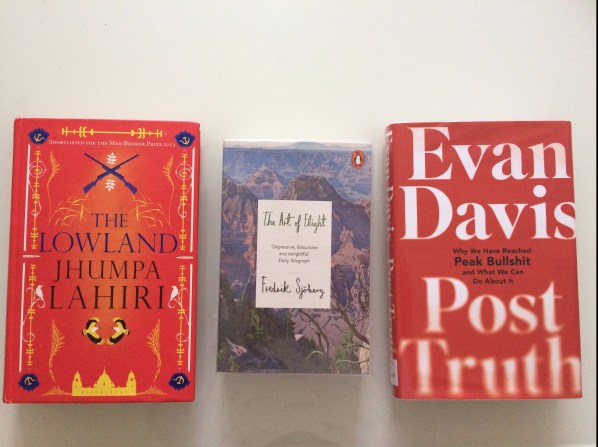
The Lowland by Jhumpa Lahiri was shortlisted for the Man Booker in 2013, and caught my eye as I love Indian literature, and having just read about Devla Murphy’s travels in the south of the country, my interest was piqued anew. It’s set in Calcutta in the 1960s and ’70s and is about two brothers, very close as children, whose lives take dramatically different paths as historical events unfold around them. I was also drawn to The Art of Flight by Frederik Sjoberg which I think is a kind of memoir, structured as a number of short essays and prose pieces about the natural world. Sjoberg is a Swedish writer I’ve never heard of, but the book looks interesting. Finally, I had reserved a copy of Evan Davis’s newly-published book Post-truth: why we have reached peak bullshit and what we can do about it, after spotting it in the bookshop recently. Evan Davis has for years been one of my favourite journalists because he is warm, watchable, connects well with the viewer and is fantastically clever. He has an ability to cut to the essence of an issue and frequently outsmarts even the most nimble interviewees, so I’m interested in his take on this cultural shift we seem to be experiencing in politics.
I want to read all of these now, so I’m not sure which I will take on for the July challenge. I’m off on a train journey to London tomorrow, so it might well be the one which weighs least!
Have you picked up anything interesting from the library recently?
If you have enjoyed this post, then please subscribe to my blog by clicking on the button below or to the left, depending on your device. Let’s also connect on social media and Goodreads.
 If, like me, you find yourself a little nostalgic for an era when travel meant slowing down, getting to know a place and its people (rather than just taking a selfie with a local and posting to Instagram), and immersing yourself in the new environment, then Dervla Murphy could be the travel writer for you. In On a Shoestring to Coorg, Murphy travels for the first time with her five-year old daughter, Rachel. They travel scarily light (I would take more stuff on a day out when my kids were younger!) with very little money and are dependent on the kindness and hospitality of people they meet, including a number of British ex-pats, who have made India their home in the post-colonial era.
 We’re all on a budget and we’re all busy, so why would you make the effort to go to an independent bookshop when, with a couple of clicks, you can get what you want from the comfort of your armchair and have it delivered, and probably for a discount on the jacket price? Well, as they say, use it or lose it!


 The novel opens with our central character Maddy’s eighteenth birthday. She celebrates this with her mother and her nurse, Carla; Maddy suffers from severe allergies and lives an isolated existence in her hermetically sealed home, which she has not left for many years, so these two women provide the only relationships she really has. Maddy is home schooled, receiving almost all her tuition over Skype from various tutors. Occasionally, they are allowed to tutor her in person, but only after they spend a period of time in a decontamination unit in the house, to ensure Maddy does not come into contact with any pathogens or foreign particles which might harm her. Maddy’s father and older brother were killed in an accident when Maddy was a baby and she and her mother are therefore incredibly close.
 I’ve decided to pick a long-neglected title from my well-populated ‘not yet read’ bookcase – On A Shoestring To Coorg: an experience of Southern India by Dervla Murphy. I bought it as part of a set of three some years ago, and of the trio I only read Full Tilt: Dunkirk to Delhi by bicycle. I loved that book: Murphy cycled across Europe to India, through countries like Afghanistan and Iran, before they were devastated by conflict. Sadly, these wonderful and fascinating places will probably not now be visited by travellers for many years so this book provides a vicarious experience that most of us will never be able to have.
 May’s reading challenge was fairly straightforward, to read a YA novel, and I expected to zip through Everything Everything by Nicola Yoon. Alas, half term and ferrying my eldest to and from GCSE exams has rather cut into my reading time this last few weeks, so I was still reading it a few days into June. However, I have now completed it and will post my review here next week. I thorougly enjoyed it and recommend it highly for YAs and OAs (older adults?!) alike. Look out for my review and let me know your thoughts if you or any teenagers you know have read it.



 This was the third book I read last term with the children’s book club at my daughter’s primary school. It was something of a risk as it’s not conventional either in its subject matter or its format. But having read
  Julia's books