World Book Day…don’t you just love it!

world book day

I love World Book Day, truly I do, but I have to confess that by the time my third and youngest child was at the end of primary school I breathed a sigh of relief that no longer would I have to be knocking up a costume the night before. (Perhaps this says more about my approach to organisation than anything else!) One of my kids hated dressing up, another is highly imaginative and I’m afraid my sewing skills could never match up to expectations and another worried about their costume and how it would compare to others. It was SO stressful, and I began to feel, towards the end, that we were sort of missing the point.

Going along to the bookshop the following weekend clutching our tokens for a free mini-book was much more in my comfort zone, though, again, we would inevitably walk out with an additional book or two and I often wondered how parents for whom money was tight, or non-existent, managed this particular challenge and having to say no once again. Possibly avoid the bookshop altogether and quietly forget the token?

I saw a post on Facebook this morning suggesting that if the costume your child wants costs more than a book, don’t buy it and get a book instead. This is good advice! Children can be strong-willed little things, however, and it can be hard to hold the line. Schools could do more, I think, to reward and recognise ‘creative’ costumes, or perhaps set the challenge that a costume has to be assembled from a certain limited range of materials and take no more than an hour to put together. Most kids LOVE a set of parameters and this would reduce the peer pressure to turn to online sellers of fabulous ensembles.

My own take on this, as a parent of teenagers, is that books are for life and not a day, and we would all do well to try and incorporate books and reading into our children’s lives. I feel certain this would counter much of the anxiety around screen-time that so many parents experience. So, here are my alternative suggestions for celebrating World Book Day:

  1. Read a book yourself – model the behaviours you want in your children.
  2. Put down the phones, sit down and have a conversation with your child about a book they have read. Value their opinions and don’t judge.
  3. If they don’t like a book (that’s okay), as them why. This will encourage them to think about what they DO like.
  4. Make using their World Book Day token an occasion. Buy them an additional book if you can afford it.
  5. If you can’t, take them along to the charity shop where there will be hundreds of kids’ books.
  6. Get them a library ticket and visit regularly.
  7. Do all of the above. Again.

Nothing is better than reading to your child at bedtime. Yes, I know it can sometimes feel like a hassle, especially if you still have work to do, are tired or want to watch your favourite TV show, but, believe me, it stops and often sooner than you think. Even five minutes reading with your child is better than none.

There was some depressing research published this week showing that only around a third of children under thirteen are read to daily for pleasure by an adult, and the trend is downwards. This is not good. When we also hear about teenagers’ mental health issues, I’m afraid I can’t help thinking there is a link.

What are your thoughts on children’s reading habits?

If you have enjoyed this post, I would love for you to follow my blog. Let’s also connect on social media.


Book review: “Becoming” by Michelle Obama

This book has certainly captured headlines since it was published in November. It was abridged and serialised on Radio 4 the week it came out. I caught a couple of the episodes, but this was merely a taster since, having now finished reading it, at over 400 pages, they gave only the very edited highlights. I do not normally go in for celebrity memoirs, and one could be quite cynical about the enormous deal that has been struck by the Obamas and their publishers (though I gather they are donating royalties to charity). However, very early on in the book any cynicism I might have had melted away.  I have no idea what help Michelle had in writing this book, but it does not ‘feel’ ghost-written. Her narrative voice is very authentic – warm and compassionate, the same way that she comes across when she speaks.

becoming imgMy book club chose this for our pre-Christmas read (I’ve only just finished it!) and we all thoroughly enjoyed it. It’s long, and perhaps could have been edited somewhat, but I imagine the main buyers of this book will be Michelle-fans who want as much detail as possible. The first part of the book was, for me, the least engaging. My fellow readers and I were a little surprised to learn that Michelle Robinson did not in fact come from an affluent background. She was a ‘Southsider’ – from a part of Chicago that was fairly blue-collar and largely African-American, and became more so as she grew older and some of the white residents moved out. A picture is painted of a family with strong values around hard work, doing the right thing, caring for others and loyalty to family. Michelle excelled in school through hard work, determination and the support of her parents and attended both Princeton and Harvard Law School. She has never forgotten her humble beginnings, however, and this underpins her commitment to equality and social justice. However, I did feel this part of the book was most descriptive; in the context of the book as a whole I can see why it would have been important to her to put her politics in perspective, but it was a tiny bit…pedestrian?

Michelle met her husband, Barack Obama, while she was working at a law firm in Chicago, and the development of their relationship forms the basis of the second part of the book. It’s a lovely romantic story, and they are clearly deeply committed to one another. However, it did not come without some pain. Much has been made of their difficulties conceiving a child (both daughters were born after IVF treatment) and of their seeking relationship counselling. What I found most interesting, however, was how Michelle has wrestled with and had to reconcile herself to, the role that being the spouse of a high-profile politician, then a Senator, then a President, has meant for her own career ambitions and her life as a parent.

The challenges of this dilemma are thrown into sharpest relief in the later chapters of Part Two where Barack Obama makes his bid for the US Presidency in 2007/8. The way that Michelle was treated is both fascinating and appalling. How she coped is beyond me, and it is to her enormous credit that she was able to rise above the racist and misogynist vitriol that came her way. I suspect those things ultimately made her stronger. Since Barack Obama left office in 2016, there have been calls from many quarters for Michelle to consider running at some point in the future, to which she has repeatedly said she never would (she states this explicitly in the final pages of the book). When you read her personal reflections in the 2008 campaign you can see fully why she is not made for that particular political bear-pit. She is a much better person than that and working towards a bigger picture than the short-termism associated with political elections.

As my visibility as Barack Obama’s wife rose, the other parts of me were dissolving from view. When I spoke to reporters, they rarely asked about my work. They inserted “Harvard-educated” in their description of me, but generally left it at that. A couple of news outlets had published stories speculating that I’d been promoted at the hospital not due to my own hard work and merit but because of my husband’s  growing political stature, which was painful to read. 

The final part of the book looks at her life in the White House. As she writes in the opening lines:

There is no handbook for incoming First Ladies of the United States.

As with most things in her life, Michelle Obama had to find her own way. In some ways that must be a liberating position to be in – having the freedom to write your own job description (the present First Lady has taken a somewhat different approach) – but for Michelle Obama there was the deep hostility she had to contend with, not just the political opposition, but the more personal, racist, misogynist and body-shaming tone she also endured.

I understood…that I’d be measured by a different yardstick. As the only African American First Lady to set foot in the White House, I was “other” almost by default. If there was a presumed grace assigned to my white predecessors, I knew it wasn’t likely to be the same for me. 

When the book was published, commentators pounced upon her comments about the present incumbent of the White House, looking for something juicy. Yes, there are some criticisms, as you might expect, and sadly the echo chamber rather defines the politics of the age – most of us prefer to read or listen to people who reflect the views we already hold. But what struck me in fact was the restraint, and the most chilling comment was that Michelle Obama will never forgive Trump and his team for placing the life of her husband and her daughters in danger. This sums up the book, and the woman, for me; it’s family, loved ones, values first, politics second.

If you’re a Michelle fan you’ll love this and have probably read it already anyway! If you’re objective there is still much to enjoy here and there’s no doubting the courage, integrity and sheer grit of the woman. She is undoubtedly a role model to us all.

What did you think of Michelle Obama’s memoir? 

If you have enjoyed this post, I would love for you to follow my blog. Let’s also connect on social media. 

Happy 2019!

2018-12-31 17.51.53-2

Happy new year, readers and fellow bloggers!

I hope you all had a good break and got plenty of reading done. My holiday was a rather different one this year. Straight after Christmas I was with family in East Anglia, so there was very little reading time. We then went on a family skiing trip to a very beautiful and very snowy Austria for New Year. (We love skiing, but I am always relieved when we all come home injury-free!)

It was probably our best family ski trip ever, in an area we have never previously visited, Serfaus-Fiss-Ladis in the South Tirol. There were very few British accents to be heard and fellow skiers were overwhelmingly Austrian, German or Dutch so it seemed to us to be well-kept secret. It was stunningly beautiful and we enjoyed the unusually bountiful snowfall, even if that caused us some problems getting back home.

the overstory imgDespite being outside skiing all day I did get a fair bit of reading done and managed finally to break the back of a book I have been reading for some time now – The Overstory by Richard Powers, the final one of the Man Booker Shortlist 2018. It’s a wonderful and brilliant novel, but it’s very long and quite hard work. The prose is a joy so much so that you simply have to read every word, which makes it doubly time-consuming. So, it was the perfect holiday choice. I’ve still not quite finished!


becoming imgOver the holiday I also completed Michelle Obama’s Becoming. This is a much faster read and very different, though also thoroughly enjoyable. Look out for my reviews of both books over the next couple of weeks.
I’ve been putting some thought into my reading plans for 2019 this last few days and have just launched this year’s Facebook Reading Challenge. If you’d like to join us do pop over to the page to have a look at the list of themes for the year. The title for January is Beryl Bainbridge’s The Bottle Factory Outing, which I gather is very funny so I’m looking forward to starting it.


I’m also planning to visit the Hay Festival again this year, which I attended for the first time in 2018. I loved it so much that I now intend to make it a regular part of my annual calendar. I am lucky enough to live in Manchester where we have a fantastic literary festival every Autumn. Unfortunately, I couldn’t make any of the events last year (the speakers I wanted to see all sold out very quickly so I need to be more on the ball this time) so that will also be a priority for 2019.

My other big goal this year is to attempt to get my own book published. I’ve been working on it for about 18 months now and finally finished the revisions to my second  draft in December. I feel it’s now time to put it in front of someone else for feedback – a terrifying prospect, but a necessary one. I feel sick even thinking about it!

I hope the year ahead will be joyfully book-filled. What a wonderful hobby we share!

What are your literary plans for 2019?

If you have enjoyed this post I would love for you to follow my blog. Let’s also connect on social media. 


Listening versus reading

headphones-3658441_1920

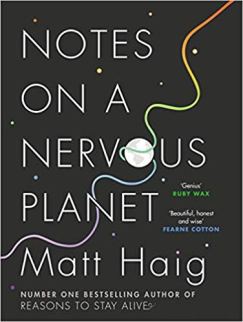
I loved listening to Matt Haig read his wonderful book Notes on a Nervous Planet. I downloaded the audiobook in the Summer and blogged about it here in October. I decided that it was definitely a book I wanted to have on my bookshelves, to dip into occasionally, to read certain chapters at specific times, and to be able to jot notes down. I also decided that it would make a great gift for a few people I know.

I set it as the November book for my Facebook Reading Challenge and so far the feedback seems to be positive. Apart from a handful of my very favourite books (eg Wuthering Heights) I seldom re-read books. I always feel I should; my husband is a great re-reader and says he gets different things out of a book each time he returns to it, and he is right of course. For me, though, there seem to be just too many books to read first time around!

Notes on a Nervous Planet imgI have made an exception and decided to read Notes on a Nervous Planet again. I’m surprised at how different the reading experience is versus listening. Firstly, the author has a wonderful reading voice and I suppose because it is non-fiction and is very much about his experiences of anxiety and depression, you can sense that it comes straight from the heart. I really think that the narrator of an audiobook plays such an important role in the experience. For example, I loved Hilary Huber’s narration of Elena Ferrante’s Neapolitan Novels, but I struggled with the reading of 1984 by Andrew Wincott…who is Adam in The Archers. I just couldn’t get Adam out of my head!

The second interesting difference is the speed. I read quite fast, and I am aware that this means I don’t always take in every detail. With listening, however, I listen at the natural pace (I dislike the 1.25 and 1.5 speeds). It does mean that you absorb a lot more of the text. I was surprised reading Notes on a Nervous Planet how many passages I remembered virtually word for word.

The third difference for me may be a very subjective one, but it’s about the way the content of the book organises itself in my head. Here, my preference is for the tangible book. Listening to this book I found it more of a continuous narrative, but reading it is more useful to me in terms of taking forward some of the ‘recommended’ actions – I use the term loosely as it’s not a smug, instructional just do as I say and your life will be perfect, sort of book! For others who are more aurally oriented the experience may be different.

Audiobooks are great, especially for long car journeys (if you have the appropriate technology), or, my particular preference, walks into town. I have found with this book, though, that reading again has brought me some extra insight, and that can’t be bad.

Are you a fan of audiobooks? Have you ever both read and listened to a particular title?

If you have this post, I would love for you to follow my blog. Let’s also connect on social media.

7 ways that reading improves your mental health

World-Mental-Health-Day

On World Mental Health Day, I would like to flag up the obvious – reading is good for you. If you need a reason, here are seven:

  1. Reading reduces stress – it can slow your heart rate and help you relax.
  2. It can help you sleep – reading before bed induces sleep much more effectively than any other activity. Switching off your mobile phone and picking up a book will promote good sleep hygiene.
  3. Reading stops you ruminating – many of us build up our anxiety levels by going over and over stressful experiences. Reading a book will take you out of that negative thought cycle.
  4. Books do not mess with your melatonin – unlike a phone. Young people in particular benefit from putting the phone, with its melatonin-suppressing blue light, away and picking up a book.
  5. Reading explands your mind – much more than YouTube or EastEnders ever will.
  6. Reading improves focus and concentration – and that can help you manage the demands of life more effectively, especially if you find it difficult to complete tasks, with all the consequent pressures that brings.
  7. You won’t be comparing yourself with perfection – most characters in good books are flawed…like the rest of us. Normal. You will not meet people living seemingly amazing lives, with perfect bodies and hundreds of friends, who are going to make you feel rubbish. You will meet characters like you. And others not like you. Life’s rich tapestry in fact.

So, celebrate World Mental Health Day by doing something for yourself and sitting down with a book.

Book review: “The Last Runaway” by Tracy Chevalier

This was one of my holidays reads and one of two books my book club chose for our summer break. It’s only my third Tracy Chevalier novel, but each time I read her I just want more! I read Girl with a Pearl Earring years ago when it was first published and then The Lady and the Unicorn a year or so ago, which I thought was wonderful. I have since picked up Virgin Blue from my local secondhand bookshop so that will be next on my list.

The Last Runaway imgOne thing that is so impressive about Chevalier is how beautifully she creates the  historical setting: the two novels I have read so far have been set in 17th century Holland and 15th century Paris and Brussels and I can only begin to imagine the amount of research she has to undertake. The Last Runaway is set in the United States in the mid-nineteenth century when parts of the country were only just being settled. Honor Bright, our main character is a young Quaker woman from Dorset in England. She has led a modest and sheltered life, but her world was turned upside down when her fiancé left her and their close-knit Quaker community for another woman. This was not only a scandal but it left Honor distraught and in a very difficult position. When her sister, Grace, is persuaded by her fiancé that they should move to America, Honor decides she must go with her, not only to support her sister, but to escape the oppression of her situation and have some chance of making a life for herself.

Their journey from Bristol to New York is arduous and Honor suffers with debilitating seasickness. As they travel the long distance from New York to Ohio, Grace contracts Yellow Fever and dies. This places Honor in a further difficult position: not only must she tell Adam Cox, Grace’s fiancé, that she is dead, but she is also in fear about where that leaves her as he, of course, has no obligation to support her. Honor, however, cannot face going back to England either because of the journey or the shame.

On the final leg of her journey, Honor has a frightening encounter with a local slave-hunter, Donovan. Honor is appalled both by his profession and his dangerous air, and yet also finds herself strangely drawn to him when he seems to flirt with her. This also sends her into a tailspin as it conflicts with her Quaker outlook and moral code.

Honor arrives in the small town of Wellington, close to Faithwell, her intended destination. There, she finds quarters with Belle Mills, the local milliner, who, it transpires, is also the half-sister of the mysterious Donovan. Belle warns Honor about him and it is clear there is a tension between these siblings. During her stay with Belle, Honor adapts her talent for quilting (quilting, its traditions, the patterns and its place in Quaker culture, are a strong and fascinating motif running through the novel) and shows promise as a hat-maker, endearing her to Belle and her many customers. Belle’s designs are often flamboyant, which is an anathema to Honor, who, as a Quaker, must observe plainness and modesty in all forms of dress. The two women develop a firm friendship, however, and Honor begins to feel more confident.

Honor first realises there is something strange going on when she finds a black man under a woodpile in the yard of Belle’s home. Honor is aware of the existence of the slave trade, indeed, the Quakers were an important part of the movement calling for its abolition, but this is the first time she has come so close to an escapee. She is terrified, particularly when Donovan comes searching at his sister’s property, sensing the presence of the runaway. Honor later learns that Belle is part of a network of citizens who provided the means of escape, food and shelter for runaway slaves fleeing the South to states which had already outlawed slavery – the ‘underground railroad’. Belle was what was known as a ‘station-master’.

Honor is collected from Belle’s by Adam Cox, Grace’s fiancé, and taken back to Faithwell, to live with him and his sister-in-law (also widowed) and to work in their shop. The domestic situation is uncomfortable for Honor, however, and her prospects only  brighten when she is wooed and then married to fellow Quaker Jack Haymaker. At first it seems like a good marriage that will improve Honor’s situation, but her mother-in-law proves to be a formidable presence, who does not conceal her contempt for her daughter-in-law and how little she has to offer when Honor goes to live with them on their isolated farm. At first, Jack is attentive and loving, but quickly becomes complacent and Honor grows increasingly miserable, despite her efforts to feel and appropriate degree of godly gratitude. Tensions deepen when Honor decides she will provide support for runaway slaves passing through their property. This is against the expressed wishes of the Haymakers. A law has been passed which makes it illegal for anyone to help a runaway, and the penalties are severe. Whilst the Quakers are against slavery, they are also against law-breaking and Honor’s actions are seen as a threat to their livelihood. Honor finds herself increasingly in conflict with the family until the point where her position becomes untenable. All the while, Donovan hovers in the background, stalking Honor and sniffing out runaways.

I will say no more as the events of the story then take quite dramatic turns. I loved the unexpected twists of the plot. I also love the way the author wove in details about the slave trade and the underground railroad (which I confess I knew very little about). Colson Whitehead’s 2016 novel The Underground Railroad brought the existence of this movement to the attention of many readers for the first time, I think. I was not aware that Tracy Chevalier had also written this novel about it. I also loved the domesticity of this novel, its femaleness and the feminine craft of homemaking, particularly in relation to the skills required for good quilting. This seems to be a common theme in Chevalier’s work. I loved how strong the women were in this novel; the men do not come out looking so good!

I recommend this book highly. It’s a great story, a fascinating read and will give you an insight into worlds you may not know much about.

If you have read this book, I would love to hear your views.

If you have enjoyed this post, do follow my blog and let’s connect on social media.

Summer holidays

We arrived in France yesterday for our family summer holiday. We had a week in Ireland last week visiting family, travelling between Dublin and West Cork. It was wonderfully full-on so there was precious little reading time. However, now that it’s just the five of us I’m looking forward to a slower pace. My children are all well into the teen zone now so my husband and I find ourselves twiddling our thumbs in the mornings, waiting for them to get up. Perfect reading time!

We are staying in Cancale, a smallish coastal town in Northern Brittany, arriving here on the overnight ferry from Cork to Roscoff, which was very pleasant indeed – good, reasonably-priced food, decent cabins and plenty to do.

I’ve been unusually restrained with my holiday library this year, just the three books: Harvesting by Lisa Harding, a harrowing account of child prostitution, child trafficking, abuse and neglect, Death on the Nile, by Agatha Christie, the August choice for my Facebook Reading Challenge, and The Last Runaway by Tracy Chevalier, one of my book club’s summer reading titles.

I’ve almost finished Harvesting in the first couple of days! It’s not for the faint-hearted, but is gripping. I’m told it has been thoroughly researched and is not an outlandish account. If this is the case, I have truly led a sheltered life. It’s tough stuff.

If I manage all three books there is always the Kindle back-up! I’ll keep you posted on my progress.

What are your holiday reading choices?

Kid’s book review: “The Explorer” by Katherine Rundell

I want to tell you about a wonderful book I have just completed which will be perfect summer reading for 9-12 year olds; long enough to last them for a holiday, but with enough pace to sustain their interest and sufficient can’t-put-it-down qualities! Katherine Rundell. This is only her fourth novel, but she has already won two major prizes: the Waterstones Children’s Book Prize in 2014 for Rooftoppers and The Explorer won the Costa Book Award in 2017. Phew!

The Explorer imgThe novel begins with a dramatic event: four children are travelling in a light aircraft across the Amazon jungle, which then crashes. The pilot dies (this is quite gently done, it is not frightening), which means the four children, five year-old Max, his older sister Lila, both Brazilian, and Con and Fred, two Brits, aged about 11-12, find themselves alone. Each of the children has their own back-story and their characters are carefully-drawn: Fred is resourceful, a natural leader who the others look to, but he is also a troubled soul, his mother is dead and he longs for the approval of his remote and uptight father. I should add at this point that the story is set, I would guess, in the 1950s. Con is a feisty and assertive girl, who is also often angry and finding herself in conflict or impatient with the others. She comes across as something of a spoiled brat, but she too is hiding a deeper insecurity. Her secret will be revealed much later. Lila and Max are siblings. Max is very young, vulnerable and afraid. Lila is fiercely protective of him, acts as a mother-figure in the absence of their own family, and has the maturity to bring the group together at times of great stress.

Straight away the children’s survival instinct kicks in and they search for food, are vaguely aware of the dangers of certain plants and creatures, build a shelter and work out how to start a fire. Very soon they find a pouch with a rudimentary map, which they hope will take them back to some sort of civilisation. With nothing to lose they decide to build a raft to take them along the river. They are forced into it in any case when their fire, which they had failed to fully extinguish, catches hold and burns the whole area they were staying in. They have to take to the river to escape.

Once on board their raft they encounter many other hazards, but they are also having the adventure of their lives, far away from the dull and staid lives they normally lead. Even though they know they are facing grave dangers at every turn, they also feel that this experience is life-affirming:

“The next day was a Wednesday. Wednesday at school began with double geography: the most exciting thing that happened on Wednesday was biology with old Mr Martin, who was liable to fart at unexpected intervals.  This Wednesday, Fred woke to a rainforest thunderstorm, and rain dripping through the roof of the den into his ear.”

About halfway through the book the children encounter a man in the rainforest, ‘the explorer’, who lives in a ruined ancient city with his pet vulture. He is initially hostile to them, which comes as a shock to the children as they clearly believe that he, as the adult, will help them in their dire need. He falls woefully short, however, and they find that they must continue their survival efforts. He allows them to stay with him in the ruined city, and, as he gets to know them better, trust develops and he transfers some of his knowledge of the rainforest to help them. Over time, he slowly reveals to them why he has chosen to live alone, rejecting the rest of human society and why it is so important to him that the ruined city remains a secret. He too has a tragic back-story that helps to explain his behaviour.

Spoiler alert: Max becomes very ill and it becomes apparent that without medical help he will die. The explorer reveals to them that he has a small plane, but that Fred will have to learn to fly it to get the children out of the rainforest and to their only chance of safety. They make it to Manaus, landing in a field, and Max gets the treatment he needs in time.

This is a really cracking story with a good balance of peril and positivity. It is both an adventure story and a very touching exploration of humanity. It will appeal to those interested in environmental issues as it is a love story to the rainforest and all that is special about it, as well as an exhortation to tread lightly on the earth. Insensitive human exploration and endeavour has a great deal to answer for and has put places like the Amazon rainforest in jeopardy. The explorer voices a desperate plea on behalf of the planet when he appeals to the children to ‘pay attention’:

“’Do you see all this?’ The explorer held his torch high, casting light on the trees and the sleeping birds. ‘You don’t have to be in a jungle to be an explorer,’ he said. ‘Every human on this earth is an explorer. Exploring is nothing more than the paying of attention, writ large. Attention. That’s what the world asks of you. If you pay ferocious attention to the world, you will be as safe as it is possible to be.’”

Another theme running through Rundell’s work is the resilience and resourcefulness of the young and the error that adults make in trying to ‘protect’ them too closely. Children need to learn to take risks and find their own boundaries and discover meaning in their lives. The four children here learn much more than school will ever teach them as a result of their experience and manage perfectly well without adults.

I loved this book and found myself moved and uplifted by it. Highly recommended for 9-12 year olds. It is augmented with some beautiful illustrations, which younger ones will enjoy.

Have you read any of Katherine Rundell’s books?

If you have enjoyed this post, please subscribe to my blog and follow me on social media.

Hot new reads for the Summer

As Britain swelters under a seemingly relentless heatwave, thoughts are turning to holidays, even though perhaps that fortnight in the sun could just as easily be had at home at the moment! So, if you are looking for ideas for your holiday reading list here are some new titles that you might look out for. It’s quite an international list so if you are outside the UK you should be able to find most of these too.

The Burning Chambers by Kate Mosse – I haven’t read any Kate Mosse but having just finished The Birth of Venus I am in the mood for historical fiction! Set in 16th century Carcassonne, France, it concerns an elderly bookseller and his family and the impact of the religious wars on their lives.

The Baghdad Clock by Shahad Al Rawi – already a best-seller in Dubai and the UAE, this novel, set in the time of the first Gulf war in 1991, looks at how the conflict affected the ordinary people of the city of Baghdad. When our television screens are full of images of refugees caught up in war, of bodies and of bombed-out buildings, I hope this novel will give us an insight into the reality of the lives of people just like us.

Lala  by Jacek Dehnel – an elderly woman recounts her extraordinary life to her grandson. Born in Poland in 1875 she lived through two world wars, life under communism and then liberation. This book has already won prizes in the author’s native Poland.

Social Creature by Tara Isabella Burton – set in New York city this novel concerns the increasingly oppressive friendship between two young women, aspiring writer Louise and wealthy social butterfly Lavinia. The two women meet when Louise goes to tutor Lavinia’s younger sister. Their friendship becomes necessary to both of them, but for different reasons, and is characterised by deceit, jealousy and an unhealthy dependency.

The Hour of Separation by Katharine McMahon – McMahon’s The Rose of Sebastapol is one of my all-time favourite books. I haven’t read anything she has written since, but I really like the sound of this novel. Another novel about friendship between two women, Christa and Estelle, this time set in 1939, who have in common Fleur – Fleur was the Belgian Resistance fighter who saved Christa’s father in the Great War. She was also Estelle’s mother. The two women meet just before the outbreak of World War Two.

My Year of Rest and Relaxation by Ottessa Moshfegh – I loved Moshfegh’s thriller Eileen, which was shortlisted for the Man Booker Prize in 2016. Her new novel, published in the UK this week, promises to be equally dark and thrilling. Set in 2000, around the corner in time from 9/11, our narrator is a wealthy young New Yorker. The deaths of her parents while she was studying at Columbia university, a sense of the pointlessness of her own life, and dysfunctional relationships with her so-called best friend and her Wall Street boyfriend, lead her to take a ‘narcotic hibernation’. It is not without consequence.

The Temptation of Gracie by Santa Montefiore – the cover tells you this is going to be perfect for poolside! Gracie Burton blows all her savings on a week-long cookery course in Tuscany, much to the consternation of her daughter Carina and granddaughter Anastasia. The trip turns out to be about more than just mid-life crisis, however, and aspects of Gracie’s past that her family were not aware of, are revealed. Tantalising!

Some of these books are only just out and so may only be available in Hardback, or e-reader – perfect for holiday packing!

What are your recommendations for the summer?

If you have enjoyed this post, do subscribe to my blog to get notifications of future posts. Let’s also connect on social media.


Book review ‘Salt to the Sea’ by Ruta Sepetys

I saw Ruta Sepetys speak at the Hay Festival in May and I’m so glad I did, because otherwise this book may not have crossed my radar. It’s being marketed as a Young Adult novel (though DO NOT let that put you off) and there were many young people in the audience with whom Ruta was gracious, charming and generally lovely.

RutaThis book is magnificent and I urge you to read it. It was my book club read this month and we all loved it. It concerns a period in hsitory that is seldom openly discussed – the brutality of the Russian advance into Germany at the end of the WW2. One of the earliest books I reviewed on this blog was A Woman in Berlin (Anonymous author) which was an account, reputedly a true story, of the siege of that city and its final capture by Russian troops who, half-starved and brutalised themselves, set about rape and pillage of the native population (which by that stage was mostly women, children, older men and the infirm) on an industrial scale. It is tough reading. My WW2 history is not great so correct me if I’m wrong, but these events are not widely recognised and discussed because of course Stalin was part of the Allied group which defeated Hitler. There was, and, arguably, continues to be, a reluctance to openly acknowledge anything which might tarnish the glory of that victory. We all know that the Allies committed many atrocities in the name of war, but somehow these have been brushed over.

Enough of the political history because Salt to the Sea is so much more than that; it concerns an event that almost no-one knows about, the sinking of the civilian ship Wilhelm Gustloff in 1945 by a Russian submarine, resulting in the largest loss of life at sea in maritime history, My children at school know all about the Titanic, thanks to the movie and the 100th anniversary of its sinking in 2012. A little over 1,500 people died in that disaster. Nine thousand died on the Wilhelm Gustloff, over half of them children and almost all of them desperate refugees.

It is a story beautifully and skilfully told through the eyes of four characters – Joana, a young Lithuanian nurse, Florian, A Prussian who worked for but then subsequently fled from the Nazi art theft effort, Emilia, a Polish girl from Lwow, whose parents sent her away from home to live with a German family with whom they thought she would be safe, and Alfred, a young German soldier, conceited, inept and deluded. Joana, Florian and Emilia are part of a small group, which includes an elderly shoemaker nicknamed ‘Poet’, a young boy, Klaus, a young blind girl, Ingrid, and Eva, a bold and forthright German woman. The raggle-taggle group has come together on the road, along with thousands of others, and is making its way to Gotenhafen, fleeing the brutal Russian advance, in the hope of boarding a ship which will take them further west and to what they hope will be relative safety.

It is the end of the war and they all know the Nazi Reich is close to collapsing, but the military remains in charge and committed to the Fuhrer’s cause. The group is also well aware of the fates of others who have fallen into the hands of Russian soldiers, some of them having direct experience of Russian violence. The group is facing multiple threats, not just from the Nazis and the Russians, but also from starvation and sickness. We follow the group as they trek across Prussia, learning about their back-stories, and the relationships between the group’s members evolve.

2018-07-11 15.29.05
“Freedom” – my copy, signed by the author!

Once they reach Gotenhafen, they feel relief and begin to feel safe. Although the town has become a ghetto, with thousands of desperate people trying to escape on a handful of ships, they are hopeful and begin to imagine a future once again. Alfred is one of the sailors on the ship and by the time the group meets him we have learned much about his earlier life. He will become an important character in the events our group is about to face, and his back-story is important to understanding the motivation behind his actions.

For the reader, the tension here is excruciating because although the characters are hopeful and relieved, we know that tragedy will strike the ship. It is just a question of who, if any of them, will survive.

Sometimes, knowledge of the general outcome of a story can have a profound effect on your reading experience. This was very much the case for me here. The tentative joy, so long held-back and so fragile, that the characters experience, contrasted so deeply with the doom and dread that I felt for them.

This is a Young Adult novel and I would suggest that it is appropriate for 14 years and upwards. Even then, some younger teens might find it quite challenging. I would liken it to The Book Thief. The characters are fictional, but the events portrayed in this book are real and we have a duty to acknowledge what happened in the past rather than to airbrush it.

I cannot recommend this book highly enough.