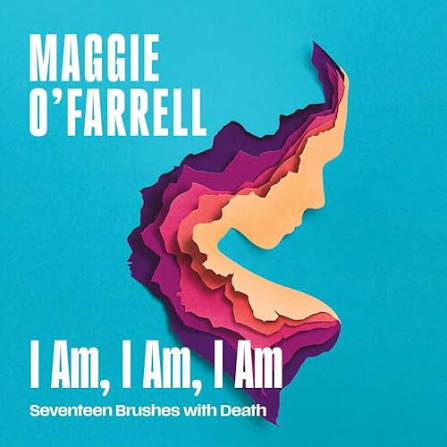
A couple of weeks ago I posted my review of Maggie O’Farrell’s latest novel Land and wrote about seeing her speak at the start of the Manchester Literature Festival, where she talked at length not only about the new novel but about Hamnet and about her 2017 memoir I Am, I Am, I Am. The title draws on the closing words of Sylvia Plath’s novel The Bell Jar in which the deeply troubled main character tries to kill herself several times and experiences extensive medical treatment for mental illness. In O’Farrell’s memoir she writes about her “seventeen brushes with death” after each of which, against the odds it would seem, she manages to survive.
O’Farrell has written and spoken extensively about her childhood illnesses, serious conditions (most seriously perhaps was the encephalitis she contracted around the age of 8) which meant many months of hospital treatment, missed schooling, separation from her family and then, when she did return to school, a sense of distance and separateness from her classmates – she was the child who often needed a wheelchair or was unable to participate in all the usual activities. At the time, being so young, of course, she was unaware of the seriousness of her condition, but nonetheless had a kind of insight into what was going on around her. She is able to recall her childlike observations of medical staff, the matter of fact response to overhearing a nurse tell another child in hospital that she was likely to die soon; too old to not understand, too young to have developed an emotional and philosophical attachment to “life”. And yet, the body endures, pulls through.
The adult Maggie is therefore able to look back on her life as framed in terms of life or death events – each time her luck could go either way. It is striking to me that many of the events here would not, for most of us, be considered a brush with death – a nasty illness or accident can be frightening, leave us shaken, but we might not see it as a brush with death if we had not had a really close brush with death in our formative years. Events like food poisoning in Asia, a knifepoint mugging in South America, even almost having a car boot brought down on her head by her mother when she was young (not interpreted by her at the time as a brush with death, only after her mother told her about it later). This is interesting because towards the end of the book, she writes about instances which speak less of her own mortality and more of her children’s. O’Farrell is a mother of three and it is clear that she sees her own life inextricably linked to that of her children – all parents will identify with this I think, and she captures the sensation brilliantly. The car boot incident has only entered her lexicon as a brush with death since she has had her own children and realised what it feels like when your children’s lives are threatened. As a parent you would give anything to swap places with them.
The final chapter is given over to her daughter. She has a number of severe life-threatening allergies and the author describes to us what her life is like – a kind of exclusion from the carefree life of other children, who can go on play dates without a care, don’t need to worry about who they sit next to when sharing a packed lunch and who can participate fully in all the activities that most of us take for granted. Her life will always be one of extreme caution. As her mother, every threat to her child’s life, is a threat to O’Farrell’s very existence. In some ways the ending is as if she has passed this baton of health concern on to her child, but in another it is about how the risks to the child are an extension to her personal sense of mortality, only much much worse.
This is a poignant, powerful, brilliant ending to the book that had this reader in tears; as the mother of a child with a life-threatening allergy (though not nearly as extensive as O’Farrell’s daughter’s) I could identify strongly with her fears. The ending is also, however, triumphant, on behalf of both herself and her daughter – the human instinct to survive, sometimes against considerable odds, is really quite awesome.
A superb book, highly recommended. I listened to this on audio and found the narration by Daisy Donovan very effective and engaging.


