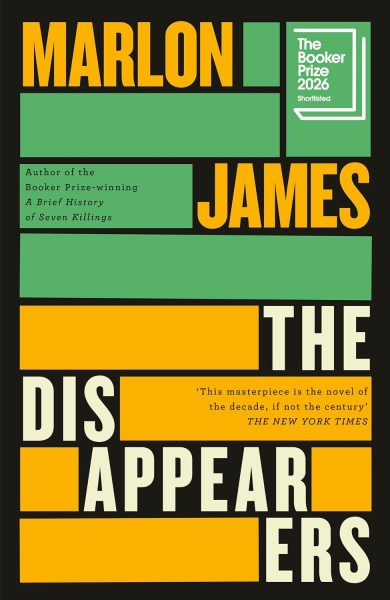
Marlon James won the Booker Prize in 2015 with A Brief History of Seven Killings – can he do it again with this novel? At more than 600 pages it is easily the longest book on the shortlist. I listened to it on audio and really enjoyed the lively narration and felt that was the best way to appreciate the language (there’s a lot of Jamaican patois). It is set mostly in Kingston, Jamaica (though final chapters are set in the United States), largely in the 1980s and early 1990s, when the AIDS crisis was at its height.
The book opens with a group of eight gay men meeting secretly to rehearse for a play. Among them are Eddy Porteous and Jordan Brown, who will be the main narrators as the novel progresses, and Havelock Titus, the group’s Director who has brought them together. They are meeting in secret because of the homophobia they would encounter if they were out. It is not entirely clear why they are meeting at all, except as a way of sharing their love of literature and drama, and as an act of solidarity.
Assembling in this way places them at great risk. One of the things James does brilliantly in this novel is set the scene of deep hostility to homosexuality in Jamaica, driven mostly by the dominance of the church but also by a culture of hyper-masculinity. This is made worse later on by the AIDS crisis, which is seen as God’s retribution for unholy and depraved homosexual activity. The environment of corruption also plays a part – people beaten up because they are gay have no recourse to the law, it might in fact make their situation worse. And gay men are, if discovered, ostracised, even disowned by their families, for whom their child’s sexuality casts a deep stain on their reputation. Within all of this is the deep irony that some of the most violently outspoken opponents of homosexuality, and the most upstanding members of society, are secretly gay themselves. James creates an environment of 1980s Jamaica as deeply hostile to gay people, dangerous, violent and isolating.
James is known for not holding back in his writing from portraying strong sex and violence, and this novel goes all out. For young gay men in Jamaica, the atmosphere of danger and constant threat (both from violent retribution and from deadly disease) creates an environment of hedonism and living only in the moment, not withholding from any opportunity for sexual gratification and maximising pleasure. It is graphic, both the violence and the sex. At times, for me, it was too much. James has been described as the literary equivalent to Quentin Tarantino in his approach to portraying extreme sexual and violent behaviour – when watching Tarantino’s films I often have to cover my eyes!
The group of gay performers is violently attacked, one is killed and another is blinded. There is no follow-up action, though some take revenge into their own hands. The events are recounted through the eyes of a number of those present – one through diary entries, another through interviews with a writer and another through letters. All exhibit deep trauma from their experiences, not just at the hands of a violent mob, but as men who were disowned by their families and communities and have struggled to find peace in their lives. Homophobia has left deep scars.
I found this novel at times very moving, but at times I found I disengaged; sometimes it felt like a point was rendered a little too far and I simply zoned out. I listened to it on audio which really helped my understanding of the language, and the reading performances were brilliant. I realise that graphic sex and violence are narrative choice on the part of the author, and I see its role, but for me, dare I say, it was too much. It did help to convey the sense of the, almost, deathwish of some of the characters, but I did become a little numb to it. I also felt it could be shorter – the excess of the content is matched by the excess of the book’s length.
I suspect this novel might be a strong contender to win the Prize. I recommend it as an important literary achievement, and I particularly recommend the audio version.

