I finished this book the day before the winner of this year’s Booker Prize was announced on Monday. The winner was M John Harrison for his novel The End of Everything. At the age of 81, Harrison is the oldest author ever to win the prize and it comes more than 50 years after he published his first novel. Quite an achievement. I am not familiar with this author’s work, as I believe he mainly writes science fiction, a genre I have not explored much, so I am very much looking forward to getting to this one on my TBR list.
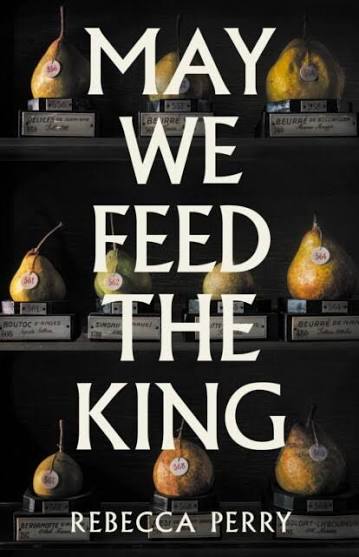
At the other end of the publishing spectrum is Rebecca Perry, a poet and alumnus of the Manchester Centre for New Writing, based in my home city. May We Feed the King is Perry’s first novel and it certainly has poetic sensibilities which make it an interesting and engaging read.
There are two narratives in this book. The central character is a woman who we learn is recently bereaved; she makes references to a likely partner and their absence from her home. She is still deep in grief when she receives a commission from a nearby unnamed palace which is about to celebrate its 500 year anniversary. The woman is a curator by profession and her particular niche is that she dresses historical scenes trying to create a sense of what life might have been like for people in the past living in the environments on display. She takes her work very seriously, is a perfectionist who pays great attention to detail. She is particularly interested in food and dining, what we eat, how and with whom. She believes that the life-sustaining and life-enhancing act of eating enables bridges to be built across the centuries; it is something we must all do and have all done and it has the power to communicate something beyond mere words.
The woman describes at length the particular replica food items she uses and how she uses them, the different kinds of plates that might be used by servants compared to their masters, and how they might eat them – around a banqueting table or lined up at a long wooden board.
It becomes clear that the woman’s employers grow frustrated with her attention to detail and the time taken to complete the work, but she is unapologetic. She finds a companion in the palace archivist who shares her passion.
Detailed ledgers enable her to enter the medieval courtly world, and alongside the curator’s story we are told about a reluctant king who ascended the throne after the unexpected deaths of his older brothers. He is a sensitive man, more interested in the sensuous pleasures of life, food, hunting, art, companionship, than in governing. He is spectacularly unsuited to the role that has been thrust upon him.
The king’s story is told in the middle section of the novel, and when that narrative is complete we are returned to the curator to find that she too has been on a journey, partly of recovery from grief, as she has completed the commission.
I really enjoyed this book and found the richness of the language particularly powerful. The author’s skill as a poet is brought to bear in the spare way that she uses words to create powerful imagery. It is an excellent debut, although I am a little surprised that it was shortlisted for the Booker – there were other titles on the longlist that were more worthy in my view (and Maggie O’Farrell’s Land, Booker judges?!?!) Rebecca Perry is an author to watch and it has made me want to read some of her poetry – she has published two collections Beauty/Beauty in 2015 and Stone Fruit in 2021.


