Book review – “Land” by Maggie O’Farrell

The Manchester Literature Festival kicked off this week and runs until 25th October. I usually like to attend a few events, but will be away for much of the period this year (more of that to follow!). I was fortunate, however, to be able to attend one of the opening events, a talk with Maggie O’Farrell; my book club recently completed her new novel Land, so it was fantastic to be able to go along and hear her speak about it. Maggie O’Farrell is surely one of the finest British authors of her generation and since she is only in her mid-fifties, hopefully has many more years of writing ahead of her. Her career reached a new zenith last year with the release of the film “Hamnet”, which was an adaptation of her 2020 Women’s Prize winning novel. O’Farrell co-wrote the screenplay of the film with Director Chloé Zhao, which itself won many awards, including a best actress BAFTA and Oscar for Jessie Buckley. 
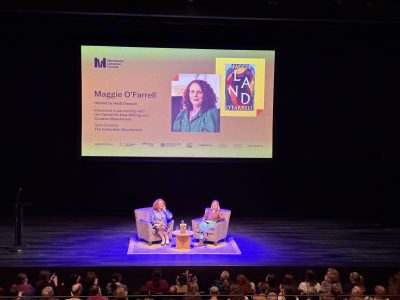
With all that going on, one can only marvel at the work ethic of O’Farrell – how on earth did this mother of three squeeze in another 400+ page novel? Furthermore she has to be one of the humblest most relatable literary giants alive! 

Land might be O’Farrell’s most personal novel to date and at the MLF talk she described the novel as loosely based on one of her own ancestors who, according to family myth (which may also be truth), was the first cartographer to map the island of Ireland in the mid-nineteenth century, in the service of the British government, which Ireland was a part of at the time. She has not been able from her research to confirm all the details of this, as cartographers were not allowed to sign their own name on the maps they produced, but she has nonetheless let her imagination form a story out of a few bare facts. 

The main character, based on O’Farrell’s ancestor, is Tomás who, when we meet him at the start of the novel, is working with his young son Liam, carrying out survey work on behalf of the British army. Liam hates the work, which is very physical. Tomás is passionate about his work and intends that Liam will follow in his footsteps. He is a tough taskmaster and a strict father and it soon becomes clear that Liam has more scholarly ambitions. Tomás is married to Phina, a strong-willed woman whom he fell in love with at the workhouse where they were both resident as children, and they have three children: in addition to Liam there is Enda and Rose. A fourth child, Eugene, will follow. 

The family has its troubles, after he is severely injured in a work accident in which he loses an arm, Tomás goes into a deep depression, through which Phina nurses him. He vows never again to work for the British, and moves the family to a remote peninsula in the west of the country, where they rent a derelict cottage and small piece of land, from which Tomás hopes they can make enough to live on. 

The story is set in the shadow of the Irish famine of the 1840s, which caused the deaths of over a million people and the mass migration of a million more. This catastrophic event changed the social make-up of the country and the physical landscape. The family itself is also deeply impacted – through Tomás’s mapping, which exposes some of the death and destruction, and through the choices made by the individual children as they consider their destinies. 

O’Farrell also weaves in Irish pagan myth and legend – at the MLF talk she shared how she drew on the many stories her father would tell her and her siblings – giving a profound sense of the how the land of Ireland, the very shape and texture, which Tomás is so diligently attempting to record, bears witness to people and stories that go back beyond mappable time. 

This is a multi-layered, complex novel that draws on many ideas and is epic in its scale. But at the heart of it is love – that which exists within the family, that which the Irish hold for the hard-won land beneath their feet, and the deep love that the author has for her family history, which she honours so powerfully in this novel. 
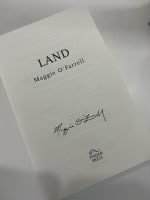
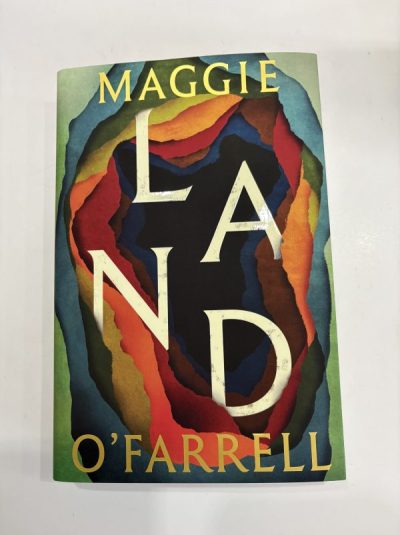
This is a brilliant piece of work that I recommend highly. I was also delighted to obtain a signed copy of the beautiful hardback edition which has the most beautiful cover artwork by Helen Cann. 

**I am baffled that this book did not make even the longlist for this year’s Booker Prize, for which it was eligible. Astonishing!**
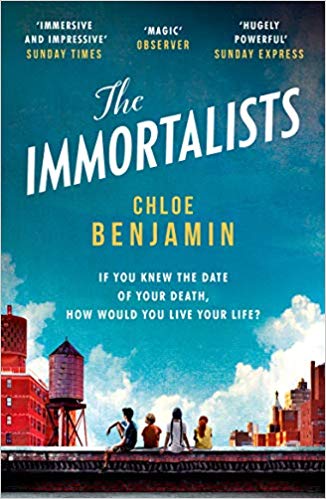
Book review – “The Immortalists” by Chloe Benjamin

I am a huge admirer of authors who can come up with clever, original, twisty plots. As a writer myself, this is, I feel, not one of my strengths, so I am in awe of those for whom it clearly is. Chloe Benjamin, in this novel at least, is definitely one of those authors. The following review contains one or two spoilers.

The Immortalists imgThe novel begins in 1969 with the four children of the Gold family – Varya, Daniel, Klara and Simon – visiting a fortune-teller in her grimy downtown New York apartment, who is said to be able to predict the date of a person’s death. The mystic consults each child privately about their fate. Their reactions vary; Daniel, the second oldest, for example, says he thinks it is all rubbish. The younger children seem more vulnerable and more preoccupied, particularly Simon, who at this point is only seven years old, and who is told that he will die young.

The novel jumps forward ten years when the children’s father, Saul, dies. This leaves their needy mother, Gertie, distraught. It was expected that Simon would continue the family tailoring business, but this is very far from his intention. With the fortune teller’s prediction preying on his mind, he is easily persuaded by Klara to leave New York and make a new life for himself in San Francisco, where, free of family expectations, he can lead a more fulfilling life. Simon is gay, something Klara recognises clearly, but they both know that this truth would be devastating to their traditional Jewish mother. Simon could never follow in his father’s footsteps.

Simon not only moves to the other side of the country, but he breaks away from the family completely, much to the consternation of Daniel, who sees Simon’s behaviour as wilful and selfish. It also means that someone else will have to care for their mother, a role that Daniel expected Simon would take on. We watch with trepidation the hedonistic lifestyle that Simon leads. It is the early ‘80s and there is talk of a terrible new ‘gay disease’. Simon’s behaviour has a kind of death-wish about it.

Spoiler alert!

Simon dies – but that might not really be a spoiler, because you know it had to happen! Once Simon’s death becomes inevitable, the narrative of the book becomes clear. The author teases us by inviting us to consider whether Simon’s death was an accurate prediction by the fortune-teller, or whether being given a date of death drives us towards fulfilling that prediction. To what extent is our destiny within our control, and to what extent mapped out for us? Did Simon in fact escape one kind of destiny (the one his mother determined, life as a tailor in the family business) for another (dying from a horrible incurable disease)?

Next, we are told Klara’s story. Klara is the most bohemian and perhaps the most fragile of the four Gold children. She meets and falls in love with Raj. They have a daughter and after some lean years on the road, they eventually develop a highly successful magic act with a residency in Las Vegas. They call themselves The Immortalists, after their seemingly death-defying tricks. Success is a burden for Klara, however, and this, coupled with her unresolved grief over Simon’s death, leads her into a life of alcoholism. Klara is fascinated by the life story of her grandmother, also a travelling magician, and replicating some of her tricks becomes part of the magic act. Whilst trying to emulate a particularly dangerous one, she hangs herself in a hotel room – deliberately? Was she trying to cheat the prediction?

Daniel was the most sceptical of the children. He is convinced that Klara and Simon’s deaths were caused by the fortune teller’s predictions and, with the aid of a police officer who once met Klara, he hunts down the elderly fortune-teller hoping to bring her to justice. The hunt becomes an obsession for him. I won’t reveal the rest of Daniel’s story.

Finally, there is Varya, who was told by the fortune teller she would live to 88. She is working as a senior biologist conducting experiments into longevity using monkeys. Varya, like all her siblings, has some considerable mental health difficulties. She has severe anxiety and OCD, restricting her calorific intake to prolong her life (as she does with her monkey research subjects) and shunning meaningful human relationships – has Varya become dangerously obsessed with fulfilling the fortune-teller’s prediction? Her world is turned upside down when her favourite monkey becomes gravely ill in the experiment and Varya breaks with protocol in a way that threatens the costly research project, an act which damages her professionally. She also she meets a young journalist, who claims to be interested in her work but who is not in fact who he says he is. Varya’s ordered, controlled life unravels and she must face her demons, not just for her own sake, but on behalf of her troubled siblings too.

The story has a brilliant ending with Ruby (Klara’s daughter), and Gertie, the Gold children’s mother, coming together at the end. I listened to this on audiobook and was totally hooked. It’s a long but extremely satisfying book, so many threads, brilliantly woven together. Some reviewers have said it has too many clichés, others found aspects of the plot contrived, but I absolutely loved it.

Highly recommended.

If you have read The Immortalists I would be interested to know what you thought of it.

If you have enjoyed this post, I would love for you to follow my blog. Let’s also connect on social media.