
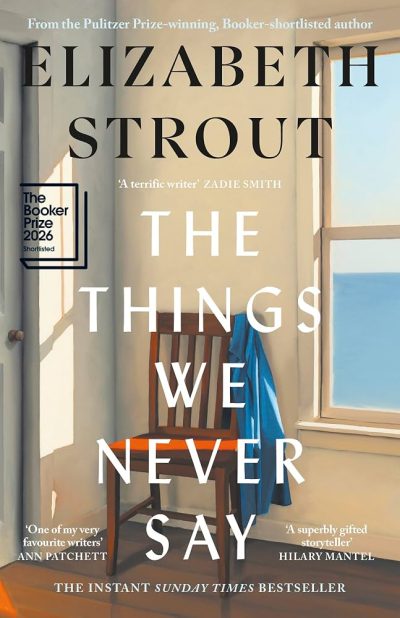
This is Elizabeth Strout’s eleventh novel and takes her away from Maine and the cast of characters with which we have become so familiar, and to Massachussetts in 2024, around the time of the last US Presidential election. It is perhaps Strout’s most explicitly political novel to date. The novel has all the trademark elements of Strout’s writing which readers have come to love. The central character is Artie Dam, a middle-aged history teacher in a high school, beloved by staff and pupils alike, but he is a man disillusioned with life, who feels lonely and, when we first meet him, is contemplating suicide. Arty lives with his wife Evie, a psychiatrist, and their marriage is showing strains often seen in long relationships where people have become complacent. They have one son, Rob, a fragile young man who is in the process of getting divorced from his wife Francesca – she is a concert pianist and her life on the road has meant they have drifted apart. Rob has had a difficult time in relationships, one of his earlier girlfriends having been killed when the car they were in crashed, and which the girlfriend’s parents partly blame Rob for.
SPOILER ALERT
Artie’s world is rocked by two events which I will discuss here, so a bit of a spoiler, but I should add these happen in the early part of the novel – I am not going to reveal how it all resolves. First, Rob reveals to Artie that he is not his biological father – this is in fact a family friend (a man who is now dead and whom Artie was not fond of, though he remains close to the friend’s widow Flossie). In her desperation to become pregnant, and guessing that Artie might be the cause of their infertility, Evie obviously sought help from the family friend, who willingly obliged, and who then, rather spitefully, went on to inform Rob by letter before he died. Rob was about to confront his mother with the information, but when Artie walked in unexpectedly, missed his opportunity.
The second event is that Artie slips from his dinghy when trying to climb aboard his beloved yacht and almost drowns. He is saved by a local man, Ken. Ironically, the brush with death gives Artie a new reason to live and he begins a friendship with the man which will be one of the more enriching parts of his life.
The rest of the novel explores Artie’s relationships – his friendships at work and outside of work, particularly with Ken, and with his students. Artie is increasingly out of place at the high school, his ways seeming increasingly old-fashioned in the world he now finds himself in, but his students continue to respond to his basic human goodness, his care for them, and his commitment to his job. Most of all, however, there is Artie’s relationship with Evie and with Rob. Artie plans to tell Evie that he knows about Rob, but as time passes the couple seem increasingly distant from one another. Evie is absorbed in her own world and seems to have less and less time or patience with her husband. This conversation that they never seem to have, is it Artie’s avoidance, or as time goes by, his disinclination to try and reach her?
In contrast, Artie’s relationship with Rob gets closer; he finds that “the conversation” opens up a channel between them, they find they can communicate better once they have communicated about something ‘real’. Both men know that although they are not biologically related, their connection goes beyond that and is in fact far deeper.
Elizabeth Strout is such a good writer that you think she is telling you a simple story, but she is in fact exploring much more complex theses about what it is to be human, about the need for connection, and about the consequences for us all, as individuals and as members of society, when this breaks down. She even gives us some Jungian philosophy in this one and her characters discuss it without for one moment sounding false, pretentious or unnatural. Her characters come alive on the page, even the minor ones; she has that capacity to give you the whole via tiny details.
I loved this book and found it hard to put down. Highly recommended.

