It has been half term in our household this week. My husband took our daughters off to visit family so I decided that I would take a trip with our eldest, to spend some quality mother and son time together. He will be taking his Spanish A level this summer so I thought it would be good to try and get him to Spain for a bit of speaking practice. I booked the flights three months ago and chose Madrid mainly because we got a fantastic price and the flight times were great. To be honest, though, I was open to going anywhere in Spain; I have been to Barcelona, San Sebastian and the Southern tip around Jerez and Tarifa, and have enjoyed my trips there very much.


Madrid, where both the grand architecture and the narrow streets bring equal pleasures.
Madrid is one of the must-see European cities. There are not too many major ‘sights’ to see, so it is not overwhelming in the same way that, say London or Paris can be (visitors to London: where do you start?), and they are mostly within a compact city centre area. You can take some great trips out of the city, for example to Toledo and Segovia, both within an hour or so, but we decided that remaining central would best suit our purpose. It is a city for walking, eating and art. We took a relaxed approach to sightseeing, soaked up the atmosphere and enjoyed it immensely.


Our companion was the Lonely Planet guide to Madrid (I find these are consistently the best travel books). On the first day we followed the suggested walking tour of old Madrid, taking in, amongst other things, the Palacio Real, the cathedral, the Plaza Mayor and, very importantly, the iconic Chocolateria De San Gines, for the ubiquitous churros and hot chocolate (take a bottle of water with you, it is very rich!)


On the second day we walked round the wonderful Parque del Buen Retiro, the huge park to the east of the city centre, with its wonderful gardens, footpath, boating lake… and more churros! Madrid’s oldest tree, a Mexican conifer planted in 1633 and with a 52m trunk circumference, stands impressively opposite the Puerte Felipe IV entrance. Near the border of the park is the stunning Museo del Prado, which we went to in the afternoon. Most galleries of this stature need two or three visits to even begin to appreciate the collection, but if you are on a short visit it is worth just taking in the highlights, and the museum provides a handy leaflet with all of these listed. Our guidebook recommended going soon after opening to avoid the queues, but we went around lunchtime and there was no queue at all. The cafe in the museum was over-priced and not particularly good.


On the third day we went to the far west of the city centre to the Parque del Oeste. We planned to go on the Teleferico, a 2.5km cable car that travels over the vast green Casa de Campo, but sadly it was closed for maintenance (an issue with low season). We went to the tiny church of Ermita de San Antonio de la Florida (above) where there are some incredible Goya frescos, and the ancient Templo de Debod, a gift from President Nasser of Egypt, dismantled and transported brick by brick in 1968 (sadly, also closed). We walked back along Gran Via and browsed the shops. I always like to get the measure of a place by checking out its bookshops and Madrid has some fantastic ones, with plenty of foreign language books. There was even a bookshop devoted entirely to mountains (Libreria de Montana, above) in the Huertas district!
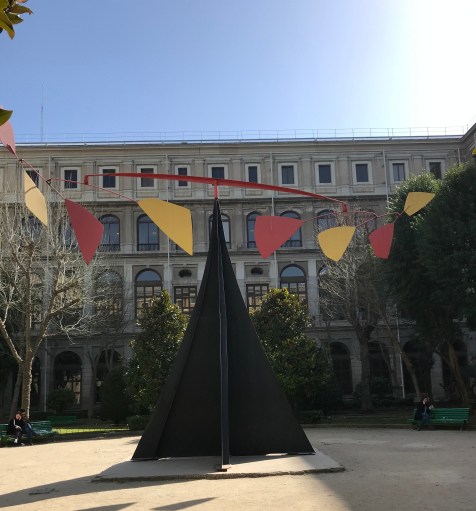
On our final day we had plenty of time before our late afternoon flight to take in the modern art gallery of Centro de Arte Reina Sofia, not far from where we were staying. I was particularly keen to see Picasso’s Guernica, a painting I have long admired. It is truly stunning and I am thrilled to have been able to see it in the flesh, as it were. It is surely one of the finest anti-war artworks ever, and, 80 years after it was created, is as relevant as ever. It was worth the €10 entrance fee on its own just to see this, but there are many other stunning works of art to take in, including films explaining the context and history, and the main highlights are all on the second floor, again, useful if you have limited time.
My son and I are both fairly frugal by nature so I was keen to try and do the trip on a budget. We stayed in a little apartment in the Lavapies district, which was quiet and is great value. You can eat fairly cheaply, because there is so much choice and the quality is reliably good (definitely unlike London!). We spent €50-60 a day on lunches and dinners, including a glass of wine with meals. I bought a 10-journey Metro ticket, but we didn’t use it all up as we were able to walk nearly everywhere. That would no doubt have been less comfortable in the summer. February was a great time of year to go and I would definitely recommend it – the weather was mild and sunny and it wasn’t too crowded. We went to the cinema a couple of times, and I was pleasantly surprised to find tickets were only €5-6 each – that’s even cheaper than my little local cinema! My son found this very useful for his Spanish.
Madrid is a fabulous city, the people are warm and friendly, the food is incredible, it’s great value and I recommend it highly. We are completely churro-ed out though!
Have you been to Madrid – what were your highlights?
If you have enjoyed this post, I would love for you to follow my blog. You can also connect with me on social media using the buttons above.
 In January the theme was a humorous novel and we read Beryl Bainbridge’s
  This third book picks up precisely where volume two left off, at a small book launch for Elena’s first book, a mildly sexual novel which has caused a stir, and where she is being questioned in a patronising way by an obnoxious critic. A familiar face from Naples walks into the room – Nino Sarratore – and Elena’s confidence is restored. Nino has been a friend since childhood, and there is a complicated triangular relationship between him, Elena and Lila, the main but elusive protagonist of all the books. Elena has been in love with Nino since they were young, but this has not been reciprocated. Like Elena, Nino proved to be a successful student, despite the disadvantages of background and upbringing, and would go on to achieve great things academically, though both know that neither is as brilliant as their mutual friend Lila, with whom Nino was once in a relationship, but who would never reach the academic heights of the other two.
 In summary, this book is set in the late ‘60s, early 70s and is about Freda and Brenda, two young women who work together in a London factory where Italian wine is bottled. They also live together in a pokey bedsit, and share a double bed at nights. Freda is blonde, buxom and outgoing, sexually frustrated and of a romantic inclination. She has the hots for Vittorio, the nephew of the factory’s Italian owner, and fantasises about being seduced by him, contriving situations to enable this. Brenda is a redhead, but mousey in personality, timid and sexually repressed. She has left her drunken husband Stanley in the Yorkshire farmhouse which they shared with his domineering mother. Freda and Brenda met after Brenda had a tearful outburst in a butcher’s shop. Freda took her in and got her a job at the factory. Freda can be kind but also cruel and the book is as much about the complex nature of relationships between women as anything else.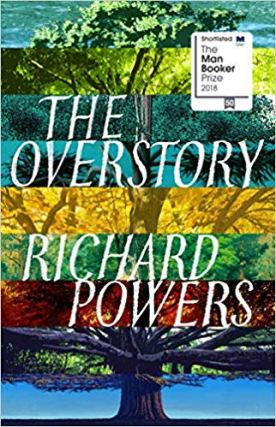



 My book club chose this for our pre-Christmas read (I’ve only just finished it!) and we all thoroughly enjoyed it. It’s long, and perhaps could have been edited somewhat, but I imagine the main buyers of this book will be Michelle-fans who want as much detail as possible. The first part of the book was, for me, the least engaging. My fellow readers and I were a little surprised to learn that Michelle Robinson did not in fact come from an affluent background. She was a ‘Southsider’ – from a part of Chicago that was fairly blue-collar and largely African-American, and became more so as she grew older and some of the white residents moved out. A picture is painted of a family with strong values around hard work, doing the right thing, caring for others and loyalty to family. Michelle excelled in school through hard work, determination and the support of her parents and attended both Princeton and Harvard Law School. She has never forgotten her humble beginnings, however, and this underpins her commitment to equality and social justice. However, I did feel this part of the book was most descriptive; in the context of the book as a whole I can see why it would have been important to her to put her politics in perspective, but it was a tiny bit…pedestrian?
 Despite being outside skiing all day I did get a fair bit of reading done and managed finally to break the back of a book I have been reading for some time now – The Overstory by Richard Powers, the final one of the
  Over the holiday I also completed Michelle Obama’s Becoming. This is a much faster read and very different, though also thoroughly enjoyable. Look out for my reviews of both books over the next couple of weeks.
 For little ones there’s We’re Going on a Bear Hunt on Christmas Eve on Channel 4 (might have to watch that even though mine are now teenagers!). Or the wonderful Paddington movie on 30th December on Channel 4.
 Thomas Hardy’s Far From the Madding Crowd (one of my favourite Hardy novels) is on BBC2 on 23 December, Jane Austen’s Emma (with Gwyneth Paltrow) is on BBC2 on 28 December, Pride and Prejudice (starring Keira Knightley) is on More4 on Christmas Day, and the brilliant 2011 version of Charlotte Bronte’s Jane Eyre (the one with Michael Fassbender as Mr Rochester) is on BBC1 on 2 January.

 Finally, for something a little more up to date, you could try
  Julia's books