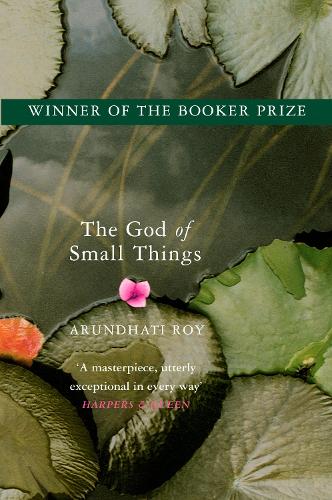
I started this book whilst on my travels in India. I seem to recall reading it when it was first published but remembered very little about it. It was the debut novel of Arundhati Roy and won the Booker Prize that year, becoming an instant classic, catapulting her to international literary fame. Remarkably, she has written only one other novel since, The Ministry of Utmost Happiness, published 20 years later in 2017 (it has been on my TBR list for years!) She has become much better known for her activism and her non-fiction work; she has published more than twenty essays and pamphlets on various topics (for example on social justice, capitalism and the environment) and has become something of a thorn in the side of the Indian political establishment. Last year she published a memoir Mother Mary Comes to Me, which was critically acclaimed. She is clearly a woman of quite formidable talents.
The God of Small Things draws on aspects of Roy’s own life for its subject matter. It is set in Kerala, where the author grew up, though she was actually born in Shillong (which was in Assam at the time but now Meghalaya) in the far north east of the country. Her mother moved back to her homeland of Kerala with her two children after divorcing their father. Like the family in her novel, Roy was brought up as a Christian, which has ancient roots in India but the religion is followed by less than 3% of the population.
The central characters in the novel are girl-boy twins Rahel and Estha, who are aged seven when the novel opens. They live with their mother Ammu (who is divorced from their father), their grandmother Mammachi (widow of an abusive husband), uncle Chacko (an Oxford graduate and committed Anglophile), and grand-aunt Baby Kochamma, superficially a deeply religious woman who carries deep bitterness and who has led an unfulfilled life. The family owns a pickle factory in the city of Ayemenem, a business which Mammachi started but which Chacko now runs. Chacko has a British ex-wife whom he met while studying at Oxford, and they have a daughter, Sophie (cousin to the twins), though Margaret left Chacko for another man (Joe, a British man) before she was born so he has never played any part in her upbringing.
The grand event of the novel is the visit by Margaret and Sophie to India, shortly after Joe’s death in a car accident. So much store is put on this visit, by everyone concerned. For Chacko, it is clear that he hopes there might be some reconciliation which will put him in a good light socially. It is the 1960s and India is still in a post-colonial era where some people still mourn for the trappings of the Raj, and where the caste system (one of the targets of the author’s criticism) remains a dominant feature of the social order. Chacko, as a former Oxford undergraduate, takes deep pride in his social standing, his manner of dress, his anglicised vocabulary and his white (ex-)wife and child. He takes the whole family (except Mammachi) to the airport to meet them and the children’s wry observations of the event, including how they have been dressed up and ordered to behave, are wonderfully comic, whilst also a serious comment on the unhealthy relationship some Indians continued to have with their recent history and erstwhile colonial masters.
We learn from the outset that Sophie suffers a tragic death soon after her arrival, drowning in a nearby river. A seismic event that will undo the entire family. Roy, skilfully and carefully moves back and forth in time in the narrative to show us how this came to pass and how a terrible price was paid by so many, particularly, and perhaps inevitably, the completely innocent. Central to the story is Velutha, a carpenter at the pickle factory, whose family has been connected to the business for many years, and who is a member of the lowest social caste, an “untouchable”. Velutha, however, is a man of immense practical abilities, critical to the running of the pickle factory. The twins also consider him a close friend, and their mother, Ammu, a woman damaged by upbringing and the circumstances of her life, falls in love with him, which the reader knows cannot end well.
This is an extraordinary novel. It clearly did not impact me strongly the first time I read it (did I even read it, I wonder!), but reading it whilst in India made me feel very connected to some of the deep social and cultural streams in that country (I say this in the full knowledge that it is a vast and diverse place). Roy draws her characters brilliantly, particularly the twins, whose childlike perspectives are so perceptive and so naive at the same time. There is a kind of purity to the way they see the world around them. And that purity of sight tells you everything you need to know about the hypocrisy and cruelty of that world; post-colonial trauma mixed with traditions of unjust social stratification create a potent mix in which tragedy can thrive.
A brilliant book which I recommend highly.

