Book review – “The Immortal Life of Henrietta Lacks” by Rebecca Skloot

I’d been reading some books about writing non-fiction (to try and improve my own writing) and I came across this book, extensively cited as a fine example of the genre. It’s a chunky book that I intended to skim read, with a view to getting an idea about structure and the concept of writing about a personal journey, but I quickly became engrossed in the incredible story of Henrietta Lacks, a black woman, mother of five from Virginia, who died in 1951 at the age of thirty-one from an aggressive form of cervical cancer. Without either her consent or knowledge, the surgeon treating Henrietta took some of her cancer cells and passed them on to a colleague who was trying to find cells which would survive long enough outside the human body to be useful for research. The idea of doing this without the patient’s consent seems shocking to a 21st century reader, but remember this occurred at a time of segregation and ethical concerns and patient rights were concepts not widely considered to be essential elements of medical practice.

Henrietta LacksThis may have been unremarkable and probably happened more than we care to imagine, but for what happened next: Henrietta’s surgeon had noticed how rapidly her cancer cells had grown, but when George Gey, the scientist to whom he had sent the cells, received them, he found that they divided and reproduced at a rapid rate, and, most remarkably, seemed extraordinarily robust outside their host, unlike all other cells he had dealt with. Gey soon forwarded cells to other colleagues working in the field and they too found the ability of these cells to thrive truly remarkable. HeLa (the name given to the cells) was born and they quickly became an essential part of research worldwide into therapies not just for cancer but for polio and HIV to name but a few. It is thought that around 50 million tonnes of HeLa cells have been cultivated since 1951.


Meanwhile, Henrietta, died and left behind a widowed husband and five young children, two still in nappies, who would never have any memory of their late mother, and one with severe disabilities who would later be committed to an institution. They were poor; Day, Henrietta’s husband, tried to scrape together a living for the family as best he could while Henrietta’s sisters helped with the children. The family would know nothing of what had happened to Henrietta’s cells.

Rebecca Skloot, the author of this book first learned about the HeLa cells in a science class, but it was not until several years later, reading a research paper that her interest was truly piqued and she decided to do a little more digging. She tried to get in touch with the family and was at first rebuffed, but she became increasingly fascinated, obsessed even about HeLa, and the woman behind the headlines, and what had happened to her family. Eventually, she built a relationship with Deborah, Henrietta’s daughter, who had been an infant when her mother died, and a woman who had never come to terms with her loss.

This book is not just the story of Henrietta and her family, and her cells, it is the author’s journey of discovery of the truth about medicine and science in the second half of the twentieth century. It is also a story about racism and health inequality, about exploitation and greed. The author put years of her life into this book and a glance at the references pages will show you the huge amount of research that went into producing it. It also raises some interesting questions about ethics and consent which may surprise you – you might think the answer to the question “who owns discarded parts of our bodies?” is obvious, but when the complexities of the proposition are explored we see that it is not quite so straightforward.

I expected to skim through this book in a few hours, but I found myself captivated by the story and by the issues it raised. Perhaps there are some bits the author could have left out, but I think it is also pretty clear why she couldn’t!

Recommended, especially if you have any interest in the world of medicine.

Have you ever found yourself becoming engrossed in a book that you didn’t expect?

If you have enjoyed this post, I would love for you to follow my blog. Let’s also connect on social media.

Why I’m giving up negative thinking for Lent

girl-1721432_1920
Image by Jess Foami from Pixabay

Sitting down with the family for our traditional Shrove Tuesday pancake feast yesterday evening, we got into the usual conversation about what each of us was giving up for Lent. We are not at all a religious family; I would describe myself as agnostic, and my children have inherited their parents’ religious scepticism. But we are interested in the bigger picture, and do not demur from Christmas gifts and Easter eggs!

In the past I have given up things like biscuits, or sweets. Scratching around for ideas this year, I suggested I might give up cake, but then remembered that I’m going away for a weekend with a couple of girlfriends shortly so that seemed a bit daft! We talked mainly about food items that might be given up, so what else was there – coffee, alcohol? Well, I don’t really consume a lot of either, but my morning coffee and a glass or two of wine now and then are small but important pleasures, so giving up those seems like reckless self-denial. I questioned my elder daughter about what the point of Lent might be for someone like me (she will be sitting her RE GCSE in a few short weeks and so is very hot on these questions at the moment). She said that for religious people the act of self-denial becomes about that person’s relationship with their god, but for the agnostics amongst us, she could see little benefit beyond it being another opportunity to make some sort of resolution, but which does not last a whole year.

I am very content with my relationship with food, and consider my diet good, on the whole. I don’t have many bad habits (I gave up Newsnight already, which was a terrible wrench, but it was a major cause of too many late nights!) and I don’t smoke, but I’m really not perfect. So, I stopped thinking about my body and started thinking about my mental habits. One of my resolutions for 2020 is to address finally my chronic self-esteem problem. I have been working through a book I discovered in my local library (one from the excellent ‘books on prescription’ selection) called Overcoming Low Self-Esteem by Melanie Fennell. I have ended up buying my own copy because I realise it is one I will want to hang onto for a long time, which seems unfair to other library users, and I find myself scribbling on copious post-it notes throughout.

Overcoming Low Self-Esteem imgThe book incorporates cognitive behavioural therapy techniques into exercises for addressing, for example tendencies to be self-critical. Low self-esteem can lead to debilitating inhibition, irrational fears, in both social and professional situations, and, I believe, can truly limit one’s life experience, achievement, enjoyment in life and personal relationships. I have found it really tough working through this book, particularly the chapters which focus on understanding the causes of poor self-esteem. Thinking about my relationship with my parents, in the aftermath of my mother’s death just a few months ago has not been easy.
 

What has become clear to me already (and with this book I feel I have started on a journey that will last many months) is my tendency to think negatively, mainly although not exclusively about myself, and this has been a source of pain and of conflict at various times in my life. So, I am going to try to give up negative thinking. Even being aware of when it is happening, will probably be a revelation.

I’ll let you know at Easter how I’ve got on, although I hope I won’t then want to go on a negative thinking binge!

Will you be giving up anything for Lent?

If you have enjoyed this post, I would love for you to follow my blog. Let’s also connect on social media.

Books to look forward to in 2020

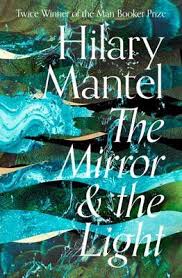
You would have to have been under a literary rock this last week or two to have missed the fact that the final part of Hilary Mantel’s Wolf Hall Trilogy, The Mirror and the Light, will be published on 5 March. An edited extract of the first chapter was published in The Guardian on Saturday – just savour these opening lines:

“Once the queen’s head is severed, he walks away. A sharp pang of appetite reminds him that it is time for a second breakfast, or perhaps an early dinner.”

The Mirror and the Light imgI think we can believe the hype – this is surely a writer at the top of her game! A few lucky critics who have had a preview have already tipped it for this year’s Booker Prize (parts one and two both won in 2009 and 2012). I am a huge fan of Mantel, ever since I read “A Place of Greater Safety”, a novel about the aftermath of the French Revolution. It was the book that really got me back into reading after I’d finished my English degree – I was all ‘read-out’ by the time I graduated, so this book saved me!

I am looking forward to reading The Mirror and the Light although at a stonking 912 pages, don’t expect a review any time soon!

2020-02-24 14.54.26There are many other books to get excited about this year. Isabel Allende’s latest book A Long Petal of the Sea was published in English last month. It is a story about escapees from the Spanish Civil War arriving in Chile in 1939, their evacuation having been organised by the great national poet Pablo Neruda. I was lucky enough to attend a talk Isabel Allende gave in Manchester (with Jeanette Winterson!) a couple of weeks ago and she was every bit as impressive and inspiring as I expected her to be. AND I got a signed copy of the book!
Sebastian Barry’s sequel to the wonderful Days Without End, will be published next month. Called A Thousand Moons it follows the story of Winona, the native American girl adopted by the narrator Thomas McNulty and his lover John Cole. Later in the spring look out for Simon Armitage’s first collection of poetry to be published since he became poet laureate, Magnetic Field. Also, new novels from Tayari Jones, author of An American Marriage, winner of last year’s Women’s Prize, called Silver Sparrow, and Ottessa Moshfegh, whose thriller Eileen was one of the highlights of the 2016 Man Booker shortlist. Her new novel is called Death in Her Hands and promises to be another novel of drama and suspense when a woman comes across a mysterious note in the woods. I am also looking forward to the next Marwood and Lovett novel from Andrew Taylor – I loved The Ashes of London and The Fire Court and am about to start The King’s Evil. This is a really interesting series of books.

Highlights of the summer for me will be a new novel from the wonderful Elena Ferrante called The Lying Life of Adults, about adolescent shame, set, like her Neapolitan novels, in Naples. Also, the final part of Ali Smith’s Seasonal Quartet, Summer; I read Autumn in 2017 when it was shortlisted for the Man Booker, and recently reviewed Winter. Better get on and finish Spring! Another book that will be hotly anticipated this summer will be the new one from Curtis Sittenfeld, author of American Wife, a book I loved. The new one is said to be about Hillary Clinton and is as yet untitled.

Information on what we can expect in the second half of the year is naturally a bit more sketchy, although I believe there are new novels from Caitlin Moran, Nick Hornby, comedian and Pointless presenter Richard Osman, and William Boyd. On the non-fiction front, I am excited by the prospect of memoirs from Manchester’s punk performance poet John Cooper Clarke, and from trans US military whistleblower Chelsea Manning.

So, it looks like my TBR list for 2020 has well and truly written itself!

There will be plenty more releases announced as the year goes on, and I like to post every few months on what’s coming up, so watch this space.

What new releases are you looking forward to this year?

If you have enjoyed this post, I would love for you to follow my blog. Let’s also connect on social media.

Book review – “The Silence of the Girls” by Pat Barker

I was very excited at the prospect of reading this book. For my sins, I have never read a Pat Barker, not even the Regeneration Trilogy, the third volume of which, The Ghost Road, won the Booker Prize in 1995. I knew about it, of course, and I think I bought it at some point (though I have moved so many times in my life that I cannot lay my hands on it now!) What I also knew about Pat Barker was that she was born and went to school in Stockton on Tees, a much-neglected part of the country, where I also lived for 12 years and where all my three children were born, and where I still have many friends. She was born to a young single mother but was brought up by her grandparents and lived a stereotypically working-class life until her academic ability set her apart and she was selected to attend grammar school. Barker started writing at a young age but her first novel was not published until she was forty. She is the same age as my mother, who died shortly before I started reading this book a few months ago. I love the ‘Pat Barker story’, feel a deep admiration for her (even though I had not hitherto read any of her books) and felt in some ways a connection with her; the working-class girl made good.

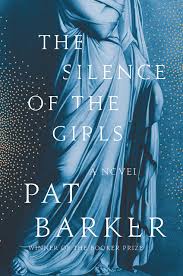
The Silence of the Girls imgThe Silence of the Girls has been critically-acclaimed and was shortlisted for last year’s Women’s Prize for Fiction. I really, really wanted to love this book, but I’m afraid I didn’t. It could be that the timing was wrong – December for me was mad busy so I read the book in short bursts over a longish period when I was quite stressed. I don’t think I gave it the time and attention it deserved. But then, neither did it really grab me when perhaps it ought to have done.
The book is a retelling of Homer’s Iliad but from the perspective of some of the women involved, primarily that of Briseis, the wife of King Mynes of Lyrnessus, the Trojan city sacked by the Greeks, led by Achilles. As a reward to the victors, the women of the city are given out to them, essentially to live as their sexual slaves. Briseis is given to Achilles and narrates the story, although it is very much her internal reflection as she plays almost no verbal part in the proceedings she observes – the banquets, the post-battle analysis by Achilles and his fellow warriors, the political machinations, primarily between Achilles and Agamemnon, and the mental strife of Achilles – hence the concept of ‘silence’. Her perspective and her account veer between the lofty, primarily Achilles’ self-doubt, his longing for the reassuring presence of his mother, the sea-nymph Thetis, and his conflict with Agamemnon, and the brutal visceral reality of war. At one point, Achilles gives Briseis to Agamemnon, although their relationship is not consummated and because of this Achilles later accepts her back.

Briseis fantasises about escaping, even comes close to achieving it at one point, but she is all too aware of her very precarious position. Even though her life is demeaning and not secure, she will always be an outsider and therefore a threat, she grows strangely close to Achilles, seeing his vulnerability and, eventually, the fragment of care he appears to have for her.

There is something of a fashion for retelling tales from the ancient classics at the moment; Daisy Johnson’s Everything Under, which was shortlisted for the 2018 Man Booker Prize, is a modern take on the Oedipus myth (I was not mad about that either), and Madeline Miller’s Circe, which I haven’t read, also takes Homeric mythology as its subject. The ideas are interesting, but somehow, for me, The Silence of the Girls just doesn’t quite work. I loved how ‘down and dirty’ it was, giving us perhaps the real insight into life at the time of the Trojan wars, rather different to the heroic presentation we get from Homer. But that ‘realism’ then jarred with, for example, Achilles’ seeking out his mother in the sea. These were parallel universes that collided in the novel, but there was no bridge between them, nothing to help me imagine that great myth and brutal, visceral reality could co-exist.  Perhaps that was a failure of my imagination! I also just could not get inside the author’s head in some of the scenes she created. The small domestic scenes, in Achilles’ quarters, the bedroom, even the hospital wards and the buildings where the women worked, were well-drawn, but I couldn’t quite see the bigger scenes, the ships at anchor, the battles, the idea of going to war as a daily job of work, from which combatants return, minus a few casualties, just did not quite ring true. And this lack of, for me, authenticity, clashed with the hyper-real scenes of blood, guts, mud and sex (for which read rape, because that’s what it was).

I’m not sure where I’m at with this book. Perhaps it was a grand ambition that just didn’t quite come off for me. I will read Regeneration and Union Street. I will delve deeper into Barker’s work, but as an introduction to her, this one, for me, was a bit disappointing.

Recommended if you’re a fan or a classicist.

What did you think of The Silence of the Girls?

If you have enjoyed this post, I would love for you to follow my blog. Let’s also connect on social media.

Book review – “Gone Girl” by Gillian Flynn

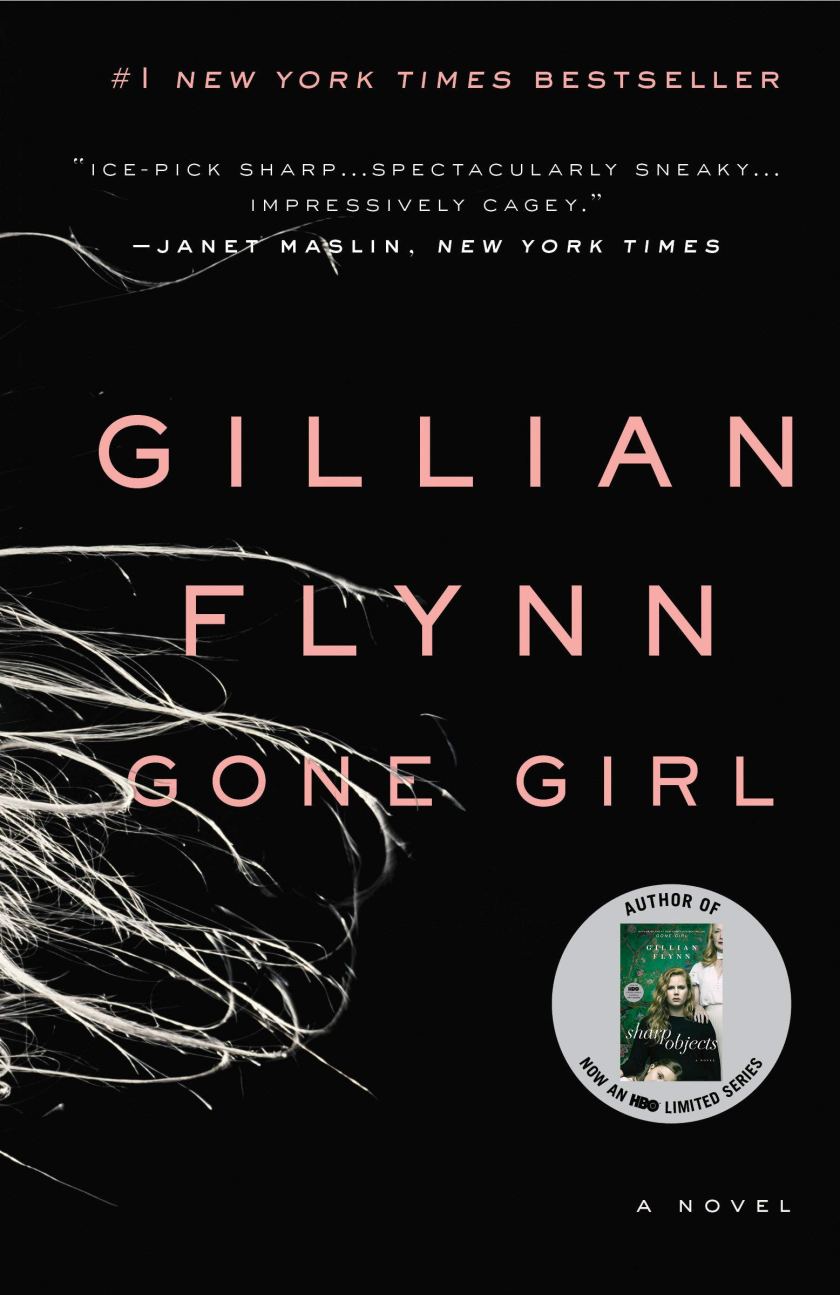
I am not a big fan of thrillers – they aren’t usually my reading of choice – which is the only way I can explain how this book passed me by when it was first published eight years ago. I have also, in the past, eschewed big bulky paperbacks in favour of something a little less…popular! When I launched my 2020 Facebook reading challenge a few weeks ago, January’s theme was a major title from the last decade and Gone Girl was undoubtedly that. It spent several weeks at number one on the New York Times bestseller list, and sold over two million copies in its first year of publication alone. If you read any reviews of the book, you will see how difficult it is to write about without spoilers and that is something I too am going to find challenging here. I will simply start by saying – OH MY GOODNESS, WHAT A BOOK!!!

Gone Girl imgThis book grabbed me by the throat right from the outset; I listened to it on audio (fantastic performances from the actors Julia Whelan and Kirby Haborne, by the way) and simply could not ‘put it down’. I got a lot of exercise in January, because going for a walk became an excuse to listen to a few more minutes’ worth!

Our two main protagonists are Nick Dunne, an out of work writer from Missouri, and his wife Amy Elliot Dunne, from New York, the only child of two psychologists who made a fortune from a children’s book series, Amazing Amy, about a perfect little girl navigating her way in the world, making perfect decisions among imperfect other people. Amy, a psychology graduate like her parents, also chose a writing career though hers is more prosaic than Nick’s, she writes personality quizzes. They meet at a party, get together, get married and share an apartment in Brooklyn, bought for them by Amy’s parents. They have a seemingly perfect life until a number of events force them to move back to Nick’s hometown. First Nick and then Amy, lose their jobs, a result of the shake up in the publishing world brought about by the internet. Then, Nick’s mother becomes terminally ill with cancer and his twin sister Go (short for Margo), asks them to return to help take care of their mother and their father who suffers with Alzheimer’s and lives in a care home. Finally, Amy’s parents run into financial difficulty and ask Amy to give them the money from her Trust Fund. It also transpires that the house they had given the couple was heavily mortgaged and they can no longer afford the repayments, so it will have to be sold.

Nick and Amy have nothing to keep them in New York so they move back to Carthage, Missouri, rent a modern house on a ghost estate where most of the properties lie empty, unsold since the economic downturn of 2008. Nick invests most of the remaining money they have (Amy’s money) in a bar with his sister.

Although I have set the scene here, as readers we are not in fact given all this information from the outset; it is drip-fed to us throughout part one. One of the most astonishing elements of this book is its brilliant structure. Amy disappears from their home at the very start of the book, on the morning of their fifth wedding anniversary, in what at first seems to have been a violent bloody struggle. The chapters are narrated by Nick and Amy in turn; his chapters are reflections on the recent weeks, months and years of his life with Amy in the aftermath of her disappearance, and his dealings with the detectives investigating Amy’s disappearance, and her chapters are extracts from her diary, going back to the time the couple met. The police have not yet found the diary. In this first part we learn much about the couple’s history, but also about their respective feelings about their relationship and about each other. As a reader you get drawn into the complex workings of what was a difficult marriage for both of them, but in different ways, their respective efforts to make it better and how these fared. I found myself constantly torn between the two, first on her side, then his. It’s a roller-coaster! Towards the end of part one, the inconsistencies begin to emerge and it becomes clear that not everything is quite what it seems.

I can say little more than that without giving away the plot, and the twist is such a breathtaking thing that you really need to enjoy it! I thought the characters were brilliantly drawn, all the way from Nick and Amy down to the police officers involved in the case. The book is fantastic as a straight-up thriller, but also says a lot about sexual politics, both within relationships and in wider society. The author does not take sides, and no-one comes out of it particularly well.

I thoroughly enjoyed this book and highly recommend it, although chances are you’ve already read it! I’m keen to watch the film now, although I’m told, and I’ve read, that it’s not as good. They rarely are!

I would love to know what you thought of Gone Girl, if you have read it.


Care to join me this month on my Reading Challenge?

Regular readers of this blog will know that I have an annual Facebook Reading Challenge, a little group where I try to push my reading boundaries. Each month I have a different theme; last month, in the spirit of the new decade, the theme was one of the biggest books from the last decade. I chose Gillian Flynn’s Gone Girl – I’ll be posting about THAT in the next couple of days. Phew! What a page-turner!

This month the theme is non-fiction and I was planning to take up a suggestion from a fellow Group member, when I happened to be in the bookshop and this title jumped off the shelf at me – Man’s Search for Meaning by Viktor E Frankl. It is described on the blurb as one of the classics to emerge from the Holocaust, a tribute to the triumph of hope. If, like me, you were deeply moved by the speeches delivered by Holocaust survivors at the 75th anniversary commemoration of the liberation of Auschwitz last week, this does seem like a fitting time to read such a book. 2020-02-06 12.42.07

And at the moment I feel I need some encouragement that hope triumphs, given the problems we are all facing. I’m afraid the departure of the UK from the European Union, and in particular the division it has wrought upon this nation, troubles me. There does not seem to be anyone on the planet at the moment capable of leading the world out of the climate crisis, except Sir David Attenborough, and he is 93 years old. As for politics, well across the world the post-truth era seems to have well and truly embedded itself.

So, I’m hoping that Dr Frankl will help me to see the bigger picture and give me some hope back!

It’s a fairly short book, for a fairly short month, so if you’d care to join me, you would be very welcome!


Book review – “Winter” by Ali Smith

This was the first book I started in the new year and I am delighted to have read it in January, the deep British midwinter, when the light is scarce but the days pass by at what seems like a snail’s, or at least a hibernating creature’s pace. That seems about right to me – I can’t really understand the wave of bloggers and columnists who are currently bemoaning the slow passage of January; I don’t really want my life to flash by me! Whilst Winter is a complex and multi-layered novel, it does seem to me to be one of the dominant themes, that is, our tendency to be propelled ever faster (I’m deliberately avoiding the term ‘forward’) on to the next thing. This might mean that we fail to notice what is in front of us, the life we have and are in right now, and we are in grave danger of losing something precious as a result.

In the same way that the first part of Ali Smith’s seasonal quartet, the Man Booker-nominated Autumn, was a highly political book, written in 2016 and described as the first post-Brexit British novel, so the ‘winter’ of this book refers to the perilous times in which we find ourselves. For many of us, these are indeed dark times where the alienation of anything ‘other’ seems to be a movement gaining traction. Bernardine Evaristo explored similar themes in her Booker prize-winning Girl, Woman, Other.

Winter imgIn Winter, Ali Smith examines the ideas through the dynamics of a family thrown unwillingly together at Christmas. Sophia lives alone in a large house in Cornwall. She was a successful businesswoman but, now late in life, finds herself alone, estranged from her sister, not knowing what is going on in the life of her only son in London, and navigating with despair some of the dehumanising aspects of modern life. When we meet her at the start of the book, she is communicating with what I can only describe as a hallucination of a child’s head, which floats about with her. To the reader, this seems surreal at first, but it gradually becomes merely a manifestation of Sophia’s mental state – her deep loneliness and her disconnection from normal life and society. Arthur, Sophia’s son will have similar hallucinations later in the book. Sophia goes about her Christmas Eve business in the town with sadness, recalling the once vibrant high street that is now a series of boarded-up shops, frustrated at being unable to withdraw money from her own bank account and the inability of the young man in the bank to appreciate or meet her needs as a customer – she has nostalgia for the days of the friendly bank manager.

Arthur, Sophia’s son, living in London, seems to have a similarly depressing existence. He works as a researcher for a legal firm, but has very little human contact with anyone there as all his work is done remotely. He also writes a blog, ‘Art in Nature’, but this has been sabotaged by his estranged girlfriend, Charlotte, who has also stolen his laptop, forcing him to work out of the local library, where he has to negotiate queues of others wanting to use the computers there. Arthur, or Art, is due to be spending Christmas in Cornwall with Charlotte and his mother, but Charlotte has now left him, and, unwilling to reveal this to his mother, he pays a young woman, Lux, whom he meets at a bus stop, £1000 if she will go to Cornwall with him and pretend to be Charlotte.

The third member of Sophia’s family to join the party is Iris, Sophia’s estranged sister. Whilst they were close growing up, they grew apart as Iris became more of an activist, involving herself at Greenham Common, living in squatting communities with artists and outsiders, going to Greece to help with the refugee crisis, all of which straight-laced and ‘proper’ Sophia despised.

Lux, the heavily pierced, highly educated non-British outsider, takes on the role of objective observer, reflector, and questioner, and becomes the catalyst for what is initially, a breaking down of the fragile family relations, which then makes way for a greater empathy, between siblings and between generations, and an opening up of previously taboo conversations. In Lux, we see how the outsider is in fact the one with the under-valued talents, with the insights which help everyone to drop their guard and open their hearts, and with the intelligence and knowledge which enables them to understand their own cultural inheritance.

There are times when I found this book challenging and disjointed – Sophia’s floating child’s head at the beginning was puzzling – but the more I read the more absorbed I became in its complex layering of themes and ideas. For one reason and another I read it quite slowly over a couple of weeks, but that was exactly the right pace because the sensation was completely in line with the long slow stretch of winter. I am looking forward to reading part three of the seasonal quartet Spring, which was published last year, and to the publication of the final novel in the series, Summer, due in July.

This is a challenging book but one which I recommend highly.

What sort of books do you like to read at this time of the year?

If you have enjoyed this post, I would love for you to follow my blog. Let’s also connect on social media.

Parents and children in literature

We learned last week of the death of  Christopher Tolkien at the age of 95. Although he was a renowned Oxford scholar of Old and Middle English, the obituaries that I read, and the tributes I heard on the radio, tended to focus on his rather more famous father, JRR Tolkien. Not unreasonable; he was, after all, chief custodian, curator and champion of his father’s literary archive after his death in 1973 and from all accounts he was pretty well-adjusted, not seeming to have suffered any lack of self-confidence or self-esteem as a result of his eminent parent.

Christopher Tolkien
Image CNN.com

The same cannot be said of other children of famous or high-achieving parents: the two children of Sylvia Plath and Ted Hughes seem to have experienced great unhappiness – Nicholas hanged himself in 2009 and their daughter, Frieda, a poet and painter, moved far from her UK birthplace to become an Australian citizen and is three times divorced. I reviewed The Prime of Miss Jean Brodie a couple of weeks ago and learned that Muriel and her only son became estranged, her having left her husband and child not long after she married in 1937, and Doris Lessing also left her husband and two young children to pursue her literary career. In Lessing’s case, I am not aware of what impact the separation had on the children longer term, and, I hasten to add, I make no judgement. It cannot be easy, though, growing up in the shadow of a famous, high-achieving literary parent.

It got me thinking about parent-child relationships explored in literature and I decided to write a list! Here are my top picks (in no particular order):

This slideshow requires JavaScript.

  1. Oranges Are Not The Only Fruit by Jeanette Winterson – based on the author’s own difficult northern childhood
  2. Educated by Tara Westover – a memoir from the child of religious zealots
  3. A Little Life by Hanya Yanagihara – harrowing novel shows us how a lack of nurturing in childhood leaves its main protagonist deeply damaged
  4. Pride and Prejudice by Jane Austen – an awful meddling mother and impotent father cause chaos in their daughters’ lives
  5. Dombey and Son by Charles Dickens – most of Dickens’ novels focus on family relationships but this for me is one of the darkest
  6. Sons and Lovers by DH Lawrence – an unhealthy relationship between mother and son blights a young man’s future
  7. Eleanor Oliphant is Completely Fine by Gail Honeyman – a woman suffering in the shadow of a toxic parent
  8. Hot Milk by Deborah Levy – a brilliant study of a young woman trying to escape the straitjacket of life with a domineering and emotionally manipulative parent
  9. Wuthering Heights by Emily Bronte – among his many other misdemeanours, Heathcliff would surely be found guilty of child cruelty today!

I’ll no doubt think of a few more in the coming days!

What are your favourites?

If you have enjoyed this post, I would love for you to follow my blog. Let’s also connect on social media.

Audiobook review: “Ashes of London” by Andrew Taylor

Regular readers of this blog will know that I am a big fan of audiobooks. Having said that, it doesn’t work every time for me; the narrator is vital and I struggled listening to 1984 as I could not get beyond the fact that the reader was Andrew Winnicot…or Adam Macy from the The Archers, which I listen to avidly! Recently, I have enjoyed The Handmaid’s Tale on audio, I listened to all of Elena Ferrante’s Neapolitan series, with the sublime Hilary Huber, and I am currently listening to Gone Girl, the January book in my Facebook Reading Challenge, (which I am finding totally gripping, by the way).

Ashes of London imgA book I listened to at the end of last year was Ashes of London by Andrew Taylor. I borrowed it from the library when it was first published in 2017 but did not manage to get through it before I had to return it for someone else. It is a historical thriller set at the time of the Great Fire of London in September 1666 and is the first in Taylor’s Marwood & Lovett detective series. I have not yet read (or listened to) the second and third books in the series, both of which were published last year, but they sound intriguing.

James Marwood works as a junior reporter on a newssheet, situated at the centre of courtly London life. Marwood lives with his elderly and increasingly senile father, a former printer and ‘Fifth Monarchist’ (a Protestant sect which believed the monarchy would fall and Christ would return to earth to rule), whose followers were considered criminals after the triumph of the Monarchists in the English Civil Wars. Marwood is asked to report on the aftermath of the Great Fire in various parts of the city and the rebuilding projects, but he soon becomes embroiled in the case of a missing person, the niece of a gentleman, Cat Lovett.

Cat Lovett, is a young woman sent to live with her uncle and step-aunt in Holborn, after her father, a convicted regicide (plotter against the monarch), became a fugitive. She is due to be married to an odious dandy, and much older man, but then her step-aunt’s son rapes her. She fights back, mortally wounding him, and, realising the danger she is now in, decides to escape and take her chances on the streets of London, hoping eventually to track down her father. An elderly servant, who had known Cat from childhood, is presumed guilty of the attack on the son and is flogged to death.

When James Marwood and Cat Lovett’s paths cross, inadvertently and fleetingly, he finds he is drawn by personal curiosity into the search for her. He realises early on that all is perhaps not what it seems in the household with the uncle and step-aunt. He suspects foul play and when he is then sent to investigate the cases of two bodies dumped in the Thames, he comes to believe that all these events are linked.

What follows is a complex thriller with a multi-layered plot, strong characters and the weaving-in of comprehensive historical knowledge of the period. I learnt a lot! It all leads to a thrilling denouement – not ideal when you’re listening whilst driving! – in the half-built St Paul’s Cathedral. I absolutely loved this book and recommend it highly. I’m delighted to inform you that it is also available for free on Kindle Unlimited!

This slideshow requires JavaScript.

I’m looking forward to reading or listening to the next two books in the series, The Fire Court and The King’s Evil.

PS The narrator on this one was great!

If you have enjoyed this post, I would love for you to follow my blog. Let’s also connect on social media.

Book review – “The Prime of Miss Jean Brodie” by Muriel Spark

150120Last week I launched my 2020 Facebook Reading Challenge and promised I would post this week, my thoughts on the final book of 2019 – The Prime of Miss Jean Brodie by Muriel Spark. The theme for December was a novella – I wanted something short as I know it is a busy time of year and I never get as much reading done as I think I’m going to! In some ways, though, this does not do full justice to what is a highly complex, multi-layered and thematically dense piece of work. You simply have to read every word on its 127 pages and read them at the measured pace of how you imagine Miss Brodie might speak.

Dame Muriel Spark is considered one of the finest writers in English and one of Scotland’s finest writers. She won many glittering international literary awards in her life, and was made a Dame in 1993. She was married briefly, just prior to the outbreak of the Second World War, during which time she gave birth to a son, from whom she later became bitterly estranged. In the 1960s she lived in New York and in Rome, where she met her long-term female partner. The couple settled in Italy, where Dame Muriel died in 2006 at the age of 88. Quite a life!

Muriel Spark
Dame Muriel Spark

I think the author’s background makes this novella all the more interesting because it is such an ‘Edinburgh’ book – I say this as a non-Scot, so please forgive me if you disagree! – or at least, an Edinburgh of a certain time (pre-war). Spark left Scotland quite early in her adult life and her father was a Lithuanian Jew. Perhaps this makes her acute observation of Miss Brodie and her other characters even more profound.


You will probably know the basic plot of the book; the 1969 film starring Maggie Smith is widely considered a classic. There was also a television series made in the late ‘70s starring Geraldine McEwan, which I vaguely recall having seen, though I was very young at the time – I definitely would not have ‘got’ it; although the book is set in a girls’ school, Malory Towers it most definitely is not! Miss Brodie initially cuts a dominant and impressive figure – determined to influence a selected group of pre-pubescent girls about the broader aspects of life which she feels the school curriculum neglects, such as genuine appreciation of art, social and cultural awareness and matters of the heart (or, more accurately, matters of sex). The strictures of the girls’ school, with its emphasis on knowledge, facts required to pass the exam for the secondary level, and the protestant ethos are seen by Miss Brodie (so she tells us) as narrow and not a true preparation for life. She tells the girls:

“I have no doubt Miss Mackay [the headmistress] wishes to question my methods of instruction. It has happened before. It will happen again. Meanwhile, I follow my principles of education and give of my best in my prime. The word “education” comes from the root e from ex, out, and duco, I lead. It means a leading out. To me education is a leading out of what is already there in the pupil’s soul. To Miss Mackay it is a putting in of something that is not there, and that is not what I call education, I call it intrusion, from the Latin root prefix in meaning and the stem trudo, I thrust. Miss Mackay’s method is to thrust a lot of information into the pupil’s head; mine is a leading out of knowledge, and that is true education as is proved by the root meaning.”

maggie smith
Dame Maggie Smith as Jean Brodie in the 1969 film

At first, we may see these girls as lucky to have such a dynamic, interesting and strong female personality in their young lives who, for example, is prepared to take them to the theatre off her own bat. What we gradually learn, however, is that the girls are merely Miss Brodie’s ‘project’, that it is not altruism and genuine care that drive her, rather it is her ego. She manipulates the girls, in some cases to their tragic detriment, and they become a vicarious extension of her own ambitions and disappointments, particularly in the matter of sex. Here, she acts as little more than a ‘pimp’, though I am aware this may be a 21st century reading of what may have been regarded at the time as less shocking (a sexual relationship between one of the girls and the married one-armed art master with whom Miss Brodie is herself in love).

In the end we can only see Miss Brodie as disappointed, disappointing, manipulative and manipulated, a deceiver and ultimately deluded. She becomes increasingly troublesome morally, as she expresses her admiration for Mussolini and fascism, and the various fates of the girls she once sought to educate are laid out before us.

This is such a clever book which I would encourage anyone to read. And read again once you’ve got to the ending!

Recommended.

If you have enjoyed this post, I would love for you to follow my blog. Let’s also connect on social media.