Last week, I wrote on here about the difficulties so many of us are having dealing with the pandemic and all its ramifications, and how reading can provide an antidote to that. I had some nice responses to that piece so I’m glad it struck a chord with a few people. This week in the UK we have surpasses the total of 100,000 lives lost to Covid-19 (although some argue that the data show we actually reached it two weeks ago). And it seems there are likely to be many more deaths before the pandemic is over and many more people whose lives will have been altered by contracting the virus.
I don’t know about you but one of the things that I have found most challenging in the last year is a shortened attention span. That has at times included my reading too, and, talking to a friend earlier this week, who shared my feeling on this, I think it’s down to being surrounded by fear and a sense of danger. We are in ‘fight or flight’ mode so much of the time, feeling uneasy in the presence of an unseen threat that could be deadly to ourselves or our loved ones. Our biology is not allowing us to relax into all the spare time we have because we need to be constantly alert.
So, don’t feel guilty if, like me, you cannot focus on anything for very long, haven’t cleared out the loft yet or completed that novel! And if a big chunky novel is beyond you, why not try something more petite? Over Christmas, (which was also crazy busy, for me, felt like I was feeding the five thousand, not five!) I did something I rarely do – I read a load of short stories! It is not a genre I have embraced very much, to be honest, and I realise now what I have been missing. They can be perfect little gems that give you exactly what you need in a small package without weighing too heavily, like one of those lovely little snacks you get in Italian coffee shops.
I read the following and loved them!
A Christmas Memory by Truman Capote

This was a revelation! Of course, I knew about Capote – Breakfast at Tiffany’s is one of my favourite books, seeing the film for the first time years ago gave me a lifelong girl-crush on Audrey Hepburn, and I loved also the late Philip Seymour Hoffman in the biopic Capote, which covers the period during which the author wrote In Cold Blood. I have learned the term ‘Southern gothic’ which Capote is said to write, and the stories in this volume are superb! An absolute joy to read any time of the year. My favourite was Jug of Silver, written in 1945, about a poor young boy from the wrong side of the small town of Valhalla in Alabama, who takes part in a competition at a local drugstore to guess how much is in a glass jug. The boy pays his fee to take part and tension builds over several weeks as he sits and stares at the jug, his little sister convinced he is going to win the prize. I won’t tell you what happens, but it will warm your heart! There are four other stories in this collection and they are all excellent.
The Adventures of Sherlock Holmes by Arthur Conan Doyle

I’m not a huge murder-mystery fan (though I am a recent convert to Agatha Christie!) so have never got around to reading any Conan Doyle, but I loved these. Perfect little nuggets to sit down with if you have a spare half hour. You can get lost in the Victorian setting. There are twelve stories in this collection and you can pick volumes up very cheaply (particularly on Kindle). Some of the scenarios are very contrived, but that just makes them fun. The best part of them is the development of the characters of Holmes and Watson and their relationship. I am minded to move onto one of the full-length novels now, to see how this plays out in a longer form. I have also lined up the television series Sherlock on my streaming list!
A Maigret Christmas & Other Stories by Georges Simenon
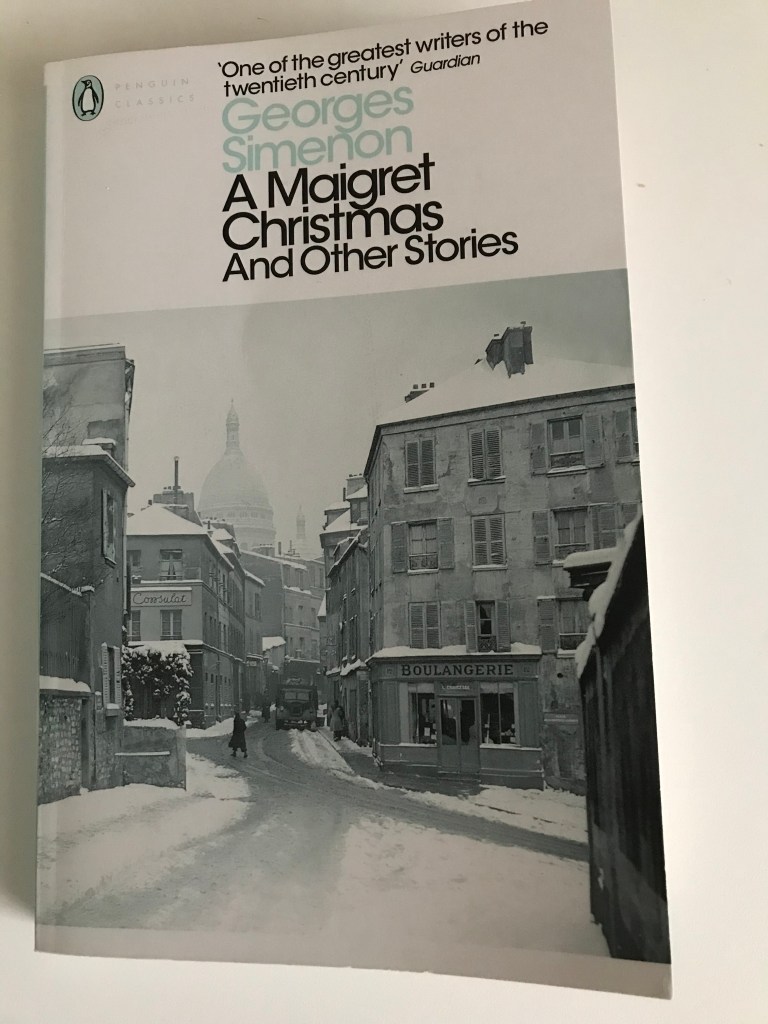
My husband is a French speaker and a Simenon fan, and I have read many reviews on the Red Lips and Bibliomaniacs blog which have piqued my interest. There are three stories here, all set around Christmas-time, evoke brilliantly a seamier side of Paris, especially one cold and deserted for the festive season. Simenon explores the dark underbelly of society in these stories. Only the first of the three is a Maigret story and I would like to read more, though this wasn’t my favourite in the volume. I liked Seven Small Crosses in a Notebook where the central character is a rather geeky loner, under-estimated, but whose vigilance solves a crime where his own nephew is a missing person and his brother is accused of murder. It’s clever, portrays the characters and their relationship really empathically, and has a nice ending.
After dabbling with these, I will definitely read more short stories. It was nice to be able to sit and read something quite short, without it being a huge commitment and feeling a sense of both achievement and satisfaction at completing a story in one sitting.
Highly recommended.




 In The ABC Murders Poirot is involved in a cat and mouse game with a serial killer, someone who warns in advance where and when he will strike, taunting our Belgian hero; the murderer begins with middle-aged shopkeeper Mrs Alice Ascher in Andover, then flirty young waitress Betty Barnard in Bexhill-on-sea, and so on. In this novel Poirot is past his career peak and his approach is challenged as somewhat old-fashioned in the form of Inspector Crome, an ambitious young detective who prefers more modern methods in his investigation. The murderer, however, pits himself squarely against our ageing Belgian hero; it is, unusually for the Poirot novels (it seems to me), a psychological game between perpetrator and hunter.
 Last month, the theme of the Reading Challenge was ‘Something from Africa’ and I picked the debut novel of contemporary Nigerian writer Lola Shoneyin The Secret Lives of Baba Segi’s Wives. If you were able to read along with me, I hope you enjoyed the book – I loved it! Shoneyin, previously a published poet, released this novel in 2010 and it was longlisted for the Orange Prize for Fiction in 2011. Described as a feminist author, I thought the book was clever in the way it portrayed the patriarch Baba Segi and his polygamous household where, though he is referred to by his wives as “Lord” and “King”, he is in fact a fool deceived by the much cleverer women around him. The book begins in comedy, but its ending is much more sober and ambivalent.
 July’s theme is ‘Something from the Americas’. I always had South America in mind here and it was hard as there is so much to choose from among the great classics by Isabel Allende, Mario Vargas Llosa or Gabriel Garcia Marquez, to name but a few. However, I really want to explore something more contemporary and less of a household name outside South America. I’ve chosen a book by Argentinian crime and mystery novelist Claudia Pineiro – Betty Boo. This was first published in 2011 in the original Spanish and then in English translation in 2016. It’s available in paperback and on Kindle.
 I really enjoyed Zennor in Darkness. It is a great story, two stories really, which become intertwined. Clare Coyne is the only daughter of widowed Francis Coyne, and the pair live together in the small town of Zennor in Cornwall. Clare’s mother was born there and the family moved from London when Clare was a baby in order to be near family. Clare’s father’s family had a higher social status, and Clare is clearly ‘different’ from her Cornish cousins, grandparents and aunts, with whom she has spent so much time, but Clare is largely disconnected from her paternal grandparents. Francis Coyne is an ineffectual character, a botanist who earns very little money from his publishing, who spends more time with his books than with his daughter, and who does not seem to understand her on any level. Clare has artistic ability and is a talented artist. She spends her time looking after her father, keeping house, and drawing plants for his latest book project.
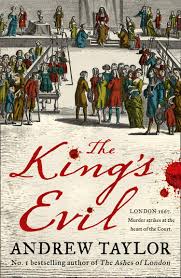 This is the third book in Andrew Taylor’s series of Marwood & Lovett novels. I have thoroughly enjoyed the first two books,
