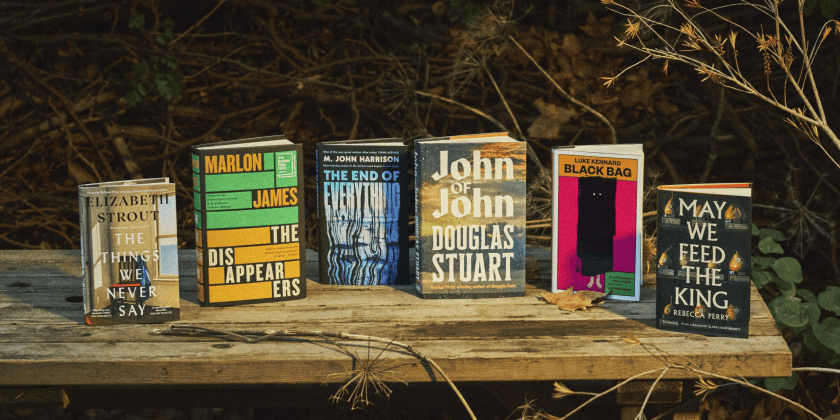
Booker Prize 2026 – winner announced tonight!

The winner of this year’s Booker Prize will be announced at a ceremony in London at around 10pm this evening – it is usually announced on the BBC’s 10 o’clock news. You can livestream the event via the Booker’s YouTube, Instagram and TikTok channels.

I have reviewed three of the titles on here (Elizabeth Strout’s The Things We Never Say, Marlon James’s The Disappearers and Douglas Stuart’s John of John) and I have just completed Rebecca Perry’s May We Feed the King.

For my personal favourite of those I have read so far, I would be hard-pressed to choose between Elizabeth Strout and Douglas Stuart – I would be very happy if Strout won it because I think her work is so deceptively rich and unique. My strong suspicion, however, is that it’s Marlon James’s to lose. Rebecca Perry’s novel is interesting and engaging but not quite Booker material for me – I’ll post my review later this week.

So, I am usually wrong (ha ha) – I think the last time I was right about the winner was when Douglas Stuart won for Shuggie Bain in 2020. I’ll be tuning in at 9.45pm to find out!

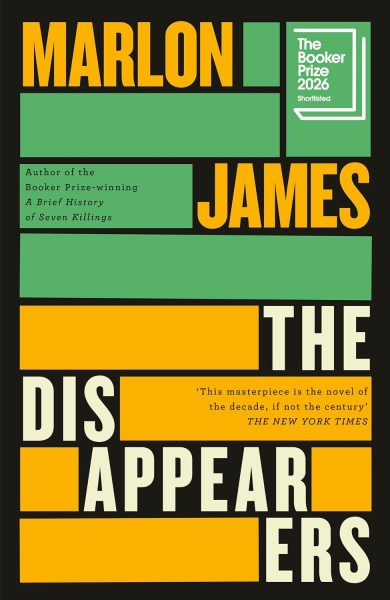
Booker shortlist review #3 – “The Disappearers” by Marlon James

Marlon James won the Booker Prize in 2015 with A Brief History of Seven Killings – can he do it again with this novel? At more than 600 pages it is easily the longest book on the shortlist. I listened to it on audio and really enjoyed the lively narration and felt that was the best way to appreciate the language (there’s a lot of Jamaican patois). It is set mostly in Kingston, Jamaica (though final chapters are set in the United States), largely in the 1980s and early 1990s, when the AIDS crisis was at its height.

The book opens with a group of eight gay men meeting secretly to rehearse for a play. Among them are Eddy Porteous and Jordan Brown, who will be the main narrators as the novel progresses, and Havelock Titus, the group’s Director who has brought them together. They are meeting in secret because of the homophobia they would encounter if they were out. It is not entirely clear why they are meeting at all, except as a way of sharing their love of literature and drama, and as an act of solidarity.

Assembling in this way places them at great risk. One of the things James does brilliantly in this novel is set the scene of deep hostility to homosexuality in Jamaica, driven mostly by the dominance of the church but also by a culture of hyper-masculinity. This is made worse later on  by the AIDS crisis, which is seen as God’s retribution for unholy and depraved homosexual activity. The environment of corruption also plays a part – people beaten up because they are gay have no recourse to the law, it might in fact make their situation worse. And gay men are, if discovered, ostracised, even disowned by their families, for whom their child’s sexuality casts a deep stain on their reputation. Within all of this is the deep irony that some of the most violently outspoken opponents of homosexuality, and the most upstanding members of society, are secretly gay themselves. James creates an environment of 1980s Jamaica as deeply hostile to gay people, dangerous, violent and isolating.

James is known for not holding back in his writing from portraying strong sex and violence, and this novel goes all out. For young gay men in Jamaica, the atmosphere of danger and constant threat (both from violent retribution and from deadly disease) creates an environment of hedonism and living only in the moment, not withholding from any opportunity for sexual gratification and maximising pleasure. It is graphic, both the violence and the sex. At times, for me, it was too much. James has been described as the literary equivalent to Quentin Tarantino in his approach to portraying extreme sexual and violent behaviour – when watching Tarantino’s films I often have to cover my eyes!

The group of gay performers is violently attacked, one is killed and another is blinded. There is no follow-up action, though some take revenge into their own hands. The events are recounted through the eyes of a number of those present – one through diary entries, another through interviews with a writer and another through letters. All exhibit deep trauma from their experiences, not just at the hands of a violent mob, but as men who were disowned by their families and communities and have struggled to find peace in their lives. Homophobia has left deep scars.

I found this novel at times very moving, but at times I found I disengaged; sometimes it felt like a point was rendered a little too far and I simply zoned out. I listened to it on audio which really helped my understanding of the language, and the reading performances were brilliant. I realise that graphic sex and violence are narrative choice on the part of the author, and I see its role, but for me, dare I say, it was too much. It did help to convey the sense of the, almost, deathwish of some of the characters, but I did become a little numb to it. I also felt it could be shorter – the excess of the content is matched by the excess of the book’s length.

I suspect this novel might be a strong contender to win the Prize. I recommend it as an important literary achievement, and I particularly recommend the audio version.

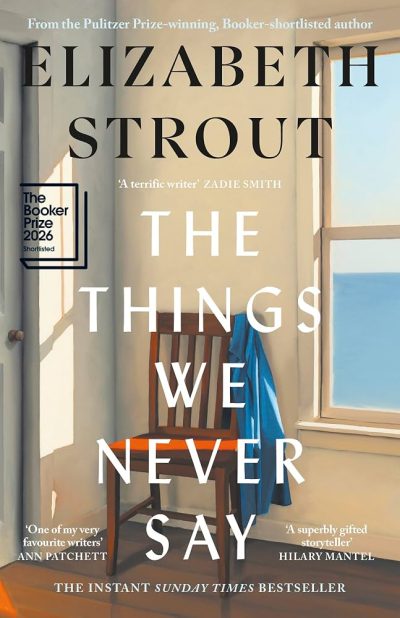
Booker shortlist review #2 – “The Things We Never Say” by Elizabeth Strout

This is Elizabeth Strout’s eleventh novel and takes her away from Maine and the cast of characters with which we have become so familiar, and to Massachussetts in 2024, around the time of the last US Presidential election. It is perhaps Strout’s most explicitly political novel to date. The novel has all the trademark elements of Strout’s writing which readers have come to love. The central character is Artie Dam, a middle-aged history teacher in a high school, beloved by staff and pupils alike, but he is a man disillusioned with life, who feels lonely and, when we first meet him, is contemplating suicide. Arty lives with his wife Evie, a psychiatrist, and their marriage is showing strains often seen in long relationships where people have become complacent. They have one son, Rob, a fragile young man who is in the process of getting divorced from his wife Francesca – she is a concert pianist and her life on the road has meant they have drifted apart. Rob has had a difficult time in relationships, one of his earlier girlfriends having been killed when the car they were in crashed, and which the girlfriend’s parents partly blame Rob for.

SPOILER ALERT

Artie’s world is rocked by two events which I will discuss here, so a bit of a spoiler, but I should add these happen in the early part of the novel – I am not going to reveal how it all resolves. First, Rob reveals to Artie that he is not his biological father – this is in fact a family friend (a man who is now dead and whom Artie was not fond of, though he remains close to the friend’s widow Flossie). In her desperation to become pregnant, and guessing that Artie might be the cause of their infertility, Evie obviously sought help from the family friend, who willingly obliged, and who then, rather spitefully, went on to inform Rob by letter before he died. Rob was about to confront his mother with the information, but when Artie walked in unexpectedly, missed his opportunity.

The second event is that Artie slips from his dinghy when trying to climb aboard his beloved yacht and almost drowns. He is saved by a local man, Ken. Ironically, the brush with death gives Artie a new reason to live and he begins a friendship with the man which will be one of the more enriching parts of his life.

The rest of the novel explores Artie’s relationships – his friendships at work and outside of work, particularly with Ken, and with his students. Artie is increasingly out of place at the high school, his ways seeming increasingly old-fashioned in the world he now finds himself in, but his students continue to respond to his basic human goodness, his care for them, and his commitment to his job. Most of all, however, there is Artie’s relationship with Evie and with Rob. Artie plans to tell Evie that he knows about Rob, but as time passes the couple seem increasingly distant from one another. Evie is absorbed in her own world and seems to have less and less time or patience with her husband. This conversation that they never seem to have, is it Artie’s avoidance, or as time goes by, his disinclination to try and reach her?

In contrast, Artie’s relationship with Rob gets closer; he finds that “the conversation” opens up a channel between them, they find they can communicate better once they have communicated about something ‘real’. Both men know that although they are not biologically related, their connection goes beyond that and is in fact far deeper.

Elizabeth Strout is such a good writer that you think she is telling you a simple story, but she is in fact exploring much more complex theses about what it is to be human, about the need for connection, and about the consequences for us all, as individuals and as members of society, when this breaks down. She even gives us some Jungian philosophy in this one and her characters discuss it without for one moment sounding false, pretentious or unnatural. Her characters come alive on the page, even the minor ones; she has that capacity to give you the whole via tiny details.

I loved this book and found it hard to put down. Highly recommended.
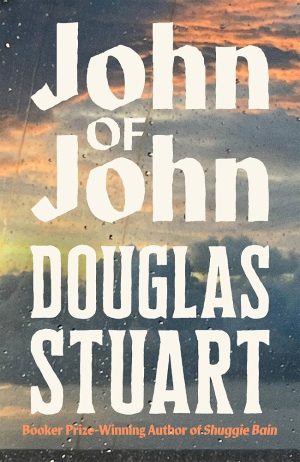
Booker shortlist review #1 – “John of John” by Douglas Stuart

Last week I shared some photos of my wonderful summer holiday in Scotland where I was fortunate enough to spend some time on the island of Harris and Lewis in the Outer Hebrides. I started reading this book while I was there and was then delighted to see that it has been shortlisted for this year’s Booker Prize. I am not surprised and would have been questioning the decisions of the judging panel if it had been omitted! 

The novel is set in the 1980s and the main character is Calum (Cal) Macleod, who is returning home from Edinburgh, where he has been a student studying textiles, at the behest of his father John (Cal is actually named after his father but prefers to use his middle name), who tells him that his grandmother’s health is failing. John lives with Cal’s grandmother Ella, even though she is actually his ex-mother-in-law, John having divorced Cal’s mother Grace some years earlier. Ella owns the croft on which the family depends for a living. Cal himself is deep in debt, from his studies, and unable to find a job, so although he is reluctant to return home, in reality he has few choices.

Also, Cal is gay, and has found his student life in Edinburgh very freeing in that respect (though, as we will learn, very isolating in others). He has not come out to anyone at home and is afraid that he will be cast out by his father and by the deeply religious community on the island if he does. (When we visited Harris and Lewis, we arrived on a Sunday and everything was closed, and that is 40 years further on from this book.) Cal has a poor relationship with his father and the novel opens with him taking the long journey home, by bus, ferry and another bus, both dreading and putting off his arrival, choosing to spend his first night back on the island drunk in Tarbert, the ferry port, rather than at the family home.  

As soon as he arrives at home, John berates his son – for not coming home earlier (word has got around that he arrived on the island the day before), for his haircut and his tardy ways. Ella does her best to calm troubled waters, but John is a stubborn man and he never misses an opportunity to criticise his son. Cal is put to work instantly, helping his father with the weaving (an activity that is meant to bring in extra money to the household, but barely pays for itself now) – it is the one area where Cal and John can begin to bond. Cal recognises his father’s ‘feel’ for the work and his eye for colour in the tweed fabrics he creates. We begin to see where Cal gets his talent for textiles and some areas of common ground slowly start to emerge between the two men. 

The novel recounts the long and tough road that their relationship will need to navigate and the compromises that Cal in particular will need to make. Douglas Stuart also begins to peel back the layers of the community, the undercurrents that are suppressed in service to the religious imperatives, how the dreams of the young people on the island are impoverished due to the lack of opportunity and how when there is no hope people turn to other ways to numb the pain of their existence. 

This novel is at times rather dark and hopeless, but there is something positive in Cal’s acceptance of his father, even if his father will struggle to accept him, and the small acts of resistance that some of the characters exercise just to be themselves. The novel answered many questions for me about the beautiful island I visited, so remote and disconnected from the pressures of urban life, but while I was there I found myself wondering about the young people brought up there, what they wanted, how they expressed themselves. I sincerely hope things have changed for them. 

This is a powerful and beautiful novel that must be a strong contender to win the Booker Prize for a second time for its author.