This was one of my holidays reads and one of two books my book club chose for our summer break. It’s only my third Tracy Chevalier novel, but each time I read her I just want more! I read Girl with a Pearl Earring years ago when it was first published and then The Lady and the Unicorn a year or so ago, which I thought was wonderful. I have since picked up Virgin Blue from my local secondhand bookshop so that will be next on my list.
 One thing that is so impressive about Chevalier is how beautifully she creates the historical setting: the two novels I have read so far have been set in 17th century Holland and 15th century Paris and Brussels and I can only begin to imagine the amount of research she has to undertake. The Last Runaway is set in the United States in the mid-nineteenth century when parts of the country were only just being settled. Honor Bright, our main character is a young Quaker woman from Dorset in England. She has led a modest and sheltered life, but her world was turned upside down when her fiancé left her and their close-knit Quaker community for another woman. This was not only a scandal but it left Honor distraught and in a very difficult position. When her sister, Grace, is persuaded by her fiancé that they should move to America, Honor decides she must go with her, not only to support her sister, but to escape the oppression of her situation and have some chance of making a life for herself.
Their journey from Bristol to New York is arduous and Honor suffers with debilitating seasickness. As they travel the long distance from New York to Ohio, Grace contracts Yellow Fever and dies. This places Honor in a further difficult position: not only must she tell Adam Cox, Grace’s fiancé, that she is dead, but she is also in fear about where that leaves her as he, of course, has no obligation to support her. Honor, however, cannot face going back to England either because of the journey or the shame.
On the final leg of her journey, Honor has a frightening encounter with a local slave-hunter, Donovan. Honor is appalled both by his profession and his dangerous air, and yet also finds herself strangely drawn to him when he seems to flirt with her. This also sends her into a tailspin as it conflicts with her Quaker outlook and moral code.
Honor arrives in the small town of Wellington, close to Faithwell, her intended destination. There, she finds quarters with Belle Mills, the local milliner, who, it transpires, is also the half-sister of the mysterious Donovan. Belle warns Honor about him and it is clear there is a tension between these siblings. During her stay with Belle, Honor adapts her talent for quilting (quilting, its traditions, the patterns and its place in Quaker culture, are a strong and fascinating motif running through the novel) and shows promise as a hat-maker, endearing her to Belle and her many customers. Belle’s designs are often flamboyant, which is an anathema to Honor, who, as a Quaker, must observe plainness and modesty in all forms of dress. The two women develop a firm friendship, however, and Honor begins to feel more confident.
Honor first realises there is something strange going on when she finds a black man under a woodpile in the yard of Belle’s home. Honor is aware of the existence of the slave trade, indeed, the Quakers were an important part of the movement calling for its abolition, but this is the first time she has come so close to an escapee. She is terrified, particularly when Donovan comes searching at his sister’s property, sensing the presence of the runaway. Honor later learns that Belle is part of a network of citizens who provided the means of escape, food and shelter for runaway slaves fleeing the South to states which had already outlawed slavery – the ‘underground railroad’. Belle was what was known as a ‘station-master’.
Honor is collected from Belle’s by Adam Cox, Grace’s fiancé, and taken back to Faithwell, to live with him and his sister-in-law (also widowed) and to work in their shop. The domestic situation is uncomfortable for Honor, however, and her prospects only brighten when she is wooed and then married to fellow Quaker Jack Haymaker. At first it seems like a good marriage that will improve Honor’s situation, but her mother-in-law proves to be a formidable presence, who does not conceal her contempt for her daughter-in-law and how little she has to offer when Honor goes to live with them on their isolated farm. At first, Jack is attentive and loving, but quickly becomes complacent and Honor grows increasingly miserable, despite her efforts to feel and appropriate degree of godly gratitude. Tensions deepen when Honor decides she will provide support for runaway slaves passing through their property. This is against the expressed wishes of the Haymakers. A law has been passed which makes it illegal for anyone to help a runaway, and the penalties are severe. Whilst the Quakers are against slavery, they are also against law-breaking and Honor’s actions are seen as a threat to their livelihood. Honor finds herself increasingly in conflict with the family until the point where her position becomes untenable. All the while, Donovan hovers in the background, stalking Honor and sniffing out runaways.
I will say no more as the events of the story then take quite dramatic turns. I loved the unexpected twists of the plot. I also love the way the author wove in details about the slave trade and the underground railroad (which I confess I knew very little about). Colson Whitehead’s 2016 novel The Underground Railroad brought the existence of this movement to the attention of many readers for the first time, I think. I was not aware that Tracy Chevalier had also written this novel about it. I also loved the domesticity of this novel, its femaleness and the feminine craft of homemaking, particularly in relation to the skills required for good quilting. This seems to be a common theme in Chevalier’s work. I loved how strong the women were in this novel; the men do not come out looking so good!
I recommend this book highly. It’s a great story, a fascinating read and will give you an insight into worlds you may not know much about.
If you have read this book, I would love to hear your views.
If you have enjoyed this post, do follow my blog and let’s connect on social media.
 I am fortunate to live in an area where we have more than our fair share of trees, of woodland and common land where I can walk, enjoy the fresh air and observe the changing of the seasons, truly one of the nicest things about living in northern Europe. The leaves seem to have been falling around me for some time, but I think the extremely dry weather over the summer caused this. Now, the leaves are visibly beginning to turn from green to various shades of red, yellow and brown and the scenery around me is taking on new vivid hues. In a couple of weeks it will be stunning.

 This shortlist was announced in May and the list was then put up for a public vote. My personal favourite of these was Wolf Hall. In 1983, the celebrate the 25th anniversary of the prize a “Booker of Bookers” contest was set up and three judges chose Salman Rushdie’s Midnight’s Children, which I probably agree with. It was good to see the vote open to the public this time rather than a small group of the literati, and the winner was
  In some ways, there is not a great deal to say about Death on the Nile that you couldn’t say about any other Christie novel, I suspect: there is a situation, in this case, a Nile cruise, being undertaken by 10-15 characters, all for different reasons. Conflicts and tensions are set up amongst the different characters, mysterious aspects of their personality or behaviour are noted, one of their number dies and then there is a process of detection to work out whodunnit. I did largely guess the correct outcome in the case of this novel, although I didn’t with Orient Express.
 I managed to read


 We are staying in Cancale, a smallish coastal town in Northern Brittany, arriving here on the overnight ferry from Cork to Roscoff, which was very pleasant indeed – good, reasonably-priced food, decent cabins and plenty to do.
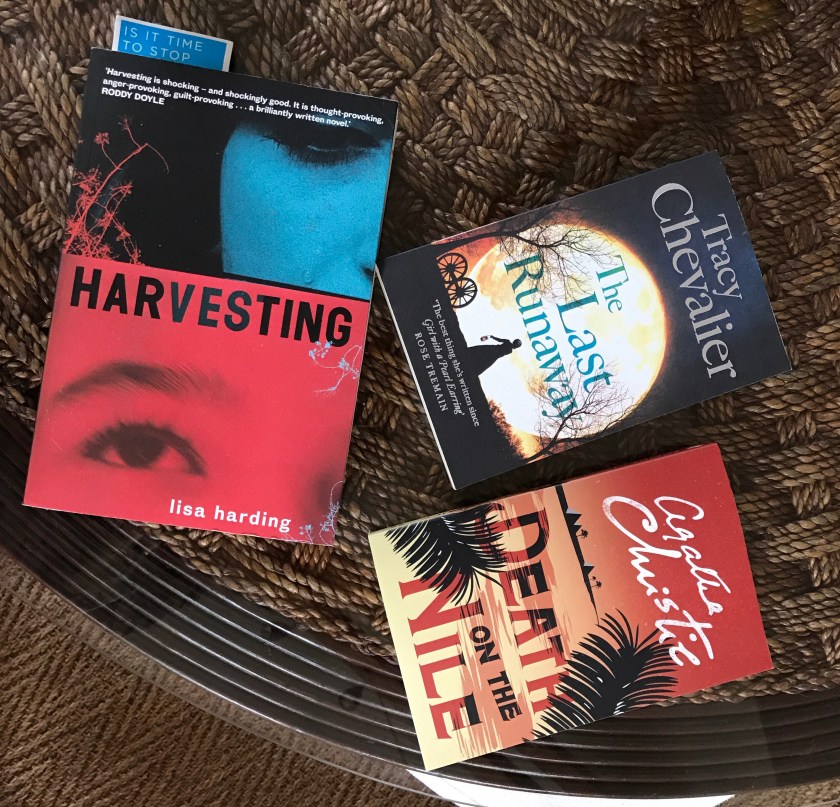
 I’ve been unusually restrained with my holiday library this year, just the three books: Harvesting by Lisa Harding, a harrowing account of child prostitution, child trafficking, abuse and neglect, Death on the Nile, by Agatha Christie, the August choice for my Facebook Reading Challenge, and The Last Runaway by Tracy Chevalier, one of my book club’s summer reading titles.
 The plot is not complicated: ‘Swede’ Levov is a third generation Jewish immigrant whose grandfather came to America from Europe. He was a glovemaker and set up a business in Newark, New Jersey which became highly successful. Swede’s father continued the business, which peaked in the 1950s and 1960s when glove-wearing for respectable women was the norm and most would have several pairs. (There is more information on gloves in this book than you will ever need to know, but it’s fascinating!) Swede inherited the business from his father, while his more wayward brother became a cardiac surgeon.
 The novel begins with a dramatic event: four children are travelling in a light aircraft across the Amazon jungle, which then crashes. The pilot dies (this is quite gently done, it is not frightening), which means the four children, five year-old Max, his older sister Lila, both Brazilian, and Con and Fred, two Brits, aged about 11-12, find themselves alone. Each of the children has their own back-story and their characters are carefully-drawn: Fred is resourceful, a natural leader who the others look to, but he is also a troubled soul, his mother is dead and he longs for the approval of his remote and uptight father. I should add at this point that the story is set, I would guess, in the 1950s. Con is a feisty and assertive girl, who is also often angry and finding herself in conflict or impatient with the others. She comes across as something of a spoiled brat, but she too is hiding a deeper insecurity. Her secret will be revealed much later. Lila and Max are siblings. Max is very young, vulnerable and afraid. Lila is fiercely protective of him, acts as a mother-figure in the absence of their own family, and has the maturity to bring the group together at times of great stress.
 Tom Hazard has an extremely rare condition called anageria which means he ages extremely slowly. He is one of a tiny group of people who live for many hundreds of years. Tom was born in London in 1581 and mixed with the likes of Shakespeare and Marlowe in his youth, worked for Captain Cook in the 1700s and was a jazz pianist in Paris in the 1920s where he met, among others, F Scott Fitzgerald and watched Josephine Baker dance. What an incredibly lucky guy, you might think, but his condition is a curse and does not go unnoticed. He is haunted by the fact that his mother was condemned as a witch in the small village in which they lived, because the locals suspected dark forces at play when her teenage son appeared never to age. In his ‘late teens’ he meets and falls in love with Rose, and they have a child, Marion. Rose is the love of Tom’s life and although they move around, trying to avoid staying in one place too long and attracting attention, he realises that his existence presents a danger to Rose and the child. He has no choice but to leave her. The last time Tom sees Rose is when she is in her 50s, on her death bed with the plague, while he still looks like the young man she fell in love with many years earlier.
 Julia's books