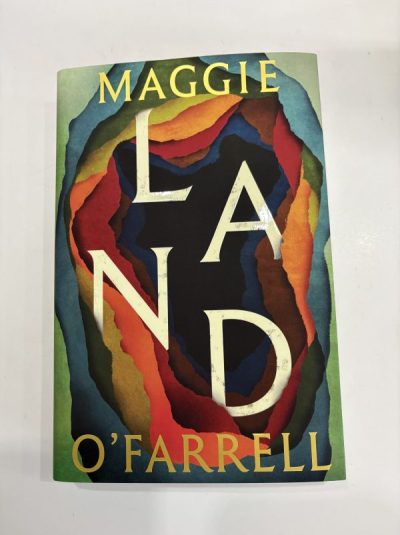
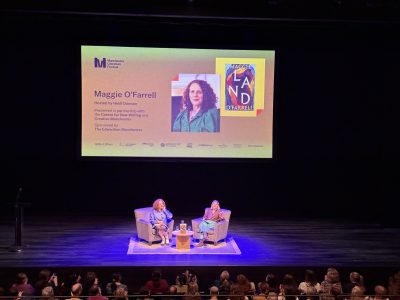
The Manchester Literature Festival kicked off this week and runs until 25th October. I usually like to attend a few events, but will be away for much of the period this year (more of that to follow!). I was fortunate, however, to be able to attend one of the opening events, a talk with Maggie O’Farrell; my book club recently completed her new novel Land, so it was fantastic to be able to go along and hear her speak about it. Maggie O’Farrell is surely one of the finest British authors of her generation and since she is only in her mid-fifties, hopefully has many more years of writing ahead of her. Her career reached a new zenith last year with the release of the film “Hamnet”, which was an adaptation of her 2020 Women’s Prize winning novel. O’Farrell co-wrote the screenplay of the film with Director Chloé Zhao, which itself won many awards, including a best actress BAFTA and Oscar for Jessie Buckley.
With all that going on, one can only marvel at the work ethic of O’Farrell – how on earth did this mother of three squeeze in another 400+ page novel? Furthermore she has to be one of the humblest most relatable literary giants alive!
Land might be O’Farrell’s most personal novel to date and at the MLF talk she described the novel as loosely based on one of her own ancestors who, according to family myth (which may also be truth), was the first cartographer to map the island of Ireland in the mid-nineteenth century, in the service of the British government, which Ireland was a part of at the time. She has not been able from her research to confirm all the details of this, as cartographers were not allowed to sign their own name on the maps they produced, but she has nonetheless let her imagination form a story out of a few bare facts.
The main character, based on O’Farrell’s ancestor, is Tomás who, when we meet him at the start of the novel, is working with his young son Liam, carrying out survey work on behalf of the British army. Liam hates the work, which is very physical. Tomás is passionate about his work and intends that Liam will follow in his footsteps. He is a tough taskmaster and a strict father and it soon becomes clear that Liam has more scholarly ambitions. Tomás is married to Phina, a strong-willed woman whom he fell in love with at the workhouse where they were both resident as children, and they have three children: in addition to Liam there is Enda and Rose. A fourth child, Eugene, will follow.
The family has its troubles, after he is severely injured in a work accident in which he loses an arm, Tomás goes into a deep depression, through which Phina nurses him. He vows never again to work for the British, and moves the family to a remote peninsula in the west of the country, where they rent a derelict cottage and small piece of land, from which Tomás hopes they can make enough to live on.
The story is set in the shadow of the Irish famine of the 1840s, which caused the deaths of over a million people and the mass migration of a million more. This catastrophic event changed the social make-up of the country and the physical landscape. The family itself is also deeply impacted – through Tomás’s mapping, which exposes some of the death and destruction, and through the choices made by the individual children as they consider their destinies.
O’Farrell also weaves in Irish pagan myth and legend – at the MLF talk she shared how she drew on the many stories her father would tell her and her siblings – giving a profound sense of the how the land of Ireland, the very shape and texture, which Tomás is so diligently attempting to record, bears witness to people and stories that go back beyond mappable time.
This is a multi-layered, complex novel that draws on many ideas and is epic in its scale. But at the heart of it is love – that which exists within the family, that which the Irish hold for the hard-won land beneath their feet, and the deep love that the author has for her family history, which she honours so powerfully in this novel.
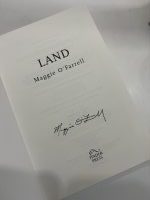
This is a brilliant piece of work that I recommend highly. I was also delighted to obtain a signed copy of the beautiful hardback edition which has the most beautiful cover artwork by Helen Cann.
**I am baffled that this book did not make even the longlist for this year’s Booker Prize, for which it was eligible. Astonishing!**

